

What Is an Employment Eligibility Check for Employers?
An employment eligibility check is the federally mandated process employers use to verify a new hire’s identity and legal authorization to work in the United States. Every U.S. employer must complete Form I-9 for every employee hired after November 6, 1986, regardless of citizenship or national origin. The standard industry term for this process is “employment eligibility verification,” and it is distinct from the discretionary background checks many employers also conduct. Employers who skip or mishandle this process face civil fines and increased government audits. Understanding both the legal requirements and the practical steps protects your agency and every hire you make.
What is Form I-9 and how is it completed?
Form I-9 is the legal instrument at the center of every employment eligibility verification. The form is mandatory for all U.S. employers and applies to every employee hired since November 6, 1986. Failing to complete it correctly is not a technicality. It is a federal compliance failure that carries real financial penalties.
The two core sections
The form divides responsibility between the employee and the employer.
- Section 1 — Employee attestation: The new hire completes this section by their first day of work. They attest to their citizenship or immigration status and provide their name, date of birth, and Social Security number if applicable.
- Section 2 — Employer document review: The employer must review documents and complete this section within three business days of the employee’s start date. The employer physically examines original documents and records the document title, issuing authority, number, and expiration date.
Acceptable documents
USCIS organizes acceptable documents into three lists:
- List A documents establish both identity and work authorization in a single document. Examples include a U.S. passport, Permanent Resident Card (Form I-551), and Employment Authorization Document (Form I-766).
- List B documents establish identity only. Examples include a state driver’s license or ID card with a photograph.
- List C documents establish work authorization only. Examples include a Social Security card or a birth certificate.
An employee presents either one List A document or one List B document combined with one List C document. The employer does not get to choose which documents the employee presents. Requiring specific documents beyond what the law allows is a form of discrimination.
How employers assess document authenticity

Employers must determine whether documents “reasonably appear genuine.” This is a visual inspection standard, not a forensic one. You are not expected to be a document fraud expert. You are expected to review the document carefully and reject anything that is obviously altered or inconsistent.
Supplement sections
Form I-9 also includes a Supplement B section for reverification and rehiring. When an employee’s work authorization expires, the employer must reverify eligibility before the expiration date. Rehired employees within three years of their original I-9 date may use the existing form rather than completing a new one.
Common pitfalls
- Leaving fields blank instead of writing “N/A”
- Accepting expired documents
- Completing Section 2 before the employee’s first day
- Failing to reverify expiring work authorization documents
- Storing I-9 forms in personnel files instead of a separate, dedicated file
Pro Tip: Conduct a self-audit of your I-9 files at least once per year. Errors caught internally carry far lower consequences than errors found during a government audit.
How does E-Verify complement the employment eligibility check process?
E-Verify is a free, web-based system that electronically matches Form I-9 information against records held by the Department of Homeland Security and the Social Security Administration. It does not replace Form I-9. It adds an electronic confirmation layer on top of the paper process. E-Verify is voluntary for most private employers but is required by federal contractors and by law in several states.
How E-Verify works step by step
- The employer completes Form I-9 with the new hire.
- Within three business days of the hire date, the employer enters the I-9 data into the E-Verify system.
- E-Verify returns one of three results: Employment Authorized, Tentative Nonconfirmation (TNC), or Case in Continuance.
- An “Employment Authorized” result closes the case. The employer retains the case number.
- A TNC means the information did not match government records. It does not mean the employee is unauthorized to work.
Resolving a tentative nonconfirmation
A TNC requires the employer to notify the employee in writing and give them the opportunity to contest the result. The employee has eight federal government workdays to contact the relevant agency (SSA or DHS) and resolve the discrepancy. Employers cannot terminate, suspend, or reduce hours during this period. Doing so exposes the employer to discrimination liability.
Enhanced documentation rules for E-Verify participants
Employers enrolled in E-Verify must require that List B identity documents include a photograph. They must also require employees to provide a Social Security number in Section 1. These requirements are stricter than standard Form I-9 rules and catch many employers off guard.
Using E-Verify strengthens workforce compliance beyond what Form I-9 alone provides. The system gives employers near-immediate electronic confirmation of work authorization status, which reduces the risk of unknowingly employing unauthorized workers.
Pro Tip: Never pre-screen applicants through E-Verify before a job offer is made and accepted. E-Verify is for new hires only. Using it earlier violates program rules and creates discrimination exposure.
How does an employment eligibility check differ from a background check?
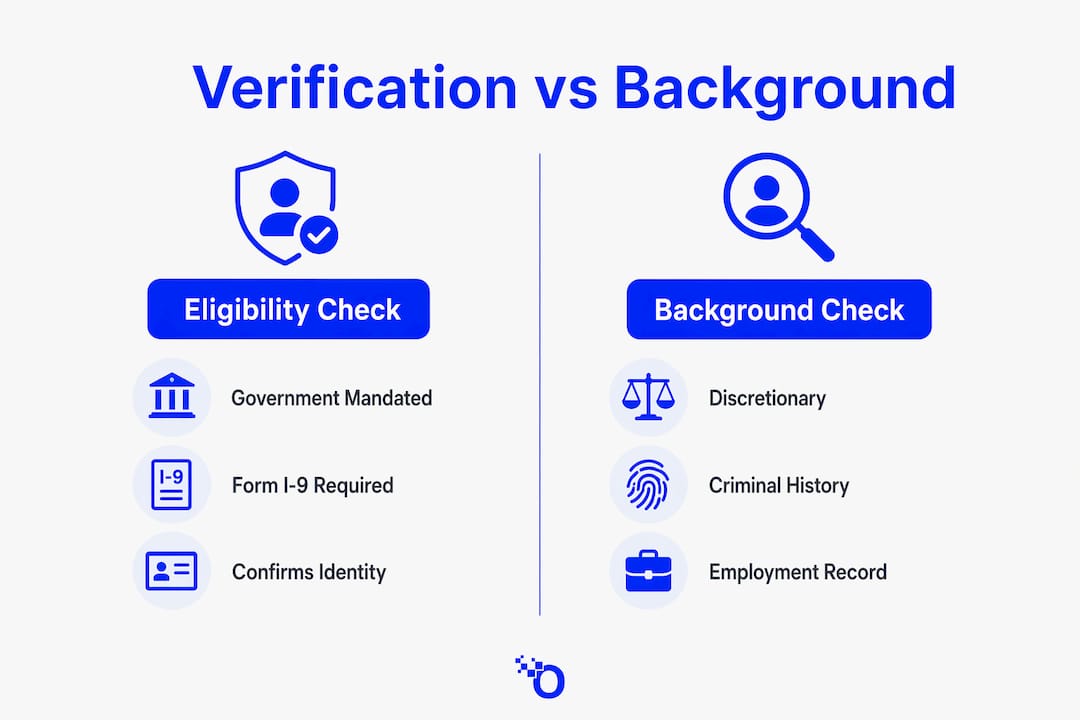
Employment eligibility verification and background checks are legally distinct processes. Conflating them is one of the most common compliance errors HR professionals make.
Form I-9 is a mandatory federal requirement. Every employer must complete it for every hire. There is no discretion involved. A background check, by contrast, is an optional risk management tool that employers choose to use based on role, industry, or organizational policy.
Key differences at a glance
| Category | Employment eligibility verification | Employment background check |
|---|---|---|
| Legal basis | Immigration Reform and Control Act (IRCA) | Fair Credit Reporting Act (FCRA) and state laws |
| Mandatory | Yes, for all U.S. employers | No, discretionary by employer |
| Purpose | Confirm identity and work authorization | Assess criminal history, credit, education, and past employment |
| Governing agency | USCIS / DHS | CFPB, EEOC, and state agencies |
| Penalties for non-compliance | Civil fines, increased audits | FCRA lawsuits, EEOC complaints |
Background check compliance obligations
Background checks carry their own legal framework. The FCRA requires a multi-step pre-adverse action process before an employer can deny a candidate based on a third-party report. That process includes providing the candidate with a copy of the report and a summary of their rights before any adverse decision is made. This gives candidates the chance to dispute inaccurate information.
The EEOC advises employers to conduct individualized assessments when criminal history appears in a background check. That means evaluating the nature and gravity of the offense, the time elapsed since the offense, and the direct relevance of the offense to the job in question. Blanket exclusions based on any criminal record create discrimination liability under Title VII.
For public safety agencies, the stakes are higher. A law enforcement officer or emergency dispatcher with an undisclosed criminal history creates direct community risk. That reality makes thorough background check compliance not just a legal obligation but an operational necessity.
Understanding what constitutes negligent hiring is also critical here. Employers who fail to conduct reasonable pre-employment checks and then hire someone who causes harm can face civil liability well beyond FCRA penalties.
What are best practices for employment eligibility compliance?
Accurate employment eligibility checks require consistent process, not just good intentions. The following practices reduce error rates and protect employers during government audits.
Timeliness and retention
- Complete Section 1 on or before the employee’s first day. Never before the job offer is accepted.
- Complete Section 2 within three business days of the start date, not the offer date.
- Retain Form I-9 for three years after the hire date or one year after employment ends, whichever is later.
- Store I-9 forms separately from personnel files to simplify government inspection.
Document inspection procedures
Inspect documents in person whenever possible. Remote verification is only lawful for employers enrolled in E-Verify and operating under DHS-authorized alternative procedures. If you conduct remote verification, you must document the method used in Section 2. Failing to do so is a compliance gap that auditors flag consistently.
Examine documents for obvious signs of alteration, inconsistency in fonts or formatting, or mismatched photographs. Do not demand specific documents beyond what the employee chooses to present from the acceptable lists. Doing so constitutes document abuse under IRCA.
Avoiding discrimination
The Form I-9 process prohibits citizenship status discrimination and national origin discrimination. Applying different document standards to employees based on their appearance, accent, or perceived national origin violates federal law. Train every hiring manager and HR team member who touches the I-9 process on these anti-discrimination rules.
Employers enrolled in E-Verify face additional scrutiny here. The program prohibits using E-Verify to pre-screen applicants or to selectively verify only certain employees. Every new hire must go through the same process.
Coordinating eligibility checks with broader hiring compliance
Employment eligibility verification fits within a larger pre-employment screening checklist that includes background investigations, reference checks, and credential verification. For public safety agencies, these steps are not sequential. They run in parallel, and each one feeds into a complete picture of the candidate’s fitness for duty.
Hiring risk mitigation in public safety requires treating Form I-9 compliance as the floor, not the ceiling. The eligibility check confirms the person has the legal right to work. The background investigation confirms they have the character and history to serve the public.
Pro Tip: Schedule annual I-9 self-audits and pair them with FCRA compliance reviews. Catching errors in both processes at the same time reduces administrative burden and keeps your entire hiring compliance program current.
It is also worth understanding how sealed criminal records interact with background check results. Candidates sometimes believe sealed records are invisible to all employers. In public safety hiring, certain agencies retain access to sealed records under specific legal authority, which affects how HR professionals interpret background check findings.
Key Takeaways
Employment eligibility verification is a mandatory federal process governed by USCIS, while background checks are discretionary tools governed by the FCRA, and conflating the two creates compliance failures that carry distinct legal consequences.
| Point | Details |
|---|---|
| Form I-9 is mandatory | Every U.S. employer must complete Form I-9 for every hire since November 6, 1986. |
| Strict completion timelines apply | Section 1 is due by the first day of work; Section 2 must be completed within three business days. |
| E-Verify adds electronic confirmation | E-Verify matches I-9 data against government databases and is required for federal contractors and in several states. |
| Background checks follow separate law | The FCRA governs background checks and requires a pre-adverse action process before any denial based on a third-party report. |
| Discrimination rules apply to both processes | Requiring specific documents or selectively verifying employees based on national origin violates IRCA and EEOC guidance. |
Why HR professionals underestimate the I-9 process
The most expensive mistake I see HR professionals make is treating Form I-9 as a formality. They hand it to a new hire on day one, collect whatever documents the employee brings, and file the form without a second look. That approach works fine until a government audit arrives, and then it doesn’t work at all.
The I-9 process has more technical requirements than most HR teams realize. The three-business-day window for Section 2 is a hard deadline. The distinction between List A, List B, and List C documents is not optional guidance. The reverification rules for expiring work authorization are legally binding. Each of these details is a potential violation, and violations compound quickly across a large workforce.
What I find equally underappreciated is the anti-discrimination dimension. Employers focus so much on completing the form correctly that they forget the form also prohibits them from demanding more documents than the law requires. Asking a candidate who appears foreign-born for additional proof beyond a valid List A document is a federal violation, even if the intent was thoroughness rather than bias.
The practical solution is to separate the I-9 process from the rest of onboarding and assign it to a trained compliance officer rather than a general HR generalist. Pair that with an annual self-audit and a documented correction procedure. Agencies that treat I-9 compliance as a standing program rather than a one-time task consistently perform better during government reviews.
— Matt
OMNI Intel’s approach to pre-employment compliance
Public safety agencies carry a higher burden of proof when it comes to hiring. A single unvetted hire can compromise community trust, agency accreditation, and officer safety. OMNI Intel’s pre-employment screening services are built specifically for law enforcement, fire and EMS, dispatch centers, and government entities that cannot afford compliance gaps.

OMNI Intel combines investigator-driven background investigations with AI-assisted recruiting tools to give agencies a complete picture of every candidate before a conditional offer is made. The platform integrates with existing hiring workflows, supports FCRA-compliant adverse action processes, and provides continuous post-hire monitoring to protect agency integrity over time. Whether your agency needs to verify employment history, assess criminal records, or manage I-9 documentation as part of a broader compliance program, OMNI Intel delivers the depth and accuracy that public safety hiring demands. Contact OMNI Intel to discuss a screening solution tailored to your agency’s specific requirements.
FAQ
What is an employment eligibility check?
An employment eligibility check is the federally required process of verifying a new hire’s identity and legal authorization to work in the United States, primarily through Form I-9. Employers must complete this process for every employee hired since November 6, 1986.
Is E-Verify the same as Form I-9?
E-Verify is not a replacement for Form I-9. It is a web-based system that electronically matches Form I-9 data against government databases to provide an additional layer of verification.
What happens if an employer does not complete Form I-9?
Improper Form I-9 management carries civil fines and increases the likelihood of government audits. Penalties apply for both failing to complete the form and for completing it incorrectly.
How is an employment background check different from an eligibility check?
An employment eligibility check is mandatory under federal immigration law and confirms identity and work authorization. A background check is discretionary, governed by the FCRA, and assesses criminal history, credit, education, and past employment.
Can employers conduct remote Form I-9 verification?
Remote verification is only permitted for employers enrolled in E-Verify and operating under DHS-authorized alternative procedures. Employers must document the remote verification method in Section 2 of the form.