

Why Reputation Matters for Nonprofits: A Leader’s Guide
A nonprofit’s reputation is its most consequential intangible asset, directly determining its capacity to raise funds, recruit volunteers, secure grants, and sustain community trust. Unlike for-profit companies that can recover from public setbacks through revenue diversification, nonprofits operate on a foundation of public goodwill that, once fractured, takes years to rebuild. Reputation management, the formal discipline of monitoring, protecting, and strengthening how stakeholders perceive an organization, is not a marketing function. It is a fiduciary responsibility. Understanding why reputation matters for nonprofits means recognizing that every donor decision, every volunteer application, and every grant award is a vote of confidence in your organization’s integrity.
Why reputation matters for nonprofits: the trust foundation
Nonprofit reputation is defined as the collective perception held by donors, volunteers, grant-makers, government partners, and the communities you serve. It is built through consistent behavior, transparent communication, and verifiable impact. When that perception is strong, it functions as a force multiplier across every operational area.

Donors now behave like consumers. Before giving, they research organizations online, read reviews, check financial disclosures, and evaluate leadership credentials. Detailed volunteer, recipient, and partner reviews rank among the most persuasive reputation signals for prospective donors. That shift in donor behavior means your digital presence is no longer supplementary. It is your primary credibility document.
The importance of reputation in nonprofits extends beyond fundraising. Volunteer recruitment, staff retention, and partnership development all depend on the same trust signals. An organization perceived as transparent and mission-driven attracts higher-quality candidates and retains them longer. One perceived as opaque or poorly managed struggles to fill roles, regardless of compensation or mission appeal.
Grant-makers apply the same scrutiny. Government agencies and private foundations evaluate organizational track records, board governance, and financial controls before awarding funds. A single unresolved allegation of misconduct can disqualify an otherwise strong application. Reputation, in this context, is not soft currency. It is the prerequisite for operational survival.
How does reputation affect nonprofit funding and sustainability?
The impact of reputation on nonprofit success is measurable and direct. A nonprofit with 75 reviews at 4.9 stars demonstrates clear transparency and impact, directly increasing donor confidence compared to profiles with under 10 reviews averaging 3.8 stars. That gap in social proof translates to a gap in conversion rates.
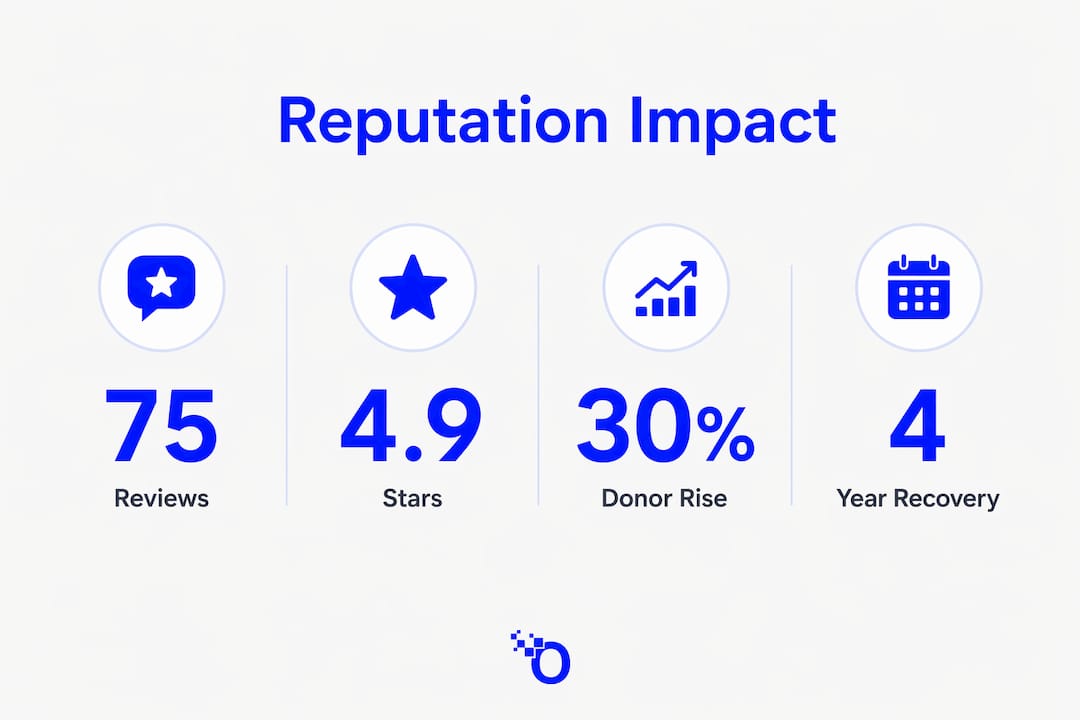
The numbers become more urgent when negative feedback enters the picture. An unaddressed negative review can reduce donor conversion rates by 15–30% for nonprofits with fewer than 50 total reviews. Negative online feedback acts as a trust barrier even when mission quality is strong. That means a single unresolved complaint carries disproportionate weight for smaller organizations.
Volunteer engagement follows the same pattern. Strong online reputations increase volunteer applications, reduce no-show rates, and improve retention. The inverse is equally true. Organizations with weak or mixed reputations spend more resources recruiting and onboarding replacements, which diverts capacity from mission delivery.
“Reputation loss triggers a domino effect across funding, staffing, and partnerships, making management a fiduciary responsibility rather than just a marketing expense. Internal financial controls and transparency are the foundation for safeguarding nonprofit reputations against existential damage.”
Source: GBMC CPAs, The 1 Risk for All Nonprofits: Your Reputation
The key operational consequences of reputation decline include:
- Donor attrition: Existing donors reduce or eliminate giving when trust erodes, often without explanation.
- Grant disqualification: Foundations and government agencies remove organizations from consideration following misconduct allegations or audit findings.
- Volunteer dropout: Volunteers disengage when they perceive organizational instability or ethical inconsistency.
- Partnership withdrawal: Corporate sponsors and community partners distance themselves to protect their own reputations.
- Staff turnover: Employees leave organizations they no longer trust, increasing hiring costs and institutional knowledge loss.
Each consequence compounds the others. Fewer donors mean fewer resources to address the root cause. Fewer volunteers mean reduced service capacity. Reduced capacity weakens the impact story needed to attract new funding. The cycle is self-reinforcing, which is precisely why building trust in nonprofit organizations requires proactive, sustained effort rather than reactive crisis management.
What are the biggest reputation risks nonprofits face?
Nonprofit leaders often underestimate how quickly a single event can cascade into a full organizational crisis. The risks fall into four primary categories, each with distinct recovery timelines and mitigation requirements.
-
Financial misconduct and governance failures. Allegations of misappropriated funds, undisclosed conflicts of interest, or board governance failures generate immediate media attention and donor withdrawal. Even unsubstantiated allegations require a formal, transparent response. Silence is interpreted as confirmation.
-
Data breaches and privacy violations. Data breaches severely damage nonprofit reputations with negative impacts lasting up to 4 years post-incident. Recovery depends on tailored messaging to stakeholders, media engagement, and security updates verified by third parties. Passive approaches that rely on time alone are ineffective. Nonprofits that store donor payment data, health information, or beneficiary records carry significant exposure and must treat cybersecurity as a reputational issue, not just a technical one.
-
Leadership misconduct. A single credible allegation against a senior leader or board member can overshadow years of mission work. The reputational damage extends beyond the individual. Donors and partners question the organization’s hiring practices, oversight mechanisms, and internal culture. Understanding reputational risk at the leadership level is the first step toward preventing it.
-
Misinformation and viral negative publicity. Social media amplifies negative narratives faster than most organizations can respond. A misleading post, a misquoted statistic, or a disgruntled former employee’s public statement can reach thousands of stakeholders before communications staff are even aware of the situation.
Pro Tip: Establish a reputation incident response protocol before a crisis occurs. Assign a designated spokesperson, define escalation thresholds, and draft holding statements for the three most likely scenarios your organization faces. Preparation reduces response time from days to hours.
Allegations of misconduct cause immediate catastrophic loss of donor capital and volunteer support lasting up to 4 years. Unlike for-profit companies that may recover gradually through revenue channels, nonprofits facing trust breaches require long-term, proactive transparency measures to repair standing. The recovery timeline alone makes prevention the only rational strategy. Reviewing your risk mitigation framework before a crisis is not optional. It is the baseline expectation for responsible leadership.
How to build and protect your nonprofit’s reputation
Proactive reputation management starts long before a crisis. Integrating transparency and impact reporting into operational workflows produces trustworthy digital summaries that drive funding decisions. The organizations that manage reputation well treat it as an ongoing operational discipline, not a communications project activated during emergencies.
Pro Tip: Publish your Form 990, annual impact report, and board governance policies on your website’s homepage or a clearly labeled “Transparency” page. Donors and grant-makers look for this information within the first 60 seconds of visiting your site.
The following practices form the foundation of a credible reputation management program:
- Authentic storytelling over polished marketing. Generic or overly polished marketing content is less credible than authentic stories and clear program outcome documentation. Raw testimonials from beneficiaries, volunteers, and community partners carry more weight than professionally produced promotional content. Stakeholders judge credibility by alignment between stated values and demonstrated behavior.
- Verified impact reporting. Quantify program outcomes with specific, verifiable data. “We served 1,200 families last year” is more credible than “we made a difference in our community.” Specificity signals accountability.
- Active review management. Respond to every review, positive and negative, within 48 hours. A thoughtful response to a critical review demonstrates accountability and often converts skeptical readers into supporters.
- Financial transparency as a credibility anchor. Publish audited financial statements and maintain clear internal controls. Organizations with documented financial oversight processes signal governance maturity to grant-makers and major donors.
- Consistent digital presence. Maintain accurate, current profiles on Google, Charity Navigator, GuideStar (now Candid), and relevant social platforms. Inconsistent or outdated information creates doubt.
The comparison below illustrates how reputation management approaches differ in their operational impact:
| Approach | Characteristics | Operational outcome |
|---|---|---|
| Reactive management | Responds only after negative events occur | Extended recovery timelines, donor attrition |
| Passive management | Maintains basic presence without active monitoring | Missed signals, slow crisis detection |
| Proactive management | Integrates monitoring, reporting, and response into operations | Faster recovery, stronger donor retention |
Safe hiring practices also belong in this framework. Every staff member and volunteer represents your organization publicly. A single incident involving a poorly vetted individual can undo years of reputation work. Screening is not a bureaucratic formality. It is a direct investment in organizational integrity.
How is AI changing nonprofit reputation management?
Artificial intelligence now plays a direct role in how donors and grant-makers evaluate nonprofits. Search engines use AI to generate summary answers about organizations, drawing from impact reports, news coverage, leadership profiles, and review platforms. Those summaries appear before a user ever visits your website.
AI tools used by grant-makers and donors assess nonprofits based on transparency of impact reports and leadership credentials, influencing fundraising outcomes. Organizations with well-documented impact receive more accurate and favorable AI-generated reputational summaries. Organizations with thin or inconsistent digital footprints receive generic or unfavorable characterizations that reduce funding opportunities.
The practical implications for nonprofit leaders are significant:
- Impact reports must be machine-readable. Use structured data, clear headings, and specific outcome metrics. AI systems extract and summarize structured content more accurately than narrative prose.
- Leadership credentials belong online. Board member bios, executive profiles, and professional affiliations should appear on your website and LinkedIn. AI systems factor leadership credibility into organizational assessments.
- Review volume matters. AI-generated summaries weight organizations with more reviews more heavily. A nonprofit with 75 detailed reviews receives a richer, more favorable summary than one with 8 reviews, regardless of mission quality.
- Negative news coverage persists. AI systems index news articles for years. A single negative story from three years ago can still appear in AI-generated summaries today. Active media engagement and published corrections are the only reliable countermeasures.
| Digital asset | AI impact | Priority action |
|---|---|---|
| Annual impact report | Primary source for AI summaries | Publish annually with specific outcome data |
| Leadership profiles | Credibility signal for grant-makers | Maintain current bios on website and LinkedIn |
| Online reviews | Volume and sentiment influence AI rankings | Actively solicit reviews from volunteers and donors |
| News coverage | Persistent positive or negative signal | Engage media proactively; correct inaccuracies promptly |
Reputation management is now a technical necessity with AI assessments influencing donor and grant-maker decisions. Organizations that treat their digital presence as a passive byproduct of their work will find themselves disadvantaged in funding competitions against organizations that manage it deliberately. Monitoring your volunteer screening practices is one concrete step that directly improves the integrity signals AI systems detect.
Key Takeaways
Nonprofit reputation is a fiduciary responsibility that directly determines funding capacity, volunteer retention, and long-term mission viability, not a communications function that operates separately from organizational leadership.
| Point | Details |
|---|---|
| Reputation drives funding | Nonprofits with strong review profiles convert donor research into giving at significantly higher rates. |
| Recovery takes years | Trust breaches from misconduct or data breaches require up to 4 years of sustained, proactive transparency to repair. |
| AI shapes donor decisions | Grant-makers and donors use AI-generated summaries based on impact reports and leadership credentials to evaluate organizations. |
| Proactive management prevents crises | Integrating transparency and screening into daily operations reduces the risk of reputation-damaging events. |
| Screening protects integrity | Vetting staff and volunteers before incidents occur is a direct investment in organizational credibility. |
Reputation is a leadership obligation, not a communications task
After working closely with public safety and nonprofit organizations on integrity and risk, one pattern stands out clearly: the leaders who treat reputation as a communications problem are always the ones caught off guard when a crisis hits.
Reputation is not what your marketing team says about you. It is what your staff, volunteers, donors, and community partners say when you are not in the room. That distinction matters enormously. You can publish a polished annual report and still lose a major donor because a volunteer had a bad experience and posted about it. You can have a compelling mission and still lose a grant because your Form 990 raised questions no one addressed publicly.
The organizations I have seen recover fastest from reputation damage share one characteristic: they had already embedded transparency into their operations before anything went wrong. They published their financials without being asked. They screened their people thoroughly. They responded to feedback quickly and honestly. When a problem did arise, they had a credibility reserve to draw on.
Trust in nonprofits must be earned daily through human-centered storytelling that showcases the people behind programs rather than abstract statistics. That is not a communications strategy. It is a leadership philosophy. The organizations that live it consistently are the ones that survive setbacks and continue growing.
The uncomfortable truth is that most nonprofit leaders know what good reputation management looks like. They have read the guides. They understand the principles. What stops them is the assumption that their mission quality will carry them through. It will not. Mission quality is the floor, not the ceiling. Reputation is what gets you the room to deliver on that mission.
— Matt
How OMNI Intel supports nonprofit reputation protection
Protecting a nonprofit’s reputation starts with the people you bring into your organization. Every unvetted hire or volunteer represents a potential risk to the trust you have spent years building.

OMNI Intel provides pre-employment background screening and continuous monitoring solutions built specifically for organizations where integrity is non-negotiable. Whether you are screening paid staff, volunteers, or board members, OMNI Intel’s investigator-driven process applies law enforcement-grade rigor to every background check. Post-hire monitoring adds an ongoing layer of protection, alerting your team to new risk signals before they become public incidents. For nonprofit leaders who treat reputation as a fiduciary responsibility, volunteer and staff screening is the most direct operational step available to protect organizational integrity.
FAQ
Why does reputation matter more for nonprofits than for-profit companies?
Nonprofits depend entirely on public trust for funding, volunteers, and partnerships, with no revenue stream to buffer reputation losses. A for-profit company can survive a scandal through product sales; a nonprofit cannot.
How long does it take to rebuild a damaged nonprofit reputation?
Trust breaches from misconduct or data breaches require up to 4 years of sustained, proactive transparency efforts to repair. Passive approaches relying on time alone are ineffective.
What is the single most damaging reputation risk for nonprofits?
Financial misconduct and governance failures generate the fastest and most severe donor withdrawal. Allegations, even unsubstantiated ones, require immediate, transparent public response to limit long-term damage.
How do online reviews affect nonprofit fundraising?
Nonprofits with fewer than 50 total reviews see donor conversion rates drop by 15–30% when a single negative review goes unaddressed. Review volume and response rate are direct fundraising variables.
How can background screening protect a nonprofit’s reputation?
Screening staff and volunteers before incidents occur removes a primary source of reputational risk. Safe hiring practices that include criminal history, reference verification, and ongoing monitoring prevent the misconduct events that trigger the most severe and lasting reputation damage.