

What Is Risk Mitigation? A Guide for Public Safety Professionals
Risk mitigation is defined as the proactive process of identifying potential hazards and implementing controls to reduce either the probability or severity of negative impact before an incident occurs. For public safety professionals, this distinction carries operational weight: a risk is a future uncertainty, while an issue is a problem that has already materialized. Mitigation acts on the uncertainty before it becomes the issue. Whether you manage a law enforcement agency, a fire department, or a dispatch center, understanding how to mitigate risk is not optional. It is the foundation of every sound safety protocol and hiring decision your agency makes.
What is risk mitigation and how does it differ from risk management?
Risk mitigation is a subset of the broader discipline of risk management. Risk management is the overarching framework that governs how an organization identifies, evaluates, and responds to threats across all operations. Risk mitigation is the specific action layer within that framework, focused on reducing exposure before harm occurs.
The distinction matters in practice. A risk management strategy sets the policy and tolerance levels for your agency. Risk mitigation techniques are the concrete controls, procedures, and safeguards that execute that policy. Without mitigation, a risk management plan is a document. With it, the plan becomes operational reality.
Public safety agencies face a category of risk that most organizations do not. Personnel decisions directly affect community safety, legal liability, and institutional trust. A single bad hire in a law enforcement or EMS role can produce consequences that no after-the-fact response can fully repair. The importance of risk mitigation in this context is not theoretical. It is measurable in outcomes.
Pro Tip: Treat risk management and risk mitigation as two separate conversations in your planning cycle. Define your tolerance levels first, then assign specific mitigation controls to each risk that exceeds those thresholds.
What are the core steps in the risk mitigation lifecycle?
Risk mitigation follows a structured five-step lifecycle: identification, assessment, prioritization, treatment, and continuous monitoring. Each step builds on the previous one, and skipping any step produces gaps that threats will eventually find.
-
Identify threats and hazards. List every risk relevant to your operations. For public safety agencies, this includes personnel misconduct, data breaches, equipment failure, regulatory non-compliance, and hiring-related liability. Cast the net wide at this stage. Incomplete identification is the most common failure point in any risk program.
-
Assess likelihood and impact. For each identified risk, estimate how likely it is to occur and how severe the consequences would be. This assessment produces a risk score that guides the next step. A high-likelihood, high-impact risk demands immediate attention. A low-likelihood, low-impact risk may warrant only periodic review.
-
Prioritize based on risk appetite. Not every risk receives equal resources. Prioritization aligns treatment efforts with your agency’s defined risk tolerance. Risks above the tolerance threshold require active treatment. Risks below it may be accepted with documented rationale.
-
Apply a treatment strategy. The four primary treatment options are avoidance, reduction, transfer, and acceptance. Each is appropriate for different risk profiles and operational contexts. The treatment strategy section below covers each in detail.
-
Monitor continuously. Effective monitoring aims for real-time visibility to detect when a treated risk changes in severity or when a new threat emerges. Monitoring is not a quarterly checkbox. It is an ongoing operational function.
Pro Tip: Assign a named owner to every risk at the prioritization stage. Risks without owners are risks without accountability, and they tend to drift until they become incidents.
What are the four primary risk mitigation strategies and how do they differ?
The four risk response strategies are avoidance, reduction, transfer, and acceptance, selected based on cost-benefit analysis and organizational risk tolerance. Each strategy serves a different risk profile, and choosing the wrong one wastes resources or leaves exposure unaddressed.
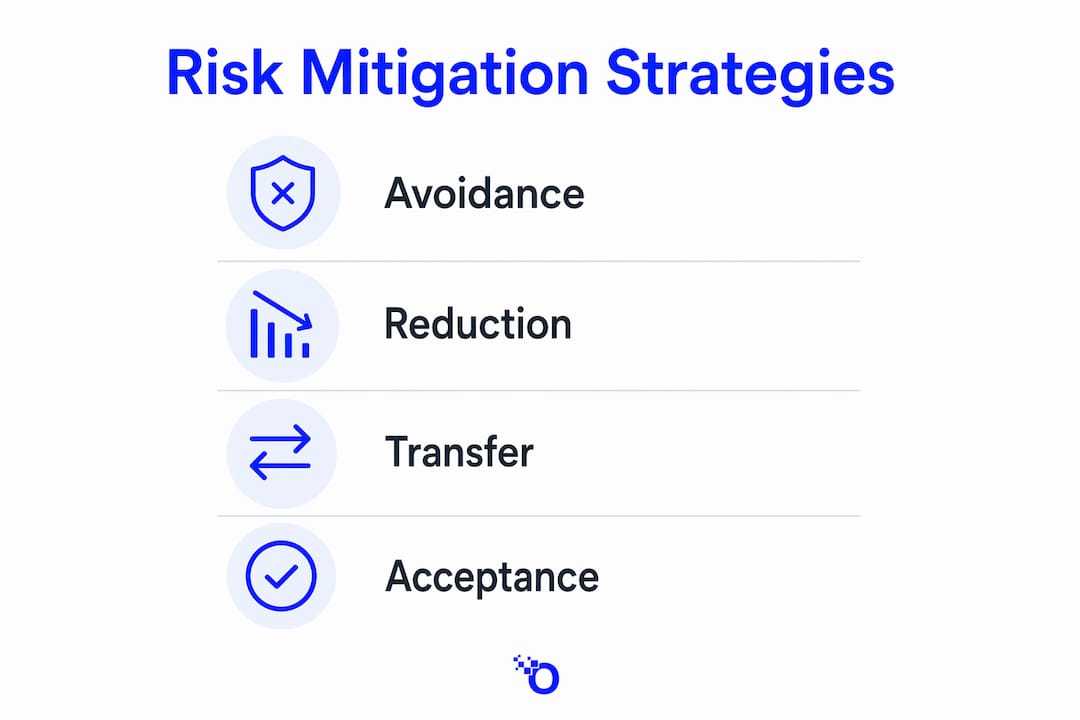
| Strategy | Definition | Best applied when |
|---|---|---|
| Avoidance | Stop the activity that creates the risk | The risk exceeds any possible benefit from the activity |
| Reduction | Implement controls to lower likelihood or impact | The activity is necessary but the risk can be managed |
| Transfer | Shift financial consequences to a third party | Residual risk remains after reduction and insurance is viable |
| Acceptance | Retain the risk with a documented contingency plan | Mitigation costs exceed the expected loss from the risk |
Avoidance
Avoidance eliminates the risk by ending the activity that produces it. A public safety agency that stops using an unvetted volunteer recruitment channel to avoid liability exposure is practicing avoidance. This strategy is appropriate when no control can reduce the risk to an acceptable level. It is the most decisive option, but also the most operationally limiting.
Reduction
Reduction is the most commonly applied strategy in public safety settings. It involves implementing technical, administrative, or physical controls that lower either the probability of a risk occurring or the severity of its impact. Pre-employment background investigations are a reduction control. So are mandatory training programs, access controls on sensitive data systems, and documented use-of-force policies.

Transfer
Transfer shifts the financial consequences of a risk to a third party, typically through insurance contracts or indemnification clauses. Transfer does not eliminate the risk. It relocates the financial burden if the risk materializes. Agencies that require contractors to carry liability insurance are transferring residual risk. This strategy works best when paired with reduction controls already in place.
Acceptance
Acceptance is the deliberate decision to retain a risk because the cost of mitigation exceeds the expected loss. Acceptance is not negligence. It requires documented rationale, a contingency plan, and a defined review date. Acceptance tolerates risk when mitigation costs exceed expected loss, but that calculation must be revisited regularly as circumstances change.
Pro Tip: Never accept a risk without assigning a review date. What is tolerable today may become unacceptable next quarter if your threat environment or regulatory obligations shift.
How is risk mitigation applied in public safety and risk management operations?
Public safety agencies rarely face risks that fit neatly into a single treatment category. Blending multiple mitigation strategies is common and necessary in high-stakes environments. A law enforcement agency managing the risk of officer misconduct might reduce that risk through rigorous pre-hire vetting, transfer residual liability through professional liability insurance, and accept a narrow band of residual risk with a documented response protocol.
The most effective operational approach layers controls across three dimensions:
- Technical controls include background investigation databases, digital record systems, body camera technology, and access-restricted data platforms. These controls reduce risk through automation and documentation.
- Administrative controls include written policies, training requirements, disciplinary procedures, and hiring standards. They set the behavioral expectations that technical controls enforce.
- Physical controls include facility access restrictions, equipment maintenance protocols, and scene safety procedures. They address risks tied to the physical environment of public safety work.
Effective risk mitigation applies layered controls across all three dimensions because no single control is infallible. Defense-in-depth is the operating principle in high-stakes environments. If one control fails, another catches the exposure.
A critical distinction that public safety risk managers must maintain is the difference between inherent risk and residual risk. Failing to distinguish inherent risk from residual risk leads to inaccurate safety assessments and poor decisions. Inherent risk is the exposure level before any controls are applied. Residual risk is what remains after controls are in place. Measuring only inherent risk overstates your exposure. Measuring only residual risk understates it if your controls are weaker than assumed.
Key risk indicators (KRIs) are the metrics that signal when residual risk is drifting toward unacceptable levels. For a public safety agency, a KRI might be the percentage of applicants who fail background screening, the frequency of policy violations, or the rate of use-of-force incidents per shift. A risk register should be dynamic and integrated with ownership, control measures, and KRIs to function as an effective daily management tool. A static spreadsheet reviewed once a year is not a risk register. It is a historical record.
Pro Tip: Link each KRI to a specific control and a named owner. When the indicator moves, the owner knows immediately and can act without waiting for a scheduled review.
What best practices ensure effective risk mitigation through continuous monitoring?
Risk mitigation is a continuous cycle, not a one-time project. Risk acceptance today may need mitigation tomorrow due to organizational changes or more sophisticated threat actors. The agencies that sustain effective safety programs treat mitigation as an ongoing operational discipline, not a compliance exercise.
-
Schedule regular reassessments. Set a fixed calendar for reviewing every accepted and treated risk. Quarterly reviews work for most public safety agencies. High-velocity risk environments may require monthly cycles. The schedule matters less than the consistency.
-
Integrate real-time monitoring where possible. Monitoring risk levels and revising mitigation strategies regularly are necessary to maintain exposure within acceptable limits. Real-time monitoring tools, continuous background screening services, and automated alert systems reduce the lag between a risk change and your response to it.
-
Assign owners and establish evidence requirements. Every control needs a named owner who is responsible for its effectiveness. That owner must provide documented evidence that the control is functioning. Evidence requirements prevent the common failure mode where a control exists on paper but not in practice.
-
Embed mitigation into existing workflows. Risk mitigation that requires separate systems or parallel processes tends to erode over time. The most durable programs integrate mitigation checkpoints into the workflows your team already uses. For hiring, that means embedding background investigation steps directly into your applicant tracking process, not treating them as a separate administrative task.
-
Track organizational risk maturity. Organizational risk maturity impacts mitigation approaches. What a small agency accepts as tolerable may require active management as the agency grows, takes on more complex operations, or faces increased regulatory scrutiny. Revisit your risk appetite statement annually and adjust your treatment strategies accordingly.
The agencies that execute this cycle consistently build a compounding advantage. Each review cycle produces better data. Better data produces more accurate risk scores. More accurate scores produce more targeted controls. Over time, the program becomes self-reinforcing rather than reactive.
Key Takeaways
Risk mitigation is the structured, proactive effort to reduce threat exposure through layered controls, continuous monitoring, and documented ownership before incidents occur.
| Point | Details |
|---|---|
| Risk vs. issue distinction | A risk is a future uncertainty; treat it before it becomes an active problem requiring crisis response. |
| Five-step lifecycle | Identify, assess, prioritize, treat, and monitor every risk on a defined schedule with named owners. |
| Four treatment strategies | Choose avoidance, reduction, transfer, or acceptance based on cost-benefit analysis and your agency’s risk tolerance. |
| Layered controls | Apply technical, administrative, and physical controls together; no single control is sufficient in high-stakes settings. |
| Live risk register | Maintain a dynamic register linked to KRIs, owners, and controls to support daily risk management decisions. |
Risk mitigation in public safety: what I’ve learned from the field
The most persistent gap I observe in public safety risk programs is not a lack of policy. Agencies generally have policies. The gap is between what the policy says and what the risk register reflects on any given Tuesday.
Static documentation is the silent failure mode of risk management. An agency completes a thorough risk assessment, documents controls, and files the report. Eighteen months later, the threat environment has shifted, two control owners have left the organization, and the KRIs have never been measured. The policy still exists. The protection does not.
The second pattern worth naming is the tendency to conflate inherent risk with residual risk. I have seen agencies present their post-control risk posture as if it were the pre-control baseline, which produces a false sense of security. If your controls are weaker than assumed, your residual risk is higher than your register shows. That gap is where incidents live.
What actually works is treating the risk register as a living operational document, not a compliance artifact. The agencies that do this well assign owners who are accountable for specific controls, set KRI thresholds that trigger automatic escalation, and review accepted risks on a fixed schedule. They also integrate mitigation directly into their public safety risk framework rather than running it as a parallel administrative function.
The future of risk mitigation in public safety will require faster feedback loops. Threats evolve faster than annual review cycles can track. Agencies that build near-real-time monitoring into their programs now will be better positioned to respond when the threat landscape shifts, as it always does.
— Matt
How OMNI Intel supports risk mitigation in public safety hiring
Pre-employment screening is one of the highest-leverage risk reduction controls available to public safety agencies. A single unvetted hire in a law enforcement, fire, or EMS role can produce liability, reputational damage, and community harm that no subsequent control can fully reverse.

OMNI Intel’s pre-employment screening services are built specifically for public safety agencies, applying investigator-driven background investigation principles to every candidate review. The platform integrates directly with hiring workflows, reducing the administrative friction that causes agencies to cut corners under recruitment pressure. Post-hire monitoring extends that protection beyond the hiring decision, flagging behavioral and compliance risks before they escalate. For agencies that take the importance of risk mitigation seriously, OMNI Intel provides the investigative depth and compliance infrastructure to act on that commitment. Learn more about OMNI Intel’s background investigation capabilities and how they fit your agency’s risk reduction program.
FAQ
What is risk mitigation in simple terms?
Risk mitigation is the process of identifying potential threats and taking deliberate steps to reduce their likelihood or impact before they cause harm. It is the action layer of a broader risk management strategy.
How does risk mitigation differ from risk management?
Risk management is the overarching framework that sets policy and risk tolerance levels. Risk mitigation is the specific set of controls and actions that execute that framework by reducing identified risks.
What are the four main risk mitigation techniques?
The four primary techniques are avoidance, reduction, transfer, and acceptance. Each is selected based on the cost of mitigation relative to the expected impact of the risk and the organization’s defined risk tolerance.
Why is continuous monitoring critical to risk mitigation?
Risk acceptance today may require active mitigation tomorrow as threats evolve and organizational complexity grows. Continuous monitoring detects when a treated or accepted risk has shifted beyond acceptable limits, enabling a timely response.
How does pre-employment screening function as a risk mitigation control?
Pre-employment background investigations are a reduction control that lowers the probability of hiring personnel who pose misconduct, liability, or safety risks. For public safety agencies, this control directly protects community safety and institutional integrity.