

Why Data Security Matters for Public Safety Agencies
Data security is the practice of protecting sensitive information from unauthorized access, modifications, and disruptions to maintain confidentiality, integrity, and availability. For public safety professionals, why data security matters goes far beyond IT policy. Criminal Justice Information Services (CJIS) data, personnel records, and investigative files represent the operational backbone of law enforcement, fire, EMS, and dispatch agencies. A single misconfiguration or ransomware attack can compromise investigations, expose agencies to federal liability, and erode community trust. Standards like CJIS 6.0 and NIST SP 800-172 Rev. 3 now set the bar for what adequate protection looks like, and the consequences of falling short are measurable and severe.
What are the core principles of data security for public safety?
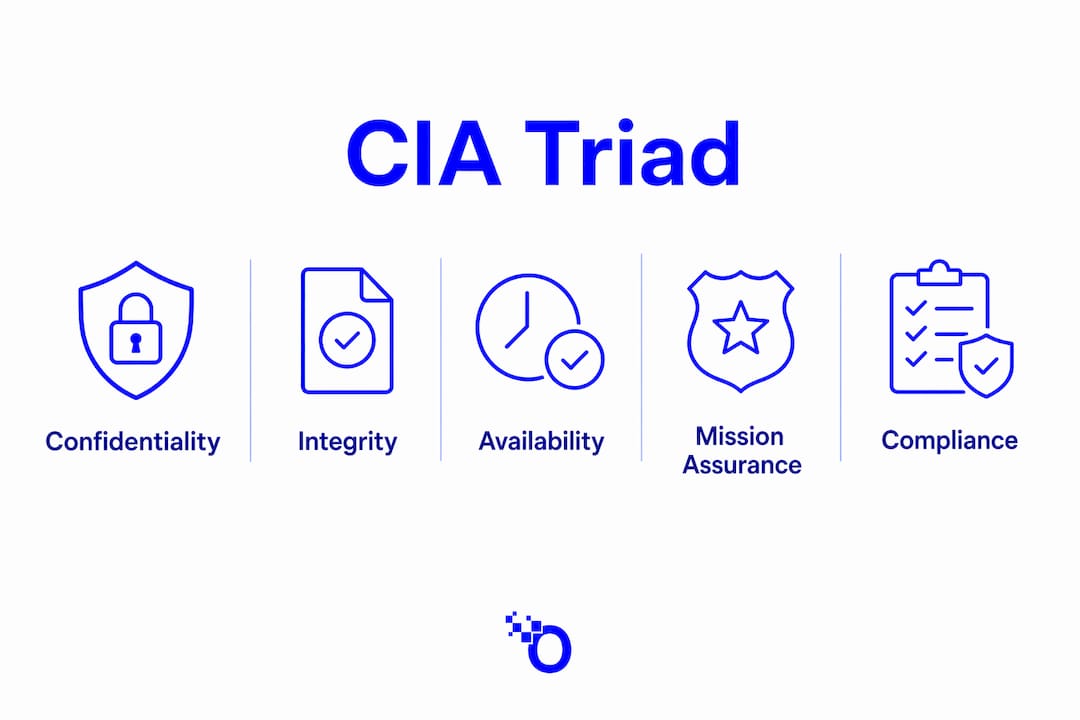
Data security rests on three principles known collectively as the CIA triad: Confidentiality, Integrity, and Availability. Each principle addresses a distinct threat vector, and all three must hold simultaneously for a public safety agency’s data environment to be considered secure.
Confidentiality
Confidentiality means restricting data access to authorized users only. In a public safety context, this covers criminal history records, active investigation files, personnel background data, and CJIS-regulated information. Unauthorized disclosure of any of these categories can compromise ongoing investigations, expose informants, or create civil liability. Access controls, role-based permissions, and encryption at rest and in transit are the primary technical mechanisms that enforce confidentiality.
Integrity
Integrity means the data you retrieve is exactly what was entered, with no unauthorized modifications. For law enforcement, a tampered arrest record or an altered background investigation report can have direct legal consequences. Audit logs, hash verification, and change management controls are the tools that protect integrity. Without them, agencies cannot trust the accuracy of the records they act on.

Availability
Availability means authorized users can access data when they need it, even during a cyberattack or system outage. Ransomware directly targets availability by encrypting files and rendering systems inoperable. For dispatch centers and emergency responders, a system outage is not an inconvenience. It is an operational failure with life-safety implications.
Pro Tip: Map your agency’s most critical data assets to each CIA triad component before selecting security controls. This prevents over-investing in confidentiality tools while leaving availability gaps that ransomware can exploit.
These three principles apply directly to CJIS security standards, which require agencies to protect criminal justice information across all three dimensions. The CIA triad is not an abstract framework. It is the operational definition of what secure public safety data looks like.
Why is data loss prevention critical under CJIS 6.0?
CJIS 6.0 requires data loss prevention measures that identify, classify, and control sensitive data across endpoints, networks, and cloud environments. This represents a fundamental shift in how public safety agencies must think about security. The perimeter is no longer the network firewall. The perimeter is the data itself.
The practical implication is significant. An agency can have a locked-down network and still suffer a data breach if an officer emails a CJIS record to a personal account or uploads a file to an unauthorized cloud service. CJIS 6.0 addresses exactly these scenarios by requiring agencies to monitor and control data movement, not just access points.
DLP enforcement is typically phased, and agencies that attempt to implement all controls simultaneously often stall. A structured approach works better:
- Identify and classify sensitive data. Catalog all CJIS-regulated data across systems, including records management, dispatch, and HR platforms. You cannot protect what you have not located.
- Deploy network-level DLP. Inspect outbound email, web traffic, and cloud uploads for sensitive data patterns. Network DLP catches the most common leakage vectors before endpoint controls are in place.
- Add endpoint-level controls. Monitor and restrict data handling on individual devices, including laptops, mobile devices, and removable storage. This layer is critical for remote and field personnel.
- Address text-based leakage. Personal messaging apps and SMS are among the hardest channels to control. Policy enforcement here requires both technical controls and staff training.
- Audit and refine continuously. DLP rules generate false positives. Regular tuning keeps enforcement accurate and prevents alert fatigue among security staff.
Public safety agencies must assess both user access permissions and actual data movement patterns. Knowing who has access is not the same as knowing where data goes. The distinction is the foundation of effective DLP.
Pro Tip: Start your CJIS 6.0 DLP program with a data classification audit before purchasing any tools. Agencies that skip classification spend months tuning DLP systems against data they never fully mapped, wasting both time and budget.
What happens when data security fails? The Ventura County case
The consequences of security misconfiguration in public safety are not theoretical. In early 2025, an audit of Ventura County’s license plate reader system revealed a critical misconfiguration in a feature called “National Lookup.” The audit found 798,000 out-of-state queries and more than 800 federal agency queries of Ventura County’s sensitive license plate data during the exposure period. That volume of unauthorized access represents a significant breach of data boundaries, even if no single query was malicious.
The incident illustrates a concept called access policy drift. The system was configured to allow data sharing beyond its intended boundaries, and that configuration change went undetected until an audit surfaced it. No intrusion occurred. No attacker broke through a firewall. The data simply flowed to unauthorized parties because a vendor feature was enabled without adequate review.
| Incident factor | Detail |
|---|---|
| System involved | License plate reader network, Ventura County |
| Misconfiguration | “National Lookup” feature enabled unauthorized sharing |
| Out-of-state queries | 798,000+ during the exposure period |
| Federal agency queries | 800+ unauthorized queries identified |
| Root cause | Access policy drift from vendor feature change |
| Detection method | Internal audit, not real-time monitoring |
“The Ventura County incident demonstrates that data security failures in public safety often originate not from external attacks but from internal configuration gaps that audits catch too late.” — Security compliance analysis, 2026
The legal and compliance implications are direct. Agencies that share CJIS-regulated data outside authorized boundaries face potential decertification, federal sanctions, and civil litigation. The operational impact compounds this. Once community trust in data handling erodes, it is difficult to rebuild. Continuous audits and access verification are the primary safeguards against this failure mode.
How do NIST standards reduce ransomware risk for public safety organizations?
NIST SP 800-172 Rev. 3 establishes enhanced security requirements for protecting Controlled Unclassified Information (CUI) in nonfederal systems. For public safety agencies that handle federal criminal justice data, compliance with this standard is a direct requirement for mission assurance. The publication addresses advanced persistent threats and treats confidentiality, integrity, and availability as operationally critical, not aspirational.
NIST frames data security as mission assurance, meaning that compliance with SP 800-172 is a safeguard for government operational effectiveness. Agencies that treat NIST compliance as a checkbox exercise miss this point entirely. The standard exists because the failure of data security in a public safety environment has consequences that extend beyond the agency to the communities it serves.
Ransomware is the most acute threat to both availability and confidentiality simultaneously. NIST IR 8374r1 frames ransomware as a dual threat: attackers encrypt data to destroy availability, then exfiltrate it to weaponize confidentiality. This combination makes ransomware uniquely damaging for public safety agencies, where both operational continuity and data privacy are non-negotiable.
Effective ransomware readiness under NIST Cybersecurity Framework 2.0 covers five components:
- Identify: Catalog all data assets, systems, and dependencies. Agencies that do not know what they have cannot protect it.
- Protect: Implement access controls, encryption, and DLP to reduce the attack surface before an incident occurs.
- Detect: Deploy monitoring tools that identify ransomware indicators early, before encryption spreads across systems.
- Respond: Maintain documented incident response playbooks specific to ransomware scenarios, including communication protocols for affected communities.
- Recover: Test backup and restoration procedures regularly. Ransomware defense requires an operational playbook approach that extends well beyond backup and restore.
Pro Tip: Run a tabletop ransomware exercise annually using NIST IR 8374r1 as the scenario framework. Agencies that practice recovery before an incident occurs restore operations significantly faster than those that improvise under pressure.
The integration of SP 800-172 and the NIST ransomware profile gives public safety agencies a coherent framework for addressing both deliberate attacks and configuration-based exposures. Neither standard is optional for agencies that handle CUI or CJIS data.
What best practices prevent access policy drift in public safety systems?
Access policy drift occurs when system updates, vendor feature releases, or integration changes silently expand data access beyond intended boundaries. It is one of the most common and least detected failure modes in public safety data environments. The Ventura County case is the clearest recent example, but the underlying risk exists in any agency that relies on third-party platforms for data management.
Preventing access policy drift requires a structured, ongoing approach rather than a one-time configuration review. The following practices form the foundation of effective drift prevention:
- Establish a configuration baseline. Document the intended access boundaries for every system that handles sensitive data. This baseline becomes the reference point for all future audits.
- Require security review before enabling vendor features. Any new feature that affects data sharing, external queries, or API integrations must pass a security review before activation. Vendor-enabled features are a primary source of unintended access expansion.
- Schedule quarterly access audits. Review actual data movement logs against the configuration baseline. Quarterly audits catch drift before it accumulates into a significant exposure.
- Integrate policy reviews into change management. System updates and vendor patches should trigger an automatic policy review. Changes that affect data boundaries require sign-off from both IT and compliance personnel.
- Complement technical controls with staff training. DLP tools and access controls reduce technical risk. Staff training reduces human risk. Both are necessary. Agencies that rely solely on technical controls leave gaps that trained personnel can close.
Continuous verification is the first line of defense against access policy drift. Configured boundaries must match intended policies after every system change, not just at initial deployment. Agencies that treat security configuration as a one-time task will eventually discover a gap through an audit or, worse, through a breach notification.
For agencies managing public safety compliance requirements, embedding drift prevention into standard operating procedures is the difference between proactive security and reactive damage control.
Key takeaways
Data security in public safety is not a compliance exercise. It is the operational foundation that protects investigations, personnel, and community trust from both external attacks and internal configuration failures.
| Point | Details |
|---|---|
| CIA triad is the baseline | Confidentiality, Integrity, and Availability must all hold for public safety data to be considered secure. |
| CJIS 6.0 shifts the perimeter | Data itself is now the security boundary, requiring DLP across endpoints, networks, and cloud environments. |
| Access policy drift is a silent threat | Vendor feature changes can expose sensitive data without any external attack, as the Ventura County case confirmed. |
| NIST standards define mission assurance | SP 800-172 Rev. 3 and NIST IR 8374r1 provide the compliance framework for protecting CUI and managing ransomware risk. |
| Continuous verification prevents drift | Quarterly audits and change-triggered policy reviews keep configured boundaries aligned with intended access policies. |
Data security as mission assurance, not a checkbox
I have watched public safety agencies invest heavily in perimeter security while leaving data movement almost entirely unmonitored. The logic made sense a decade ago. Networks were simpler, data lived on local servers, and the threat model was primarily external intrusion. That model no longer reflects reality.
What strikes me most about the CJIS 6.0 DLP requirements is not their technical complexity. It is the conceptual shift they demand. Agencies are being asked to treat data as the security perimeter, which requires a fundamentally different operational mindset. Most IT teams in public safety were trained to protect systems. Protecting data movement is a different discipline, and the learning curve is real.
The Ventura County incident is instructive precisely because it was not a sophisticated attack. A vendor feature was enabled, data flowed to unauthorized parties, and the exposure ran for months before an audit caught it. That scenario will repeat itself in agencies that rely on annual compliance reviews instead of continuous verification. The agencies that get this right are the ones that build drift detection into their standard operating procedures, not their annual audit calendar.
Ransomware preparedness is the other area where I see consistent gaps. Agencies build backups and assume that covers the risk. NIST IR 8374r1 makes clear that ransomware is a dual threat. Encryption destroys availability, but exfiltration destroys confidentiality. A backup restores your files. It does not undo the exposure of sensitive personnel records or active investigation data. Agencies need response playbooks that address both impacts, not just recovery procedures.
The broader point is this: data security in public safety is mission assurance. When it fails, investigations are compromised, personnel are exposed, and communities lose confidence in the agencies that protect them. Treating it as a compliance checkbox is the most expensive mistake an agency can make.
— Matt
How OMNI Intel supports secure public safety hiring
Public safety agencies face data security risks not only in their operational systems but also in their hiring processes. Background investigation data, applicant records, and personnel files are among the most sensitive data categories an agency handles, and they require the same rigorous protection as CJIS operational data.

OMNI Intel provides pre-employment screening services built specifically for law enforcement, fire, EMS, dispatch, and government agencies. Every investigation follows FCRA-compliant, investigator-driven processes that protect sensitive applicant data while delivering the depth of vetting that public safety roles demand. For agencies working to align hiring practices with CJIS security requirements, OMNI Intel’s background investigations platform offers a structured, compliance-aware approach to candidate screening that reduces data security risk at every stage of the hiring process.
FAQ
What is the CIA triad in data security?
The CIA triad stands for Confidentiality, Integrity, and Availability. It defines the three core requirements that any data security program must satisfy to protect sensitive information from unauthorized access, tampering, and disruption.
What does CJIS 6.0 require for data loss prevention?
CJIS 6.0 requires agencies to identify, classify, and control sensitive CJIS data across endpoints, networks, and cloud environments. Enforcement is phased, starting with data classification and progressing through network-level and endpoint-level DLP controls.
What is access policy drift and why does it matter?
Access policy drift occurs when system updates or vendor feature changes silently expand data access beyond intended boundaries. The Ventura County license plate reader incident exposed over 798,000 unauthorized out-of-state queries as a direct result of this failure mode.
How does ransomware threaten public safety data?
Ransomware attacks both availability and confidentiality simultaneously by encrypting files and exfiltrating data for extortion. NIST IR 8374r1 recommends a comprehensive readiness approach covering identify, protect, detect, respond, and recover stages.
How does NIST SP 800-172 Rev. 3 apply to public safety agencies?
NIST SP 800-172 Rev. 3 establishes enhanced security requirements for protecting Controlled Unclassified Information in nonfederal systems. Public safety agencies that handle federal criminal justice data must meet these requirements as a condition of mission assurance and federal compliance.