

What Is Adverse Action in Hiring? A Guide for Public Safety HR
Adverse action is defined as any negative employment decision made in whole or in part based on information from a consumer report, such as a background check, credit report, or driving record. Under the Fair Credit Reporting Act (FCRA), codified at 15 U.S.C. §1681m, employers who use consumer report data to deny employment, rescind a job offer, or terminate a current employee must follow a specific notification process before and after taking that action. For public safety HR professionals and employers, the stakes are especially high. Errors in this process expose agencies to significant legal and financial liability, and they undermine the fairness that public trust demands.
What is adverse action under the Fair Credit Reporting Act?
Adverse action, as defined by the FCRA, covers a broader range of employment decisions than most HR professionals initially expect. Negative employment decisions such as refusing to hire, rescinding offers, denying promotions, demotion, termination, and pay reductions all qualify as adverse action when a consumer report plays any role in the decision. The phrase “in whole or in part” is the critical legal standard. Even if a background check finding is only one factor among several, the adverse action process applies.

The FCRA’s adverse action requirements extend beyond criminal background checks. Consumer report types that trigger these obligations include credit reports, driving records, and any other third-party data obtained from a Consumer Reporting Agency (CRA). Public safety agencies that pull motor vehicle records for dispatcher candidates or credit histories for financial crimes investigators must follow the same process as agencies running full criminal background investigations.
The law also applies to every work arrangement, not just full-time employment. All work arrangements including part-time, temporary, contractor, and volunteer positions fall under FCRA adverse action requirements. A fire department that declines a volunteer based on a background check result must follow the same notification steps as a police department rejecting a sworn officer candidate.
The following employment decisions are covered under the FCRA adverse action definition:
- Denying an initial employment application
- Rescinding a conditional job offer after a background check
- Denying a promotion based on a consumer report
- Demoting a current employee following a periodic screening
- Reducing compensation tied to a consumer report finding
- Terminating employment based on background data
- Reassigning an employee to a less favorable role based on report findings
Understanding this scope is the foundation of compliance. Any HR professional who limits their adverse action thinking to “we just didn’t hire them” is operating with a dangerously narrow view of the law.
What is the adverse action process and required notifications?
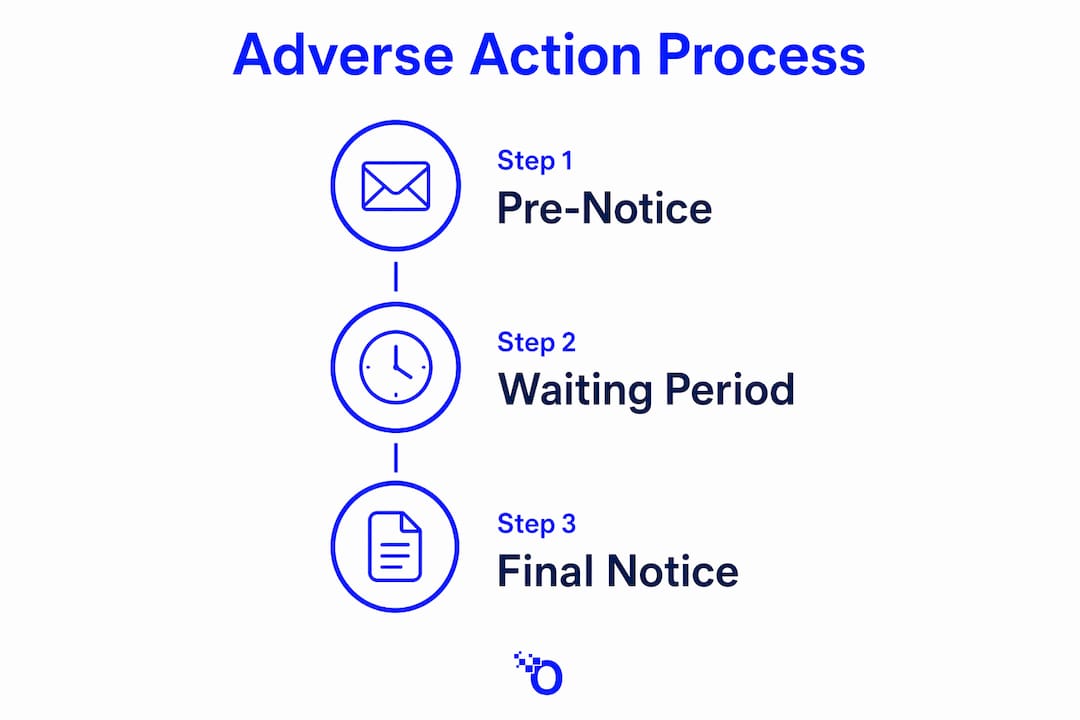
The adverse action process involves three sequential steps: a pre-adverse action notice, a reasonable waiting period, and a final adverse action notice. Each step carries specific legal requirements. Skipping or shortcutting any one of them exposes the employer to litigation.
-
Send the pre-adverse action notice. Before taking any negative action, the employer must provide the applicant or employee with a copy of the consumer report that influenced the decision and a written Summary of Rights under the FCRA. This notice must be delivered before the decision is finalized. The purpose is to give the individual an opportunity to review the information and identify any errors before the employer acts.
-
Observe the waiting period. The pre-adverse action waiting period is typically 5 to 7 business days. This window allows the candidate to dispute inaccurate or outdated information with the CRA. Some employers choose 7 business days to provide an additional margin of safety. The waiting period is not optional. Proceeding to a final decision before it expires is one of the most common and costly compliance failures.
-
Send the final adverse action notice. Once the waiting period has passed and no dispute has altered the outcome, the employer sends the final adverse action notice. This notice must include the name, address, and phone number of the CRA that provided the report, a statement that the CRA did not make the hiring decision and cannot explain why the decision was made, and information about the applicant’s right to dispute the accuracy of the report and obtain a free copy within 60 days.
Pro Tip: Document the exact date and method of delivery for both notices. Email with read receipts or certified mail creates a clear compliance record that protects the agency if a dispute or lawsuit arises.
Failure to provide proper notices or to observe the correct waiting period exposes employers to significant legal and financial liability. Courts have awarded statutory damages, actual damages, and attorney fees in FCRA adverse action cases. For public safety agencies operating under public scrutiny, the reputational cost compounds the financial one.
One important clarification: the final adverse action notice references the CRA, not the employer’s internal reasoning. Adverse action notices must only reference CRA contact information, not the employer’s decision process. The CRA cannot explain the employer’s decision, and the employer is not required to disclose its internal hiring criteria. This distinction limits employer liability while still protecting applicant rights.
How does adverse action apply in public safety hiring?
Public safety agencies face a distinctive set of adverse action scenarios that general HR guidance often does not address with enough specificity. Law enforcement, fire and EMS, dispatch centers, and private security firms regularly make employment decisions based on layered consumer report data, including criminal history, credit reports, and driving records. Each layer can independently trigger adverse action obligations.
The most common adverse action scenarios in public safety hiring include:
- A law enforcement agency rescinds a conditional offer after a background investigation reveals a disqualifying criminal conviction.
- A fire department denies employment to an applicant whose driving record shows multiple serious violations.
- A dispatch center declines a candidate based on a credit report showing patterns inconsistent with financial responsibility requirements.
- An EMS agency demotes a current paramedic following a periodic background review that surfaces new criminal activity.
- A private security firm terminates a guard after a consumer report reveals a previously undisclosed felony.
Each of these scenarios requires the full three-step adverse action process, regardless of how clear-cut the disqualifying information appears.
The distinction between applicants and current employees matters operationally. For applicants, the pre-adverse action notice typically goes out before a final hiring decision is communicated. For current employees, the process must be handled with additional care because the individual is already in a working relationship with the agency. HR teams should consult legal counsel when adverse action involves a tenured employee, particularly in unionized public safety environments where collective bargaining agreements may impose additional procedural requirements.
Pro Tip: Build a separate adverse action checklist for current employees versus applicants. The legal obligations are identical, but the operational steps, communication channels, and documentation requirements differ enough to warrant distinct workflows.
Dispute handling during the waiting period requires particular attention. If a candidate disputes background check results during the waiting period, employers must pause final decisions until the CRA completes its reinvestigation. That reinvestigation can take up to 30 days. For public safety agencies with urgent staffing needs, this delay can strain operations. Planning for this possibility by maintaining a pipeline of qualified candidates reduces the operational pressure that sometimes pushes HR teams toward premature decisions.
Agencies can review public safety compliance steps to build processes that account for these timing realities from the start.
Common compliance pitfalls and best practices
Most adverse action violations do not stem from intentional misconduct. They result from procedural gaps, misunderstandings about notice content, and inadequate documentation. Recognizing the most frequent errors is the first step toward eliminating them.
Common compliance failures in adverse action:
- Sending the pre-adverse action notice and the final adverse action notice simultaneously, which eliminates the waiting period entirely
- Failing to include the consumer report copy with the pre-adverse action notice
- Providing the wrong Summary of Rights form (the FCRA requires a specific document)
- Proceeding with a final decision while a candidate’s dispute is still under CRA reinvestigation
- Treating the adverse action notice as an explanation of hiring criteria rather than a reference to the CRA
Best practices for consistent compliance:
- Use a standardized adverse action checklist for every screening decision that involves a consumer report
- Log the date, delivery method, and recipient confirmation for every notice sent
- Train HR staff to recognize which employment decisions trigger adverse action, including promotions and reassignments
- Pause the hiring decision clock when a dispute is received and document the pause
- Conduct annual audits of adverse action files to verify procedural consistency
Pro Tip: Assign a single HR staff member as the adverse action compliance owner for each hiring cycle. Distributed responsibility is the primary reason notices get sent late or skipped entirely.
The FCRA Disposal Rule adds another layer of obligation that many agencies overlook. Proper disposal of background check information is a legal requirement under the FCRA Disposal Rule. Employers must shred or permanently erase all consumer report data to prevent unauthorized use. Retaining background check files beyond their necessary period creates both a legal and a security risk.
The table below compares compliant and non-compliant adverse action practices at a glance:
| Practice | Compliant approach | Non-compliant approach |
|---|---|---|
| Pre-adverse notice timing | Sent before any final decision | Sent simultaneously with final notice |
| Consumer report copy | Included with pre-adverse notice | Omitted or sent separately after the fact |
| Waiting period | 5–7 business days observed | Skipped or shortened |
| Dispute handling | Decision paused pending CRA reinvestigation | Decision finalized despite active dispute |
| Data disposal | Shredded or permanently erased per FCRA Disposal Rule | Retained indefinitely in unsecured files |
Agencies that want a structured approach to hiring compliance documentation will find that building these controls into standard operating procedures reduces both error rates and legal exposure.
Key Takeaways
Adverse action compliance under the FCRA requires a precise three-step notification process, and any employment decision influenced by a consumer report triggers these obligations regardless of role type or work arrangement.
| Point | Details |
|---|---|
| Adverse action definition | Any negative employment decision based in whole or in part on a consumer report triggers FCRA obligations. |
| Three-step process | Pre-adverse notice, a 5–7 business day waiting period, and a final adverse notice are all legally required. |
| Scope of coverage | All work arrangements, including volunteers and contractors, fall under FCRA adverse action requirements. |
| Notice content | Notices must reference CRA contact information, not the employer’s internal hiring rationale. |
| Dispute handling | Employers must pause final decisions when a candidate disputes report findings during the waiting period. |
Adverse action compliance: what experience actually teaches you
I have worked alongside HR teams in public safety agencies long enough to know that adverse action compliance failures are almost never about bad intent. They are almost always about speed. An agency has a critical vacancy, a candidate looks strong, and the background check comes back with a flag. The instinct is to move quickly, close the file, and fill the position. That instinct is exactly what creates liability.
The waiting period feels like a bureaucratic delay when you are trying to staff a patrol division or a dispatch center. What it actually represents is a meaningful safeguard. Background check errors are more common than most HR professionals realize. Identity mismatches, outdated records, and data entry errors appear in consumer reports with enough frequency that the 5 to 7 business day window is not just a legal formality. It is a genuine opportunity for a qualified candidate to correct a mistake that would otherwise end their career in public safety.
The second thing experience teaches is that the notice content requirement is consistently misunderstood. HR teams often feel they owe the candidate an explanation of why they were not hired. The FCRA does not require that, and providing it can actually create additional legal exposure by implying that the employer’s decision was based solely on the report rather than on a broader evaluation. The notice points to the CRA. That is its entire function. Keeping it clean and legally precise protects both the agency and the applicant.
The agencies that handle adverse action best are the ones that treat it as a standard operating procedure rather than a case-by-case judgment call. They have checklists, they have designated compliance owners, and they have documentation habits that make audits straightforward. That level of process discipline is not bureaucracy for its own sake. It is what separates agencies that operate with integrity from those that end up in federal court over a skipped notice.
— Matt
How OMNI Intel supports compliant public safety hiring

Public safety agencies carry a higher compliance burden than most employers because the stakes of a bad hire extend directly to community safety. OMNI Intel’s pre-employment screening services are built specifically for law enforcement, fire and EMS, dispatch centers, and private security firms. The platform supports investigator-driven background investigations that align with FCRA requirements, helping HR teams manage the adverse action process with accuracy and consistency. From consumer report delivery to documentation support, OMNI Intel provides the infrastructure that agencies need to make evidence-based hiring decisions without cutting procedural corners. Agencies that want to reduce litigation risk while maintaining rigorous screening standards can explore OMNI Intel’s background investigations platform to see how compliant, thorough vetting works in practice.
FAQ
What is the adverse action definition under the FCRA?
Adverse action is any negative employment decision, including denial of hire, rescission of a job offer, demotion, or termination, made in whole or in part based on information from a consumer report. The FCRA at 15 U.S.C. §1681m requires employers to follow a specific notification process whenever a consumer report influences such a decision.
What is an adverse action process in hiring?
The adverse action process consists of three steps: sending a pre-adverse action notice with a copy of the consumer report and Summary of Rights, observing a waiting period of 5 to 7 business days, and then sending a final adverse action notice that includes CRA contact information and the applicant’s dispute rights.
Does adverse action apply to volunteers and contractors?
Yes. FCRA adverse action requirements apply to all work arrangements, including full-time, part-time, temporary, contractor, and volunteer positions. A public safety agency that declines a volunteer based on a background check must follow the same three-step process as it would for a paid employee.
What happens if a candidate disputes their background check during the waiting period?
The employer must pause the final adverse action decision and wait for the CRA to complete its reinvestigation. That reinvestigation can take up to 30 days. Proceeding with a final decision while a dispute is active violates FCRA requirements and exposes the employer to legal liability.
What must the final adverse action notice include?
The final adverse action notice must include the name, address, and phone number of the CRA that provided the report, a statement that the CRA did not make the hiring decision, and information about the applicant’s right to dispute the report and obtain a free copy within 60 days. The notice does not need to explain the employer’s internal hiring criteria.