
Employee Monitoring Process Guide for Public Safety HR
Public safety agencies face real challenges when integrating new monitoring tools with everyday workflows. If your system complicates existing routines, staff pushback increases and adoption stalls. By focusing on mapping your current workflows and prioritizing seamless data integration, you can develop a monitoring process that fits your agency’s needs while supporting compliance and strengthening trust within the community. This approach puts your team in position to make smarter decisions and protect organizational integrity.
Table of Contents
- Step 1: Integrate Monitoring Tools With Agency Workflows
- Step 2: Review And Analyze Employee Activity Data Regularly
- Step 3: Verify Process Effectiveness And Document Outcomes
Quick Summary
| Key Insight | Explanation |
|---|---|
| 1. Integrate Tools Seamlessly | Select monitoring tools that align with existing workflows to increase staff acceptance and reduce extra work. |
| 2. Focus on Pain Points | Identify specific operational gaps where monitoring tools can deliver value without adding complexity. |
| 3. Train Staff Effectively | Choose user-friendly tools and provide adequate training to ensure quick adoption and minimize resistance. |
| 4. Regularly Analyze Data | Establish a consistent review schedule to uncover trends and address potential issues proactively. |
| 5. Document Outcomes Clearly | Measure and report the effectiveness of monitoring systems to justify investments and guide future improvements. |
…
Step 1: Integrate monitoring tools with agency workflows
Your monitoring system only works when it fits seamlessly into how your team actually operates. Integration means selecting tools that complement existing processes, not replacing them with technology your staff will resist or abandon.
Start by mapping your current workflows. Document how information moves through your agency right now. Where do hiring decisions get made? How does personnel data flow between departments? What systems do your HR team and supervisors already use daily? Understanding this foundation prevents you from introducing tools that create extra work instead of reducing it.
Next, identify specific pain points. Are investigators spending hours compiling reports manually? Do supervisors struggle to access employee history when making performance decisions? Is compliance documentation scattered across different platforms? These gaps show you exactly where monitoring tools can add value without disrupting operations.
When evaluating potential tools, prioritize seamless data integration. The best monitoring solution connects with systems your agency already uses, whether that is payroll software, case management platforms, or HR databases. This reduces double entry and keeps information current across all departments.
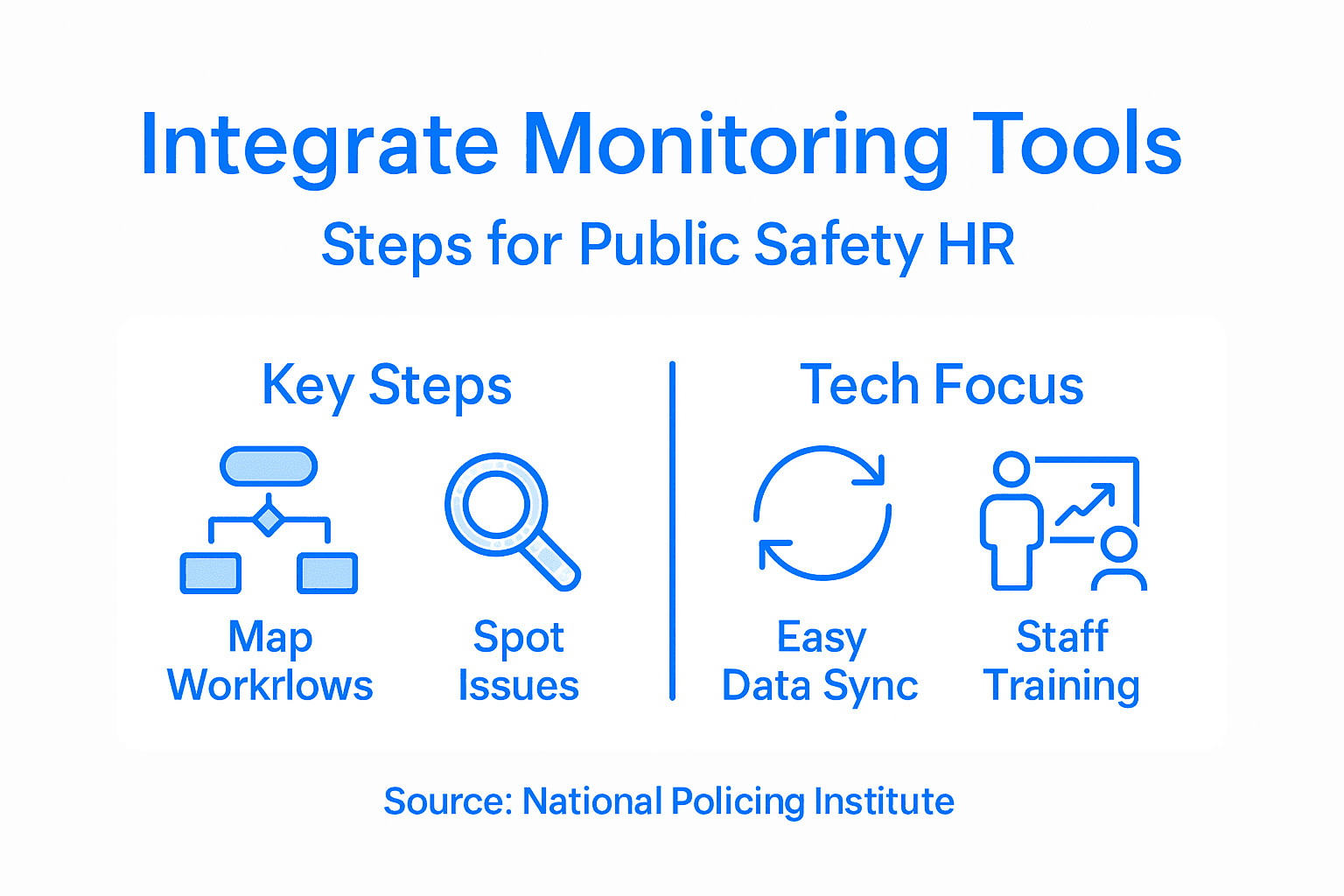
Consider your staff’s technical capacity honestly. Training requirements matter. Tools requiring extensive onboarding create resistance. Look for solutions with intuitive interfaces and clear workflows that existing personnel can adopt quickly.
The National Policing Institute recommends tailoring technology to agency needs and implementing tools in ways that fit existing operational workflows. This approach ensures your monitoring system enhances rather than disrupts agency operations.
Roll out integration in phases rather than all at once. Start with one department or function, measure results, and refine before expanding agency-wide. This method reduces risk and gives you time to address technical or process issues before full deployment.
Key integration steps:
- Connect monitoring tools to existing HR and personnel systems
- Reduce manual data entry by automating information transfer
- Establish clear protocols for how supervisors access monitoring data
- Create standardized reporting that fits your agency’s communication style
- Schedule regular check-ins to identify integration gaps early
Successful tool integration reduces administrative burden while increasing visibility into employee performance and compliance status.
Your monitoring system should make supervisors’ jobs easier, not harder. When tools integrate properly with existing workflows, staff adoption increases, data accuracy improves, and your agency gains the oversight benefit you intended.
Here’s a summary of key factors for successful monitoring tool integration:
| Factor | Importance for Agencies | Business Impact |
|---|---|---|
| Workflow Mapping | Prevents mismatched tools | Reduces workload, improves buy-in |
| Data Integration | Keeps info current | Minimizes errors, boosts efficiency |
| Staff Training Level | Affects adoption speed | Reduces resistance, shortens onboarding |
| Phased Rollout | Allows real-world testing | Lowers risk, enables refinement |
Pro tip: Start integration with your most tech-savvy department or supervisor first, then use their experience and feedback to refine the rollout strategy for the rest of your agency.
Step 2: Review and analyze employee activity data regularly
Regular analysis of monitoring data transforms raw information into actionable intelligence about your workforce. Without consistent review, you collect data but miss the patterns and risks that matter for public safety agency operations.
Establish a review schedule that your team can actually maintain. Weekly reviews work well for critical incidents or conduct concerns, while monthly comprehensive reviews capture broader performance trends. Quarterly deep dives allow you to assess patterns over time and adjust policies or training as needed.
Start by identifying what specific data points you will examine each review cycle. Are you tracking complaint patterns? Monitoring policy compliance rates? Watching for performance declines in specific job categories? Clear focus prevents you from getting lost in data volume.
When analyzing activity data, people analytics helps solve business problems and improve workforce management through systematic review of employee behavior and performance trends. This structured approach moves beyond gut feelings to evidence-based decisions about staffing, training, and discipline.
Look for red flags that require immediate attention alongside emerging trends. A single misconduct incident demands swift response. Multiple minor policy violations from one supervisor or unit suggest systemic issues needing intervention.
Document your findings clearly so patterns become visible. Create simple reports showing what you discovered, what it means for your agency, and what action you recommend. Share results with supervisors and command staff so they understand the data and support necessary changes.
Key analysis focus areas:
- Track conduct complaints by department and employee tenure
- Monitor policy violation patterns and identify repeat offenders
- Assess performance rating trends across your agency
- Identify training gaps revealed by data
- Review compliance with agency protocols and procedures
Regular data analysis reveals patterns invisible in isolated incidents, enabling prevention rather than crisis response.
Remember that monitoring data analysis must balance compliance with privacy expectations, so handle sensitive information carefully and communicate transparently with employees about how you use this data.
Schedule dedicated time for analysis rather than treating it as something you squeeze in during busy weeks. Even one hour per week examining key metrics prevents small problems from becoming agency-wide challenges.
Consider these data review frequencies for optimal oversight:
| Review Frequency | Typical Use Case | Benefit to Agency |
|---|---|---|
| Weekly | High-risk incident audits | Promotes rapid response |
| Monthly | Performance trend analysis | Reveals patterns, informs training |
| Quarterly | Policy and retention review | Guides strategic policy changes |
Pro tip: Create a simple tracking spreadsheet that highlights concerning data points automatically, so you can spot emerging issues quickly without manually reviewing every record.
Step 3: Verify process effectiveness and document outcomes
Your monitoring process only matters if it actually improves agency safety and accountability. Verification means measuring whether your system delivers the results you intended and documenting those outcomes for stakeholders.
Start by defining clear success metrics before you launch or expand your monitoring effort. What specific improvements do you expect? Will complaint resolution happen faster? Should misconduct cases be identified earlier? Will policy compliance rates increase? These targets give you concrete ways to measure whether the investment works.
Collect baseline data before implementation. How long does complaint investigation currently take? What percentage of policy violations go undetected? What is your current employee retention rate? Without starting points, you cannot prove progress later.
After your monitoring system operates for a defined period, typically 3 to 6 months, gather outcome data showing actual results. Government agencies focus on measuring program outcomes to ensure effectiveness and accountability through systematic collection and use of performance data for decision-making and transparent reporting.
Compare your outcomes against original baselines. Did investigation timelines improve? Are supervisors identifying issues that previously went unnoticed? Have termination decisions become more defensible because documentation is stronger? Real numbers matter more than impressions.
Gather feedback from staff using the monitoring system daily. Are investigators finding the tools helpful or cumbersome? Do supervisors feel the data supports better decisions? Process evaluation involves gathering data on participation, adherence, satisfaction, and staff perceptions to identify strengths and shortcomings needing adjustment.

Document your evaluation findings comprehensively. Create reports showing what worked, what needs adjustment, and what unexpected benefits emerged. This documentation supports budget requests, justifies continued investment, and guides continuous improvement.
Key verification elements:
- Compare current complaint resolution speed against baseline timeline
- Measure detection rates for policy violations before and after implementation
- Track employee retention changes in your agency
- Document cost savings from reduced misconduct and turnover
- Record staff feedback about system usability and value
Documented outcomes prove your monitoring process works, justify its cost, and guide improvements for sustained success.
Share results with executive leadership, union representatives, and the community. Transparency about what your monitoring achieves builds trust and demonstrates your commitment to accountability.
Pro tip: Create a simple quarterly outcome dashboard showing your key metrics over time, making trends immediately visible to leadership and helping you spot when adjustments become necessary.
Streamline Employee Monitoring with OMNI Intel’s Tailored Solutions
Maintaining a seamless and effective employee monitoring process is a critical challenge for public safety agencies striving to align technology with existing workflows. The article highlights pain points such as manual data entry, poor integration with current systems, and the need for clear, actionable insights from activity data. OMNI Intel addresses these concerns with a background screening platform designed specifically for law enforcement, fire, EMS, and other public safety roles that enhances your agency’s ability to monitor employees post-hire while ensuring integrity and compliance.
Experience the benefits of:
- AI-driven tools for continuous employee monitoring
- Integration that fits your agency’s existing HR and personnel systems
- Clear, evidence-based reporting for informed decision-making
Stop struggling with disconnected processes and incomplete data. See how OMNI Intel can transform your monitoring workflow and support your agency’s mission to promote safety and accountability.

Ready to elevate your employee monitoring process today Take the first step by exploring how our background screening platform tailored for public safety agencies can integrate seamlessly with your existing systems for real results Visit OMNI Intel now to get started and secure your agency’s workforce with confidence.
Frequently Asked Questions
How can I effectively integrate monitoring tools into our current HR workflows?
To effectively integrate monitoring tools, start by mapping your existing workflows to identify how information flows through your agency. This will help you select tools that complement, rather than disrupt, current processes, enhancing staff buy-in and reducing manual work.
What specific employee activity data should we review regularly?
Focus on reviewing data points such as complaint patterns, policy compliance rates, and performance trends across different job categories. Establish a review schedule, like weekly for critical incidents and monthly for broader performance trends, to ensure consistent analysis and timely intervention.
How do I verify the effectiveness of our monitoring processes?
Verify effectiveness by establishing clear success metrics before implementation and collecting baseline data. After operating the monitoring system for several months, compare outcomes against these baselines to measure improvements in complaint resolution times and policy compliance rates.
What are some common pain points when monitoring employee activities in a public safety agency?
Common pain points include difficulties in manual report compilation, lack of easy access to employee history, and scattered compliance documentation. Identifying these gaps early can help ensure that the monitoring tools you choose will effectively address and streamline these issues, improving overall operations.
How should we document outcomes from our employee monitoring efforts?
Document outcomes by creating detailed reports that show what worked, what needs adjustment, and any unexpected benefits. This documentation is essential for justifying costs, supporting budget requests, and guiding continuous improvement efforts in your agency.
What integration steps should we prioritize for new monitoring systems?
Prioritize connecting monitoring tools to existing HR and personnel systems to reduce manual data entry and automate information transfer. Additionally, establish clear protocols for supervisor data access and create standardized reporting that fits your agency’s communication style.