
Credential verification: reduce hiring risks & protect safety
TL;DR:
- Skipping credential verification exposes public safety agencies to multimillion-dollar lawsuits and reputational damage.
- Thorough primary source checks and continuous monitoring significantly reduce negligent hiring risks and ensure compliance.
- Combining traditional verification methods with AI tools and ongoing vetting creates a safer, more trustworthy workforce.
Skipping credential verification is not a minor oversight. For public safety agencies, it is a direct exposure to lawsuits that can reach $60 million or more in verdicts, not counting the reputational damage that follows. Whether you lead a law enforcement agency, a fire department, or an EMS organization, the people you hire carry your agency’s credibility into every call they answer. This guide covers why credential verification is a non-negotiable safeguard, how it reduces negligent hiring risks, which methods and technologies work best in 2026, and why the process must extend well beyond the initial hire date.
Table of Contents
- The hidden dangers of skipping credential verification
- How credential verification reduces hiring risks and boosts compliance
- Methods and technologies for verifying credentials effectively
- Beyond hiring: The role of continuous credential monitoring
- Credential verification versus skills-based hiring: What still matters in 2026?
- Our take: What leaders often miss about credential verification
- Next steps: Reliable credential verification for safer hiring
- Frequently asked questions
Key Takeaways
| Point | Details |
|---|---|
| Credential checks cut legal risk | Thorough credential checks reduce negligent hiring litigation and fines for public safety agencies. |
| Verification drives compliance | Proactive verification aligns with legal and insurance mandates, supporting safer hires and agency reputations. |
| Ongoing monitoring essential | Continuous re-verification catches most new risks and strengthens long-term agency safety. |
| Tech boosts speed, not standards | AI helps streamline vetting, but human oversight and primary source checks remain vital. |
The hidden dangers of skipping credential verification
Cutting corners on credential verification is one of the most financially and operationally dangerous decisions a public safety agency can make. The risks are not theoretical. They play out in courtrooms, in communities, and in the careers of the leaders who signed off on the hire.
When an agency fails to verify that a candidate holds the credentials they claim, it opens the door to negligent hiring liability. Courts have consistently held that employers who skip reasonable vetting steps bear responsibility for harm caused by unqualified employees. Negligent hiring verdicts have reached $60 million in compensatory damages and as high as $7 billion in punitive damages in cases where basic background and credential checks were not performed.
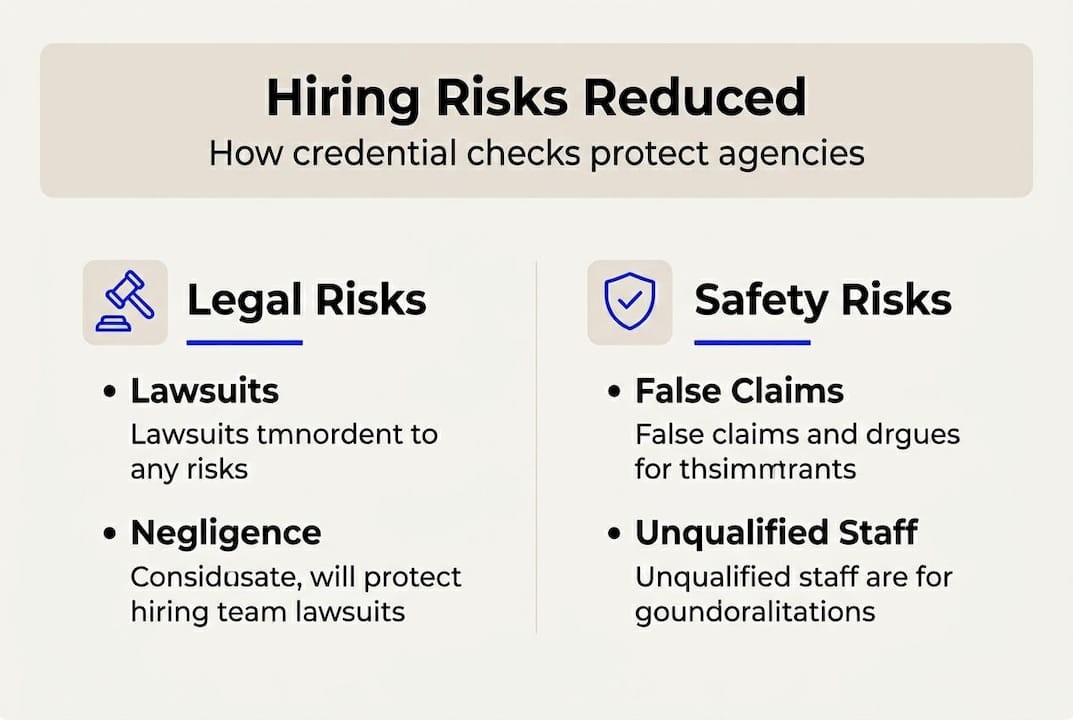
Those numbers represent more than financial loss. They signal a systemic failure that erodes public trust in the institutions communities depend on most.
Key risks agencies face when credential verification is absent or insufficient:
- Legal liability: Agencies become targets for negligent hiring lawsuits when unqualified personnel cause harm.
- Reputational damage: A single high-profile incident involving a fraudulently credentialed employee can permanently damage an agency’s standing.
- Operational failures: Unqualified personnel in EMS, dispatch, or law enforcement roles create direct threats to community safety.
- Insurance exposure: Insurers increasingly scrutinize hiring practices, and gaps in verification can affect coverage and premiums.
- Regulatory penalties: Agencies that fail to meet state or federal credentialing standards may face audits, sanctions, or loss of funding.
Consider a scenario where an EMS agency hires a paramedic who falsified their National Registry of EMTs certification. If that individual responds to a cardiac event and delivers incorrect care, the agency faces both a wrongful death lawsuit and a licensing review. The credential check that was skipped would have cost less than an hour of administrative time.
“The question is never whether verification is worth the effort. The question is whether your agency can afford the consequences of skipping it.”
Thorough public safety background checks are the first line of defense against these scenarios. They are not bureaucratic formalities. They are the mechanism by which agencies confirm that the people they trust with lives and authority are exactly who they say they are.
The financial stakes alone justify rigorous verification. But the deeper issue is the integrity of the agency itself. When pre-employment background screening is treated as optional, the agency signals that it values speed over safety. That signal has consequences that extend far beyond any single hire.
How credential verification reduces hiring risks and boosts compliance
Understanding the consequences is only half the challenge. Now let’s examine exactly how verification makes a measurable impact on agency operations and compliance.
Effective credential verification is not simply a checkbox exercise. It is a structured process that, when executed correctly, reduces negligent hiring risks by up to 40% in EMS and public safety roles, while simultaneously improving patient safety and agency compliance ratings. That figure reflects what happens when agencies move from self-reported credential review to primary source verification.

The difference between accepting a resume claim and confirming it with the issuing authority is the difference between assumption and evidence. Agencies that build evidence-based hiring processes see measurable improvements across multiple dimensions.
| Verification approach | Risk reduction | Compliance impact | Hiring speed |
|---|---|---|---|
| Self-reported only | Minimal | Low | Fast |
| Reference checks only | Low | Moderate | Moderate |
| Primary source verification | High (up to 40%) | High | Moderate |
| AI-assisted primary source | High (up to 40%) | High | Fast |
Compliance is another area where thorough verification pays dividends. Agencies operating under state licensing requirements, federal grant conditions, or accreditation standards must demonstrate that their personnel hold valid, current credentials. Gaps in this documentation create audit vulnerabilities. A well-designed verification process produces a clear, auditable record that satisfies regulators and insurers alike.
Insurance carriers are paying close attention to hiring practices in 2026. Agencies that can demonstrate consistent, documented credential verification often qualify for better liability coverage terms. Those that cannot may face higher premiums or coverage exclusions tied to personnel-related incidents.
For EMS agencies specifically, the stakes extend to patient outcomes. A verified paramedic or EMT is not just a legal protection. They are a clinical safeguard. The background checks explained framework makes clear that credential verification is inseparable from the broader goal of fielding qualified, trustworthy personnel.
Pro Tip: Build credential verification into your onboarding workflow as a mandatory gate, not an afterthought. Agencies that treat verification as a parallel process rather than a sequential one reduce time-to-hire without sacrificing rigor.
Understanding the full range of background check types available to public safety HR professionals is essential for designing a process that matches the risk profile of each role. Not every position carries the same exposure, but every position deserves a defensible verification standard.
Methods and technologies for verifying credentials effectively
Knowing the value of thorough verification, let’s break down how it is done and what has changed as new technologies emerge.
The most reliable credential verification processes combine traditional primary source checks with modern technology. Neither approach alone is sufficient. Together, they create a verification framework that is both thorough and efficient.
Primary source verification steps for public safety roles:
- Direct registry checks: Confirm certifications through authoritative bodies such as the National Registry of EMTs, state licensing boards, and professional associations.
- State license verification: Contact the issuing state agency to confirm active status, expiration dates, and any disciplinary history.
- FBI fingerprinting (Level 2): A federal-level biometric check that surfaces criminal history not always captured by state databases.
- Polygraph screening: Used selectively in law enforcement hiring to assess truthfulness about background disclosures, though it functions as a supplement rather than a replacement for documentary verification.
- AI-driven automated checks: Integrated platforms that cross-reference multiple databases simultaneously, reducing manual processing time by up to 30%.
The data on AI-assisted verification is compelling. Automated tools can accelerate the hiring cycle significantly, but they must be paired with human review and primary source confirmation to achieve the full 40% risk reduction that thorough vetting delivers. Speed without accuracy is not an improvement.
| Method | Speed | Accuracy | Compliance coverage |
|---|---|---|---|
| Manual registry check | Slow | High | Moderate |
| State license portal | Moderate | High | High |
| FBI fingerprinting | Moderate | Very high | High |
| AI-assisted platform | Fast | High (with human review) | High |
| Polygraph | Slow | Supplemental | Moderate |
FCRA compliance (the Fair Credit Reporting Act) governs how background check data is collected, used, and disclosed. Any agency using a third-party screening provider must follow FCRA protocols, including providing candidates with disclosure notices and obtaining written consent before initiating checks. Ban-the-Box laws, which restrict when criminal history questions can be asked during the application process, add another layer of regulatory complexity that agencies must navigate carefully.
AI in public safety hiring is evolving rapidly, and the agencies that integrate these tools thoughtfully are gaining a real competitive advantage in recruitment speed without compromising verification standards.
Pro Tip: Always confirm that your screening vendor maintains background check privacy standards aligned with FCRA and applicable state laws. A compliance failure at the vendor level becomes your agency’s liability.
Beyond hiring: The role of continuous credential monitoring
While technology and process can streamline initial checks, safety does not end after hire. Ongoing vigilance is essential.
The assumption that a single pre-employment credential check is sufficient is one of the most persistent and costly misconceptions in public safety HR. Credentials expire. Licenses get suspended. Personnel develop issues after hire that would have disqualified them from the role had they emerged earlier. A one-time check captures a snapshot. Continuous monitoring captures the full picture.
Continuous vetting post-hire catches approximately 70% of risks that emerge after the initial background check. That is not a marginal improvement. It represents the majority of the risk exposure that agencies carry when they rely on hire-date verification alone.
What continuous credential monitoring should include:
- License renewal tracking: Automated alerts when certifications approach expiration or are flagged for review.
- Criminal record monitoring: Ongoing checks that surface new arrests, charges, or convictions after hire.
- Decertification index checks: Regular queries against state and national decertification registries to catch officers or personnel who have been removed from eligibility in other jurisdictions.
- Social media and public record monitoring: Identifying conduct that may violate agency policy or create reputational risk.
- Disciplinary database updates: Monitoring for actions taken by licensing boards or professional associations.
“Agencies that monitor continuously are not demonstrating distrust of their personnel. They are demonstrating a commitment to the standards that earned public trust in the first place.”
Integrating continuous monitoring into agency policy requires clear protocols. Personnel should be informed at hire that ongoing monitoring is a condition of employment, and the process should be documented in writing. This transparency protects the agency legally and sets clear expectations for staff.
The privacy dimension of continuous monitoring is real and must be managed carefully. Agencies should work with legal counsel to ensure that monitoring practices comply with applicable state laws governing employee privacy. The employee monitoring guide provides a structured framework for building a compliant, defensible monitoring program.
For agencies that want to align their practices with current standards, reviewing monitoring best practices is a practical starting point for building or refining an ongoing vetting program.
Credential verification versus skills-based hiring: What still matters in 2026?
With ongoing monitoring in place, consider this: do skills-only approaches really suffice, or is credential vetting still critical today?
The skills-based hiring movement has gained significant traction across industries, and for good reason. Focusing on demonstrated competencies rather than degree requirements has opened doors for qualified candidates who lack traditional academic credentials. But in public safety roles, this trend requires careful calibration.
The core tension is this: skills can be demonstrated in an interview or assessment. Credentials are verified against an authoritative source. For roles where an unqualified hire can result in loss of life, the difference matters enormously.
Research from the Burning Glass Institute highlights a critical data point: only 12% of non-degree credentials deliver measurable wage gains for holders, suggesting that the credential landscape is uneven in quality and relevance. For public safety agencies, this means that not all certifications carry equal weight, and the value of a credential is directly tied to the rigor of the issuing body and the verification process applied.
Risks of accepting unverified skills or credentials in public safety hiring:
- Candidates may present credentials from unaccredited or low-rigor programs that do not reflect actual competency.
- Skills assessments alone cannot surface criminal history, license suspensions, or prior disciplinary actions.
- Agencies may inadvertently hire personnel who were decertified in another jurisdiction but present alternative credentials as substitutes.
- Insurance and accreditation bodies may reject claims or certifications tied to hires whose credentials were not verified through primary sources.
The practical answer for 2026 is not to choose between skills-based hiring and credential verification. It is to use both. Skills assessments identify capable candidates. Credential verification confirms that those candidates meet the legal, ethical, and professional standards required for the role.
Pro Tip: When evaluating credentials from newer or less familiar issuing bodies, check whether the organization is recognized by a national accreditation body. Credentials from unaccredited sources carry significantly higher verification risk.
Reviewing screening best practices for HR professionals in public safety provides a structured approach to integrating credential verification into a modern, skills-aware hiring process without sacrificing the rigor that these roles demand.
Our take: What leaders often miss about credential verification
Most public safety leaders understand that credential verification matters. Fewer recognize how often their current process falls short of what it needs to be.
The most common gap we see is over-reliance on self-reported information. A candidate who lists a certification on their resume has provided an assertion, not evidence. Reference checks add context, but they do not confirm the validity of a credential. Only primary source verification, meaning direct confirmation from the issuing authority, closes that gap with certainty.
The second gap is treating verification as a one-time event. As discussed, the majority of post-hire risks emerge after the initial check. Agencies that do not build continuous monitoring into their HR policy are carrying risk they cannot see.
The third and most overlooked gap is cultural. Credential verification is most effective when it is embedded in agency culture as a standard of professional integrity, not treated as an administrative burden. Leaders who communicate clearly that verification protects both the agency and the personnel it employs create an environment where thoroughness is valued.
The investigation principles for hiring that guide law enforcement background work apply equally to credential verification: follow the evidence, confirm the source, and document everything. Agencies that operate by these principles build hiring processes that are not just compliant but genuinely protective.
The agencies that get this right do not just avoid lawsuits. They build teams that communities trust.
Next steps: Reliable credential verification for safer hiring
Credential verification is not a process you can afford to treat as optional. The financial exposure, the legal liability, and the operational risk of a single unverified hire in a public safety role are too significant to ignore.

OMNI Intel is built specifically for agencies like yours. Our pre-employment screening services combine primary source verification, AI-assisted efficiency, and FCRA-compliant workflows into a single platform designed for the demands of public safety hiring. From law enforcement to EMS to dispatch, our public safety background checks give your agency the evidence-based foundation it needs to hire with confidence and maintain compliance post-hire. Contact our team today to build a verification process that protects your agency, your personnel, and the communities you serve.
Frequently asked questions
What is considered a primary source for credential verification?
A primary source is the original issuing body of a credential, such as a licensing board or national registry, used to confirm authenticity directly. For EMS roles, this includes the National Registry of EMTs and state licensing agencies.
How does credential verification help prevent negligent hiring lawsuits?
Verifying credentials reduces the risk of hiring unqualified employees, protecting agencies from costly lawsuits and multimillion-dollar verdicts when incidents occur. Courts hold agencies responsible when reasonable verification steps were available but not taken.
Are AI tools alone enough for credential vetting in public safety?
AI accelerates checks and reduces processing time, but primary source and traditional vetting must be integrated for full compliance and risk mitigation. AI-driven tools work best as part of a layered verification process, not as a standalone solution.
How often should agencies re-verify credentials after hire?
Credential monitoring should be ongoing, as 70% of emerging risks are detected after the initial check. Annual re-verification at minimum, combined with automated alerts for license changes, is the recommended standard for public safety agencies.