

Essential compliance checklist for agencies: step-by-step hiring guide
TL;DR:
- Comprehensive, sequenced checklists ensure consistent, compliant hiring processes for public safety agencies.
- Sector-specific standards like CALEA, NFPA 1582, and licensing govern tailored requirements for law enforcement, fire/EMS, and private security.
- Ongoing monitoring, documentation, and structured procedures are vital for sustained legal and accreditation compliance.
A single missed step in your agency’s hiring process can trigger an audit failure, expose your organization to legal liability, and erode public trust in ways that take years to rebuild. Core hiring compliance checklist items for public safety agencies include comprehensive background investigations, psychological evaluations, medical exams, fingerprint-based criminal checks, drug testing, and social media screening. Whether you lead a law enforcement agency, a fire department, an EMS unit, or a private security firm, the question is rarely whether these requirements exist. The real risk is whether your process is disciplined enough to catch every one of them, every time. This guide delivers a practical, sequenced checklist built specifically for compliance officers and agency administrators who need a process that holds up under scrutiny.
Table of Contents
- Understanding core compliance requirements
- Sequencing the hiring process: Step-by-step checklist
- Key differences: Law enforcement, fire/EMS, and private security
- Compliance pitfalls to avoid and best practices
- Maintaining compliance: Ongoing monitoring and reviews
- A practical perspective: Why compliance checklists succeed where guidelines fail
- Level up your agency’s compliance with trusted support
- Frequently asked questions
Key Takeaways
| Point | Details |
|---|---|
| Multilayered compliance is essential | Agencies must cover backgrounds, psych, medical, licensing, and records for true hiring compliance. |
| Checklists prevent costly mistakes | A step-by-step checklist ensures every critical compliance requirement is verifiably met. |
| Standards vary by sector | Law enforcement, fire/EMS, and private security each have unique compliance mandates to address. |
| Ongoing monitoring matters | Sustained compliance requires regular audits, record reviews, and annual updates to checklists. |
Understanding core compliance requirements
With the stakes established, it is essential to know exactly what universal and sector-specific requirements your agency faces before a single application is reviewed. Compliance in public safety hiring is not a single document or a one-time review. It is a layered framework of federal mandates, state statutes, accreditation standards, and role-specific certification requirements that intersect in ways that catch underprepared agencies off guard.
At the federal and cross-sector level, multi-layered checks are essential, covering criminal history, employment and education verification, professional references, certifications, and driving records. None of these elements are optional for agencies operating under public trust. Skipping or abbreviating any one of them introduces a gap that auditors, plaintiff attorneys, and oversight bodies will find.
CALEA standards (the Commission on Accreditation for Law Enforcement Agencies) mandate structured recruitment and selection, thorough background investigations, and medical exams as foundational requirements for accredited agencies. CALEA accreditation is the benchmark for professional law enforcement, and its standards are increasingly referenced in litigation as the expected standard of care across the sector.
For ensuring hiring compliance in fire and EMS, the NFPA 1582 standard (Standard on Comprehensive Occupational Medical Program for Fire Departments) governs medical fitness for duty. This standard specifies mandatory medical conditions that may disqualify candidates and outlines what annual medical evaluations must include. Ignoring NFPA 1582 exposes fire and EMS agencies to serious workers’ compensation and negligent hiring claims.
Core compliance requirements across all public safety sectors include:
- Criminal history and fingerprint checks: Local, state, and FBI-level checks are required. Federal fingerprint submissions through the FBI’s Next Generation Identification system are standard practice.
- Employment and education verification: Confirming all claimed credentials, degrees, and job history prevents resume fraud, which is more common than most agencies expect.
- Psychological screening: A structured psychological evaluation by a licensed examiner is mandatory for law enforcement and strongly recommended across fire, EMS, and dispatch roles.
- Medical examinations: Role-specific fitness standards apply, with NFPA 1582 governing fire and EMS and state-specific standards applying to law enforcement.
- Drug testing: Pre-employment drug screens are universal; some agencies extend this to panel testing that includes prescription drug misuse.
- Social media and open-source review: Increasingly referenced in agency audit checklists as a required element of the background investigation.
- Citizenship, education, and discharge verification: Proof of legal right to work, educational credentials, and honorable discharge status where applicable.
“A compliance framework is only as strong as its most overlooked requirement.” Agencies that treat background investigations as checkbox exercises rather than investigative processes face the greatest audit exposure.
Pro Tip: Understanding background check laws at the state level is just as critical as federal mandates. Several states have added ban-the-box restrictions and individualized assessment requirements that directly affect how and when criminal history may be reviewed in the hiring process.
Sequencing the hiring process: Step-by-step checklist
Now that you understand the components, breaking compliance down into a practical, sequenced checklist makes the entire process defensible and repeatable. A multi-layered, sequential process anchored by standardization mitigates bias and reduces the margin for human error at every stage.
Here is the sequenced hiring compliance checklist for public safety agencies:
- Application and job posting review: Confirm that job descriptions reflect current legal requirements and that disqualifying criteria are explicitly documented before posting.
- Resume and license verification: Check claimed certifications, licenses, and employment history against primary sources before advancing any candidate.
- Initial screening and minimum qualifications review: Apply consistent pass/fail criteria tied directly to the role’s legal requirements. Document every decision.
- Fingerprint-based criminal history check: Submit to local, state, and FBI systems. Do not advance candidates until results are returned and reviewed under your written adjudication policy.
- Comprehensive background investigation: Assign to a trained investigator. Cover employment history, education, driving record, financial history, and references using standardized forms.
- Reference checks: Contact all professional references and, where permitted, past supervisors not listed by the candidate.
- Social media and open-source screening: Conduct under a documented policy that limits reviewers’ exposure to protected class information.
- Psychological evaluation: Administer after a conditional offer is extended, using a licensed examiner with public safety-specific experience.
- Medical examination: Conduct post-conditional offer, role-specific, and NFPA 1582-compliant for fire and EMS roles.
- Drug screening: Administer at the conditional offer stage; confirm your panel includes substances specified in your agency policy.
- Conditional offer and final adjudication: Document all findings, apply written standards, and retain all records per your state’s retention schedule.
- Onboarding and credential confirmation: Verify all certifications are current and confirm compliance training is scheduled before the first day of service.
Pro Tip: Use this step-by-step hiring process as the backbone for a written standard operating procedure. A documented process that all hiring staff follow identically is your first and strongest defense in any audit or legal challenge.
| Hiring stage | Key compliance requirement | Common failure point |
|---|---|---|
| Application review | Legal disqualifiers documented | Vague or missing criteria |
| Background investigation | FBI fingerprint + full history | Incomplete or delayed results |
| Psychological evaluation | Post-offer, licensed examiner | Pre-offer timing errors |
| Medical examination | Role-specific, NFPA 1582 for fire/EMS | Generic medical forms used |
| Drug screening | Panel aligned to agency policy | Outdated substance panels |
Review this hiring compliance guide for detailed adjudication frameworks that map each stage to your documentation obligations.
Key differences: Law enforcement, fire/EMS, and private security
Of course, requirements are not identical for every agency type. The checklist adjusts meaningfully by sector, and administrators who apply a one-size-fits-all approach routinely discover gaps during accreditation reviews or incident investigations.
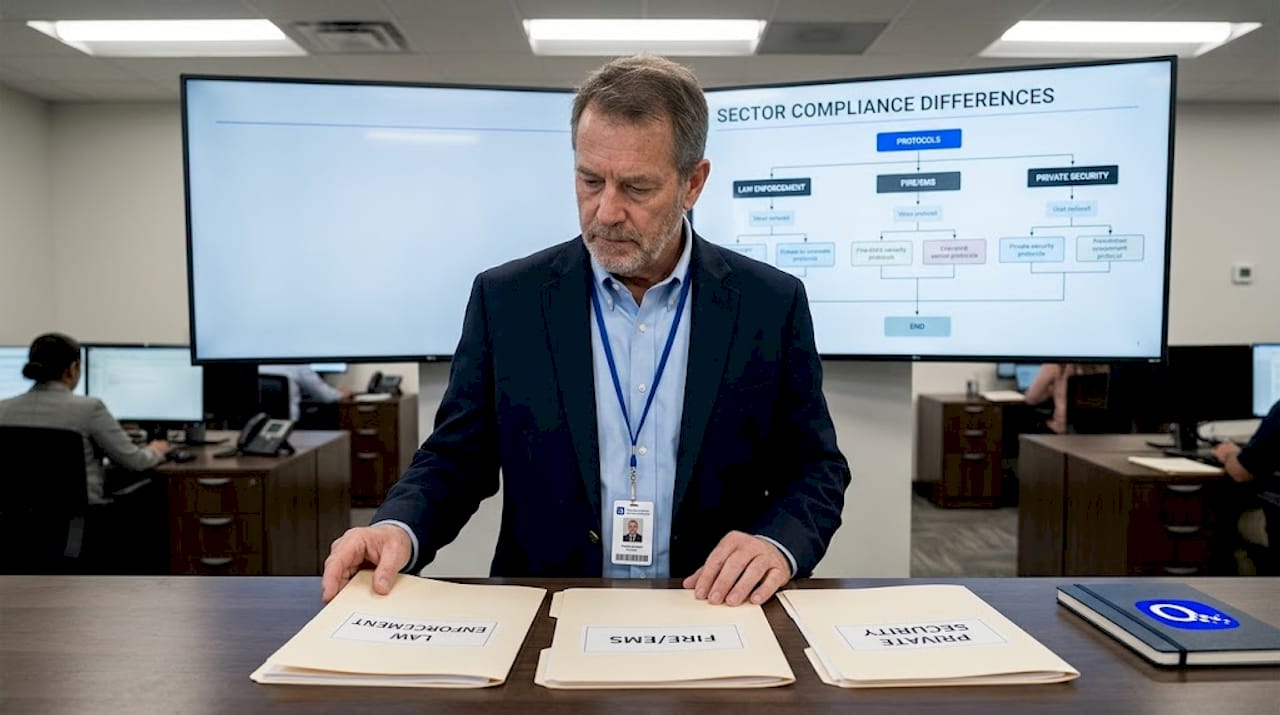
Law enforcement operates under the most intensive compliance framework. CALEA accreditation standards, state POST (Peace Officer Standards and Training) requirements, and federal mandates converge to require detailed background investigations, structured psychological evaluations, medical fitness exams, and rigorous recordkeeping. Law enforcement agencies must also track and retain documentation related to any use-of-force training completed prior to hire, prior discipline records from previous agencies, and decertification status through applicable state indices.
Fire and EMS compliance centers heavily on medical and physical fitness standards. NFPA 1582 covers EMS and fire medical fitness requirements and specifies disqualifying medical conditions with precision. National Registry of Emergency Medical Technicians (NREMT) certification must be verified at the point of hire and is subject to recertification requirements that must be tracked post-hire. Behavioral health screening is also increasingly required given the documented mental health burden on fire and EMS personnel.
Private security operates under a distinct framework. State licensing requirements for private security include separate company registration, periodic employee training mandates, and additional rules governing armed officers that vary significantly by jurisdiction. The distinction between company-level records and individual employee records is a frequent source of audit failures for security firms.
Common threads across all three sectors:
- Background checks including criminal history and employment verification
- Drug testing at the pre-employment stage
- Reference checking using standardized forms
- Documentation of all adjudication decisions with written rationale
| Requirement | Law enforcement | Fire/EMS | Private security |
|---|---|---|---|
| Background investigation | Mandatory, detailed | Mandatory | Required, scope varies |
| Medical exam standard | State POST | NFPA 1582 | Not universally mandated |
| Psychological evaluation | Mandatory | Recommended | Rarely required |
| Certification verification | POST, CALEA | NREMT, CFPS | State guard license |
| Firearms rules | Governed by POST | N/A (typically) | State-specific, armed license |
Use comprehensive screening for safer hiring resources to adapt your checklist to the specific accreditation and licensing framework governing your agency type. Reviewing hiring process best practices by sector will help you identify gaps your current process may not address.
Compliance pitfalls to avoid and best practices
With both requirements and sector differences in hand, it is equally vital to recognize the traps that cause most agency compliance failures. These are not exotic legal scenarios. They are predictable, recurring mistakes that show up repeatedly in audits, court records, and accreditation reviews.
The most common compliance pitfalls include:
- Unstandardized background review processes: When different investigators apply different criteria, the process becomes indefensible. Every reviewer must follow the same written adjudication matrix.
- Poor record retention: Many states require hiring records to be retained for five to seven years or longer. Agencies that purge records early, or that fail to maintain organized documentation, face serious exposure during litigation and audits.
- Ignoring state and local law variations: FCRA compliance (the Fair Credit Reporting Act, which governs how background check information may be used) is a federal floor, not a ceiling. Several states layer additional protections that agencies must follow independently.
- Failure to track diversity and equity metrics: Standardizing pass/fail points, documenting variance, tracking equity metrics, and adhering to FCRA are essential for risk reduction and for demonstrating procedural fairness in the face of a disparate impact claim.
- Skipping social media screening documentation: Conducting a social media review without a documented policy creates as much risk as not conducting one at all.
“Agencies that fail audits rarely fail because they were unaware of a requirement. They fail because their process was not structured to catch every step, every time.”
Best practices that counteract these pitfalls, drawn from background check best practices across high-performing agencies:
- Update your compliance checklist at least once annually, and immediately whenever a governing law or standard changes.
- Conduct internal audit simulations at least once per year using a third-party reviewer or a designated internal compliance officer.
- Document every exception to standard procedure in writing, including the rationale and the approving authority.
- Build FCRA compliance best practices into every step that touches consumer report data, including clear pre-adverse and adverse action notice procedures.
Pro Tip: Establish a formal feedback loop between your compliance officer and your HR team. When a hire later creates a problem, tracing the decision back through the checklist reveals exactly where the process broke down and gives you the evidence to fix it systematically. Review public safety compliance tips for additional audit-readiness guidance.
Maintaining compliance: Ongoing monitoring and reviews
Real compliance is not a pre-employment event. It is a sustained culture of oversight that continues after the badge, the credential, or the security license is issued. Agencies that treat compliance as a one-time hiring exercise are the same agencies that face liability when a post-hire incident reveals something that a monitoring protocol would have caught.
Annual demographic data, passage rates by hiring stage, and unified recruitment tracking are recognized best practices for ongoing compliance in high-performing agencies. Collecting and analyzing this data accomplishes two things simultaneously: it identifies process inefficiencies, and it creates an evidence record that demonstrates procedural fairness to oversight bodies.
Ongoing compliance monitoring should include:
- Annual checklist review: Every item on the hiring checklist should be reviewed against current law, current accreditation standards, and any reported incidents or near-misses from the prior year.
- Post-hire credential monitoring: Certifications expire. Licenses lapse. An agency that issued a conditional offer based on a valid NREMT certification must track renewal dates and take action when credentials are not maintained.
- Continuous activity monitoring: For law enforcement in particular, monitoring for new criminal activity, civil judgments, or professional discipline after hire is a recognized risk-reduction practice.
- Demographic tracking and equity review: Reviewing pass/fail rates by demographic group at each stage of the hiring process is increasingly expected by oversight bodies and is foundational to defending a process against disparate impact challenges.
- Record retention schedule enforcement: Assign ownership for record retention compliance. Someone must be accountable for ensuring records are retained for the correct period and that expired records are disposed of securely.
| Review type | Recommended frequency | Responsible party |
|---|---|---|
| Hiring checklist update | Annually or upon law change | Compliance officer |
| Post-hire credential audit | Quarterly | HR/records unit |
| Demographic data review | Annually | HR director |
| Record retention audit | Annually | Legal/compliance |
| Internal process simulation | Annually | Compliance officer |
Pro Tip: Use automated reminders built into your records management or employee monitoring best practices platforms to flag expiring certifications, approaching retention deadlines, and scheduled review dates. Automation removes the human memory dependency that causes most retention failures. Review the employee monitoring essentials checklist to build a post-hire oversight protocol with the same rigor as your pre-employment process.
A practical perspective: Why compliance checklists succeed where guidelines fail
Having established how ongoing monitoring sustains compliance, it is worth examining why checklists remain the practical tool that makes standards real rather than aspirational. Most agencies have access to the same guidelines, the same accreditation standards, and the same legal frameworks. The agencies that fail audits and the agencies that pass them are frequently working from the same rulebook. The difference is almost always the checklist.
Guidelines describe what is required. A checklist forces who does it, when it happens, and how the outcome is documented. That shift from description to execution is where compliance either holds or collapses. When an investigator skips a reference check because a candidate seemed promising, it is rarely because the investigator did not know the requirement. It is because there was no sequenced, documented step requiring a supervisor’s sign-off before the process could advance.
The failures we see repeatedly in agency audits are not failures of knowledge. They are failures of structure. An agency that experienced a negligent hiring claim after overlooking a prior termination for cause in a reference check did not lack a policy requiring reference checks. It lacked a checklist that made advancing to the next stage impossible without documenting the outcome of every reference contact.
Following detailed hiring steps in a sequenced, documented format also creates a bias-resistant process. When every candidate moves through identical stages with identical documentation requirements, the process becomes both more equitable and more defensible. That is not a coincidence. It is the design.
Level up your agency’s compliance with trusted support
Building and maintaining a rigorous hiring compliance process requires more than a well-designed checklist. It requires the right tools, the right data, and a screening partner who understands the specific demands of public safety hiring.

OMNI Intel’s pre-employment screening services are built specifically for law enforcement, fire, EMS, dispatch, and private security agencies. Our platform integrates background investigations conducted under law enforcement-grade investigative standards with continuous post-hire monitoring, so your compliance does not stop at the offer letter. Whether you need to close gaps in your current process or build a new framework from the ground up, our background checks for public safety solutions deliver accuracy, speed, and full FCRA compliance. Contact OMNI Intel to see how purpose-built screening technology can reduce your compliance risk and strengthen your agency’s integrity from the first application to the last day of service.
Frequently asked questions
What are the must-have items for an agency hiring compliance checklist?
Every agency hiring checklist should include background investigations, psychological evaluations, medical exams, verification of credentials, drug testing, and fingerprint checks. A complete agency audit checklist also requires proof of citizenship, education verification, military discharge status where applicable, and social media screening.
How do hiring compliance requirements differ for law enforcement, fire/EMS, and private security?
Law enforcement and fire/EMS have mandatory medical, psychological, and background standards, while private security requires state licensing and firearms-specific checks. NFPA 1582 governs fire/EMS medical fitness, state guard licensing governs private security, and CALEA sets the accreditation standard for law enforcement.
What common compliance mistakes should agencies avoid?
Typical mistakes include unstandardized processes, skipping key checks, poor record retention, and failing to adhere to local law variations. Nonstandard reviews and incomplete records are the leading causes of compliance failures identified in agency audits.
How often should agency hiring checklists and compliance processes be updated?
Agencies should review and update checklists at least annually, or whenever governing laws and standards change. Annual or law-driven updates are recognized as critical for sustained compliance in high-performing public safety agencies.