

What Is Tailored Screening? A Guide for Public Safety Hiring
TL;DR:
- Tailored screening aligns background checks with specific role risks and regulatory requirements.
- It includes customized checks like criminal, credit, decertification, and polygraph evaluations based on role.
- Implementing role-specific, ongoing post-hire monitoring enhances workforce integrity and legal defensibility.
Many public safety agencies operate under the assumption that a single, standardized background check is sufficient to protect their communities and their organizations. That assumption carries real risk. A uniform screening process applied to every candidate, regardless of role, can miss critical red flags for high-stakes positions while simultaneously over-screening applicants for lower-risk roles, wasting time and resources in a hiring environment where speed matters. Tailored screening offers a smarter, more defensible alternative. This article defines what tailored screening means in the public safety context, breaks down its core components, addresses the legal and compliance landscape, and gives you a practical framework for building or refining your own process.
Table of Contents
- Defining tailored screening in public safety hiring
- Key components of tailored screening: What makes it unique?
- Nuances, legalities, and best practices for implementation
- Comparing tailored and uniform screening: Which approach wins?
- Practical application: Building or improving your own tailored screening process
- A fresh perspective: What most public safety agencies miss about tailored screening
- Ensuring safe hires with tailored screening solutions
- Frequently asked questions
Key Takeaways
| Point | Details |
|---|---|
| Role-specific screening | Tailored screening matches checks to precise job risks, avoiding unnecessary or insufficient vetting. |
| Legal and ethical compliance | Staying compliant with FCRA, GDPR, and public safety standards is non-negotiable in customized screening. |
| Continuous monitoring | Ongoing post-hire screening is as vital as pre-employment checks for safeguarding agency integrity. |
| Efficiency and accuracy balance | Combining human expertise with technology prevents both over-screening and missed risks. |
Defining tailored screening in public safety hiring
Standard background checks were designed for general employment. They typically verify identity, pull a criminal history, and confirm prior employment. For a retail associate or an office administrator, that level of scrutiny may be entirely appropriate. For a patrol officer, a firefighter, or a 911 dispatcher, it is demonstrably insufficient.
Tailored screening is the practice of aligning the specific background checks conducted for a candidate with the actual risk profile and regulatory requirements of the role being filled. It is not simply adding more checks. It is selecting the right checks, in the right sequence, calibrated to the responsibilities and vulnerabilities of a specific position.
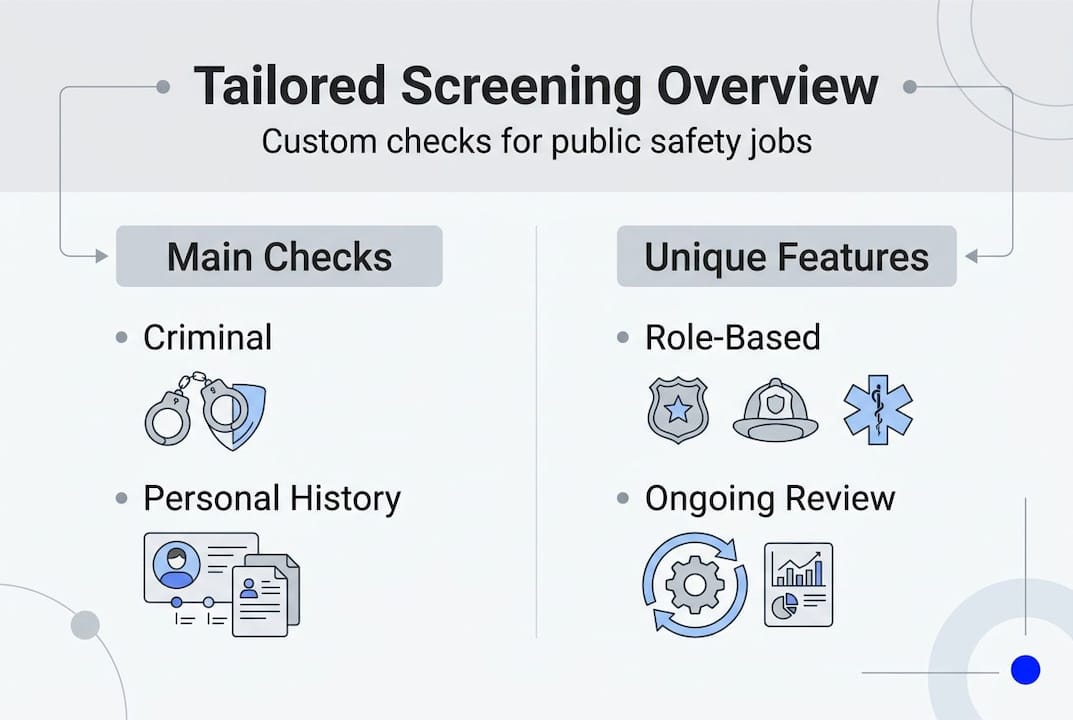
For public safety agencies, tailored screening solutions include comprehensive personal history reviews, criminal and credit checks, reference interviews, polygraph examinations where permitted by law, decertification index checks, and full compliance with POST (Peace Officer Standards and Training) and CJIS (Criminal Justice Information Services) standards to ensure integrity and mitigate risks like safety threats or misconduct.
The contrast with a one-size-fits-all approach is significant. Consider the table below:
| Feature | Tailored screening | Uniform screening |
|---|---|---|
| Risk alignment | Matched to role | Same for all roles |
| Compliance | POST, CJIS, FCRA-specific | Generic FCRA baseline |
| Components | Customized per position | Fixed checklist |
| Efficiency | Optimized resource use | Potential over/under-screening |
| Bias risk | Managed through structured criteria | Higher if criteria are vague |
| Candidate experience | Transparent and role-relevant | Can feel arbitrary |
The components most commonly tailored in public safety hiring include:
- Personal history questionnaires calibrated to role-specific integrity standards
- Criminal background checks at federal, state, and county levels
- Credit history reviews for roles involving financial access or sensitive data
- Reference and character interviews conducted by trained investigators
- Polygraph examinations where state law permits and agency policy requires
- Decertification checks against national and state law enforcement registries
- POST and CJIS compliance verification for sworn and regulated positions
- Social media and open-source intelligence reviews for behavioral pattern analysis
As one background investigations specialist put it: “The moment you apply the same screening template to a dispatcher and a SWAT team member, you’ve already accepted a level of risk that no agency should be comfortable with. Role risk must drive check selection, not administrative convenience.”
Understanding what background checks explained for public safety roles actually covers is the first step toward building a process that holds up under scrutiny, both legally and operationally.
Key components of tailored screening: What makes it unique?
Having defined tailored screening, let’s walk through the precise components that can be customized and why these matter most.
Tailored screening optimizes hiring by aligning checks with role risks, which is essential for public safety agencies seeking to verify integrity through criminal checks, polygraph examinations, and other tools while mitigating liabilities tied to misconduct or negligent hiring.
Not every role demands the same level of scrutiny. The table below illustrates how screening requirements shift across common public safety positions:
| Check type | Law enforcement | Fire/EMS | Dispatch | Private security |
|---|---|---|---|---|
| Criminal history | Required | Required | Required | Required |
| Credit check | Yes (financial access) | Situational | Situational | Yes |
| Polygraph | Yes (where legal) | Situational | Situational | Rare |
| Decertification check | Required | N/A | N/A | Situational |
| POST compliance | Required | N/A | N/A | N/A |
| CJIS compliance | Required | N/A | Required | N/A |
| Reference interviews | Required | Required | Required | Required |
| Social media review | Recommended | Recommended | Recommended | Recommended |
The steps in a well-structured tailored background process follow a logical sequence:
- Position analysis: Define the role’s responsibilities, access levels, and risk exposure before selecting any checks.
- Check selection: Choose only the screening components that are legally permissible and directly relevant to identified risks.
- Compliance vetting: Confirm that the selected checks align with FCRA, applicable state laws, POST requirements, and CJIS standards.
- Execution: Conduct checks using trained investigators and validated data sources, not automated-only systems.
- Adjudication and review: Evaluate results against documented, role-specific criteria to ensure consistent and defensible decisions.
- Candidate notification: Provide required disclosures and adverse action notices in accordance with FCRA timelines.
Polygraph examinations, when permitted under polygraph screening standards, add a layer of validity that document-based checks cannot replicate, particularly for detecting deception around drug use, prior misconduct, or undisclosed associations. Fingerprinting through FBI-linked databases provides a definitive identity anchor that self-reported information cannot guarantee. Decertification checks, often overlooked, are critical for law enforcement roles because a candidate may have resigned under investigation in another state without a criminal conviction on record.
Pro Tip: When tailoring background checks for agencies, document your legal basis for each check type in writing before you begin. This creates a defensible record under FCRA and helps you demonstrate that your process is job-related and consistent, two of the most important legal standards for avoiding discrimination claims.
For a deeper look at the full range of types of background checks applicable to public safety hiring, reviewing role-specific frameworks is a practical starting point.
Nuances, legalities, and best practices for implementation
Understanding the mechanics is only half the battle. Implementation brings its own set of challenges, especially around compliance and efficiency.
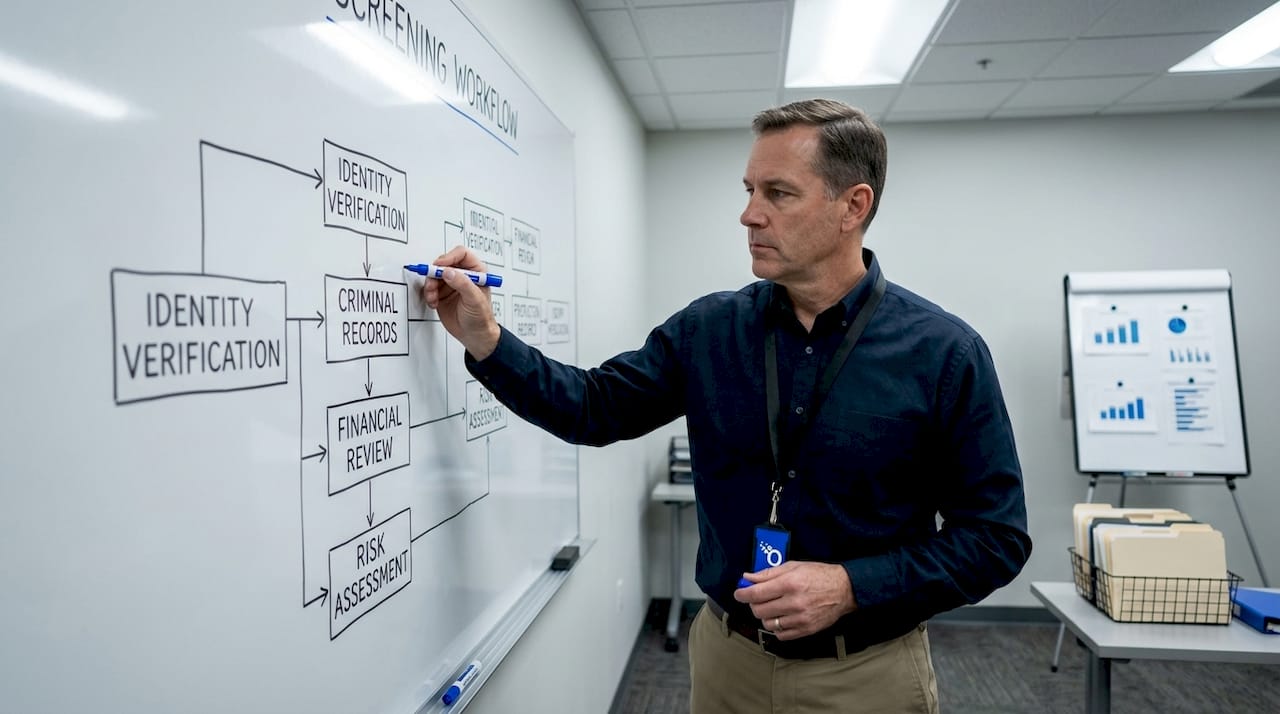
The legal framework governing background screening in public safety is layered. The Fair Credit Reporting Act (FCRA) sets baseline federal requirements for how consumer reports, including background checks, are obtained, used, and disclosed. GDPR applies when agencies interact with candidates who are EU residents, though this is less common in domestic public safety hiring. POST standards govern sworn law enforcement positions in most states, dictating minimum screening requirements. CJIS standards apply to anyone with access to criminal justice information systems, including many dispatch and administrative roles.
The guidance is clear: prioritize FCRA and GDPR compliance, role-specific customization for public safety positions, and post-hire monitoring to sustain long-term integrity across your workforce.
Common pitfalls in implementation include:
- Failing to obtain proper authorization before initiating any consumer report
- Using blanket disqualifiers that do not account for the nature, recency, or relevance of an offense
- Skipping adverse action procedures, which exposes agencies to significant legal liability
- Relying solely on automated database results without human investigator review
- Neglecting to update screening criteria as roles evolve or regulations change
- Over-screening low-risk positions, which slows hiring and discourages qualified candidates
Transparency with candidates is not just a legal requirement under FCRA compliance for HR standards. It is also a practical tool for building trust and reducing attrition during the hiring process. Candidates who understand why specific checks are required for their role are more likely to cooperate fully and remain engaged.
Balancing thoroughness with efficiency requires a deliberate approach. One-size-fits-all screening wastes resources and can miss role-specific risks, while regulated roles in public safety require stricter checks, including fingerprints and polygraph, that generic platforms cannot adequately support. Screening transparency throughout the process reduces candidate dropout and strengthens your agency’s reputation as a fair employer.
Pro Tip: The most accurate and defensible screening programs combine human investigator expertise with technology-driven data aggregation. Automated systems are fast but miss context. Investigators catch nuance. Use both, and document the human review step for every candidate who reaches final consideration. Post-hire screening should be built into your program design from the start, not added as an afterthought.
Comparing tailored and uniform screening: Which approach wins?
To solidify understanding, let’s pit tailored and uniform screening against each other and clarify when each approach makes sense.
| Dimension | Tailored screening | Uniform screening |
|---|---|---|
| Effectiveness | High, role-specific risk coverage | Moderate, generic coverage |
| Efficiency | Optimized per position | Can waste resources |
| Risk coverage | Targeted and complete | May miss role-specific risks |
| Legal compliance | Customized to role and regulation | Consistent but may be insufficient |
| Bias management | Structured criteria reduce bias | Vague criteria increase bias risk |
| Scalability | Requires expertise to maintain | Easier to administer at scale |
The debate between tailored and uniform screening is real in public safety circles. Contrasting views acknowledge that uniform screening ensures consistency and baseline compliance but is inefficient and imprecise, while tailored, risk-based screening is more accurate but requires expertise to avoid bias or under-screening. Polygraph adds validity to high-stakes vetting but remains legally controversial in some jurisdictions.
A statistic worth noting: research consistently shows that agencies using role-differentiated screening report fewer post-hire integrity incidents than those applying uniform processes, though the precise percentage varies by agency size and sector. The directional evidence strongly favors customization for regulated, high-trust roles.
“Precision in screening is not about doing more. It is about doing what is right for the role. A dispatcher who handles sensitive CJIS data carries different risks than a civilian records clerk, and your screening process must reflect that distinction clearly and defensibly.”
Uniform screening still has a place. For very low-risk, non-regulated positions within a public safety agency, such as administrative support roles without system access, a streamlined uniform process may be appropriate and legally sufficient. The key is making that determination deliberately, not by default. Reviewing your hiring compliance guide for specific role categories helps agencies draw those lines with confidence.
Practical application: Building or improving your own tailored screening process
Armed with a clear sense of the options and challenges, here is how you can implement tailored screening at your agency.
Building a tailored screening program from the ground up, or improving an existing one, requires structured thinking and cross-functional collaboration. The steps below provide a practical framework:
- Conduct a role risk audit: Map every position in your agency to its risk level, regulatory requirements, and access privileges. This becomes the foundation for all screening decisions.
- Define position-specific screening matrices: For each risk tier, document which checks are required, which are conditional, and which are not applicable. Tie every decision to a documented legal or operational rationale.
- Select compliant vendors and tools: Choose screening partners who understand public safety requirements, including POST, CJIS, and FCRA, and who can support investigator-led review processes.
- Train your HR and hiring teams: Ensure everyone involved in the hiring process understands the legal requirements, the adjudication criteria, and the adverse action process.
- Pilot and refine: Run your tailored process on a small cohort before full deployment. Identify gaps, compliance risks, and efficiency bottlenecks before scaling.
- Implement continuous post-hire monitoring: Continuous monitoring post-hire is essential to sustain integrity, because people and circumstances change after the hire date.
- Schedule periodic program reviews: Regulations change. Roles evolve. Your screening program must be reviewed at least annually to remain current and defensible.
The post-hire monitoring guide provides detailed guidance on structuring ongoing monitoring that integrates with your existing HR workflows without creating administrative burden. Tools like OMNIView post-hire monitoring are designed specifically for public safety agencies that need continuous visibility without manual overhead.
Pro Tip: Involve legal counsel, IT security, and field leadership in the design phase, not just HR. Legal ensures compliance. IT identifies data handling requirements. Field leaders know the real-world risks of each role. That combined perspective produces a screening program that earns buy-in across the organization and holds up under external scrutiny.
A fresh perspective: What most public safety agencies miss about tailored screening
Most conversations about tailored screening stop at the pre-hire stage. That is the first and most significant gap we see in agencies that believe they have solved their screening problem.
Pre-hire checks are essential. But a candidate who passes every screen on day one is not a static risk profile. People develop financial pressures, substance dependencies, and associations that did not exist at the time of hire. Agencies that treat background screening as a one-time event are managing yesterday’s risk, not today’s.
The second gap is subtler. Many agencies customize their checks on paper but fail to customize their adjudication criteria. They run a polygraph for law enforcement candidates but apply the same pass/fail threshold regardless of role. They pull credit reports but have no documented standard for what constitutes a disqualifying pattern. That inconsistency creates legal exposure and, more importantly, allows bias to fill the space where clear criteria should be.
Real risk management in public safety hiring requires why post-hire monitoring matters to be understood not as a compliance checkbox but as a cultural commitment. It requires leadership at every level to treat screening outcomes as living data, not archived decisions.
What HR teams can do right now: audit your adjudication criteria for every role tier, build a post-hire monitoring protocol into your next budget cycle, and bring your field commanders into the conversation about what integrity actually looks like in their units. The agencies that get this right are not the ones with the most sophisticated technology. They are the ones where screening is treated as an organizational value, not an administrative task.
Ensuring safe hires with tailored screening solutions
If you are ready to move from theory to action, partnering with specialists who understand the specific demands of public safety hiring makes a measurable difference in both outcomes and efficiency.

OMNI Intel provides proven, FCRA-compliant pre-employment screening services designed specifically for law enforcement, fire and EMS, dispatch centers, and related agencies. Our investigator-driven approach combines advanced data tools with human expertise to deliver accurate, defensible results on every candidate. Whether you need to build a tailored screening matrix from scratch or strengthen an existing program, our team brings the operational knowledge and compliance depth that public safety hiring demands. Explore our background checks solutions or connect directly with our team through background investigations to start a conversation about your agency’s specific needs.
Frequently asked questions
What exactly is tailored screening in public safety hiring?
Tailored screening means customizing background checks to match the specific risks and requirements of each public safety role rather than using the same process for all positions. For law enforcement, fire and EMS, and dispatch agencies, this includes personal history reviews, criminal checks, polygraph examinations where permitted, decertification checks, and POST and CJIS compliance verification.
Why is tailored screening better than a uniform approach?
It targets actual role-specific risks, which reduces liability and enhances community safety, while a uniform process can overlook critical exposures or misallocate investigative resources. Tailored screening optimizes hiring by aligning checks with role risks, which is essential for verifying integrity and mitigating liabilities tied to misconduct.
How do agencies comply with privacy laws when tailoring screening?
Agencies must integrate FCRA and GDPR requirements into every stage of the process, ensuring only job-relevant data is collected and that all procedures remain transparent and fair to candidates. FCRA and GDPR compliance, combined with role-specific customization and post-hire monitoring, form the foundation of a legally defensible program.
What role does post-hire monitoring play in tailored screening?
Continuous post-hire monitoring ensures ongoing suitability and integrity by alerting agencies to new risks that emerge after the hire date, such as financial distress, criminal activity, or behavioral changes. Continuous monitoring post-hire is essential to sustaining the integrity that pre-hire screening alone cannot guarantee.
What checks are typically included in a tailored screening process?
Typical checks include criminal history, credit review, reference interviews, polygraph examinations where allowed, employment verification, and decertification registry searches for regulated roles. For public safety agencies, POST and CJIS standards also shape which checks are required and how results must be documented and adjudicated.