

Public safety hiring guide: effective recruitment in 2026
TL;DR:
- Staffing shortages in public safety are an immediate operational issue, not a future concern.
- Modern recruitment requires clear standards, thorough documentation, and use of technology to improve outcomes.
- Balancing responsible hiring with process efficiency and candidate engagement is essential for success.
Staffing shortages are no longer a future concern for public safety agencies. They are an immediate operational reality. 91% of agencies report operating below required staffing levels, and the majority of candidate eliminations occur not at the application stage, but during background investigations. A single hiring misstep can expose your agency to liability, erode community trust, and compromise public safety. This guide walks hiring managers and decision-makers through the full recruitment cycle: from understanding today’s landscape, to preparing your process, conducting defensible background investigations, and continuously improving outcomes. Every section is built around what actually works in public safety hiring.
Table of Contents
- Understand the modern public safety hiring landscape
- Preparation: What you need before you start hiring
- Step-by-step: Conducting an effective background investigation
- Common pitfalls, troubleshooting, and continuous improvement
- The uncomfortable truth about public safety hiring: What most guides miss
- Streamline your agency’s hiring with expert support
- Frequently asked questions
Key Takeaways
| Point | Details |
|---|---|
| Standardized screening is essential | Using defensible, job-related criteria protects your agency and improves candidate quality. |
| Technology streamlines hiring | Modern tools and AI reduce processing time and help agencies stay competitive in a tight labor market. |
| Transparency and fairness boost recruitment | Clear, honest communication with candidates raises retention and trust throughout the process. |
| Ongoing review prevents hiring risks | Regularly updating your process and learning from feedback leads to better future hires. |
Understand the modern public safety hiring landscape
Public safety hiring has never been more complicated. Agencies are competing for a shrinking pool of qualified candidates while managing increased scrutiny from the public, oversight bodies, and the courts. The pressure to fill seats quickly must be balanced against the obligation to hire responsibly. Getting that balance wrong carries consequences that extend far beyond a single bad hire.
The numbers tell a sobering story. Over 70% of agencies report that recruitment is harder today than it was five years ago, and the average agency operates at roughly 91% of required staffing. That gap compounds over time. Fewer officers on patrol means longer response times, higher burnout among existing staff, and reduced capacity for community engagement programs.
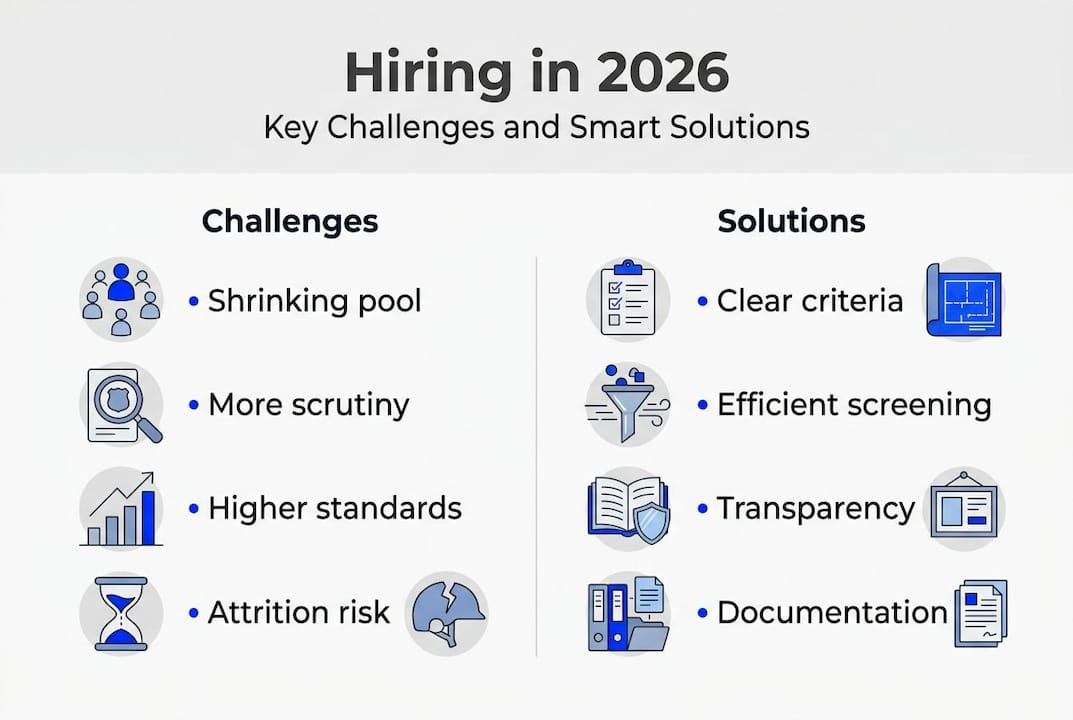
| Challenge | Impact on agencies |
|---|---|
| Candidate pool shrinkage | Fewer qualified applicants per opening |
| Increased regulatory scrutiny | Higher documentation burden |
| Background check attrition | Most eliminations happen post-application |
| Competing private sector offers | Salary and benefit gaps widen |
| Changing public perception | Fewer candidates self-select into public safety roles |
Beyond raw numbers, the candidate market itself has shifted. Younger applicants bring different expectations around transparency, process speed, and workplace culture. Agencies that fail to adapt their outreach and screening timelines risk losing strong candidates to faster-moving employers, both inside and outside public safety.
Regulatory and standards evolution is also reshaping who qualifies. Many agencies have updated their policies to reflect a more realistic view of the modern candidate pool:
- Tattoo and grooming standards have been relaxed at 77% of agencies, recognizing that visible tattoos are no longer meaningful predictors of poor judgment
- Prior minor offenses are increasingly reviewed on a case-by-case basis rather than treated as automatic disqualifiers
- Streamlined hiring timelines are being adopted to reduce the dropout rate among candidates who accept other offers during lengthy processes
- Expanded outreach to nontraditional candidate pools, including veterans, career changers, and diverse community members, is now standard practice at forward-thinking agencies
Understanding compliance in public safety hiring is foundational to navigating these shifts without creating legal exposure. Agencies that modernize their standards thoughtfully, with documented rationale and consistent application, strengthen rather than weaken their hiring programs. Leveraging technology for recruiting can also help agencies reach qualified candidates faster and filter more efficiently at the top of the funnel.
The agencies succeeding in this environment are not the ones with the most rigid standards. They are the ones with the clearest, most consistently applied standards, backed by documentation that can withstand legal challenge.
Preparation: What you need before you start hiring
With the context clear, the next step is arming your agency with what you need before launching the hiring process. Rushing into recruitment without the right infrastructure in place is one of the most common and costly mistakes agencies make. Preparation is not bureaucratic overhead. It is the foundation of a defensible, efficient, and fair hiring program.
Start by establishing clear, job-related criteria for every position you are filling. These criteria must be grounded in the actual duties and responsibilities of the role, not assumptions or tradition. Vague standards create inconsistency, invite bias claims, and make it nearly impossible to defend adverse hiring decisions. Document the rationale for each requirement before you post the position.
| Preparation element | Why it matters |
|---|---|
| Written job-related criteria | Ensures consistency and legal defensibility |
| Consent and authorization forms | Required for FCRA-compliant background checks |
| Candidate waiver documentation | Protects agency during sensitive inquiries |
| Screening platform selection | Determines speed and depth of investigation |
| Process documentation | Creates an auditable record for every decision |
Next, gather the forms and authorizations you will need throughout the process. Background investigations for public safety roles are layered and extensive. Multi-layered checks typically include criminal history, financial records, social media review, reference interviews, and in some cases polygraph examinations. Each of these components requires specific consent language and authorization forms that comply with federal and state law.
Selecting the right screening tools is equally important. Your background investigation platform should:
- Integrate with your existing applicant tracking system
- Support FCRA-compliant workflows from the start
- Provide access to comprehensive criminal, civil, and financial databases
- Enable investigator-driven checks for sensitive public safety roles
- Maintain a secure, auditable record of every action taken
Pro Tip: Build your disqualification criteria into your screening platform’s workflow before you receive a single application. This forces consistency and removes the temptation to make ad hoc exceptions that could later be characterized as discriminatory.
Documentation is the thread that holds your entire process together. Every decision, every deviation from standard procedure, and every accommodation made for a candidate should be recorded in real time. Agencies that maintain thorough records are far better positioned to defend their decisions if challenged. Reviewing data privacy in hiring requirements before you begin ensures that your record-keeping practices protect both the agency and the candidate. A solid hiring compliance checklist tailored to public safety roles can serve as your quality control mechanism throughout the entire process.

Step-by-step: Conducting an effective background investigation
Once preparation is complete, public safety agencies need a proven roadmap for executing effective screening. The background investigation is not a single event. It is a sequence of coordinated steps, each building on the last, designed to develop a complete and accurate picture of the candidate.
Here is the standardized sequence most high-performing agencies follow:
- Announce the position with clear, specific eligibility criteria and a realistic timeline so candidates self-select appropriately
- Pre-screen applications for minimum qualifications, flagging incomplete submissions or obvious disqualifiers before investing investigative resources
- Conduct initial background checks covering criminal history, driving records, and civil filings using a verified screening platform
- Schedule structured interviews focused on behavioral questions that reveal judgment, integrity, and decision-making under pressure
- Complete the full background investigation including financial review, social media analysis, reference interviews, and employment verification
- Administer polygraph examination where required by agency policy or state law, ensuring the examiner is certified and the process is documented
- Conduct final review with a designated decision-maker who evaluates the complete file against pre-established criteria before any offer is extended
Understanding the background check process at each stage helps investigators avoid shortcuts that create liability. The most important principle to reinforce with candidates early is honesty. Most eliminations occur during the in-person interview and background check phases, and the primary driver is not a flawed history but rather dishonesty about that history.
“A candidate who discloses a past mistake and demonstrates accountability is often a stronger hire than one with a spotless record who conceals minor issues.”
Common automatic disqualifiers in public safety hiring include felony convictions, drug abuse patterns, and significant financial misconduct. However, edge cases require careful analysis. A single marijuana use years ago is treated very differently than a pattern of substance abuse. A bankruptcy resulting from a medical emergency is evaluated differently than a history of fraud. Investigators must apply consistent criteria while exercising informed judgment.
Pro Tip: Use AI-powered screening tools to standardize the early stages of your investigation. Automation reduces processing time on routine checks and frees your investigators to focus on the complex, judgment-intensive portions of the file.
Publishing transparent hiring criteria in your job postings also reduces attrition. Candidates who understand the standards upfront are more likely to be honest in their disclosures and less likely to drop out mid-process when they realize they do not qualify.
Common pitfalls, troubleshooting, and continuous improvement
Even with thoughtful execution, setbacks happen. Here is how to identify and avoid the most common hiring pitfalls that derail public safety recruitment programs.
The most frequent mistakes agencies make fall into three categories:
- Unclear or inconsistently applied standards: When investigators apply different thresholds to similar situations, the agency creates both legal exposure and internal inequity. Every disqualification must be traceable to a documented, job-related criterion.
- Insufficient documentation: Agencies that rely on verbal decisions or informal notes cannot defend their choices when challenged. Every step of the investigation must produce a written record.
- Over-filtering at early stages: Eliminating candidates based on surface-level application data before conducting a thorough review wastes qualified applicants and shrinks your pool unnecessarily.
Bias risks are real and often unintentional. Investigators may unconsciously apply stricter scrutiny to candidates from certain backgrounds, or interpret ambiguous information differently depending on the candidate’s demographic profile. Using standardized, job-related criteria and building legal defensibility into every decision point is the most effective mitigation strategy. Regular audits of hiring outcomes by demographic group can surface patterns that warrant process review.
Pro Tip: After each hiring cycle, review both your disqualified and retained candidates against their subsequent performance data. If candidates you eliminated were later hired by other agencies and performed well, that is a signal your thresholds may be too restrictive. If retained candidates underperformed, examine whether your screening missed meaningful risk indicators.
The feedback loop is one of the most underutilized tools in public safety recruitment. Agencies that safeguard their hiring programs through continuous review consistently outperform those that treat each hiring cycle as a standalone event. Build a formal review cadence into your process: quarterly for active recruitment periods, annually for policy and criteria review.
Candidate experience also matters more than most agencies acknowledge. Slow communication, unclear timelines, and opaque decision-making drive dropout rates up. Addressing background check privacy concerns transparently and keeping candidates informed at each stage reduces attrition and builds goodwill, even among those who are ultimately not selected.
The uncomfortable truth about public safety hiring: What most guides miss
Looking beyond procedures, there are hard truths that most hiring guides gloss over. The most significant one is this: the relentless pursuit of the perfect candidate is actively harming public safety agencies.
Agencies that filter for flawless records are not necessarily hiring the most capable officers, dispatchers, or investigators. They are hiring the candidates who have had the fewest opportunities to make mistakes, or who have been skilled enough to conceal them. That is not the same thing as integrity. Undisclosed issues lead to automatic rejection, and rightly so. But a candidate who voluntarily discloses a past struggle and demonstrates genuine accountability is often a more reliable indicator of character than a spotless record with no explanation.
The agencies that are solving their staffing crises are not doing it by lowering standards. They are doing it by getting smarter about which standards actually predict performance. Leveraging AI for faster hiring allows agencies to process more candidates with greater consistency, freeing human judgment for the decisions that genuinely require it.
Modernizing engagement is equally critical. Candidates who feel respected and informed throughout the process are more likely to complete it. Agencies that communicate proactively, explain their criteria clearly, and provide timely feedback retain more qualified applicants through to the offer stage. The cost of a streamlined, candidate-friendly process is minimal compared to the cost of starting a hiring cycle over from scratch.
Rethinking rigid disqualifiers, with appropriate legal review and documented rationale, can meaningfully expand your candidate pool without compromising the integrity of your agency or the safety of your community.
Streamline your agency’s hiring with expert support
For agencies committed to safer, more successful hires, the right partner makes all the difference. The strategies outlined in this guide require not just policy changes but the right tools and expertise to execute them consistently and at scale.

OMNI Intel is built specifically for public safety agencies navigating exactly these challenges. Our pre-employment screening for public safety solutions integrate seamlessly with your current hiring workflow, reducing time-to-offer while maintaining the investigative depth your roles demand. From FCRA-compliant background investigations to AI-driven candidate screening, every feature is designed around the standards and accountability requirements unique to law enforcement, fire and EMS, dispatch, and related agencies. Explore our full suite of background checks for public safety or visit OMNI Intel to see how we support defensible, efficient, and integrity-driven hiring from application through post-hire monitoring.
Frequently asked questions
What disqualifies a candidate during public safety hiring?
Felony convictions, dishonesty, and significant financial problems are among the most common automatic disqualifiers, along with documented patterns of poor judgment or substance abuse that suggest an inability to meet the demands of a public safety role.
How long does the public safety hiring process take?
Most offers are made within three months when agencies have streamlined their processes, though candidates with complex backgrounds or incomplete documentation may require additional investigation time before a final decision is reached.
Are tattoos or prior minor offenses automatic disqualifiers?
Not at most agencies today. 77% of agencies have loosened tattoo and grooming standards, and minor past offenses are now frequently evaluated on a case-by-case basis rather than treated as blanket disqualifiers.
Why do so many candidates fail background checks?
Most eliminations happen during the background investigation stage, primarily because of undisclosed information, application errors, or failure to meet documented job-related criteria rather than the nature of the underlying issue itself.