

Risk Mitigation Strategies List for Decision-Makers
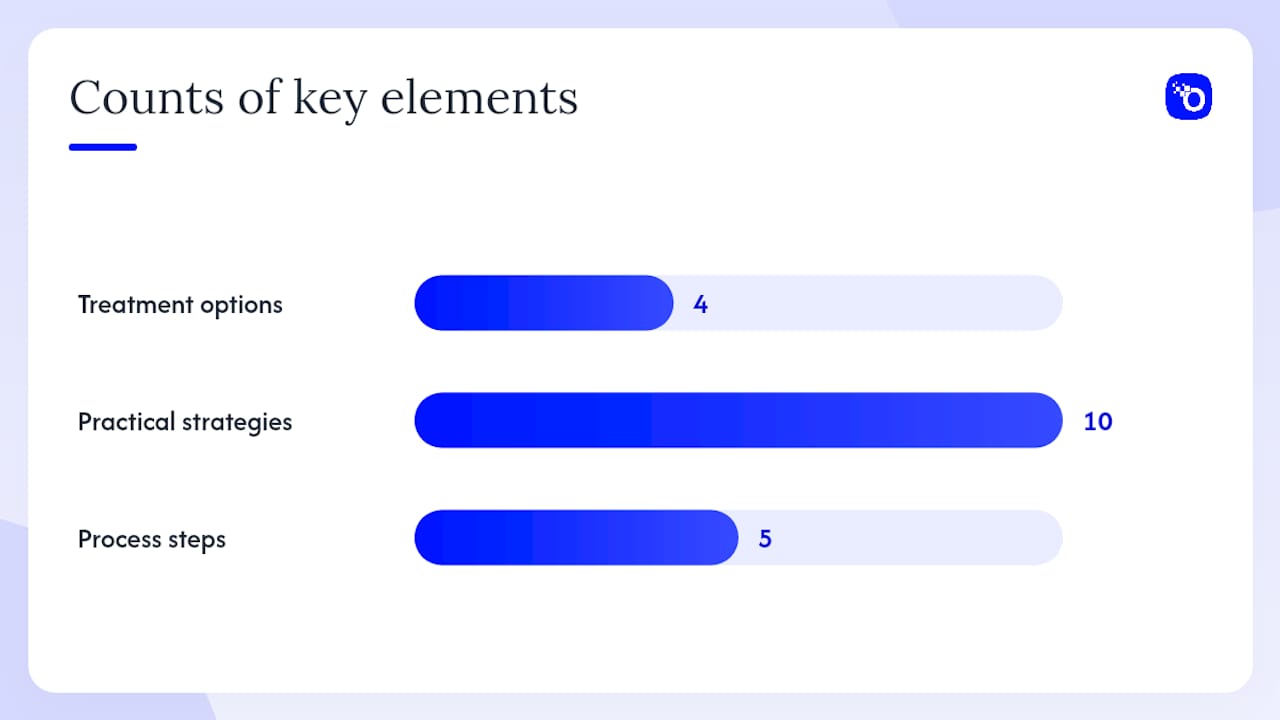
Prioritize avoidance, reduction, transfer, and acceptance: the four treatment options that organize every practical mitigation decision. Mapped across those options, here are the 10 strategies that deliver the most consistent risk reduction for operational and business environments.
The 10 strategies at a glance:
- Eliminate the activity (avoidance) — A fire department discontinues a high-risk training drill with no operational benefit.
- Strengthen hiring and screening (reduction) — A law enforcement agency adds investigator-driven background checks before every conditional offer.
- Segregation of duties (reduction) — A dispatch center separates payroll approval from payroll processing.
- Redundancy and backups (reduction) — An EMS agency maintains a secondary CAD system on a separate server.
- Vendor due diligence (reduction) — A municipality audits third-party IT vendors annually before contract renewal.
- Contracts with indemnity clauses (transfer) — A private security firm shifts liability for equipment failure to the supplier.
- Insurance layering (transfer) — A government agency stacks general liability, cyber, and umbrella policies.
- Business continuity planning (reduction) — An agency documents a 72-hour operational continuity plan tested twice a year.
- Incident playbooks and exercises (reduction) — A dispatch center runs quarterly tabletop exercises against its top three threat scenarios.
- Continuous monitoring and analytics (reduction) — A law enforcement agency uses post-hire activity dashboards to flag early warning indicators.
Pro Tip: Within the next 72 hours, pull your last incident report and identify which of the 10 strategies above was absent or underperforming. That gap is your highest-priority mitigation action this quarter.
Key Takeaways
Effective risk mitigation requires selecting the right treatment option for each risk, implementing layered controls, and sustaining governance through regular reviews rather than one-time audits.
| Point | Details |
|---|---|
| Four treatment options | Every mitigation decision maps to avoidance, reduction, transfer, or acceptance; match the option to the risk’s severity and cost of control. |
| Ten practical strategies | Strategies range from hiring and screening to insurance layering; quick wins include segregation of duties, vendor due diligence, and tabletop exercises within 30–90 days. |
| Five-step process | Identify, analyze, prioritize, implement, and monitor; use an impact-by-likelihood matrix to decide which treatment option applies to each risk. |
| Personnel risk priority | Hiring and insider risk carries the highest consequence for public safety agencies; combine pre-employment investigations with continuous post-hire monitoring for durable reduction. |
| OMNI Intel for agencies | OMNI Intel’s investigator-driven screening and continuous monitoring platform covers the full personnel risk lifecycle for law enforcement, fire and EMS, dispatch, and private security. |
Table of Contents
- What Is Risk Mitigation, and How Does It Differ from Risk Management?
- The Four Core Risk Treatment Options Explained
- 10 Practical Risk Mitigation Strategies with Examples
- How to Build a Risk Mitigation Process Step by Step
- Common Business and Operational Risk Types to Prioritize
- Mitigating Hiring and Insider Risk in Public Safety Agencies
- Risk Mitigation Checklist and Tracking Template
- Why Layering Mitigation Strategies Produces Durable Risk Reduction
- How OMNI Intel Supports Personnel Risk Mitigation for Public Safety Agencies
- Sources
- FAQ
What Is Risk Mitigation, and How Does It Differ from Risk Management?
Risk mitigation is the deliberate selection and implementation of measures that reduce the probability, severity, or impact of an identified risk. It is one phase within the broader discipline of risk management, which spans identification, analysis, prioritization, treatment, and ongoing monitoring.
The distinction matters in practice. Risk management is the governance framework; risk mitigation is the action layer inside it. Risk prevention aims to stop a hazard from materializing at all, while risk mitigation accepts that some hazards will occur and focuses on limiting their consequences. Risk financing, by contrast, arranges funding to cover losses after they happen. All three concepts coexist in a mature program.
Three authoritative frameworks anchor U.S. practice:
- DHS Risk Management Fundamentals defines the full risk management cycle, from threat and vulnerability assessment through treatment selection and monitoring, and explicitly names the four treatment options used throughout this article.
- FEMA/USFA provides a five-step operational model used widely by fire and emergency services.
- NIST SP 800-30 governs information security risk management for federal agencies and contractors, establishing a structured process for IT and cyber risk that many private organizations adopt by reference.
Understanding where mitigation sits in the larger cycle prevents the most common organizational mistake: treating a single mitigation action as a complete risk program. For a public safety risk mitigation framework that maps these concepts to agency operations specifically, the linked resource provides additional context.
The Four Core Risk Treatment Options Explained
DHS Risk Management Fundamentals identifies four treatment options that apply across every sector. Choosing the right one depends on the risk’s likelihood, potential severity, and the cost of control relative to the residual exposure.
Avoidance
Avoidance eliminates the activity or condition that creates the risk. It is the highest-certainty treatment because it removes exposure entirely, but it is also the most operationally limiting.
When to use it: The risk is catastrophic, the activity has no compensating operational value, or no other treatment reduces residual risk to an acceptable level. A law enforcement agency that discontinues a training scenario with documented injury history and no tactical necessity is applying avoidance correctly.
Reduction (Control)
Reduction lowers the likelihood or impact of a risk through administrative, engineering, or procedural controls. It is the most frequently applied treatment because it allows the organization to continue the activity while managing the exposure.
When to use it: The activity is operationally necessary, and controls can bring residual risk within tolerance. Pre-employment background investigations, segregation of duties, and redundant systems all fall here.
Transfer
Transfer shifts financial or legal responsibility for a risk to a third party, typically through insurance, contracts, or outsourcing arrangements. It does not eliminate the operational risk; it reallocates the cost of a loss event.
When to use it: The risk is financially significant but operationally manageable, and a willing counterparty can absorb the liability at a cost lower than self-insuring. Indemnity clauses in vendor contracts and cyber liability policies are standard examples.
Acceptance
Acceptance is a deliberate, documented decision to retain a risk without additional treatment, usually because the cost of control exceeds the expected loss or the risk falls below the organization’s tolerance threshold.
When to use it: The risk is low-severity, low-likelihood, or the residual risk after other treatments is negligible. Acceptance must be explicit and recorded, not simply the absence of action.
10 Practical Risk Mitigation Strategies with Examples
DNV’s risk mitigation guidance stresses tailoring strategies to the organization’s specific operational and strategic context. The numbered list below follows that principle, pairing each strategy with a concrete example, an implementation prompt, and a note on whether it is a quick win (achievable within 30–90 days) or a longer program.
-
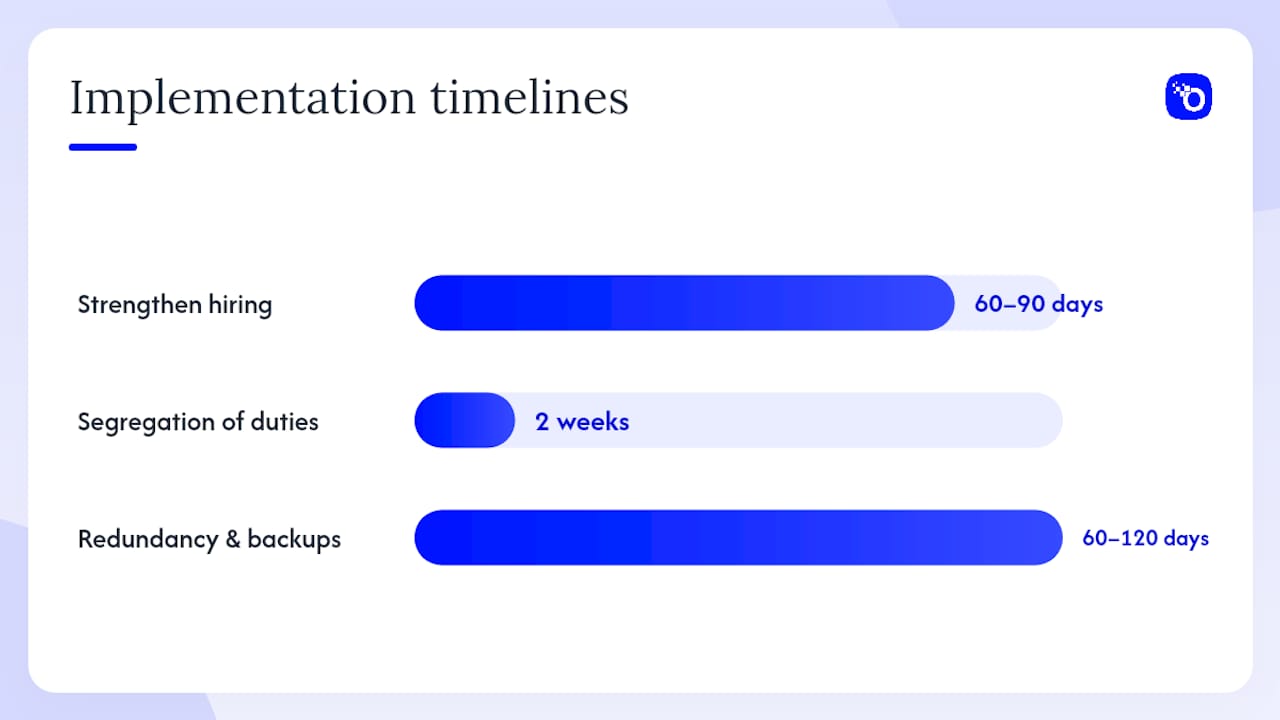
Strengthen hiring and screening. A law enforcement agency adds an investigator-driven pre-employment background investigation to every conditional offer, including criminal history, credential verification, and integrity checks. Treatment: reduction. Timeline: quick win if a vendor is already contracted; 60–90 days to onboard a new provider.
-
Segregation of duties. A dispatch center separates the roles of payroll entry, payroll approval, and bank reconciliation across three staff members. Treatment: reduction. Timeline: quick win — a policy change and role reassignment can be completed in two weeks.
-
Redundancy and backups. An EMS agency maintains a secondary CAD system on an isolated server and tests failover quarterly. Treatment: reduction. Timeline: 60–120 days for infrastructure setup; policy and testing cadence can be set immediately.
-
Vendor due diligence. A municipality requires annual security audits and insurance certificates from every IT vendor before contract renewal. Treatment: reduction. Timeline: quick win — add the requirement to the next renewal cycle.
-
Contracts with indemnity clauses. A private security firm negotiates supplier contracts that shift liability for equipment defects to the manufacturer. Treatment: transfer. Timeline: quick win on new contracts; longer for renegotiating existing agreements.
-
Insurance layering. A government agency stacks general liability, cyber liability, and umbrella policies to cover different loss scenarios without gaps. Treatment: transfer. Timeline: 30–60 days to complete a coverage gap analysis and bind additional policies.
-
Business continuity planning. An agency documents a 72-hour operational continuity plan, assigns ownership to a named deputy, and exercises it twice a year. Treatment: reduction. Timeline: 60–90 days for initial plan; exercises are ongoing.
-
Incident playbooks and tabletop exercises. A dispatch center runs quarterly tabletop exercises against its three highest-probability threat scenarios and updates playbooks after each session. Treatment: reduction. Timeline: first exercise can be scheduled within 30 days.
-
Monitoring and analytics. A law enforcement agency deploys post-hire activity dashboards that flag early warning indicators, such as use-of-force frequency or complaint patterns, for supervisory review. Treatment: reduction. Timeline: 60–90 days to configure dashboards; policy framework can be drafted in two weeks.
-
Employee training and SOPs. An agency formalizes standard operating procedures for its top 10 high-risk activities and delivers annual certification training with documented completion records. Treatment: reduction. Timeline: SOPs can be drafted in 30 days; training rollout is a 60–90-day program.
Pro Tip: Strategic Fire’s layered mitigation guidance confirms that combining prevention, protection, and response measures produces more durable risk reduction than any single tactic. When selecting from the list above, choose at least one measure from each layer rather than stacking multiple controls in the same category.
Quick wins that deliver noticeable reduction within 30–90 days: segregation of duties (strategy 2), vendor due diligence requirements on renewals (strategy 4), and scheduling the first tabletop exercise (strategy 8).
How to Build a Risk Mitigation Process Step by Step
USFA’s Risk Management Practices outlines five principal steps: identify exposure, evaluate potential, rank and prioritize, determine and implement control actions, and evaluate and revise. The process below expands that model into seven operational steps suited to business and public safety environments.
-
Set context. Define the scope, the organizational units involved, the risk tolerance threshold, and the governance structure (who owns risk decisions and who signs off). Without this step, prioritization debates stall.
-
Identify risks. Use structured methods: process mapping, incident log review, staff interviews, regulatory checklists, and threat assessments. Document each risk with a clear description, potential trigger, and affected asset or function.
-
Analyze risks. Estimate likelihood and potential impact for each identified risk. Qualitative scales (high/medium/low) work for most operational contexts; quantitative modeling is warranted for financial or catastrophic risks.
-
Prioritize risks. Plot risks on a simple impact-by-likelihood matrix. Risks in the high-impact, high-likelihood quadrant demand immediate treatment. High-impact, low-likelihood risks warrant transfer or contingency planning. Low-impact risks in either likelihood category are candidates for acceptance.
Decision rules by quadrant:
- High impact, high likelihood: avoid or reduce immediately.
- High impact, low likelihood: transfer or develop a contingency plan.
- Low impact, high likelihood: reduce through administrative controls.
- Low impact, low likelihood: accept with documented rationale.
-
Develop and select options. For each priority risk, generate at least two treatment options, estimate cost and residual risk for each, and select the option with the best cost-to-risk-reduction ratio. DHS capability-based planning links this step directly to resource allocation, ensuring mitigation investments produce measurable preparedness returns.
-
Implement. Assign a named owner, set a completion date, allocate budget, and document the action in a risk register. Quick wins (under 90 days) should be tracked weekly; longer programs monthly.
Budget guidance: administrative controls (policy changes, role reassignments, training updates) typically cost under $5,000 to implement. Engineering controls (redundant systems, physical security upgrades) range from $10,000 to $250,000 depending on scope. Insurance and contractual transfers carry ongoing premium or legal costs that should be modeled against expected loss frequency.
-
Monitor and review. HSAJ case studies recommend Compstat-style command risk meetings, incident review boards, sentinel event reviews, and data dashboards for ongoing agency-level monitoring. Schedule formal risk reviews quarterly at the operational level and annually at the executive level. Update the risk register after every significant incident or organizational change.
Tools for tracking progress: risk registers in Microsoft Excel or Google Sheets work for smaller agencies. Purpose-built platforms such as LogicManager, Resolver, or ServiceNow GRC support larger organizations with automated workflows, audit trails, and dashboard reporting.
Common Business and Operational Risk Types to Prioritize
The World Economic Forum’s Global Risks Report 2026 underscores the growing severity of systemic, high-consequence risks and the need for capability-based planning to guide mitigation investments. For most U.S. organizations, the following risk categories demand the earliest attention.
-
Operational risk. Process failures, equipment breakdowns, and human error. Best pairings: SOPs and training (strategy 10), incident playbooks (strategy 8), redundancy (strategy 3).
-
IT and cyber risk. Data breaches, ransomware, and system outages. Best pairings: redundancy and backups (strategy 3), vendor due diligence (strategy 4), insurance layering (strategy 6), monitoring and analytics (strategy 9). Regulatory exposure under state breach notification laws and federal frameworks makes this a first-priority category for most agencies.
-
Financial risk. Fraud, budget overruns, and cash flow disruption. Best pairings: segregation of duties (strategy 2), contracts with indemnity (strategy 5), insurance layering (strategy 6).
-
Reputational risk. Misconduct, media incidents, and community trust erosion. Best pairings: hiring and screening (strategy 1), monitoring and analytics (strategy 9), training and SOPs (strategy 10). For public safety agencies, reputational risk carries direct operational consequences: reduced community cooperation, legislative scrutiny, and recruitment difficulty.
-
Compliance and regulatory risk. Violations of federal, state, or local mandates. Best pairings: training and SOPs (strategy 10), vendor due diligence (strategy 4), business continuity planning (strategy 7). Regulatory exposure is a reliable first-priority filter: if non-compliance carries statutory penalties or loss of accreditation, treat it before lower-consequence risks.
-
Hiring and insider risk. Negligent hiring, misconduct by current employees, and unauthorized data access. Best pairings: hiring and screening (strategy 1), segregation of duties (strategy 2), continuous monitoring (strategy 9). See the section below for a detailed playbook.
-
Supply chain risk. Vendor failures, sole-source dependencies, and delivery disruptions. Best pairings: vendor due diligence (strategy 4), contracts with indemnity (strategy 5), redundancy (strategy 3).
-
Safety and environmental risk. Workplace injuries, hazardous material incidents, and environmental liability. Best pairings: avoidance where feasible, engineering controls, training and SOPs (strategy 10), insurance layering (strategy 6). The Illinois SFM Community Risk Reduction Planning Guide recommends prioritizing administrative and engineering controls before relying on personal protection equipment.
Quick filters for deciding which risks to address first: regulatory exposure (statutory penalties or accreditation loss), public visibility (reputational consequence if the event becomes news), likelihood based on recent incident history, and severity of the worst credible outcome.
Mitigating Hiring and Insider Risk in Public Safety Agencies
Personnel risk is the category where a single bad hire can generate liability, community harm, and years of reputational damage. Police Chief Magazine documents that risk management succeeds when leadership embeds it in culture through training, communication, and consistent policy enforcement, and that principle applies with particular force to the hiring process.
A DOJ COPS forum report identified 11 core elements of agency risk management, with recruitment and hiring, training, supervision systems, and sentinel event reviews among the most consequential. The practical sequence below operationalizes those elements.
Pre-employment controls
-
Role profiling. Before posting, define the integrity, behavioral, and competency standards specific to the position. A dispatcher and a patrol officer carry different risk profiles; the screening criteria should reflect that difference.
-
Structured interviews. Use standardized, scored interview questions tied to the role profile. Unstructured interviews introduce bias and miss the behavioral indicators that predict integrity failures.
-
Investigator-driven background investigations. Commission a thorough pre-employment background investigation that covers criminal history, employment history, credential verification, reference interviews, and integrity checks. Automated database pulls alone miss context that a trained investigator surfaces through follow-up.
-
Credential verification. Confirm every claimed license, certification, and degree directly with the issuing institution. A step-by-step credential verification process reduces the risk of credential fraud, which is more common in public safety applications than most agencies expect.
-
Compliance documentation. Obtain written consent, maintain records per FCRA requirements, and document the basis for every adverse action. Agencies that skip this step face both legal exposure and evidentiary gaps if a hiring decision is later challenged.
Post-hire controls
-
Continuous monitoring. One-time screening establishes a baseline; it does not detect conduct that develops after hire. Post-hire employee monitoring programs that flag changes in criminal records, license status, or behavioral indicators give supervisors the early warning needed to intervene before an incident escalates.
-
Early intervention systems. Establish threshold-based triggers (complaint frequency, use-of-force patterns, absenteeism spikes) that automatically route an employee to supervisory review. High-performing agencies treat these reviews as coaching opportunities, not disciplinary events, which improves both retention and risk reduction.
-
Sentinel event reviews. After any significant incident, conduct a structured review that examines contributing factors across hiring, training, supervision, and policy. HSAJ research shows that agencies using sentinel event reviews adjust tactics and supervision in near real time, materially reducing recurrence.
-
Supervision enhancements. Increase direct oversight for employees in high-risk roles or those flagged by early intervention triggers. Document supervisory contacts and outcomes.
-
Ongoing training. Annual certification on use-of-force policy, data privacy, and conduct standards keeps legal and behavioral expectations current and creates a documented record of notice.
Pro Tip: Compliance in public safety hiring carries consequences that extend well beyond the individual hire. Agencies that document every step of the screening and monitoring process build a defensible record that protects them in litigation, accreditation reviews, and legislative inquiries.
Risk Mitigation Checklist and Tracking Template
Use the checklist below to confirm each phase of your mitigation program is complete. Copy the template fields into a spreadsheet or risk register to track every active mitigation action.
Phase checklist
Assess:
- Scope and risk tolerance defined and approved by leadership.
- Risk identification completed using at least two structured methods (e.g., incident log review plus process mapping).
- Likelihood and impact scored for each identified risk.
- Risks plotted on an impact-by-likelihood matrix.
Decide:
- Treatment option selected (avoidance, reduction, transfer, or acceptance) for each priority risk.
- At least two treatment options evaluated per risk before selection.
- Cost and residual risk estimated for the chosen treatment.
- Decision documented with named approver and date.
Implement:
- Named owner assigned to each mitigation action.
- Budget allocated and confirmed.
- Completion date set.
- Action entered in the risk register.
- Stakeholders notified of their roles.
Monitor:
- Review cadence set (weekly for quick wins; monthly for longer programs).
- Metrics or indicators defined to measure mitigation effectiveness.
- Escalation path documented for actions that fall behind schedule.
- Quarterly operational review scheduled.
- Annual executive-level risk review scheduled.
Risk register template fields
Capture these fields for every mitigation action:
- Risk ID — unique identifier for cross-referencing.
- Risk description — one sentence describing the event and its potential consequence.
- Risk owner — named individual accountable for the mitigation.
- Treatment chosen — avoidance, reduction, transfer, or acceptance.
- Mitigation action — specific control or measure being implemented.
- Expected cost — estimated budget in dollars.
- Expected benefit — qualitative or quantitative reduction in likelihood or impact.
- Timeline — start date and target completion date.
- Status — not started / in progress / complete / overdue.
- Review date — next scheduled check-in.
- Sign-off authority — the role (e.g., chief, director, risk officer) required to approve closure.
Pro Tip: Review cadence should match risk severity. High-severity mitigations warrant monthly sign-off by a named executive. Lower-severity actions can be reviewed quarterly by the risk owner alone. Documenting who signed off and when is as important as the action itself when an incident triggers an external review.
Why Layering Mitigation Strategies Produces Durable Risk Reduction
The most persistent mistake in organizational risk programs is the belief that a single, well-chosen control is sufficient. It rarely is. Controls degrade: policies go unenforced, insurance coverage develops gaps, and a vendor that passed due diligence two years ago may have changed its security posture since. Layering multiple strategies across the avoidance, reduction, and transfer options creates redundancy in the control environment itself, so that when one measure fails, others remain active.
The second most common mistake is treating risk management as a one-time project rather than a continuous governance function. Police Chief Magazine’s research is direct on this point: programs that embed risk awareness into daily leadership behavior, training cycles, and communication patterns outperform those that rely on annual audits and periodic policy updates. The difference is not the quality of the initial plan; it is the consistency of execution over time.
Two governance changes produce the most reliable improvement in sustained mitigation performance. First, schedule command-level risk reviews on a fixed cadence, modeled on the Compstat approach, where data on incidents, near-misses, and control effectiveness is reviewed by senior leadership at regular intervals. Second, formalize sentinel event reviews so that every significant incident generates a structured analysis of contributing factors, not just a disciplinary response. Both practices convert reactive incident management into proactive risk reduction.
How OMNI Intel Supports Personnel Risk Mitigation for Public Safety Agencies
Personnel risk is the category where public safety agencies face the highest-consequence exposure, and it is also the category where a structured, investigator-driven approach produces the clearest, most defensible results. OMNI Intel is built specifically for this environment: its pre-employment screening services combine thorough background investigations with AI-driven candidate nurturing and continuous post-hire monitoring, giving agencies a single platform that covers the full personnel risk lifecycle.

Three capabilities that directly support the mitigation strategies in this article:
- Tailored public safety screening packages — customized investigation scopes for law enforcement, fire and EMS, dispatch, and private security roles, covering criminal history, credential verification, employment history, and integrity checks.
- Applicant system integration — OMNI Intel connects with existing hiring platforms so screening is embedded in the workflow rather than bolted on as a separate step, reducing delays and documentation gaps.
- Continuous post-hire monitoring — post-hire activity dashboards flag early warning indicators in near real time, giving supervisors the data they need to intervene before a conduct issue becomes a liability event.
Agencies ready to close the gap between one-time screening and continuous personnel risk management can schedule a consultation with OMNI Intel to review their current screening process and identify where investigator-driven checks and monitoring would have the greatest impact.
Sources
Decision-makers who need primary evidence and implementation templates should consult the following:
- Risk Management Fundamentals (DHS)
- Risk Management in Law Enforcement (COPS DOJ forum report)
- Risk Management for Law Enforcement Agencies: Two Case Studies – HSAJ
- Risk management practices (USFA FEMA)
- Develop mitigation strategies and tactics – Strategic Fire Risk Reduction
- Weforum
Consult qualified legal counsel for compliance-sensitive items, including FCRA recordkeeping, consent requirements, and state-specific data privacy obligations. This article provides general information, not legal or professional advice.
FAQ
What are the four risk mitigation strategies?
The four core treatment options are avoidance (eliminating the risk-generating activity), reduction or control (lowering likelihood or impact through administrative and engineering measures), transfer (shifting financial responsibility through insurance or contracts), and acceptance (retaining the risk with a documented rationale). DHS Risk Management Fundamentals defines all four within the broader risk management cycle.
What are examples of risk mitigation in practice?
Common examples include pre-employment background investigations (reduction), segregation of duties in financial processes (reduction), cyber liability insurance (transfer), vendor indemnity clauses in contracts (transfer), and a documented decision to retain a low-severity risk without additional controls (acceptance). Each example maps directly to one of the four treatment options.
What are the five steps of the risk management process?
USFA’s Risk Management Practices outlines five steps: identify the exposure, evaluate its potential impact, rank and prioritize risks, determine and implement control actions, and evaluate and revise those actions over time. This cycle repeats continuously rather than concluding after the first implementation.
How do you prioritize which risks to mitigate first?
Plot each risk on an impact-by-likelihood matrix and address high-impact, high-likelihood risks first through avoidance or immediate reduction controls. Apply secondary filters for regulatory exposure (statutory penalties or accreditation loss), public visibility, and severity of the worst credible outcome to break ties between risks of similar matrix scores.
How does continuous monitoring reduce hiring and insider risk?
One-time pre-employment screening establishes a baseline but does not detect conduct that develops after hire. Continuous post-hire monitoring programs that flag changes in criminal records, license status, complaint frequency, or behavioral indicators give supervisors early warning before a conduct issue escalates into a liability event, materially reducing the likelihood of high-cost outcomes compared with screening alone.