

Risk Factor Examples for Public Safety Hiring and Monitoring
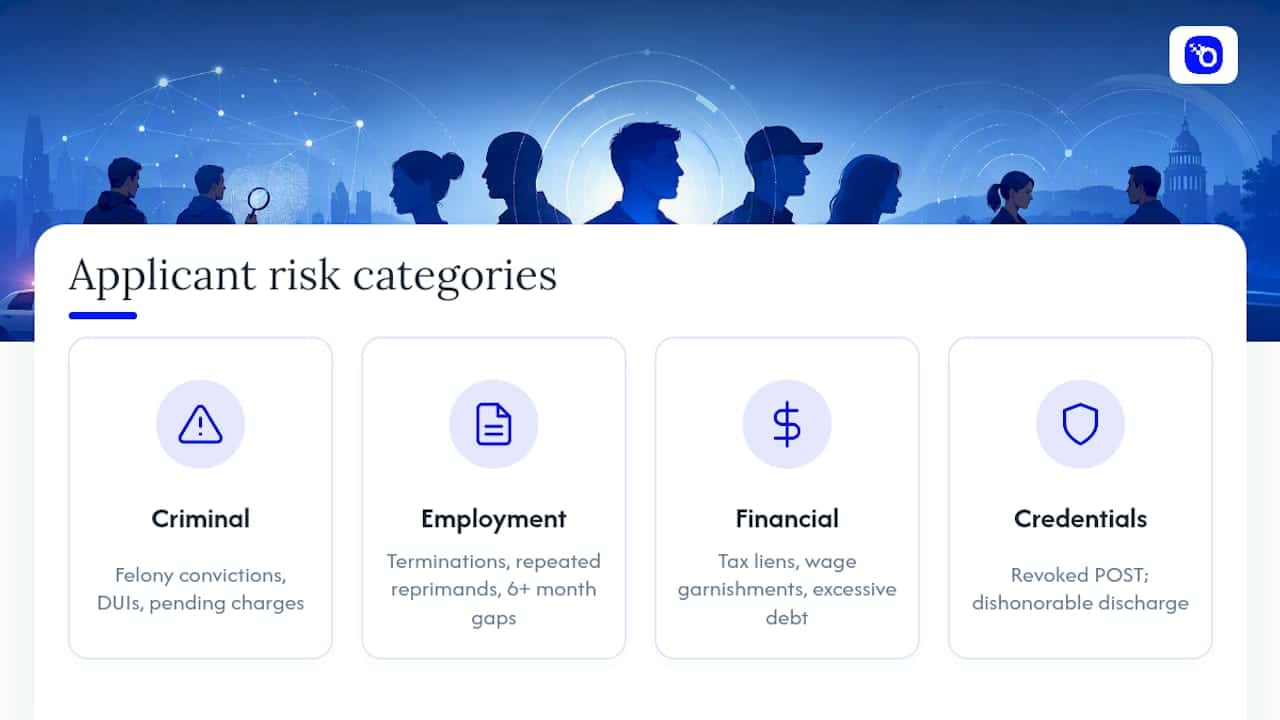
The highest-priority risk factors to flag during public safety pre-employment screening are: criminal convictions or pending charges, dishonesty or falsified credentials, repeated disciplinary actions or terminations for cause, financial instability (liens, garnishments, excessive debt), substance-related incidents including DUIs, problematic social media or extremist indicators, and professional disqualifiers such as decertification or dishonorable military discharge. Background investigations routinely evaluate all of these categories as part of a defensible pre-hire file.
For each flag, the immediate action is specific:
- Criminal history: Obtain certified court dispositions from the originating jurisdiction.
- Falsified credentials: Verify directly with the issuing agency or POST registry.
- Repeated discipline: Request separation paperwork and personnel files from prior employers.
- Financial instability: Pull a credit report under FCRA consent and review for liens, garnishments, or bankruptcy filings.
- Substance incidents: Collect certified driving records and any treatment or disciplinary documentation.
- Social media or extremist indicators: Conduct a documented, policy-governed social media review.
- Decertification or dishonorable discharge: Check the National Decertification Index and DD-214.
Immediate triage checklist: (1) Stop the file if a disqualifying indicator appears before verification. (2) Verify every flag against a primary source before escalating. (3) Escalate to a supervisor or legal counsel when a finding is ambiguous, involves a protected class, or suggests a pattern.
Key Takeaways
The most defensible hiring decisions in public safety combine a categorized risk factor checklist, a four-dimension scoring rubric, and continuous post-hire monitoring tied to documented triggers and consistent policy application.
| Point | Details |
|---|---|
| Top risk factors to flag | Criminal history, dishonesty, repeated discipline, financial instability, substance incidents, extremist indicators, and decertification are the highest-priority categories. |
| Four-dimension scoring | Rate every finding on recency, frequency/pattern, severity, and job relatedness before issuing a hiring recommendation. |
| Fewer than 10% hit High Risk | Psych screening High Risk flags are rare and high-signal; always corroborate with documentary and reference checks. |
| Legal guardrails are non-negotiable | FCRA consent, EEOC job-relatedness documentation, and consistent policy application are required for every adverse action. |
| OMNI Intel for public safety agencies | OMNI Intel delivers audit-ready pre-employment files and configurable post-hire monitoring feeds designed for public safety HR teams. |
Table of Contents
- Why these risk factors matter for public safety agencies
- Detailed examples of applicant and employee risk factors
- What documents and records to collect and how to verify them
- How to weigh risk factors: recency, frequency, severity, and job relatedness
- Legal and compliance guardrails every U.S. agency must follow
- Practical template: red-flag scoring rubric and screening tiers
- Post-hire triggers and continuous monitoring best practices
- Patterns versus isolated incidents: an investigator’s perspective
- OMNI Intel gives agencies the tools to screen and monitor with confidence
- Sources
- FAQ
Why these risk factors matter for public safety agencies
Hiring errors in public safety carry consequences that do not exist in most other sectors. A single officer, dispatcher, or firefighter with an undetected history of dishonesty, violence, or substance abuse can expose an agency to civil liability, federal oversight, and community trust failures that take years to repair.
Operational, organizational, and personal factors each contribute to public safety personnel risk and mental health outcomes, which means the screening lens must extend beyond criminal history alone. Workload, supervisor culture, and personal mental health history all interact to shape on-the-job behavior.
Three operational impacts agencies face when screening is inadequate:
- Officer and responder safety: Personnel with unresolved impulse-control or substance issues create direct hazards during high-stakes responses.
- Legal liability and decertification risk: Agencies that hire or retain personnel with known disqualifying histories face civil suits and potential loss of POST certification.
- Morale and culture degradation: One hire with a pattern of misconduct erodes the standards the rest of the workforce upholds.
NIOSH surveillance data highlights that surveillance gaps persist for EMS and telecommunications, reinforcing why agencies cannot rely on sector-wide data alone and must conduct individual-level screening and monitoring.
Detailed examples of applicant and employee risk factors
University of Nebraska Omaha research confirms that background investigations commonly evaluate prior employment misconduct, financial instability, criminal history, and professional disqualifiers including dishonorable military discharge and decertification. The categories below expand that list into actionable specifics.
Criminal and judicial indicators
Felony convictions, domestic violence misdemeanors, pending charges, and patterns of arrests without conviction all warrant scrutiny. A single DUI five years ago differs materially from two DUIs in three years. Collect certified court dispositions; do not rely on self-reported summaries.
Employment history and disciplinary red flags
Terminations for cause, repeated written reprimands, unexplained gaps of six months or more, and references that decline to rehire are all signals. The POST Background Investigation Manual requires employment verification for the prior ten years, reference interviews, and neighbor interviews as standard components.
Financial instability indicators
Excessive debt relative to income, tax liens, wage garnishments, and gambling-related borrowings suggest vulnerability to corruption or theft. Unexplained wealth relative to salary is equally concerning.
Professional disqualifiers and credential issues
A revoked or suspended POST certificate, a dishonorable or other-than-honorable military discharge, a denied or revoked security clearance, and falsified training records are categorical disqualifiers in most jurisdictions. Verify credentials directly with the issuing agency, not from copies the applicant provides.
Substance-related indicators
DUI convictions, positive pre-employment drug screens, and unresolved substance-related disciplinary actions from prior employers all carry weight. Treatment history alone is not disqualifying, but an unresolved pattern is.
Behavioral and psychological screening dimensions
The POST psychological screening manual identifies integrity, impulse control, stress tolerance, decision-making, and bias-related traits as core investigative dimensions. Validated instruments such as the CPI and PAI produce risk statements across these domains. The PAI Selection Report also provides public safety norm comparisons and critical item endorsements that focus interviews on suitability concerns.
Online and off-duty conduct
Documented threats, hate speech, extremist group affiliations, and patterns of harassing or discriminatory posts are job-relevant because they predict on-duty conduct and expose the agency to liability. A single offensive post differs from a sustained pattern.
Investigators should treat a pattern of two or more related incidents across different employers or time periods as a higher-order signal than any single incident in isolation. Recency and cross-source corroboration are what convert a data point into a defensible finding.
Red-flag escalation checklist: Escalate immediately when you find (a) a disqualifying credential issue, (b) two or more related incidents forming a pattern, © a psych screening High Risk designation, or (d) evidence of active extremist affiliation.
Pro Tip: When references are vague or uniformly positive, probe with behavioral questions tied to specific incidents from the personnel file. Corroborate weak reference responses with documented disciplinary records from the same employer.
What documents and records to collect and how to verify them
A defensible background file depends on primary-source records, not applicant-supplied copies. The pre-employment investigation workflow requires systematically organized documentation with chain-of-custody notes.
Essential records by risk category:
- Certified court dispositions and arrest reports (criminal and judicial)
- Personnel files, separation paperwork, and disciplinary records (employment history)
- Credit report under FCRA consent, tax lien searches, bankruptcy filings (financial)
- DD-214 or equivalent military discharge documents (professional disqualifiers)
- POST or state decertification registry check, license verification from issuing agency (credentials)
- Certified driving record (substance and driving history)
- Behavioral health screening forms per ERHMS standards (medical and behavioral)
Verification workflow when a red flag appears:
- Obtain a certified copy directly from the court, agency, or registry of record.
- Contact the issuing agency or employer by phone or written request to confirm authenticity.
- Cross-reference the finding against at least one corroborating source (reference interview, second record, or prior employer personnel file).
- Document the chain of custody: date received, source contacted, method of verification, and investigator name.
- Attach a written summary note to the file before routing for adjudication.
Pro Tip: Retain originals or certified copies, never applicant-provided photocopies, as the record of reference. Document every phone interview with date, time, contact name, and a verbatim summary of key statements.
How to weigh risk factors: recency, frequency, severity, and job relatedness
Every finding should be rated on four dimensions before a hiring recommendation is made: recency (how recent is the incident?), frequency/pattern (isolated or repeated?), severity (minor infraction or serious misconduct?), and job relatedness (does it directly affect the duties of this role?).
Two DUIs within three years for a candidate applying to drive emergency vehicles is a High designation on all four dimensions. One DUI seven years ago with no subsequent incidents and documented rehabilitation is a Low-to-Medium finding that warrants documented discussion, not automatic denial.
Rating checklist for investigators:
- Is the incident within the past three years? (Recency: elevated concern)
- Does a second or third related incident exist across employers or time periods? (Pattern: elevated concern)
- Did the incident involve violence, dishonesty, or a direct safety threat? (Severity: elevated concern)
- Does the behavior directly affect the core duties of this specific role? (Job relatedness: required for adverse action)
| Risk Level | Recency | Pattern | Severity | Job Relatedness | Recommended Action |
|---|---|---|---|---|---|
| Low | More than 5 years ago | Isolated | Minor | Indirect | Proceed; document finding |
| Medium | 2–5 years ago | Two related incidents | Moderate | Partial | Conditional hire; add controls or monitoring |
| High | Within 2 years | Three or more incidents | Serious or violent | Direct | Deny or refer for deeper investigation |
Legal and compliance guardrails every U.S. agency must follow
Screening must be job-related and proportionate. Federal FCRA requirements mandate written consent before obtaining consumer reports, and EEOC guidance requires that adverse action based on criminal history be tied to a documented business necessity specific to the role. Compliance obligations in public safety hiring are not optional procedural steps; they are the legal foundation for every adverse decision.
Core compliance steps:
- Obtain written, FCRA-compliant authorization before any consumer report is pulled.
- Avoid disability-related or medical questions before a conditional offer of employment (ADA).
- Document the job-relatedness rationale for every disqualifying finding before issuing an adverse action.
- Apply the same screening criteria consistently across all applicants for the same role.
- Retain background files for the period required by state law and POST standards.
When a risk factor finding correlates with a protected class, the agency must confirm that the policy is applied uniformly and that the disqualifying criterion is genuinely job-related. Disparate impact claims arise when a facially neutral policy disproportionately screens out a protected group without a documented business necessity. Effective mental health programs for public safety workers must also address organizational factors, which means post-hire monitoring programs need the same legal scaffolding as pre-hire screening.
Pro Tip: For every adverse action, attach a written business-necessity memo that names the specific finding, the role’s core duties, and the direct connection between the two. This memo is your audit trail if the decision is challenged.
Practical template: red-flag scoring rubric and screening tiers
The rubric below gives investigators a consistent scoring framework. Each finding is scored across four dimensions (1 = low concern, 2 = moderate, 3 = high concern), then totaled for a composite band.
Screening tier outcomes:
- Proceed: All categories score Low; no single High finding.
- Conditional hire with controls: One or two Medium findings; no High; documented monitoring plan attached.
- Deny or refer: Any single High finding, or three or more Medium findings across categories.
Each scored file should carry a one-paragraph audit note: the finding, the score rationale, the verification source, and the recommended outcome. This note is what survives a POST audit or civil challenge.
Pro Tip: Validate your scoring thresholds annually by comparing hiring outcomes against post-hire performance and disciplinary data. A rubric that never produces a Medium or High finding is not calibrated; it is broken.
Post-hire triggers and continuous monitoring best practices
Pre-hire screening captures a snapshot. Continuous monitoring is what detects risk that develops or surfaces after hire.
Top triggers for re-assessment:
- Arrest or new criminal charge
- Formal disciplinary action or internal affairs referral
- Credible social media threat or extremist activity report
- Decertification report or license suspension
- On-duty driving violation or vehicle incident
- Financial lien or garnishment when the role involves financial access
Monitoring options by intensity:
- Event-driven checks: triggered by a specific incident report or arrest notification
- Periodic audits: annual or biennial credential and decertification registry checks
- Targeted social media review: policy-governed, documented, role-specific
- Occupational health re-evaluations: per ERHMS annual assessment standards for responders
- Environmental and physiological monitoring for field roles: first responder exposure monitoring for CO, VOCs, and physiological vitals
Response workflow when a post-hire trigger fires:
- Verify the trigger against a primary source (arrest record, court docket, decertification feed).
- Implement temporary reassignment or duty restrictions pending investigation.
- Conduct a documented investigation using the same rubric applied at pre-hire.
- Issue a written disposition: return to full duty, modified duty with controls, or separation.
Pro Tip: Match monitoring intensity to role criticality. An armed officer with financial access warrants more frequent checks than a non-sworn administrative role. Document the rationale for each monitoring tier in the agency’s written policy.
Patterns versus isolated incidents: an investigator’s perspective
The most consequential skill in background investigation is not finding a record. It is knowing what a record means in context.
A single use-of-force complaint from eight years ago, with no subsequent incidents and strong supervisor references, is a data point. The same complaint, combined with two prior employer terminations for aggression and a social media history of threatening language, is a pattern that predicts future behavior with much higher confidence. The difference is corroboration across independent sources.
Context also shifts the weight of a finding. A financial lien from a period of documented medical hardship reads differently than one accumulated during active employment with no apparent cause. Investigators should document the context, not just the fact, in every file narrative.
CPI selection reports note that a small minority of applicants typically fall into High Risk categories. When a psych screening instrument produces a High Risk flag, that rarity makes it a high-signal trigger for targeted documentary follow-up, not a standalone disqualifier. Corroborate it with employment records, reference interviews, and social media review before routing the file.
OMNI Intel gives agencies the tools to screen and monitor with confidence
Public safety agencies need more than a checkbox background check. They need audit-ready investigation files, configurable monitoring feeds, and rubric templates that hold up under POST review and civil challenge.

OMNI Intel provides pre-employment investigations built on law enforcement investigation principles, integrated psych screening workflows, and continuous monitoring designed specifically for law enforcement, fire and EMS, dispatch centers, and private security. Two concrete capabilities set it apart: turnkey OMNIScreen background files that are auditable for POST submission from day one, and configurable monitoring feeds that deliver decertification alerts and arrest notifications without manual registry checks. Whether you are onboarding a new patrol officer or monitoring a dispatcher with financial access, OMNI Intel’s platform scales to the role’s risk profile. Start with pre-employment screening services built for public safety agencies.
Sources
Investigators should consult primary sources directly rather than relying on secondary summaries or applicant-provided copies.
- Factors identified for risk assessment (University of Nebraska Omaha research brief)
- Mental health of public safety personnel: operational, organizational, and personal factors (PMC article)
- ERHMS Pre-Deployment medical requirements and screening forms (CDC/NIOSH publication)
- Environmental and physiological monitoring for first responders (PMC article)
- NIOSH surveillance needs and initiatives for the public safety sector (CDC/NIOSH bulletin)
- POST Background Investigation Manual: Guidelines for the investigator
Always obtain certified records from the source of record. A verified copy with a documented chain of custody is the only version that survives a POST audit or legal challenge.
This article is general information, not a substitute for advice from a qualified lawyer. Consult a qualified legal professional about your own circumstances before acting on anything here.
FAQ
What are the most common risk factors in public safety background checks?
Criminal history, employment misconduct, financial instability, substance-related incidents, and professional disqualifiers such as decertification or dishonorable discharge are the most frequently flagged categories. Background investigations for public safety roles evaluate all of these as standard components.
How do investigators decide whether a risk factor is disqualifying?
Investigators weigh recency, frequency or pattern, severity, and direct job relatedness. A single isolated incident with no recurrence is treated differently than two or more related incidents across employers or time periods.
When should a psych screening High Risk flag trigger deeper investigation?
Immediately, because fewer than 10 percent of applicants typically receive a High Risk designation, making the flag high-signal. Corroborate it with employment records, reference interviews, and a social media review before routing the file to adjudication.
What legal requirements govern how agencies use risk factor findings?
FCRA requires written consent before pulling consumer reports, EEOC guidance requires documented job-relatedness for criminal history exclusions, and ADA prohibits disability-related questions before a conditional offer. Agencies must apply criteria consistently across all applicants for the same role.
How often should agencies re-assess risk factors after hire?
Event-driven triggers (arrest, disciplinary action, decertification report) require immediate re-assessment. Periodic audits of credentials and decertification registries should occur at least annually, with higher-frequency checks for roles involving financial access or use of force.