

Why vetting is critical for safe law enforcement hiring
TL;DR:
- Weak vetting in law enforcement risks public harm, reputational damage, and the admission of unsuitable personnel. Thorough, ongoing, and bias-aware vetting processes are essential to ensure trustworthiness, community safety, and organizational integrity. Implementing structured checks, continuous reviews, and technology solutions helps agencies manage risks effectively and maintain public confidence.
When law enforcement agencies cut corners on vetting, the consequences extend far beyond a single bad hire. A historical vetting review found that weakened or non-standard vetting “creates risk of public harm and reputational damage by allowing unsuitable people into policing,” a finding that challenges the widespread assumption that passing a basic criminal records check is sufficient for someone carrying a badge, a firearm, and the public’s trust. This guide examines what thorough vetting actually requires, what breaks down when shortcuts are taken, and how agencies can build a sustainable, bias-aware, and legally defensible vetting framework.
Table of Contents
- What does vetting really mean in law enforcement?
- What can go wrong: Risks of weak or inconsistent vetting
- How effective vetting protects agencies, communities, and trust
- Ensuring fairness and quality: Addressing bias and consistency in vetting
- Integrating vetting into your agency’s full risk governance framework
- Why law enforcement vetting must be dynamic, not a static formality
- Need help strengthening your vetting process?
- Frequently asked questions
Key Takeaways
| Point | Details |
|---|---|
| Vetting is an integrity safeguard | It screens candidates for trustworthiness, reducing the risk of harm to the public and agency. |
| Periodic reviews are essential | Annual or regular vetting updates keep clearance relevant and maintain agency safety standards. |
| Weak vetting creates real risk | Cutting corners can lead to misconduct, legal consequences, and loss of public confidence. |
| Bias monitoring protects fairness | Effective vetting includes controls to prevent and address bias across all applicant groups. |
| Vetting supports holistic risk governance | When integrated with broader policies, vetting enables ongoing, consistent personnel risk management. |
What does vetting really mean in law enforcement?
Most hiring managers understand that a background check is part of onboarding. In law enforcement, however, vetting is a fundamentally different exercise. It is not simply a records query or a reference call. The public safety vetting process encompasses a structured, evidence-based assessment of an individual’s trustworthiness, conduct history, financial responsibility, social behavior, and suitability for roles that carry extraordinary powers over the public.
According to authoritative professional guidance, vetting is a core safeguard because police personnel are entrusted with intrusive powers and public-facing responsibilities that require proven trustworthiness and suitability. In practical terms, that means vetting must answer a deeper question than “Has this person committed a crime?” It must address whether this person can be trusted not to abuse authority, maintain confidentiality, sustain professional conduct under pressure, and uphold community relationships over time.
The pre-employment vetting importance for law enforcement extends across several evidence categories that go well beyond the standard corporate background check:
- Criminal history checks at local, state, and federal levels, including juvenile records where permitted
- Employment and reference verification spanning every past employer, not just the most recent
- Financial history review to identify debt patterns, fraud indicators, or vulnerability to bribery
- Driving record checks as a proxy for judgment and self-regulation
- Social media and open-source intelligence (OSINT) assessments for behavioral indicators
- Psychological evaluations conducted by licensed professionals
- Polygraph or integrity testing where legally permitted and policy-supported
- Field investigations involving interviews with neighbors, former colleagues, and associates
“Vetting is a core integrity safeguard because police personnel are entrusted with intrusive powers and public-facing responsibilities that require proven trustworthiness and suitability.” — College of Policing, Vetting Authorised Professional Practice, 2024
Each of these components serves a distinct function. Financial history data, for example, is rarely collected in civilian hiring but is critical in law enforcement because financial stress or patterns of fraud can indicate susceptibility to corruption. Social media assessments are equally important because they surface behavioral traits and associations that structured interviews rarely reveal. Vetting, at its most effective, is a corroborating exercise: each data type either confirms or challenges what other sources have shown, and discrepancies are precisely where investigators focus attention.
What can go wrong: Risks of weak or inconsistent vetting
Now that vetting’s scope is clear, it is crucial to understand what is at risk when corners are cut. The consequences are not hypothetical. They are documented, measurable, and in many cases, irreversible.
A pivotal example comes from the Metropolitan Police’s Operation Jorica review, which examined whether previously admitted recruits would have cleared more rigorous standards. The findings were sobering: roughly 4.4% of applicants may have failed vetting had higher, more consistent standards been applied. In a large agency, that percentage translates into dozens or hundreds of personnel who were carrying authority they were never properly cleared to hold.
Statistic callout: If 4.4% of applicants would fail under fully applied standards, a department that hires 500 officers over five years may have admitted approximately 22 individuals who should not have cleared vetting.
The downstream consequences of that kind of miss are severe. Supporting integrity in public safety hiring is not just a policy preference; it is an operational necessity backed by evidence of real-world harm.

Here is a direct comparison of what differentiates a rigorous vetting process from a compromised one:
| Vetting element | Standard practice | Weakened or rushed practice |
|---|---|---|
| Criminal checks | Multi-level, including federal and juvenile | Local check only, no federal cross-reference |
| Employment verification | All employers, all periods | Most recent employer only |
| Financial history | Full credit and fraud inquiry | Omitted or waived |
| Social media review | Structured OSINT review | Informal or skipped |
| Reference interviews | In-depth field interviews | Email or phone confirmation only |
| Psychological evaluation | Licensed professional assessment | Not completed or outsourced informally |
| Documentation | Full written record with deviation governance | Partial notes, no deviation tracking |
The numbered list below captures the primary failure modes that emerge when vetting is treated as a formality rather than a structured risk-management process:
- Personnel risk escalation: Unsuitable candidates gain access to sensitive information, weapons, and authority over vulnerable individuals.
- Community harm: Officers with undetected conduct issues may commit or enable abuse, harassment, or corruption at the community interface.
- Legal and financial liability: Agencies face costly civil litigation, settlements, and federal oversight when vetting failures contribute to officer misconduct.
- Reputational damage: Public trust, once lost, is slow and expensive to rebuild. A single high-profile case tied to a vetting failure can set back community relations by years.
- Internal morale deterioration: Officers who passed rigorous vetting resent colleagues admitted through shortcuts, and morale-related turnover follows.
- Regulatory and oversight risk: Inspections and audits by oversight bodies, such as federal compliance reviews, can find deficiencies that trigger mandatory corrective action plans.
The compliance dimension deserves special attention. Agencies working with compliance tips for risk mitigation understand that vetting gaps do not stay hidden. They emerge in misconduct complaints, disciplinary records, civil suits, and oversight inspections, often simultaneously.
Pro Tip: Assign a dedicated quality assurance reviewer whose sole responsibility is checking that every vetting file meets your documented standards before a conditional offer is extended. This single structural change prevents the most common form of unintentional shortcut, which is letting deadline pressure override process integrity.
How effective vetting protects agencies, communities, and trust
Having seen the consequences of weak vetting, it is worth detailing how strong, consistent processes actively sustain public safety and internal morale over time.
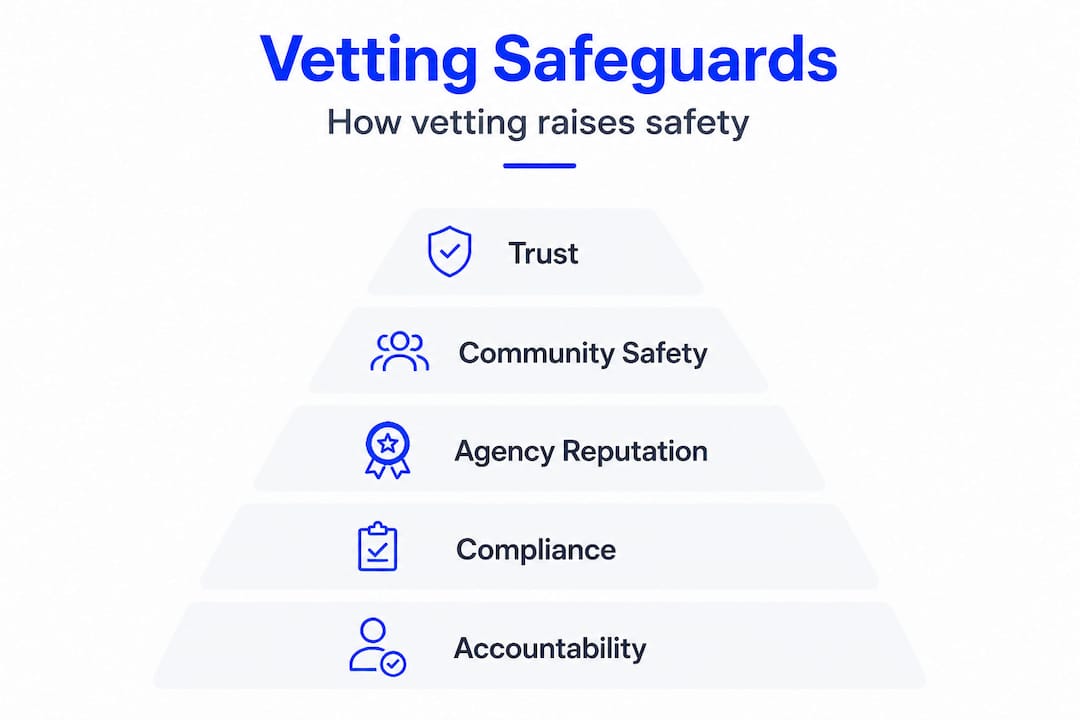
The benefits of rigorous, regularly reviewed vetting show up at multiple levels simultaneously. For the agency itself, law enforcement screening best practices consistently demonstrate lower rates of misconduct complaints, fewer internal affairs referrals, and reduced legal expenditure when vetting is treated as an ongoing governance function rather than a pre-hire checkbox.
Consider what robust vetting produces at the personnel level:
- Stronger team cohesion because officers have confidence their colleagues were held to the same standard
- Fewer conduct-related terminations because character issues were identified before hire rather than discovered after incidents
- Lower turnover because well-vetted officers tend to align with agency values and remain for longer tenures
- Reduced risk of insider threats as ongoing monitoring catches behavioral changes that post-hire risk assessments would surface
- Greater resilience under public scrutiny because the agency can demonstrate documented, evidence-based hiring decisions when challenged
The second critical insight here is that vetting must not be treated as a static gate that candidates either pass or fail at the time of hire. Research on best practices for law enforcement hiring in 2026 confirms that the operational environment changes, individuals’ circumstances change, and what was true about someone’s financial stability or social associations at hire may have shifted materially three years later.
As Her Majesty’s Inspectorate of Constabulary and Fire and Rescue Services documented in its review of Thames Valley Police, vetting is not a one-time event; robust processes typically include periodic and annual review cycles with proper governance to prevent clearances from becoming outdated or ineffective. Annual reviews are not bureaucratic overhead. They are how agencies detect early indicators of corruption, exploitation, or behavioral deterioration before they become public incidents.
“Vetting is not a standalone formality. It is, at its best, an ongoing risk management function that connects individual suitability to organizational integrity and community safety.”
The ICE Vetting Program applies a similar logic: gather background information to support fitness determinations and continuously reassess when roles are sensitive or time-dependent. This risk-management orientation distinguishes agencies with strong vetting cultures from those treating it as an administrative hurdle.
Pro Tip: Structure your re-vetting schedule around role sensitivity, not just calendar years. Personnel in intelligence functions, internal affairs, or digital forensics units should be reviewed more frequently than those in lower-risk assignments, with formal documentation of the rationale for each review interval.
Ensuring fairness and quality: Addressing bias and consistency in vetting
While robust vetting creates safety, its quality depends on fairness and consistency. Even when agencies apply standardized policies, vetting outcomes can vary in ways that raise legitimate legal and ethical concerns.
A 2025 experimental study on police vetting bias found that vetting outcomes can vary by protected characteristics in complex, multi-stage situations, underscoring the need for active bias monitoring within vetting systems. This finding is not an argument against rigorous vetting. It is an argument for structured, auditable, and transparent vetting that can withstand scrutiny from multiple directions.
The data below illustrates how scenario complexity influences the risk of inconsistent outcomes:
| Vetting scenario complexity | Bias risk level | Recommended safeguard |
|---|---|---|
| Single-stage, standardized check | Low | Documented criteria with audit trail |
| Multi-stage with subjective judgment | Moderate | Panel review, written rationale required |
| High-discretion, unstructured interview | High | Structured interview rubric, bias training |
| Multi-factor risk assessments (no rubric) | Very high | Independent review, outcome monitoring by demographics |
The vetting process for consistency must therefore include structural safeguards alongside the investigative components. Practically, this means:
- Regular demographic audits of approval and denial rates, disaggregated by protected characteristics such as race, gender, and national origin
- Structured decision rationale documentation for every outcome, especially denials and conditional approvals
- Panel review requirements for any case involving high discretion or ambiguous evidence
- Ongoing bias awareness training for all personnel involved in vetting decisions
- Clear escalation protocols when an investigator or reviewer identifies a potential bias risk in a specific file
- Formal feedback loops where audited outcomes inform updates to criteria, training, and process design
Consistency in decision rationale is not just an ethical obligation. It is a legal one. Agencies that cannot demonstrate equivalent standards were applied to all applicants face heightened exposure in equal employment lawsuits, civil rights complaints, and federal compliance reviews. The investment in bias monitoring, auditing, and structured governance is far less costly than defending a discrimination claim after the fact.
It is worth emphasizing that fairness and rigor are not in conflict. The agencies with the most defensible vetting programs are those where every decision is documented, where reviewers are trained and accountable, and where audit data drives continuous process improvement. Consistency in standards protects the agency just as much as it protects applicants.
Integrating vetting into your agency’s full risk governance framework
With the components of effective vetting clearly established, the final structural challenge is ensuring vetting does not operate as an isolated function. From a methodology standpoint, vetting effectiveness depends on running appropriate checks, not using vetting in isolation, and linking it to a wider protective security regime with consistent standards and controlled deviations.
Vetting is not a gate; it is a thread running through the entire lifecycle of personnel management. Agencies that treat initial vetting as a complete solution, without connecting it to continuous monitoring, conduct management, and security protocols, leave significant risk unaddressed. Consider the structure below for streamlining vetting workflow within a broader risk governance framework:
- Initial pre-employment vetting: Conduct the full suite of checks (criminal, financial, reference, psychological, OSINT) before any conditional offer is extended, with documented outcomes for every component.
- Clearance level assignment: Assign personnel to access and authority tiers based on vetting outcomes, ensuring that the scope of clearance matches the role’s actual risk exposure.
- Onboarding integrity briefing: Ensure all new personnel understand the agency’s conduct standards, reporting obligations, and the consequences of integrity failures before they take on operational duties.
- Periodic re-vetting reviews: Implement structured review cycles tied to role sensitivity and individual risk indicators, with formal documentation and governance for each review cycle.
- Continuous behavioral monitoring: Establish systems to flag and respond to conduct complaints, financial alerts, social media concerns, or association changes that arise between scheduled reviews.
- Deviation governance: Require written justification, supervisory approval, and documented oversight for any instance where a standard vetting step is waived, modified, or delayed.
- Downstream risk response: Connect vetting findings to concrete action protocols, including counseling, restricted access, additional investigation, or separation, so that identified risks are actively managed rather than filed away.
- Policy review and improvement cycles: Use data from conduct outcomes, audit findings, and external reviews to revise vetting criteria, procedures, and training at regular intervals.
This framework treats vetting as a living system rather than a finished product. Evidence standardization and clear documentation are essential across all eight steps because they are what allow the agency to demonstrate, at any point, that its processes are legally compliant, operationally consistent, and continuously improving. Without documentation, deviation governance is impossible, and without deviation governance, even strong policies erode over time.
Why law enforcement vetting must be dynamic, not a static formality
The most persistent failure in law enforcement vetting is not a failure of policy. It is a failure of mindset. Agencies that invest in well-designed vetting processes at the point of initial hire, then allow those processes to calcify into annual paperwork exercises, are building a false sense of security. The threat landscape that vetting is designed to address does not stand still.
New technologies introduce new risks. Social media platforms that did not exist five years ago are now significant behavioral intelligence sources. Financial products, cryptocurrency transactions, and informal lending networks create new vectors for corruption and compromise that traditional financial history reviews may not capture. The criminal associations that were not apparent at hire may have formed or deepened during employment. These are not hypothetical concerns; they are documented patterns in officer misconduct cases across the country.
What this field has taught us is that the dynamic vetting processes that distinguish genuinely safe agencies from statistically lucky ones share three characteristics. They are regularly updated to reflect current threat intelligence. They are practiced by trained, accountable reviewers who receive ongoing professional development. And they are connected to organizational feedback loops that allow recent misconduct cases to inform the next round of process improvements.
The uncomfortable truth is that many agencies update their vetting procedures reactively, only after a high-profile failure has already occurred. By that point, the damage to public trust, community relations, and officer morale has already been done. The enhancing integrity with adaptable policies framework argues for a different approach: treat every review cycle, every audit finding, and every conduct case as an input into a continuous improvement process that adjusts standards before the next failure rather than after it.
The real test of a vetting program is not what it blocks today. It is what it is structured to prevent tomorrow, under conditions that may look very different from those that existed when the policy was last revised.
Need help strengthening your vetting process?
The evidence is clear: well-designed, consistently applied, and continuously reviewed vetting is one of the most powerful tools available to public safety agencies for protecting their personnel, their communities, and their institutional credibility. Translating that evidence into operational practice requires the right tools, processes, and expertise.

OMNI Intel was built specifically for this challenge. Our pre-employment screening services are designed around the investigator-driven rigor that law enforcement hiring demands, not generic corporate screening models. From public safety background checks that span criminal, financial, social media, and reference evidence, to fully documented pre-employment investigations that support defensible, FCRA-compliant hiring decisions, OMNI Intel gives recruitment officers and HR managers the structured capability to vet with confidence. Connect with our team to discuss how we can integrate with your existing workflow and strengthen every stage of your vetting cycle.
Frequently asked questions
How often should law enforcement agencies re-vet personnel?
Best practice is annual or periodic review, because clearances become outdated over time when circumstances, associations, or conduct patterns change after initial hire. High-sensitivity roles warrant more frequent review intervals than standard assignments.
What are the main risks if vetting is rushed or incomplete?
Rushed vetting allows unsuitable candidates to enter the force, directly increasing risk of public harm and reputational damage that erodes community trust and exposes the agency to legal liability. The downstream costs consistently exceed the cost of thorough upfront investigation.
How can agencies reduce bias in the vetting process?
Agencies should conduct demographic audits, require structured decision rationale, and train reviewers to recognize and address bias, because vetting outcomes can vary by protected characteristics in complex or high-discretion decision scenarios. Structured panel reviews for ambiguous cases add a further safeguard.
Is vetting a law enforcement requirement in the US?
Vetting is widely required across public safety agencies for suitability, trust, and compliance purposes, though specific standards, depth of investigation, and legal frameworks differ between federal, state, and local jurisdictions. Most agencies are subject to both statutory requirements and professional guidance from oversight bodies.
Can technology help improve vetting efficiency?
Yes. Technology platforms can support integrated background screening, continuous monitoring, bias tracking, and documentation governance in a single workflow, reducing processing time while improving the consistency and auditability of outcomes across large candidate pools.