
Why Verify Applicant Credentials in Public Safety Hiring
Accepting applicant documents at face value creates dangerous blind spots in public safety hiring. Digital submissions seem convenient, but they open the door to forged credentials, borrowed identities, and misrepresented qualifications that put communities at risk. For agencies responsible for public safety, thorough credential verification isn’t just administrative housekeeping. It’s the foundation of hiring integrity, legal compliance, and community trust. This guide explains why verification matters, what goes wrong without it, and how to implement effective screening processes that protect your agency and the people you serve.
Table of Contents
- Risks Of Relying Solely On Digital Document Submissions
- The Importance Of A Human Element In Background Checks
- Consequences Of Inadequate Verification In Public Safety Hiring
- Best Practices And Guidelines For Verifying Applicant Credentials
- Explore Expert Screening Solutions For Public Safety Hiring
- Frequently Asked Questions
Key takeaways
| Point | Details |
|---|---|
| Verification reduces negligent hiring | Thorough credential checks prevent unqualified or dishonest candidates from entering public safety roles |
| Digital-only submission invites fraud | Uploaded documents are easily altered, forged, or borrowed without physical inspection |
| Human oversight catches what technology misses | Trained investigators detect irregularities in biometrics, character, and documentation that automated systems overlook |
| Poor vetting creates costly consequences | Inadequate verification leads to misconduct, legal liability, reputational damage, and community safety threats |
| Multi-layered verification follows best practices | Combining employment, education, criminal, and psychological checks with standardized evaluation reduces hiring risks |
Risks of relying solely on digital document submissions
Digital document uploads streamline application processes, but they create serious vulnerabilities in public safety hiring. Digital submission of documents alone opens the door to altered PDFs, borrowed documents, and misrepresented credentials. Trusted security industries require physical inspection by trained screeners precisely because digital files are so easy to manipulate. Relying on applicant-submitted files risks hiring unqualified or dishonest candidates who pose threats to agency integrity and community safety.
Common digital document forgery methods include:
- Altered PDFs with modified dates, grades, or certifications
- Borrowed identification documents from friends or relatives
- Fake diplomas purchased from diploma mills or created with design software
- Photoshopped transcripts showing credentials never earned
- Scanned copies of legitimate documents with details digitally changed
Human inspection combined with technology enhances detection capabilities. Physical documents reveal texture, watermarks, and security features that digital copies hide. Trained screeners spot inconsistencies in formatting, fonts, and institutional seals that automated systems miss. Background checks explained for public safety roles require this multi-layered approach because the stakes are so high.
Accepting digital documents without verification is like trusting a suspect’s alibi without checking it. Both create unacceptable risks when public safety hangs in the balance.
Agencies that implement pre-employment background check guides for public safety understand that convenience can never trump thoroughness. Every shortcut in verification creates an opportunity for fraud, and every fraudulent hire creates liability your agency can’t afford.

The importance of a human element in background checks
Biometric methods like fingerprinting have inherent limitations requiring human judgment. Fingerprinting requires a human element due to biometric capture challenges that technology alone can’t overcome. Physical issues like worn or damaged fingerprints can cause software failure, leaving gaps in verification that only trained technicians can address. Trained technicians catch issues software overlooks, increasing accuracy and reducing false rejections that could cost you qualified candidates.
Human investigators verify character aspects that data alone can’t reveal. They conduct interviews, follow up on inconsistencies, and assess credibility in ways algorithms never will. Background screening best practices for HR emphasize this human judgment because public safety roles demand more than checkbox compliance.
Biometric challenges requiring human expertise include:
- Worn ridges from manual labor or aging that prevent clear prints
- Scars from injuries that distort fingerprint patterns
- Dry or sweaty skin affecting print quality during capture
- Missing fingers or partial amputations requiring alternative identification
- Medical conditions like eczema or psoriasis that damage ridge detail
Pro Tip: Blend technology with skilled personnel for best results. Use automated systems to flag potential issues, then deploy trained investigators to resolve them. This combination catches fraud that pure automation misses while maintaining efficiency that pure manual review can’t match.
Agencies that conduct employee background checks effectively understand that technology amplifies human judgment rather than replacing it. The most sophisticated screening platform still needs experienced investigators to interpret results, follow leads, and make final determinations about candidate suitability.
Consequences of inadequate verification in public safety hiring
Real-world data reveals the heavy costs of poor credential verification. Inadequate vetting led to misconduct and costly lawsuits in major police forces, with over 130 misconduct cases traced directly to insufficient pre-employment screening. Statistics show personnel lacking complete pre-employment references create ongoing liability, while vetting review panels that overturn initial refusals often see subsequent misconduct reports from those same hires.
| Verification Level | Annual Misconduct Incidents per 1000 Officers | Average Legal Costs per Incident | Community Trust Rating |
|---|---|---|---|
| Robust multi-layered vetting | 12 | $45,000 | 78% positive |
| Basic digital-only checks | 42 | $125,000 | 51% positive |
| Reduction with proper vetting | 71% fewer incidents | 64% lower costs | 53% higher trust |
Consequences of inadequate verification extend beyond statistics:
- Legal costs from negligent hiring lawsuits that drain agency budgets
- Reputational harm eroding community trust and cooperation
- Operational risks when unqualified personnel make critical errors
- Community safety threats from officers or responders who shouldn’t be in the field
- Morale damage among qualified staff who resent working alongside unvetted colleagues
The cost of thorough verification is measured in thousands. The cost of negligent hiring is measured in careers, reputations, and sometimes lives.
Agencies that avoid hiring risks through master pre-employment background investigations understand that cutting corners on verification creates exponentially larger problems down the road. Every dollar saved on screening can cost hundreds in legal fees, settlements, and reputation repair.
Best practices and guidelines for verifying applicant credentials
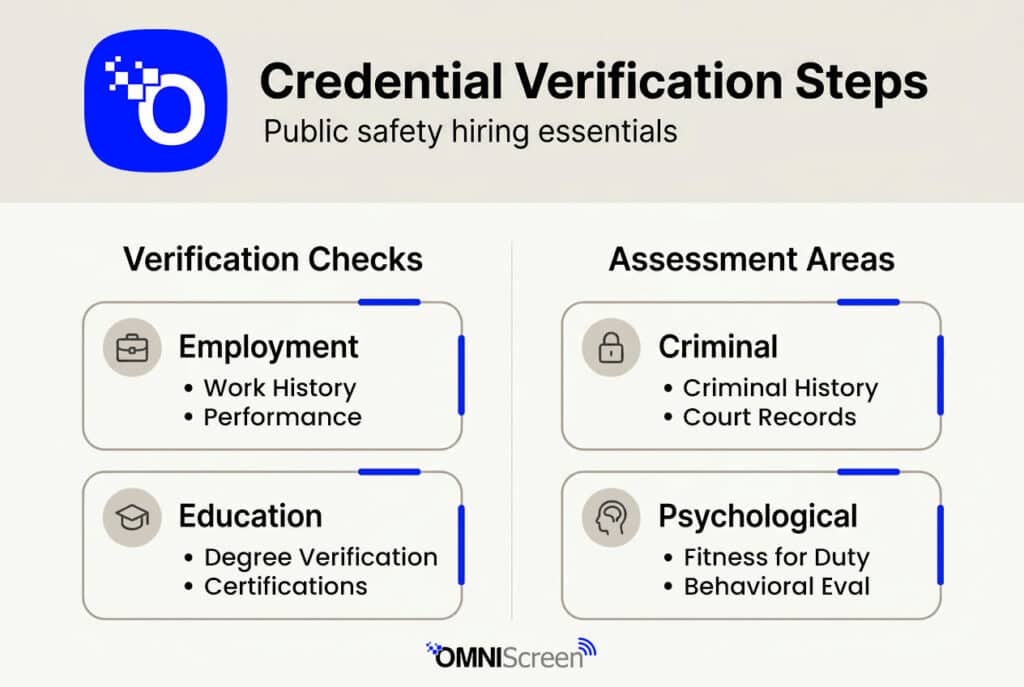
Background checks should include employment, education, criminal, psychological, and polygraph components as needed for the specific role. Background checks use multifaceted approaches guided by industry standards like IACP and POST manuals that reflect decades of law enforcement hiring experience. These frameworks provide tested protocols for thorough verification while respecting legal boundaries and candidate rights.
| Check Component | Primary Purpose | When to Apply |
|---|---|---|
| Employment verification | Confirm work history, performance, and reasons for leaving | All candidates |
| Education verification | Validate degrees, certifications, and specialized training | Roles requiring specific credentials |
| Criminal history | Identify convictions, pending charges, and patterns of behavior | All public safety positions |
| Psychological evaluation | Assess mental fitness, stress tolerance, and judgment | High-stress roles like law enforcement |
| Polygraph examination | Verify honesty about undisclosed issues | Sensitive positions with security clearance |
Step-by-step best practices for verification processes:
- Establish written policies defining verification requirements for each position type
- Require candidates to sign comprehensive release forms authorizing all verification activities
- Contact employers, schools, and references directly rather than accepting provided documentation alone
- Conduct criminal history checks at local, state, and federal levels appropriate to the role
- Use standardized evaluation criteria applied consistently across all candidates
- Document every verification step, finding, and decision for legal defensibility
- Implement quality control reviews of completed background investigations before hiring decisions
- Address discrepancies through follow-up interviews allowing candidates to explain inconsistencies
Legal and practical challenges from expunged and juvenile records create blind spots requiring careful navigation. Expunged records don’t appear in standard checks, yet the underlying behavior may indicate character issues. Agencies must balance legal restrictions on accessing sealed records with their duty to thoroughly vet candidates.
Pro Tip: Maintain standardized evaluation criteria and use diverse review panels to reduce bias and errors. Multiple reviewers catch issues single investigators miss, while documented standards prevent inconsistent decisions that create legal exposure.
Agencies exploring key types of background checks for public safety hiring benefit from understanding which components matter most for specific roles. Entry-level positions may require less intensive screening than command staff, but every hire deserves thorough verification appropriate to their responsibilities. Implementing a pre-employment screening workflow for public safety ensures consistency, completeness, and compliance across all hiring decisions.
Explore expert screening solutions for public safety hiring
Verifying applicant credentials demands specialized expertise, investigative resources, and comprehensive databases that most agencies struggle to maintain in-house. Expert screening services streamline verification while enhancing accuracy through dedicated investigators trained in public safety hiring requirements. These solutions combine technology platforms with human oversight to catch fraud, confirm credentials, and assess character in ways that protect your agency and community.

Specialized public safety pre-employment screening services tailor verification processes to law enforcement, fire, EMS, and security roles. They understand the unique risks, legal requirements, and community expectations that make public safety hiring different from corporate recruitment. Professional background checks for public safety go beyond checkbox compliance to deliver the thorough investigations your agency needs. Comprehensive public safety background investigations provide the depth and expertise that protect your hiring decisions from fraud, liability, and regret.
Frequently asked questions
Why is verifying applicant credentials crucial in public safety hiring?
Thorough credential verification protects agencies from negligent hiring liability while ensuring only qualified, trustworthy candidates enter public safety roles. It prevents fraud, confirms competence, and demonstrates due diligence that courts recognize as reasonable care. Communities trust agencies that thoroughly vet personnel, while background checks for public safety roles reduce misconduct incidents by over 70% compared to minimal screening.
How can agencies mitigate risks posed by expunged or incomplete records?
Agencies should conduct comprehensive interviews exploring gaps in employment or education history, use psychological evaluations to assess character beyond criminal records, and implement polygraph examinations for sensitive positions. While you can’t access sealed records directly, thorough questioning about the time periods involved often reveals relevant information candidates voluntarily disclose. Standardized evaluation criteria help assess candidates fairly when record gaps exist.
What distinguishes verification beyond digital document submission?
Effective verification contacts sources directly rather than accepting applicant-provided documents, uses trained investigators to spot fraud indicators digital files hide, and combines multiple verification methods to cross-check information. Physical document inspection reveals security features and alterations that scanned copies conceal. Human judgment interprets inconsistencies and follows leads that automated systems can’t recognize or pursue.
How should agencies handle discrepancies discovered during verification?
Conduct follow-up interviews giving candidates opportunity to explain inconsistencies before making adverse decisions. Document the discrepancy, the candidate’s explanation, and your evaluation of their credibility. Some discrepancies reflect innocent errors or misunderstandings, while others indicate intentional deception. Consistent evaluation criteria and multiple reviewers reduce bias in assessing explanations.
Should agencies continue monitoring credentials after hiring?
Ongoing monitoring detects license expirations, criminal charges, and professional sanctions that occur post-hire, allowing agencies to address issues before they create liability. Periodic re-verification of critical credentials ensures personnel maintain required certifications. Continuous monitoring demonstrates sustained commitment to integrity that protects agency reputation and community safety throughout employment, not just at hiring.