
Employee Monitoring Best Practices for Public Safety 2026
Public safety agencies face mounting pressure to protect sensitive data while maintaining employee trust. Without proper monitoring practices, agencies risk data breaches, compliance violations, and damaged morale. This guide delivers actionable best practices for implementing effective employee monitoring that enhances workplace integrity, reduces legal risks, and supports your mission. You’ll learn how to prepare, execute, and verify monitoring programs that balance security needs with ethical standards and employee rights.
Table of Contents
- Understanding The Need For Employee Monitoring In Public Safety
- Preparing For Effective And Compliant Employee Monitoring
- Executing Employee Monitoring: Tools And Strategies
- Verifying Monitoring Effectiveness And Maintaining Ethical Standards
- Explore Comprehensive Background And Monitoring Solutions With OMNI Intel
- Frequently Asked Questions About Employee Monitoring Best Practices
Key takeaways
| Point | Details |
|---|---|
| Monitoring reduces security incidents | Properly implemented systems decrease breaches by 30-40% in public safety environments. |
| Legal compliance is non-negotiable | Undisclosed monitoring creates privacy violation and labor practice risks. |
| Transparency builds trust | Clear communication about monitoring purposes and scope maintains employee acceptance and morale. |
| Advanced tools offer comprehensive protection | AI sentiment analysis, geolocation, and DLP features prevent data exfiltration. |
| Regular audits ensure effectiveness | Continuous review maintains ethical standards and adapts to emerging threats. |
Understanding the need for employee monitoring in public safety
Your agency handles sensitive information daily. From confidential investigations to protected personal data, the stakes are extraordinarily high. Electronic monitoring protects proprietary information, detects insider threats, ensures compliance, investigates misconduct, and improves productivity. Without robust monitoring, you’re vulnerable to data exfiltration, unauthorized access, and security breaches that compromise operations and public safety.
Insider threats represent one of your most significant vulnerabilities. Disgruntled employees, compromised credentials, or simple negligence can expose classified information or sensitive case files. When implemented correctly, employee monitoring significantly reduces security incidents within public safety agencies. This isn’t about distrust. It’s about creating accountability frameworks that protect your mission, your personnel, and the communities you serve.
Regulatory compliance drives monitoring requirements across multiple frameworks. Federal mandates, state privacy laws, and industry standards create complex obligations. Your employee monitoring process must address these requirements while supporting internal investigations and quality control initiatives.
Consider these core benefits of structured monitoring:
- Protection of confidential investigative data and personally identifiable information
- Early detection of policy violations before they escalate into serious incidents
- Evidence collection for misconduct investigations and disciplinary proceedings
- Productivity insights that identify training needs and operational inefficiencies
- Compliance documentation demonstrating due diligence to auditors and oversight bodies
Effective monitoring creates a culture of accountability where employees understand expectations and agencies can demonstrate their commitment to security and integrity.
The balance between security and privacy requires careful calibration. Overly intrusive practices damage morale and create legal exposure. Insufficient monitoring leaves gaps that adversaries exploit. Your goal is implementing proportionate controls that address real risks without creating a surveillance culture that undermines trust.
Preparing for effective and compliant employee monitoring
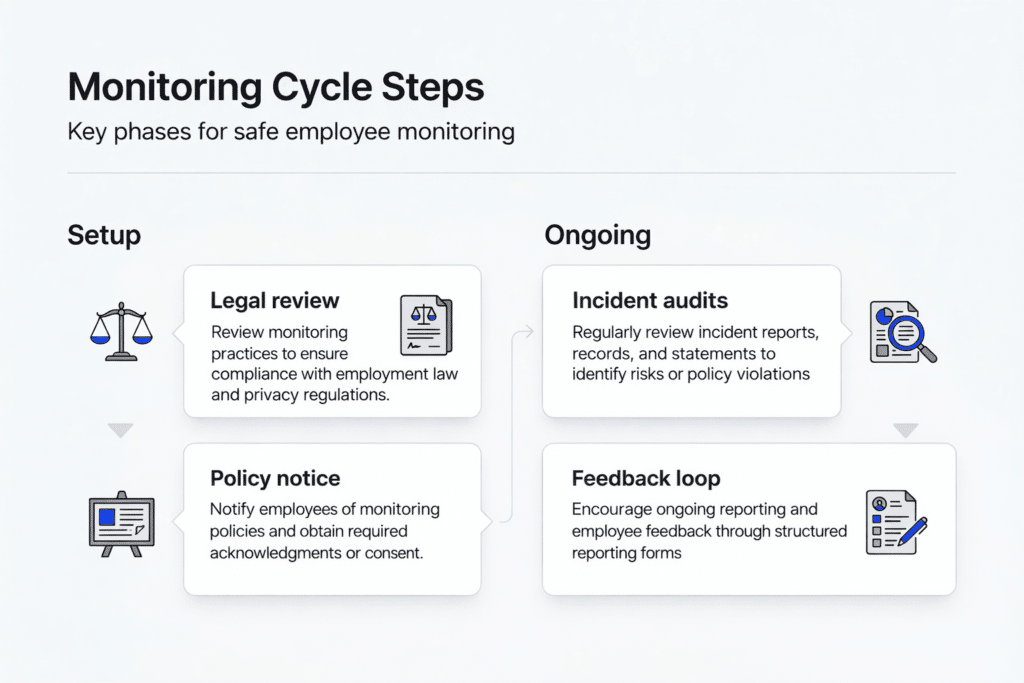
Before deploying any monitoring technology, you must establish legal and ethical foundations. Undisclosed or overly intrusive monitoring triggers invasion of privacy claims, wiretapping violations, and unfair labor practice charges. Your preparation phase determines whether monitoring enhances security or creates liability.
Start with comprehensive legal review. Federal laws like the Electronic Communications Privacy Act set baseline requirements, but state laws vary dramatically. California, Connecticut, and Delaware impose strict notice requirements. Some states mandate consent for specific monitoring types. Consult legal counsel familiar with public sector employment law in your jurisdiction. Document your compliance analysis for future audits.
Transparency forms the cornerstone of ethical monitoring. Clear communication about monitoring builds trust and ensures employee acceptance. Your policy should specify what you monitor, why you monitor it, how data is used, who has access, and retention periods. Distribute policies during onboarding and provide annual refreshers. Make policies easily accessible through your intranet or employee handbook.

Data security for monitoring information deserves special attention. The behavioral data you collect reveals patterns, communications, and activities that could be weaponized if breached. Implement encryption for data at rest and in transit. Restrict access using role-based controls. Establish audit trails tracking who views monitoring data and when. Your implementation workflow should include security protocols that match the sensitivity of collected information.
Employee morale impacts monitoring success. Position monitoring as accountability, not surveillance. Emphasize how it protects everyone by detecting threats early, ensuring fair treatment, and maintaining operational integrity. Share aggregate insights showing how monitoring improves security without identifying individuals. This framing helps employees see monitoring as a professional standard rather than personal distrust.
Pro Tip: In unionized environments, monitoring often constitutes a mandatory bargaining subject. Engage union representatives early in the planning process. Their input can identify concerns, suggest improvements, and build buy-in that prevents grievances. Document all discussions and agreements in writing.
These preparation steps create sustainable monitoring programs:
- Conduct legal compliance review covering federal, state, and local requirements
- Draft clear policies explaining monitoring scope, purposes, and data handling
- Implement technical security controls protecting monitoring data from unauthorized access
- Develop communication plans that position monitoring as accountability and protection
- Engage stakeholders including unions, privacy officers, and IT security teams
- Create governance structures defining roles, responsibilities, and oversight mechanisms
Your monitoring checklist should capture these preparation elements before technology deployment begins. Skipping preparation creates technical debt that’s expensive to remediate later.
Executing employee monitoring: tools and strategies
Modern monitoring extends far beyond basic activity logs. Advanced tools now offer AI sentiment detection, geolocation tracking, and real-time screen capture that provide comprehensive visibility into employee activities. Selecting the right tools and implementing them systematically determines program effectiveness.
Data Loss Prevention capabilities should anchor your technology stack. DLP features within monitoring systems prevent sensitive data exfiltration, reducing breaches by up to 60%. These tools identify when employees attempt to transfer classified information to unauthorized locations, copy files to personal devices, or email protected data to external addresses. Configure DLP policies matching your data classification scheme and regulatory requirements.
Follow this systematic deployment approach:
- Define monitoring objectives aligned with specific security risks and compliance requirements
- Select tools offering features matching your objectives while respecting privacy boundaries
- Configure monitoring parameters including what activities trigger alerts and logging levels
- Conduct pilot testing with a small group to identify technical issues and gather feedback
- Refine configurations based on pilot results, adjusting sensitivity to reduce false positives
- Deploy broadly with phased rollout allowing support teams to manage questions and issues
- Monitor system performance and user feedback, making continuous improvements
Your tool selection should consider these capabilities:
| Feature | Purpose | Public Safety Application |
|---|---|---|
| Keystroke logging | Captures typed content | Detects unauthorized database queries or information sharing |
| Screen recording | Visual activity documentation | Provides evidence for misconduct investigations |
| Email monitoring | Communication oversight | Identifies policy violations or inappropriate external contacts |
| Web filtering | Internet usage control | Blocks access to malicious sites or inappropriate content |
| File tracking | Document movement monitoring | Prevents case file exfiltration or unauthorized copying |
| Application control | Software usage management | Ensures only approved tools access sensitive systems |
Data security policies must govern retention and access throughout the monitoring lifecycle. Establish retention periods matching legal requirements and operational needs. Implement automatic deletion for data exceeding retention limits. Restrict access to monitoring data using the principle of least privilege. Your data security practices should treat monitoring information with the same rigor as investigative files.
Continuous improvement requires measuring monitoring effectiveness. Track metrics like incident detection rates, false positive percentages, response times, and policy violation trends. Use this data to refine configurations, update policies, and demonstrate value to stakeholders. Your effective monitoring checklist should include regular performance reviews.
Verifying monitoring effectiveness and maintaining ethical standards
Implementation marks the beginning, not the end, of your monitoring journey. Regular verification ensures programs remain legally compliant, ethically sound, and operatively effective.
Conduct quarterly compliance audits examining whether monitoring practices align with stated policies and legal requirements. Review access logs to verify only authorized personnel view monitoring data. Check retention practices against documented schedules. Assess whether monitoring scope remains proportionate to identified risks.
Ethical frameworks guide decision-making when policy doesn’t provide clear answers. Europol developed an ethical decision-making model for law enforcement technology assessments that you can adapt. This model evaluates technologies against principles like proportionality, necessity, transparency, and accountability. Apply these principles when considering new monitoring capabilities or responding to unusual situations.
Transparency reports build trust by demonstrating responsible monitoring practices. Share aggregate statistics about monitoring activities without compromising individual privacy. Report how many policy violations were detected, what types of incidents occurred, and how monitoring improved security. Explain any policy changes and the reasoning behind them. This transparency in public safety monitoring reinforces that monitoring serves legitimate purposes rather than unchecked surveillance.
Employee feedback mechanisms provide measured truth about monitoring impacts. Anonymous surveys can reveal whether employees understand policies, feel monitoring is fair, or have concerns about implementation. Exit interviews offer insights into whether monitoring contributed to departure decisions. Use this feedback to identify blind spots and make adjustments that maintain effectiveness while preserving morale.
Policy updates must keep pace with evolving technology and threats. Review monitoring policies annually at minimum, or more frequently when introducing new tools or responding to incidents. Consider emerging technologies like AI-powered analytics, biometric authentication, or IoT device monitoring. Assess whether current policies adequately address these capabilities or require revision.

Compare verification approaches to determine what works for your agency:
| Approach | Advantages | Limitations |
|---|---|---|
| Internal audits | Deep institutional knowledge, lower cost, ongoing access | Potential bias, limited external perspective |
| Third-party reviews | Independent assessment, specialized expertise, credibility | Higher cost, less frequent, learning curve |
| Peer agency collaboration | Shared learning, practical insights, relationship building | Inconsistent rigor, coordination challenges |
| Automated compliance tools | Continuous monitoring, objective metrics, scalability | Initial setup complexity, false positives |
Your verification strategy should incorporate multiple approaches. Internal audits provide regular oversight. Annual third-party reviews offer independent validation. Automated tools enable continuous compliance monitoring between formal audits.
These verification activities maintain program integrity:
- Quarterly access audits confirming only authorized personnel view monitoring data
- Annual policy reviews updating procedures for new technologies and threats
- Biannual employee surveys measuring understanding and perceptions of monitoring
- Monthly metrics reviews tracking detection rates, false positives, and response times
- Incident post-mortems analyzing whether monitoring performed as expected
- Ethics committee consultations for novel situations lacking clear precedent
Verification isn’t about finding problems. It’s about continuous improvement that keeps monitoring effective, compliant, and aligned with your agency’s values. Regular review demonstrates your commitment to responsible monitoring that serves legitimate security needs without overreaching.
Explore comprehensive background and monitoring solutions with OMNI Intel
Implementing the best practices covered in this guide requires specialized expertise and proven tools. OMNI Intel delivers employee monitoring process guides specifically designed for public safety agencies facing unique security and compliance challenges. Our platform combines comprehensive pre-employment screening with ongoing monitoring capabilities that protect your agency while maintaining employee trust.

Our background investigations leverage law enforcement investigation principles to ensure thorough vetting of applicants and continuous monitoring of personnel. We understand the critical balance between security imperatives and privacy rights in public safety environments. Our solutions integrate seamlessly with your existing systems while providing the compliance documentation and audit trails essential for oversight and accountability. Explore how OMNI Intel can help you implement monitoring programs that enhance integrity, reduce risks, and support your mission.
Frequently asked questions about employee monitoring best practices
What legal risks should be considered before starting employee monitoring?
Undisclosed monitoring creates exposure to invasion of privacy claims, wiretapping statute violations, and unfair labor practice charges. State laws vary significantly on notice and consent requirements. Consult legal counsel familiar with public sector employment law in your jurisdiction before implementation.
How can agencies maintain employee trust while monitoring?
Transparency is essential. Clearly communicate what you monitor, why it’s necessary, how data is used, and who has access. Position monitoring as accountability that protects everyone rather than surveillance. Share aggregate insights showing security improvements without identifying individuals.
What advanced monitoring tools are most effective in public safety?
Data Loss Prevention systems preventing unauthorized data transfers reduce breaches by up to 60%. AI-powered sentiment analysis detects concerning behavioral patterns. Screen recording provides investigation evidence. Select tools matching your specific risks while respecting privacy boundaries.
How often should employee monitoring policies be reviewed and updated?
Review policies annually at minimum, or more frequently when introducing new technologies or responding to significant incidents. Quarterly compliance audits verify practices align with policies. Continuous monitoring ensures controls function as designed between formal reviews.
What ethical guidelines should guide the use of monitoring technologies?
Apply principles of proportionality, necessity, transparency, and accountability when making monitoring decisions. Ensure monitoring scope matches identified risks. Use the least intrusive methods achieving security objectives. Document decision-making rationale for future review. Consult your monitoring checklist essentials for comprehensive guidance.