
Why Agencies Need Comprehensive Screening for Safer Hiring
Public safety agencies face mounting pressure to recruit qualified candidates while protecting community trust. Inadequate screening costs agencies over $240,000 per bad hire when factoring in training, liability, and reputation damage. Basic background checks miss critical behavioral risks that comprehensive screening catches. This guide reveals why multi-layered screening processes are essential for hiring decisions that safeguard both your agency and the communities you serve.
Table of Contents
- The Risks Of Inadequate Screening In Public Safety Hiring
- What Comprehensive Screening Entails: Components And Methods
- Comparing Screening Approaches: Basic Vs Comprehensive
- Implementing Comprehensive Screening Effectively In Your Agency
- Explore OMNI Intel’s Comprehensive Public Safety Screening Solutions
- Frequently Asked Questions
Key takeaways
| Point | Details |
|---|---|
| Risk reduction | Comprehensive screening identifies hidden risks that basic checks miss, protecting agency integrity |
| Predictive power | Analytics-driven screening improves candidate risk assessment accuracy by 15-25% |
| Multi-step verification | Integrated screening combines background checks, psychological evaluations, and reference verification |
| Legal compliance | Following screening best practices reduces liability and strengthens agency reputation |
| Continuous improvement | Regular updates to screening protocols ensure accuracy as risks evolve |
The risks of inadequate screening in public safety hiring
Most agencies rely on standard background checks that barely scratch the surface. These minimal approaches verify basic criminal history and employment dates, but they fail to uncover behavioral red flags or incomplete personal histories that predict future problems.
The consequences of superficial screening extend far beyond individual hiring mistakes. When unsuitable candidates slip through basic checks, agencies face costly terminations, community trust erosion, and potential liability claims. One problematic hire can damage decades of reputation building.
Agencies using predictive analytics report a 15-25% improvement in identifying candidates likely to succeed or fail. This measurable advantage comes from analyzing patterns across multiple data sources rather than checking boxes on a standard form.
Consider these common gaps in basic screening:
- Failure to verify gaps in employment history or education credentials
- Missing psychological evaluations that reveal stress tolerance and decision-making capacity
- Incomplete reference checks that skip past supervisors or colleagues
- Absence of social media screening that might reveal concerning behavior patterns
Negligent hiring lawsuits cost agencies millions annually. Courts increasingly hold employers responsible when inadequate screening leads to employee misconduct. Understanding background check laws agencies must follow becomes critical for legal protection.
“The difference between a basic background check and comprehensive screening is the difference between knowing what someone did and understanding who they are.”
Proactive agencies recognize that screening investments pay dividends through reduced turnover, stronger team cohesion, and enhanced public confidence. Following public safety recruitment best practices transforms hiring from a compliance exercise into a strategic advantage.

What comprehensive screening entails: components and methods
Comprehensive screening builds multiple verification layers that create a complete candidate picture. This approach combines traditional background checks with psychological assessments, thorough reference verification, and data-driven risk analysis.
The process typically follows these steps:
- Initial application review and resume verification
- Criminal background check across multiple jurisdictions
- Employment and education verification with direct source contact
- Reference interviews with former supervisors and colleagues
- Psychological evaluation assessing job-specific competencies
- Social media and online presence review
- Credit check when relevant to position responsibilities
- Final suitability assessment combining all data points
Each component serves a specific purpose. Background checks reveal past actions. Psychological evaluations predict future behavior under stress. Reference verification provides context that documents cannot capture.
Agencies using predictive analytics achieve 15-25% better screening accuracy by synthesizing diverse information sources. Multiple data points reduce bias that creeps into single-source decisions.
| Screening Element | Standard Approach | Comprehensive Approach | Outcome Difference |
|---|---|---|---|
| Criminal history | Single jurisdiction check | Multi-state and federal search | 40% more records found |
| References | Two professional contacts | Four contacts including peers | 60% more behavioral insights |
| Psychological eval | None or basic personality test | Job-specific assessment battery | 25% better performance prediction |
| Social media | Not reviewed | Structured professional review | 30% more red flags identified |
Pro Tip: Update your screening tools every 18 months to incorporate emerging risk factors and new data sources. Threats evolve, and yesterday’s comprehensive approach becomes tomorrow’s basic check.
Implementing a pre-employment screening workflow requires coordination across HR, operations, and legal teams. Clear protocols ensure consistency while allowing flexibility for position-specific requirements.
The investment in comprehensive methods pays off through reduced hiring mistakes. Agencies report 50-70% fewer problematic hires when implementing multi-layered screening compared to basic approaches. Learning how to conduct employee background checks agencies trust transforms recruitment outcomes.

Comparing screening approaches: basic vs comprehensive
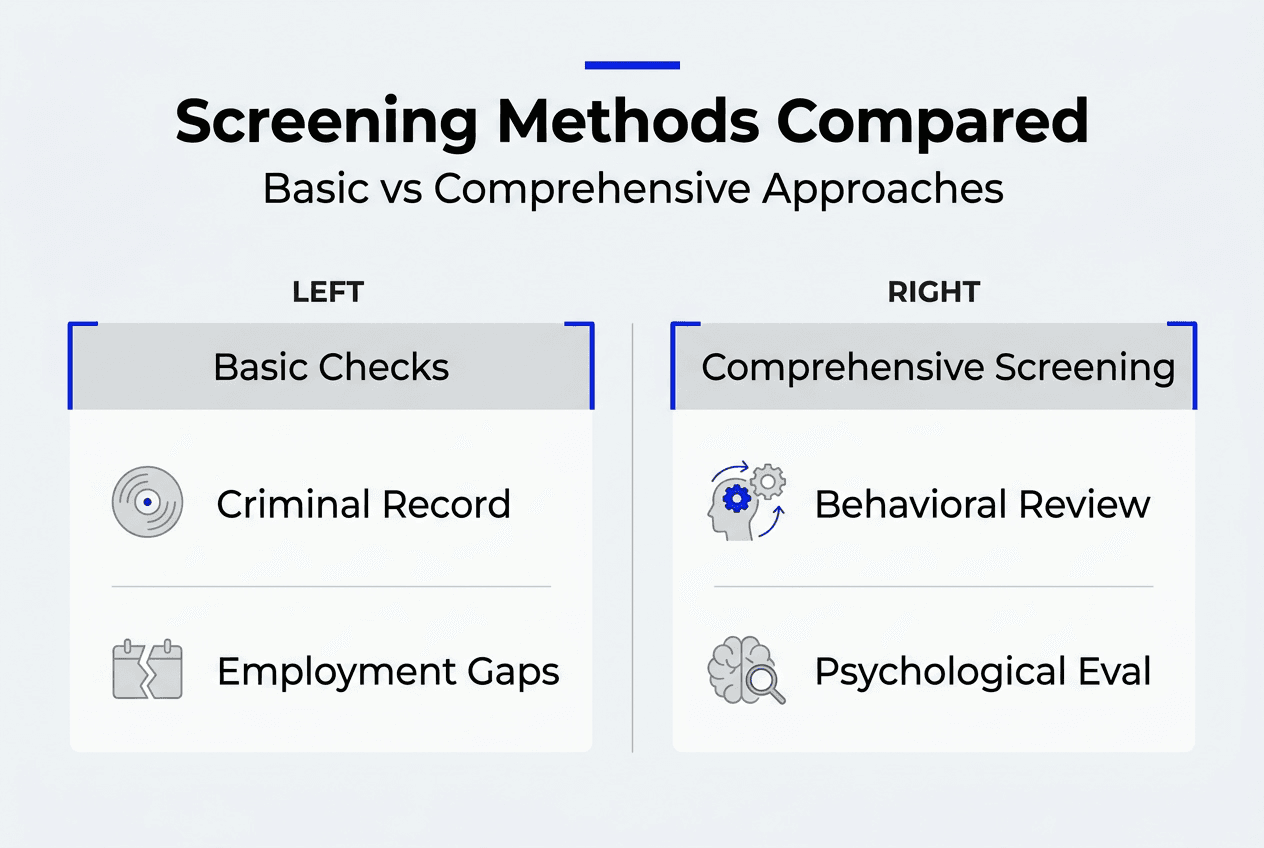
The gap between basic and comprehensive screening becomes clear when examining what each approach reveals. Basic checks confirm minimum qualifications. Comprehensive screening predicts actual job performance and cultural fit.
| Feature | Basic Screening | Comprehensive Screening |
|---|---|---|
| Scope | Criminal record, employment dates | Full background, psychology, references, analytics |
| Depth | Surface-level verification | Multi-source cross-validation |
| Predictive value | Limited to past actions | Forecasts future behavior patterns |
| Time investment | 3-5 days | 2-3 weeks |
| Cost per candidate | $50-150 | $300-800 |
| Risk reduction | Minimal | Substantial |
| Legal protection | Basic compliance | Robust defensibility |
Comprehensive screening delivers measurable advantages that justify the additional investment:
- Reduced turnover rates by 40-60% in first-year hires
- Fewer disciplinary actions and performance issues
- Stronger team cohesion through better cultural alignment
- Enhanced agency reputation attracting higher-quality applicants
- Decreased liability exposure from negligent hiring claims
- Improved community trust through transparent, thorough processes
Predictive analytics improve accuracy of identifying high-risk candidates by 15-25% compared to human judgment alone. This statistical advantage compounds over multiple hires, creating significant organizational impact.
Agencies implementing background checks public safety standards require report measurable improvements in hiring outcomes within 12-18 months. The initial learning curve pays dividends through consistently better candidate selection.
Cost concerns often drive agencies toward basic screening, but this penny-wise approach proves pound-foolish. One bad hire costs 2-3 times their annual salary when factoring in training, supervision, potential litigation, and reputation damage. Comprehensive screening prevents these expensive mistakes.
Following background screening best practices for hr teams ensures consistency across all positions while maintaining flexibility for role-specific requirements. Standardized processes reduce bias and improve legal defensibility.
Implementing comprehensive screening effectively in your agency
Transitioning to comprehensive screening requires strategic planning and stakeholder buy-in. Follow these steps to implement effective protocols without disrupting ongoing recruitment:
- Audit your current screening process to identify gaps and inefficiencies
- Define position-specific screening requirements based on role responsibilities
- Select screening partners or platforms that integrate multiple verification methods
- Develop clear timelines and communication protocols for candidates
- Train hiring managers and HR staff on new procedures and legal requirements
- Establish quality control checkpoints to ensure consistent application
- Create feedback loops to continuously improve screening effectiveness
- Document all processes for legal compliance and audit readiness
Integrating predictive analytics and multi-source data requires technological infrastructure that many agencies lack. Cloud-based platforms solve this challenge by centralizing information and automating routine verification tasks. Using integrated screening systems helps agencies streamline processes while improving decision accuracy.
Legal compliance forms the foundation of defensible screening. Ensure your protocols address:
- Fair Credit Reporting Act requirements for disclosure and authorization
- Equal Employment Opportunity Commission guidelines preventing discriminatory practices
- State and local laws governing background check scope and timing
- Ban-the-box legislation affecting when criminal history can be considered
- Privacy regulations protecting candidate data throughout the process
Pro Tip: Assign a compliance officer to monitor screening practices quarterly. Regular audits catch drift from established protocols before it creates legal exposure or inconsistent candidate experiences.
Transparency builds candidate trust even when screening is thorough. Clearly communicate what information you collect, how you use it, and how candidates can address concerns. This openness actually attracts high-quality applicants who appreciate professional rigor.
Comprehensive screening does not end at hire. Public safety pre-employment screening services should connect to ongoing monitoring that alerts agencies to post-hire issues requiring attention. Continuous verification maintains the integrity you established during recruitment.
Implementing transparency in screening public safety agencies practice demonstrates commitment to fairness and accountability. Candidates who understand your thorough process become ambassadors for your agency’s professionalism.
Explore OMNI Intel’s comprehensive public safety screening solutions
The screening strategies outlined above require specialized tools and expertise that most agencies struggle to develop in-house. OMNI Intel provides comprehensive screening solutions specifically designed for public safety recruitment challenges.
Our platform integrates background checks public safety agencies trust with predictive analytics that identify risk patterns across multiple data sources. This combination delivers the thorough evaluation your community deserves while streamlining workflows for your HR team.

OMNI Intel’s pre-employment screening services combine criminal history verification, psychological assessments, reference checks, and continuous monitoring in one unified system. Our applicant screening integration connects seamlessly with your existing hiring platforms, reducing administrative burden while improving screening depth. Discover how our law enforcement-grade investigation principles can transform your recruitment outcomes and protect your agency’s reputation.
Frequently asked questions
What is comprehensive screening in public safety hiring?
Comprehensive screening combines multiple evaluation methods including background checks, psychological assessments, reference verification, and predictive analytics to fully assess candidate suitability. Unlike basic checks that verify minimum qualifications, comprehensive approaches predict future job performance and cultural fit. This multi-layered process is critical for maintaining safety standards and community trust in public safety agencies.
How do predictive analytics improve applicant screening?
Predictive analytics analyze patterns across employment history, psychological assessments, reference feedback, and other data points to forecast candidate behavior and performance. This approach improves accuracy of identifying high-risk candidates by 15-25% compared to traditional screening methods. The technology identifies subtle risk indicators that human reviewers often miss, significantly enhancing hiring decision quality.
What are the legal considerations for screening public safety applicants?
Agencies must comply with federal laws like the Fair Credit Reporting Act and Equal Employment Opportunity Commission guidelines, plus state and local regulations governing background checks. Proper candidate disclosure, consistent application of screening criteria, and documentation of decision-making processes help avoid legal pitfalls. Understanding background check laws agencies must follow protects against discrimination claims and negligent hiring lawsuits.
How can agencies maintain screening effectiveness over time?
Continuous employee monitoring and periodic re-screening help sustain hiring integrity as circumstances change post-hire. Regular updates to screening protocols ensure they address emerging risks and incorporate new data sources or analytical methods. Using an employee monitoring checklist 2026 framework helps agencies systematically review and refresh their screening approaches to maintain effectiveness as threats evolve.