

What Is Post-Hire Screening for Public Safety?
Every law enforcement leader knows hiring the right people is only the beginning. The ongoing challenge is making sure those sworn to protect and serve remain as dependable years into their careers as they were on day one. As public expectations and workplace risks evolve, post-hire screening becomes a proactive shield, helping your agency spot changes in employee behavior that pre-employment checks might miss and sustain community trust. Discover what a strong post-hire screening program truly delivers for public safety.
Table of Contents
- Defining Post-Hire Screening And Its Purpose
- Types Of Post-Hire Screening In Public Safety
- Key Procedures And Monitoring Methods Explained
- Legal Requirements And Compliance Standards
- Risks, Benefits, And Best Practices
Key Takeaways
| Point | Details |
|---|---|
| Post-hire screening is essential | It shifts focus from pre-employment vetting to ongoing evaluation of employee behavior and risks post-deployment. |
| Early problem detection matters | Continuous monitoring helps identify issues like financial distress or substance abuse that can compromise safety and integrity. |
| Legal compliance is crucial | Adhering to regulations like the FCRA and ADA ensures that the screening process protects employee rights and mitigates legal risks. |
| Clear policies enhance trust | Transparent communication about screening processes fosters a culture of accountability and supports officer well-being. |
Defining Post-Hire Screening and Its Purpose
Post-hire screening represents a critical shift in how public safety agencies approach employee oversight. Unlike pre-employment vetting, which focuses on what candidates were before they joined your organization, post-hire screening examines what employees do after they’ve been sworn in, trained, and deployed. This ongoing evaluation process identifies behaviors and risks that might not have surfaced during initial background checks, ensuring that officers, firefighters, dispatchers, and support staff remain aligned with the integrity standards your agency demands.
The purpose of post-hire screening extends far beyond simply catching problems after the fact. Your agency faces real liability when an employee’s conduct—whether it’s financial distress, substance abuse, criminal activity, or behavioral red flags—goes undetected and ultimately affects public safety or damages community trust. Post-hire screening works as an early detection system, monitoring for changes in an employee’s circumstances, associations, or actions that might compromise their reliability. When officers encounter financial hardship, struggle with substance abuse, develop concerning associations, or engage in questionable conduct outside of work, these situations can impair judgment, increase corruption risk, or create security vulnerabilities. By conducting continual evaluation to ensure trustworthiness and suitability, your agency stays proactive rather than reactive, catching problems during their early stages before they escalate into public incidents or administrative crises.
What makes post-hire screening distinct from routine performance management is its investigative depth and structural consistency. Performance evaluations address job competency and work quality. Post-hire screening, by contrast, examines integrity factors: criminal activity, financial instability, substance abuse indicators, dishonesty, or pattern changes that suggest declining trustworthiness. This includes monitoring for arrests or citations, checking for financial judgments or bankruptcy filings, verifying ongoing compliance with licensing requirements, and conducting periodic background reviews. The screening isn’t punitive in intent. Rather, it acknowledges that people change, circumstances evolve, and what looked solid on a background application five years ago may no longer reflect current reality. Officers who maintain clean records while employed deserve recognition. Those whose situations shift—whether through personal crisis, poor judgment, or deeper issues—receive the support or removal your agency’s safety standards require.
The investigative foundation matters here. Your post-hire screening program should operate with the same rigor and documentation standards that drive your initial hiring investigations. This means using verified data sources, maintaining detailed records, following Fair Credit Reporting Act (FCRA) compliance requirements, and ensuring transparency with employees about what is being monitored and why. Inconsistent or poorly documented screening can invite legal challenges while failing to protect your community. When your post-hire process mirrors law enforcement investigation principles, you build credibility internally and defensively. Officers understand that oversight applies equally to everyone, and you maintain the evidentiary foundation necessary if screening results ever require personnel action.
Pro tip: Establish a formal post-hire screening schedule tied to specific calendar intervals (annual, semi-annual, or quarterly depending on role sensitivity) rather than ad hoc checks, so your agency develops consistent baseline data and can more easily identify meaningful changes in employee status or behavior over time.
Types of Post-Hire Screening in Public Safety
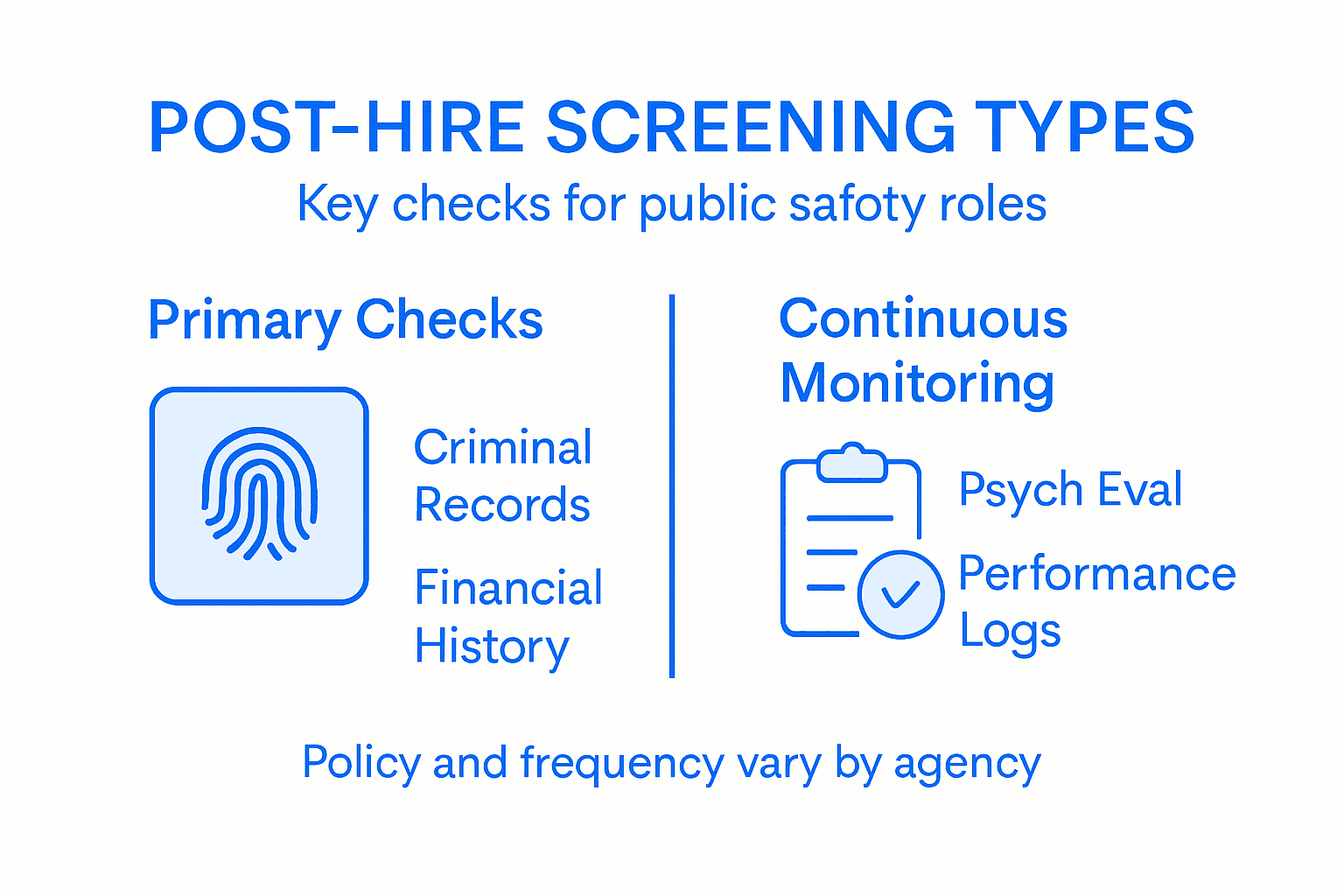
Post-hire screening in public safety agencies isn’t one-size-fits-all. Your department needs a layered approach that addresses the specific vulnerabilities tied to each role and the threats your officers face daily. The most effective programs combine multiple screening methods into a coordinated system that runs continuously or at regular intervals, catching problems before they undermine officer credibility or community trust. The core screening types include criminal history checks, substance abuse monitoring, financial assessments, psychological evaluations, and employment verification. Each serves a distinct purpose, and together they create a comprehensive picture of whether an employee remains suitable for duty.
Criminal history checks form the foundation of post-hire screening. Unlike the initial background investigation, which examined an officer’s history up to the hiring date, post-hire criminal screening monitors for new arrests, citations, charges, or convictions that occur after employment begins. An officer who stays clean after five years of service deserves confidence. One who receives a DUI arrest, faces assault charges, or engages in domestic violence incidents needs immediate attention. Criminal record checks should connect to local, state, and federal databases and occur at intervals your agency determines based on role sensitivity. A patrol officer in a high-crime jurisdiction might warrant annual checks, while administrative staff might receive screening every two to three years. Dispatch centers, where employees have access to sensitive information and can influence officer safety, warrant more frequent monitoring. Substance abuse screening, whether through drug testing, alcohol monitoring, or behavioral indicators, addresses one of the most significant risks to officer judgment and liability. Substance abuse doesn’t always announce itself loudly. An officer might perform adequately on the job while struggling privately with addiction or alcohol dependence. Post-hire screening catches warning signs: erratic behavior, unexplained absences, performance deterioration, or failed drug tests that suggest deeper issues requiring intervention or removal.

Financial assessments examine credit reports, bankruptcy filings, wage garnishments, and court judgments to identify officers facing serious money problems. Financial desperation creates corruption vulnerabilities. An officer drowning in debt becomes susceptible to bribery, theft, or side deals that compromise his integrity and department reputation. Psychological evaluations assess mental fitness and emotional stability. Unlike the pre-hire psychological evaluation, which examines baseline suitability, post-hire psychological screening can catch signs of depression, trauma, burnout, or declining mental health that affect decision-making and fitness for duty. Employment verification confirms that officers maintain required certifications, licenses, and training credentials. A patrol officer whose law enforcement certification lapses, a paramedic whose medical credentials expire, or a dispatcher whose communications qualification becomes invalid should be flagged immediately. Finally, education and history verification ensures that the background officers provided during hiring hasn’t changed materially and that any discrepancies between initial claims and current reality are addressed.
Here’s a summary comparing major post-hire screening types and their unique focus:
| Screening Type | Main Focus | Typical Indicators Monitored | Protective Benefit |
|---|---|---|---|
| Criminal history | Law compliance | New arrests, charges, convictions | Prevents liability, maintains trust |
| Substance abuse | Fitness for duty | Drug tests, erratic conduct, absences | Reduces risk, early intervention |
| Financial assessment | Integrity and vulnerability | Credit reports, bankruptcies, judgments | Prevents corruption, supports stability |
| Psychological eval. | Mental and emotional health | Mood shifts, trauma responses | Mitigates burnout, prevents escalation |
| Employment verification | Certification upkeep | License validity, required training | Ensures qualifications, flags lapses |
The frequency and scope of post-hire screening depends on your state’s regulations, your department’s policies, and the sensitivity of each role. Screening methods and frequency requirements vary significantly by state and employer type, so you need clarity on your jurisdiction’s mandates. Some states require annual checks for all law enforcement officers. Others mandate screening only when reasonable suspicion of a problem emerges. Best practice suggests establishing a baseline schedule that applies consistently, then conducting additional targeted screening when specific concerns arise. A dispatcher with access to confidential information warrants more frequent monitoring than a records clerk. An officer with a history of complaints or disciplinary action warrants closer observation than one with a clean record. The key is building flexibility into your system so screening intensity reflects actual risk.
Pro tip: Integrate your post-hire screening tools into your human resources management system with automated alerts tied to screening completion dates, so no employee accidentally falls through the cracks due to scheduling oversights or administrative gaps.
Key Procedures and Monitoring Methods Explained
Post-hire screening procedures aren’t vague commitments or occasional spot checks. They’re structured, documented processes that follow the same investigative rigor your agency applies to hiring decisions. Understanding what each procedure accomplishes and how to implement it correctly separates effective screening from compliance theater. Your monitoring methods should balance thoroughness with practicality, ensuring your team can sustain the program over years without burning out on administrative overhead or creating morale problems through perceived overreach.
Psychological evaluations represent one of the most powerful tools in post-hire screening, yet many agencies overlook or underutilize them. Unlike the single pre-hire psychological evaluation, post-hire psychological screening occurs periodically or when specific incidents suggest concerns. Psychological evaluations assess mental fitness for duty and can identify officers experiencing depression, trauma, burnout, substance abuse, or declining emotional stability. An officer who passed the pre-hire psych evaluation with flying colors might later experience critical incident stress after a shooting, struggle with PTSD following a major investigation, or spiral into depression during a divorce or family crisis. Post-hire psychological screening catches these situations before they escalate into poor judgment calls, use-of-force incidents, or officers going rogue. The key is conducting these evaluations with clinical expertise and legal compliance. Your evaluators must understand law enforcement stressors and the specific mental health challenges your officers face. They must also follow Americans with Disabilities Act guidelines, treating mental health issues as medical concerns rather than character flaws, and maintaining confidentiality while still flagging fitness-for-duty concerns that require action. Medical examinations follow a similar logic. Medical examinations and drug tests conducted periodically verify that officers remain physically capable and free from substances that impair judgment. An officer with unchecked diabetes, hypertension, or sleep apnea faces increased risk of sudden medical emergencies during duty. One struggling with alcohol or prescription drug addiction poses dangers to himself, other officers, and the public. Periodic physicals, including drug screening, create touchpoints for early intervention.
Continuous monitoring protocols track specific data streams without requiring formal evaluations. Criminal database checks flag new arrests or citations. Financial monitoring identifies judgment liens, bankruptcy filings, or wage garnishments. Employment verification confirms that certifications and licenses remain current. These passive monitoring methods run automatically if your systems are configured properly, flagging anomalies without requiring officers to submit to additional testing or evaluations. Stop here. This is critical. The most sustainable post-hire screening programs automate what can be automated while reserving intensive procedures like psychological evaluations and fitness-for-duty assessments for situations where data suggests concerns. An officer with no red flags after three years doesn’t need a full psych evaluation if you’re already monitoring his criminal record, financial status, and licensing status continuously. But one who receives a DUI arrest, faces a theft charge, or shows signs of erratic behavior immediately triggers deeper investigation including psychological evaluation, medical screening, and fitness-for-duty determination.
Implementation requires clear documentation and employee communication. Your post-hire screening policy should specify which procedures apply to which roles, at what intervals screening occurs, what triggers additional screening, and how results are reviewed and acted upon. Officers deserve transparency about what you’re monitoring, why, and how the information is used. When screening feels fair and applied equally, officers are more likely to accept it as legitimate oversight rather than harassment. When it feels capricious or targeted, it breeds resentment and legal vulnerability. Documentation matters defensively as well. If screening results ever lead to personnel action, your records must clearly show that the process was consistent, properly conducted, and reviewed by qualified personnel. A poorly documented fitness-for-duty determination can crumble in arbitration or court, while thorough documentation protects your agency and demonstrates professional management.
Pro tip: Establish a centralized screening calendar that tracks completion dates for each screening type by employee, with automated reminders 30 days before deadlines, so your human resources department stays ahead of requirements rather than scrambling reactively or allowing lapses that undermine program credibility.
Legal Requirements and Compliance Standards
Post-hire screening operates within a complex web of federal, state, and local laws designed to protect employee rights while allowing employers to ensure workplace safety and integrity. Ignoring these requirements doesn’t just create legal exposure. It can invalidate your entire screening program, expose your agency to costly litigation, and undermine the credibility of your hiring and management decisions. Understanding the key legal frameworks isn’t optional for public safety directors and background investigators. It’s foundational.
The Fair Credit Reporting Act (FCRA) governs how employers obtain and use background information, including post-hire screening results. Under FCRA compliance, you must provide employees with clear, written notice before conducting background checks, obtain their written consent, and disclose results if adverse action is taken based on those results. The FCRA applies whether you conduct screening internally or through third-party vendors. This means your post-hire screening policy must explicitly state what you’re monitoring, how often, and what will happen if problems are discovered. Employees cannot claim they didn’t know about post-hire screening if your policy clearly outlines these procedures. The Americans with Disabilities Act (ADA) creates critical restrictions on what you can ask during post-hire medical and psychological evaluations. The Employee Polygraph Protection Act restricts polygraph use in most employment contexts, with narrow exceptions for security firms and certain government positions. For law enforcement agencies, polygraph restrictions vary by state and by whether testing occurs at hiring versus post-hire. Federal law prohibits using polygraph results as the sole basis for personnel decisions, so if you do conduct polygraph testing post-hire, you must corroborate findings with other evidence. The ADA prohibits medical inquiries and testing that would reveal disabilities unless the testing is job-related and consistent with business necessity. Post-hire medical examinations must be carefully designed to assess fitness for duty without unlawfully inquiring about disabilities. An agency cannot require a post-hire psychological evaluation designed to ferret out mental health diagnoses. It can require psychological fitness-for-duty evaluations when specific incidents or data suggest concerns. That’s a legal distinction with enormous practical implications.
GENETIC Information Nondiscrimination Act (GINA) and Equal Employment Opportunity Commission (EEOC) guidance restrict what questions your screening process can ask and prohibit discrimination based on protected characteristics. Post-hire screening legal compliance requires adhering to laws prohibiting discrimination and protecting employee rights. Your post-hire screening procedures must apply consistently across your workforce. If you conduct annual criminal history checks for patrol officers, you must conduct them for all patrol officers, not selectively based on age, race, gender, or other protected characteristics. Selective screening creates liability for discrimination even if no discriminatory intent exists. State and local laws often impose additional requirements beyond federal law. Some states mandate annual post-hire background checks for all law enforcement officers. Others require specific frequency for certain screening types. California imposes strict limits on what employers can consider from criminal records. New York mandates certain mental health resources for officers. Texas requires background checks at specific intervals. Your legal team and human resources department must research your jurisdiction’s specific requirements before finalizing your post-hire screening policy.
Implementation requires documentation that demonstrates compliance and good faith effort. When you conduct post-hire screening, document when it occurred, what methods were used, who conducted the screening, what results were found, and what actions followed. This documentation protects your agency if an employee later challenges the screening or if screening results lead to disciplinary action or termination. Retain these records according to your jurisdiction’s requirements, typically three to seven years depending on state law. Review your post-hire screening program periodically with legal counsel to ensure continued compliance as laws change. Train your human resources team and supervisors on legal requirements so they understand what questions are permissible, what actions are appropriate based on screening results, and what documentation is needed. A well-intentioned screening program can become legally indefensible if procedures violate employee rights or lack proper documentation.
This table summarizes compliance frameworks relevant to post-hire screening:
| Law or Standard | Area Governed | Key Requirement | Impact on Screening Process |
|---|---|---|---|
| FCRA | Background data usage | Written notice, employee consent | Transparent process; limits liability |
| ADA | Disability protections | Job-related medical inquiries | Requires confidentiality, limits screening |
| GINA | Genetic information | Prohibits discrimination | No screening based on genetic data |
| EEOC guidance | Equal employment | Consistent procedures | Prevents selective targeting |
Pro tip: Before implementing any post-hire screening procedure, consult with an employment law attorney familiar with your state’s public safety regulations to verify that your proposed screening methods, frequency, and employee notification processes fully comply with FCRA, ADA, GINA, and state-specific requirements.
Risks, Benefits, and Best Practices
Post-hire screening programs operate in tension. They promise safety, integrity, and early problem detection. They also risk creating distrust, legal vulnerability, and burnout if poorly designed or implemented. Understanding this tension helps you build a program that captures the genuine benefits while minimizing the real risks. The agencies that succeed treat post-hire screening not as a one-time compliance checkbox but as an ongoing commitment requiring resources, leadership attention, and continuous refinement.
The benefits are tangible and substantial. Post-hire screening helps mitigate risks such as involvement in violent incidents or impairment on duty by catching problems before they escalate into public incidents or officer misconduct. An officer struggling with substance abuse gets intervention before he shows up impaired to a call. A financially desperate officer gets referred to employee assistance before he steals from an evidence locker. An officer spiraling into depression gets psychological support before he makes a fatal use-of-force error. Beyond officer-level benefits, your agency gains institutional protection. Early detection reduces liability exposure when screening catches problems before they result in public harm. Your community sees an agency taking integrity seriously, which strengthens public trust even when screening sometimes results in difficult personnel actions. Comprehensive post-hire screening also demonstrates professional management practices that protect your agency defensively in litigation, establishing that your hiring and oversight decisions rest on thorough investigation rather than guesswork. Officers who stay clean benefit from a culture that recognizes integrity. Those with genuine problems get support rather than crisis intervention after catastrophic failures.
The risks are equally real. If your screening feels arbitrary or targeted, officers lose confidence in its fairness. Selective screening or procedures applied inconsistently breed resentment and legal challenges. If your agency lacks clear policies about what triggers additional screening or what happens after screening reveals problems, you create confusion and defensibility issues. Employees may view post-hire screening as invasive surveillance rather than legitimate oversight, damaging morale and recruitment. Poor communication about screening purposes compounds this risk. If officers don’t understand why you’re monitoring something or how results will be used, they assume worst intentions. Legal missteps pose another category of risk. Screening that violates FCRA requirements, discriminates based on protected characteristics, or fails to follow ADA restrictions can result in costly litigation and damage your agency’s credibility. Poorly documented screening decisions create liability if an officer later challenges personnel action based on screening results.
Best practices balance these competing concerns. Start with clear policy that specifies what you’re screening for, how often, and what happens with results. Best practices emphasize ongoing screening processes, clear communication of policies, and ensuring confidentiality while maintaining legal and ethical standards. Apply procedures consistently across your entire workforce so no officer can claim selective targeting. Train your supervisors and human resources team on screening purposes and appropriate actions based on results. Communicate with officers transparently about what screening exists and why, framing it as legitimate oversight that protects them and the community. Use technology to automate routine monitoring tasks like criminal database checks and financial monitoring, reserving staff time for thoughtful review and appropriate intervention. Tie screening frequency and intensity to actual risk. Dispatch employees with access to confidential information warrant more frequent monitoring than records clerks. Officers with disciplinary history warrant closer attention than those with clean records. Front-line operational staff warrant different screening than administrative support staff. Create a tiered system where baseline monitoring runs continuously for everyone, with targeted deeper screening triggered by specific concerns. Connect screening results to appropriate resources and support. When an officer shows signs of substance abuse, provide access to treatment and employee assistance, not just discipline. When financial problems surface, connect the officer to financial counseling and assistance programs. When psychological concerns emerge, offer access to mental health services and fitness-for-duty evaluation, not presumed termination. This approach treats screening as part of a comprehensive officer wellness and accountability system rather than a hunting expedition.
Pro tip: Pilot your post-hire screening program with a small group of employees for six months, document what works and what creates friction, gather feedback from officers and supervisors, then refine your procedures before rolling out agency-wide implementation.
Strengthen Your Post-Hire Screening with OMNI Intel
Post-hire screening is vital to maintaining integrity and trust in public safety agencies. If you face challenges like monitoring criminal records, assessing financial vulnerability, or ensuring continuous compliance with certifications, OMNI Intel offers solutions designed specifically for your needs. This platform helps you detect risks early through comprehensive and ongoing screening tailored for law enforcement, fire and EMS, dispatch centers, and more. By using proven investigative principles and automated tools, you reduce liability, catch changes in employee status, and support officer wellness effectively.

Discover how to implement rigorous yet fair post-hire screening by exploring Hiring Best Practices | OMNI Intel. Take control of your agency’s screening process with OMNI Intel’s tailored background checks and continuous monitoring services. Do not wait for problems to arise. Protect your community and enhance your department’s integrity today by getting started at OMNI Intel.
Frequently Asked Questions
What is post-hire screening in public safety?
Post-hire screening in public safety involves ongoing evaluation of employees after they have been hired, focusing on their behaviors and risks that may develop during their employment. This process helps ensure that employees maintain integrity and public trust.
Why is post-hire screening necessary for public safety agencies?
Post-hire screening is crucial for public safety agencies to proactively identify potential issues such as financial distress, substance abuse, or criminal activities that could impact an employee’s ability to perform their duties safely and ethically.
How often should post-hire screening be conducted?
The frequency of post-hire screening typically depends on the sensitivity of the role, ranging from annual checks for high-risk positions to less frequent evaluations for administrative staff. Establishing a formal schedule helps identify meaningful changes in employee behavior.
What types of assessments are included in post-hire screening?
Post-hire screening may include criminal history checks, substance abuse monitoring, financial assessments, psychological evaluations, and employment verification, providing a comprehensive view of an employee’s suitability for their role.
Recommended
- Avoid Hiring Risks: Master Pre-Employment Background Investigations for Public Safety Professionals • OMNI Intel
- Struggling with Post Employment Background Verification? Here’s the Fix • OMNI Intel
- Why Employment Screening for Government Employees Is Crucial Now • OMNI Intel
- OMNIScreen™ | Public Safety Background Investigations for Agencies
- Surveillance Tactics Used by Insurance Companies
- AB 1512’s Impact on Anaheim Security Officers | Serendib Law Firm