

Risk Mitigation Tips for Public Safety Agencies
The most effective personnel risk program for a U.S. public safety agency combines role-based vetting tiers, continuous monitoring with documented alert thresholds, and scheduled performance audits. Start here:
- Set position designations today. Classify every role as entry, sensitive, or critical based on CHRI access, operational impact, and IT privileges.
- Enable Rap Back enrollment for all safety-critical positions where your state participates, so criminal repository changes notify your agency automatically.
- Approve a written monitoring policy that names alert thresholds, data sources, triage owners, and the audit schedule before you enroll a single employee.
Pro Tip: Restrict Criminal History Record Information (CHRI) access to named roles in writing on day one. This single control costs nothing, satisfies the least-privilege principle, and gives auditors a clear baseline to measure against.
Key Takeaways
A role-based vetting program with documented alert thresholds, continuous monitoring via Rap Back, and scheduled performance audits is the most defensible personnel risk framework a U.S. public safety agency can implement.
| Point | Details |
|---|---|
| Policy before software | A written policy with alert thresholds and audit cadence must exist before monitoring enrollment begins. |
| Position designation drives depth | Federal vetting guidelines tie vetting tier and monitoring frequency directly to position sensitivity. |
| NDI query is non-negotiable | IADLEST standards require querying the National Decertification Index for all sworn and dispatch candidates. |
| Continuous monitoring fills pre-hire gaps | Post-hire awareness and Rap Back enrollment detect risks that pre-employment screens cannot surface. |
| OMNI Intel maps to each step | OMNI Intel provides pre-employment screening, NDI queries, Rap Back support, and audit reporting for public safety agencies. |
Table of Contents
- What Does a Formal Vetting Policy Actually Require?
- How Position Designation Controls Your Vetting Depth
- What Pre-Employment Checks Should Public Safety Agencies Require?
- How Do You Build a Continuous Monitoring Program That Works?
- Documenting Access Limits and Posting Restrictions
- How HR, Internal Affairs, and Information Security Should Work Together
- Audit Programs, Vendor Oversight, and Training Requirements
- A Prioritized Implementation Checklist for Agencies
- Red Flags, Intervention Thresholds, and Escalation Protocols
- What Most Agencies Get Wrong in Program Rollouts
- How OMNI Intel Supports Every Step of This Program
- Sources
- FAQ
What Does a Formal Vetting Policy Actually Require?
A defensible monitoring policy does more than authorize background checks. It defines scope, legal authority for CHRI use, position designation rules, documented alert thresholds, data retention periods, access rules, and vendor oversight requirements. Without those elements in writing, an agency cannot demonstrate compliance during an audit or a legal challenge.
Map your policy to CJIS outsourcing expectations: channelers must document a Security Program, report PII breaches to designated officials within one hour, maintain current access records, provide annual refresher training for all personnel with CHRI access, and submit written follow-up breach reports within five calendar days.
Audit cadence should include:
- Quarterly: Review access logs and verify that role-based access assignments match current position designations.
- Semi-annual: Pull performance audit reports and close any open remediation items.
- Annual: Conduct a full policy review, confirm vendor Security Program currency, and certify training completion for every CHRI-authorized employee.
Pro Tip: Store remediation logs alongside the original audit finding. Auditors and courts look for evidence that the agency identified a gap AND closed it, not just that it ran an audit.
See public safety policy examples for adaptable policy language your legal team can review.
How Position Designation Controls Your Vetting Depth
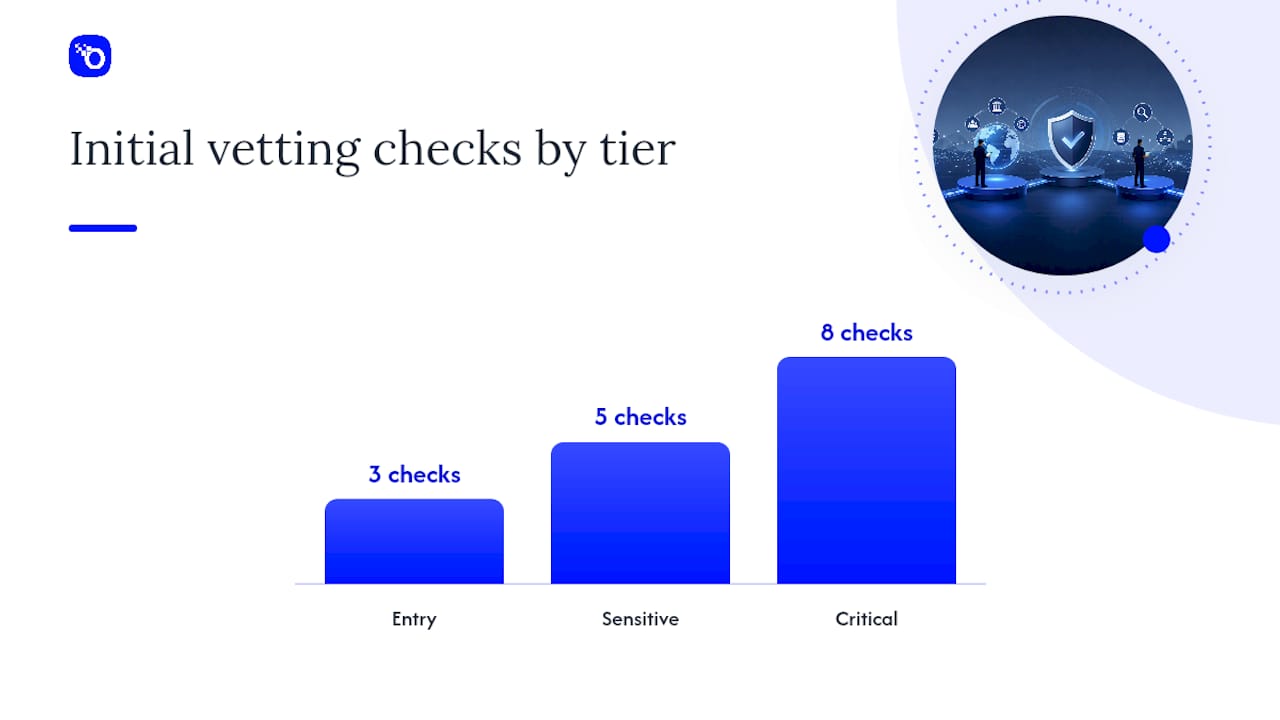
Federal Personnel Vetting Guidelines assign position designation as the primary driver of vetting tier and continuous-vetting frequency. The logic is straightforward: the greater the access, authority, or public trust a role carries, the deeper the initial investigation and the more frequent the post-hire monitoring.
| Tier | Example Roles | Initial Checks | Monitoring Cadence |
|---|---|---|---|
| Entry | Civilian admin, volunteers | State criminal history, employment verification, reference checks | Annual review |
| Sensitive | Dispatchers, records clerks with CHRI access | All entry checks plus NDI query, fingerprint-based national criminal history | Semi-annual review |
| Critical | Sworn officers, armed security, IT admins with system access | All sensitive checks plus psychological screening, polygraph support, social media review | Continuous (Rap Back enrolled) |
Re-evaluate a position’s designation whenever duties change, an employee receives a promotion, or a candidate is upgraded to a role with broader access. A dispatcher who gains administrative CHRI query rights moves from sensitive to critical without a new hire event.
Pro Tip: Document the designation rationale in the position file, not just the HR system. If a designation is ever challenged, the written rationale is your first line of defense.
For context on how public safety organizational models affect designation responsibilities across shared-service arrangements, consult your agency’s legal counsel alongside that guidance.
What Pre-Employment Checks Should Public Safety Agencies Require?
IADLEST model standards recommend thorough background investigations for peace officers and dispatchers, including fingerprint-based criminal history checks, a query of the National Decertification Index (NDI), standardized reference checks, and psychological screening. The NDI check is particularly critical: it surfaces officers decertified in other states, a gap that a standard criminal history check will not catch.
Required and strongly recommended checks by category:
- Fingerprint-based state criminal history check through the appropriate state repository
- FBI national criminal history check via an approved channeler
- IADLEST NDI query for any sworn or dispatch candidate
- Multi-jurisdictional records check covering all counties of residence in the past seven years
- Employment verification for the past ten years, with direct supervisor contact
- Education verification for all claimed degrees and certifications
- Driving record check for any role involving vehicle operation
- Structured interview using validated, job-related questions
- Psychological evaluation interpreted by a licensed clinician, not used as a sole disqualifier
- Limited-scope screening polygraph where state law permits, focused on a small set of high-priority behavioral indicators
On polygraphs specifically: model policy guidance warns that accuracy declines as question breadth increases. Keep the scope narrow and treat results as one input among many, never as a standalone disqualifier.
For transit agencies, APTA recommends aligning screening with federal guidance, applying federally approved disqualifying-offense lists where applicable, and building a redress process into the background check workflow.
The POST Background Investigation Manual provides procedural guidance for assembling a defensible background packet, covering fingerprint collection, social media and internet searches, discrepancy interviews, and documentation practices. Every completed packet should include signed release forms, all check results, interview notes, and the adjudication decision with its rationale.
See key compliance steps for public safety hiring for a practical CHRI and channeler compliance walkthrough.
How Do You Build a Continuous Monitoring Program That Works?
Continuous monitoring is not a single tool. It is a workflow: enroll employees, receive alerts from multiple data sources, triage each alert, investigate, and remediate or discipline. Formal policy with documented alert thresholds and regular performance audits is what separates a program that catches problems early from one that surfaces them after a critical incident.
Core data sources to integrate:
- FBI Rap Back Service for criminal repository changes on enrolled employees
- HR event triggers (new complaints, use-of-force incidents, leave patterns)
- IADLEST NDI for decertification events in other jurisdictions
- Lawfully conducted social media monitoring where agency policy authorizes it
Alert threshold examples:
- Management intervention: new felony arrest, discovered decertification, sustained internal affairs finding
- Administrative review: misdemeanor charge, unexplained access anomaly, repeated performance complaints within 90 days
Vendor and channeler oversight checklist:
- Confirm the vendor holds a current, documented Security Program per the CJIS Outsourcing Standard
- Verify breach reporting capability: one-hour notification to designated officials, written follow-up within five calendar days
- Audit access records semi-annually
- Confirm annual CHRI training certification for all vendor personnel with system access
Document a response playbook for each alert tier and test it at least annually. Continuous monitoring steps for public safety HR provides a step-by-step enrollment and triage playbook.
Pro Tip: Early-warning software that triggers management intervention before conduct escalates to formal discipline is most effective when alert thresholds are written into policy, not left to supervisor discretion. Discretionary thresholds create inconsistency and legal exposure.

Documenting Access Limits and Posting Restrictions
Geographic posting restrictions and IT access limits must be documented, proportionate to the risk they address, and reviewed on a defined schedule. Stale restrictions that no longer match an employee’s current role create both operational friction and legal risk.
Access-control principles to apply:
- Least privilege: grant only the access the role requires, nothing more
- Role-based access: tie permissions to the position designation record, not the individual
- Split functions: the person who can query CHRI should not also hold audit rights over those queries
Access review cadence:
| Control Type | Review Frequency | Owner |
|---|---|---|
| CHRI query access | Semi-annual | Information Security |
| IT system privileges | Annual or on role change | IT Admin |
| Geographic posting restrictions | Annual or on duty change | HR / Supervisor |
| Vendor access records | Semi-annual | Compliance Officer |
Every restriction should carry a written proportionality note explaining why it applies to that role. When a restriction no longer fits, document the removal with the same rigor as the original imposition.
How HR, Internal Affairs, and Information Security Should Work Together
Siloed offices produce siloed risk programs. When HR, internal affairs (IA), and information security each hold a piece of the vetting picture without sharing it, trust determinations are made on incomplete information. Effective agency risk management strategies require a defined process for case intake, evidence sharing, and adjudication across all three functions.
Critical data fields to share across offices:
- Position designation record and current vetting tier
- CHRI findings and adjudication decision
- Training history and certification status
- IT access logs and anomaly reports
- Rap Back event history and triage outcomes
Roles and responsibilities:
| Function | Investigates | Adjudicates | Escalation Path |
|---|---|---|---|
| HR | Employment history, reference discrepancies | Hiring decisions, duty restrictions | IA for conduct; InfoSec for access anomalies |
| Internal Affairs | Conduct complaints, use-of-force incidents | Disciplinary action | Legal counsel; Chief/Director |
| Information Security | Access anomalies, CHRI misuse | Access revocation | IA for conduct implications; HR for employment action |
Effective public safety partnerships can inform how shared-service agencies structure these cross-functional responsibilities when staff are distributed across multiple jurisdictions.
Audit Programs, Vendor Oversight, and Training Requirements
Governance controls are only as strong as the evidence that they ran. Every audit, training session, and vendor review needs a record.
Vendor due-diligence questions:
- Does the vendor hold a current CJIS Security Program approval?
- What is the documented breach notification timeline, and has it been tested?
- How often are access records reviewed, and who receives the report?
- Can the vendor produce training certification records for all CHRI-authorized staff on request?
Training requirements checklist:
- Initial security awareness training before any CHRI access is granted
- CJIS-aligned training for all personnel with direct CHRI access
- Annual refresher certification with a documented completion record
- Supervisor training on alert triage and escalation procedures
Audit metrics to track:
- Time-to-investigate from alert receipt to triage decision
- Percentage of audit findings closed within the defined remediation window
- Access-change turnaround time after a role change or termination
- Vendor SLA compliance rate across breach reporting and training obligations
A Prioritized Implementation Checklist for Agencies
The primary metric to track program health is the percentage of safety-critical roles enrolled in continuous monitoring. Agencies that cannot answer this question with a specific number do not yet have a functioning program.
Red Flags, Intervention Thresholds, and Escalation Protocols
Standard pre-employment psychological screening and criminal checks were not designed to detect ideologically motivated insider threats. Research published in Homeland Security Affairs warns that preventing insider attacks requires post-hire awareness programs, internal reporting mechanisms, and investigative capabilities that go beyond traditional pre-hire screens.
Concrete red flags requiring immediate escalation:
- New felony arrest or indictment
- Discovery of decertification in any jurisdiction via NDI
- Sustained internal affairs finding involving dishonesty or use of force
- Unexplained financial stress indicators in roles with access to evidence or funds
- Repeated credible complaints within a 90-day window
Escalation flow:
- Alert received by designated triage officer (HR or IA, per policy)
- Triage officer classifies alert as management intervention or administrative review within 24 hours
- Investigating office (HR, IA, or InfoSec per the matrix) opens a case and notifies the supervisor
- Supervisor restricts duties or access pending investigation if the alert tier warrants it
- Adjudicating authority issues a written decision with rationale within the policy-defined window
- Decision and supporting documentation filed in the employee’s compliance record
Every escalation must generate a written record using a consistent template. Inconsistent documentation is one of the most common reasons agencies lose employment litigation.
What Most Agencies Get Wrong in Program Rollouts
The most common failure in agency risk management rollouts is not a missing tool. It is a missing policy. Agencies purchase monitoring software, enroll employees, and receive alerts, but have no written threshold that tells a supervisor what to do next. The alert sits in a queue. Nothing happens. When the conduct eventually surfaces as a critical incident, the agency cannot demonstrate that its program functioned as designed, because it was never designed at all.
A second recurring mistake is treating position designation as a one-time event. Roles evolve. An officer who moves to a digital forensics unit now holds IT privileges that warrant a critical-tier designation, but if the designation record was never updated, the monitoring frequency stays at annual. That gap is exactly where insider risk lives.
The fix for both problems is the same: write the policy before you buy the software, and build a designation review trigger into every HR workflow that touches a role change.
How OMNI Intel Supports Every Step of This Program
Agencies that have worked through the checklist above often discover that the hardest part is not knowing what to do. It is finding a vendor whose capabilities map directly to each step without requiring multiple disconnected systems.

OMNI Intel’s pre-employment screening services cover fingerprint-based criminal history checks, IADLEST NDI queries, employment and education verification, and psychological screening coordination, all documented in a defensible background packet. Post-hire, OMNI Intel’s continuous monitoring platform supports Rap Back enrollment, alert triage workflows, and the audit reporting your compliance officer needs at the 90-day milestone and beyond. The platform is built for public safety agencies specifically, which means CJIS-aware vendor controls and access record management are built in, not bolted on.
To see how OMNI Intel maps to your agency’s position designations and monitoring requirements, request a demo and bring your current policy draft. The conversation starts there.
Sources
- SECURITY and MANAGEMENT CONTROL OUTSOURCING STANDARD for CHANNELERS
- Federal Personnel Vetting Guidelines
- Background Investigation Manual
FAQ
What is the first step in building a personnel risk program?
Approve a written monitoring policy that defines position designations, alert thresholds, data sources, and audit cadence before purchasing any software or enrolling employees.
Which background checks are required for sworn public safety officers?
IADLEST model standards call for fingerprint-based state and national criminal history checks, an IADLEST NDI query, employment and education verification, reference checks, and psychological screening interpreted by a licensed clinician.
What does the FBI Rap Back Service do for agencies?
Rap Back notifies an enrolled agency automatically when a fingerprint-based criminal repository record changes for a current employee, enabling continuous vetting without manual re-checks.
How does OMNI Intel support CJIS compliance for agencies?
OMNI Intel operates with CJIS-aware vendor controls, supports Rap Back enrollment, and provides audit reporting that aligns to the access record and training obligations in the CJIS Outsourcing Standard.
Can pre-employment screening detect insider threats?
Standard pre-employment checks are not designed to detect ideologically motivated insider threats. Post-hire awareness programs, internal reporting mechanisms, and continuous monitoring are necessary to address that risk after hire.