

Public Safety Recruitment Websites with Integrated Screening
For U.S. public safety agencies, the right approach is an integrated recruitment microsite with ATS/HCM connectors, FCRA-compliant screening, CJIS-grade data handling, and AI-driven candidate nurturing. Request a demo or use cooperative purchasing through OMNIA Partners to accelerate procurement.
- Why it matters: The FBI’s Police Officer Selection System confirms that background investigations can take several months and include polygraph, urinalysis, fingerprinting, credit checks, and extensive interviews. Fragmented systems extend that timeline and cost you qualified candidates.
- Immediate impact: Agencies that digitize and centralize their hiring workflow report faster time-to-offer, cleaner audit trails, and fewer candidates dropping off during the investigation phase.
- Next step: Schedule a demo, request a sample integration checklist, or use a cooperative purchasing vehicle like OMNIA Partners to bypass lengthy RFP cycles and reach vetted suppliers faster.
Key Takeaways
An integrated public safety recruitment website with CJIS-grade security, FCRA-compliant screening, and ATS/HCM connectors is the only configuration that reduces time-to-hire without creating compliance exposure.
| Point | Details |
|---|---|
| Choose integrated, not assembled | A microsite without ATS and screening connectors loses candidates at every manual handoff. |
| Require three attestations | CJIS handling plan, SOC 2 Type II report, and FCRA adverse-action documentation are non-negotiable before signing. |
| Pilot before full rollout | Run 10 to 20 candidates through the full workflow to surface integration gaps before agency-wide deployment. |
| Use cooperative purchasing | OMNIA Partners and similar vehicles cut procurement timelines from months to weeks while preserving auditability. |
| OMNI Intel covers the full stack | OMNI Intel provides recruitment microsites, OMNIScreen investigations, ATS/HCM integration, and audit trail exports for public safety agencies. |
Table of Contents
- What Does a Public Safety Recruitment Website Actually Cover?
- Core Features Every Public Safety Recruitment Website Must Include
- How an Integrated Recruitment Site Should Map to Your Hiring Workflow
- Security, Compliance, and Procurement Considerations for U.S. Agencies
- Typical Implementation Phases, Timelines, and Cost Drivers
- What to Ask Vendors During Demos and RFP Scoring
- How OMNI Intel Maps to These Requirements
- What Agencies Get Wrong About Recruitment Websites
- OMNI Intel Gives Public Safety HR a Faster Path to Qualified Hires
- Sources
- FAQ
What Does a Public Safety Recruitment Website Actually Cover?
The term “public safety recruitment website” is used loosely across the industry, which creates real procurement confusion. For the purposes of this guide, it refers specifically to recruitment websites and microsites built for public safety agencies that combine candidate sourcing, AI-driven nurturing, applicant screening, and integration with background-investigation workflows.
In scope:
- Campaign microsites and mobile-friendly career landing pages targeting law enforcement, fire, EMS, and dispatch candidates
- ATS/HCM bi-directional connectors that push applicant data into your existing HR systems
- Screening integrations that trigger background investigations at the right hiring milestone
- Candidate nurturing automation, including drip sequences and status notifications
- Audit logs and reporting dashboards for hiring managers and agency leadership
Out of scope: General job boards or consumer-facing portals where individual job seekers browse public safety jobs. Those platforms serve a different audience and solve a different problem. Evaluating them alongside an integrated agency recruiting platform produces a false comparison.
Core Features Every Public Safety Recruitment Website Must Include
Not every feature a vendor demos is worth paying for. The list below separates what you must require from what is genuinely useful but negotiable.
Must-haves:
- CJIS-grade data segregation and handling for any system touching criminal justice information
- FCRA-compliant screening workflows with documented adverse-action procedures
- ATS/HCM bi-directional integration with sandbox API access for pre-contract testing
- Secure fingerprint enrollment support and multi-site scheduling options
- Mobile-optimized campaign microsites with analytics
- Candidate portal with encrypted personal history statement collection
- Exportable audit trail and reporting for hiring metrics, pass/fail rates, and pipeline status
Nice-to-haves:
- AI-driven candidate nurturing sequences that re-engage applicants during long investigation windows
- Automated reference summaries that reduce investigator review time
- Multi-site fingerprint logistics coordination
- Post-hire continuous monitoring for ongoing employee risk
- Built-in diversity and readiness dashboards
Background-investigation software that enforces consistent investigator workflows and provides SOC 2 Type II and CJIS-aligned security is now a baseline expectation, not a differentiator.
Pro Tip: Prioritize data-handling attestation and audit-log exports over marketing feature gloss. The absence of a CJIS-compatible handling plan or SOC 2 Type II attestation is an immediate disqualifier, regardless of how polished the candidate-facing microsite looks.
How an Integrated Recruitment Site Should Map to Your Hiring Workflow
Map your recruitment site events to hiring milestones so every candidate touchpoint triggers the correct downstream action. The sequence below reflects how well-designed public safety hiring workflows actually operate.
- Application capture on the campaign microsite triggers an ATS entry and sends the candidate a portal login.
- Automated assessments and writing sample collection occur within the candidate portal, reducing scheduling friction.
- Conditional job offer trigger initiates the formal background investigation phase.
- Background investigation initiation covers fingerprint enrollment, investigator assignment, polygraph scheduling, psychological examination, and reference interviews. Municipal agencies like CMPD include psychological exams and polygraph testing as standard qualification steps.
- Investigation updates feed back into the ATS so hiring managers see real-time status without emailing investigators.
- Final adjudication and offer close the loop with a documented decision record.
Statistic: According to PowerDMS research, 47% of agencies complete background investigations in 30 to 90 days, while 8% take longer than 90 days. Only 45% finish in under 30 days. Fragmented documentation and manual handoffs between recruiting and investigation units are the primary culprits.
Digitizing personal history statements and centralizing investigator files are the two interventions most likely to compress that timeline. A real-time dashboard visible to hiring managers further reduces candidate dropoff by keeping applicants informed rather than silent during long investigation windows.
Security, Compliance, and Procurement Considerations for U.S. Agencies
Insist on CJIS-compatible data handling for any system touching criminal justice information, FCRA-compliant screening practices, and SOC 2 Type II or equivalent attestations. These are not negotiable contract points.
Attestations and certifications to require:
- CJIS data handling plan with documented access controls and audit logging
- SOC 2 Type II report from an independent auditor
- FedRAMP authorization or AWS GovCloud hosting details where applicable
- FCRA-compliant background-check process with adverse-action workflow documentation
- Data retention and secure deletion policy with defined timelines
- HIPAA compliance documentation where medical or psychological data is collected
Contract clauses to insist on:
- Data ownership and return provisions upon contract termination
- Breach notification timelines (72 hours is a reasonable floor)
- Audit rights for your agency’s legal and compliance teams
- Full subcontractor list with their own compliance attestations
- Liability caps for data exposure events
- SLAs for background-investigation throughput and reporting turnaround
For procurement, cooperative purchasing vehicles like OMNIA Partners give agencies access to pre-vetted suppliers under competitively bid contracts, cutting months off a standard RFP cycle while preserving auditability. Pair that with your agency’s compliance steps for public safety hiring to build a procurement package your legal team can approve quickly.
Typical Implementation Phases, Timelines, and Cost Drivers
Expect 8 to 16 weeks for a standard microsite plus ATS/HCM connector implementation. Add fingerprint logistics and custom CJIS workflows and the realistic range extends to 4 to 6 months.
Primary cost drivers include setup and professional services fees, recurring subscription or per-seat fees, per-investigation or per-fingerprint charges, FedRAMP/GovCloud hosting surcharges, and ongoing training. Multi-site fingerprinting capabilities reduce candidate wait times and are worth budgeting for if your agency runs high-volume hiring cycles.
Pro Tip: Run a small pilot cohort of 10 to 20 candidates before full rollout. Pre-book fingerprint windows through partner networks and require sandbox API access in your contract before signing. Discovering integration gaps after go-live is significantly more expensive than finding them in QA.
What to Ask Vendors During Demos and RFP Scoring
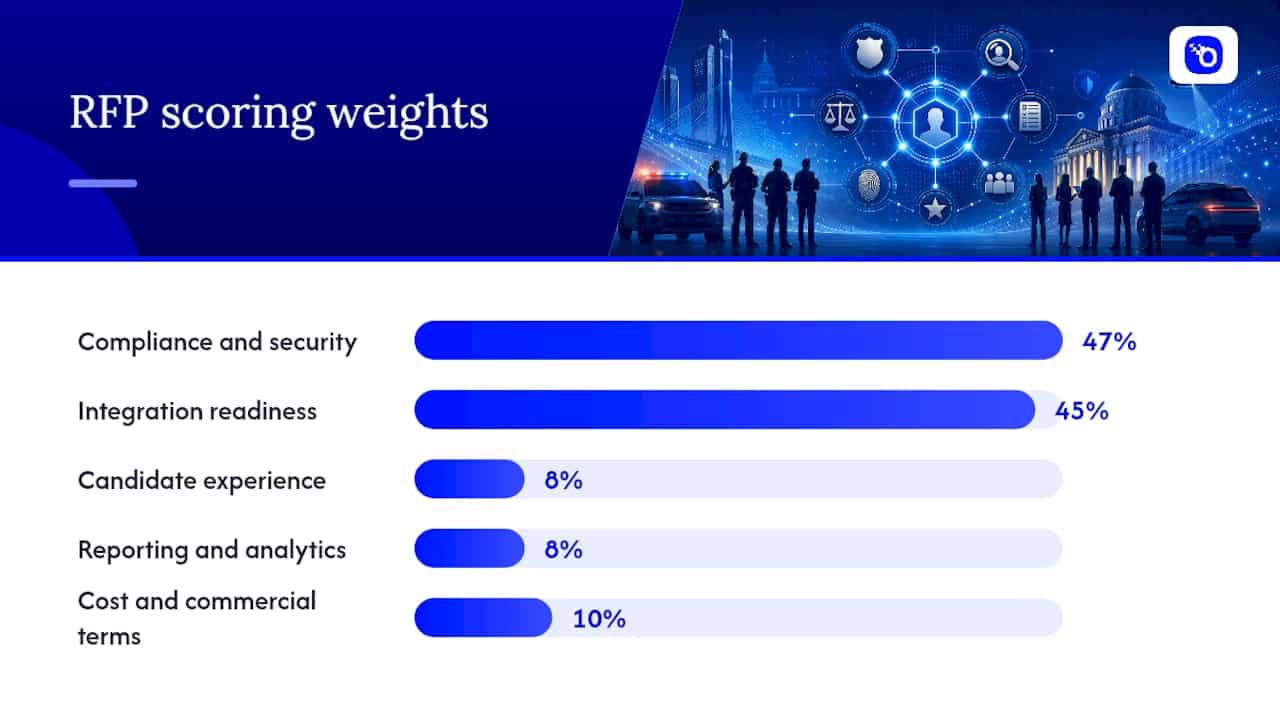
Use a weighted checklist that prioritizes compliance, integration readiness, and auditability above candidate-facing marketing features.
Demo questions that reveal real capability:
- Walk through a complete CJIS data handling plan, including access controls and audit logging.
- Show an end-to-end screening case from application submission to final adjudication.
- Export a full audit trail on demand and explain what each field captures.
- Demonstrate ATS/HCM connector setup time and the sandbox testing environment.
- Show mobile microsite analytics including drop-off rates by device type.
- Provide sample SLAs for time-to-complete background investigations.
Red flags that should end the conversation:
- No SOC 2 Type II report available
- Vague or undocumented FCRA adverse-action process
- Inability to segregate CJIS data from general applicant data
- No exportable audit logs
- Single-location fingerprinting with no mobile or multi-site option
Suggested scoring rubric for RFPs:
| Category | Weight |
|---|---|
| Compliance and security | 47% |
| Integration readiness | 45% |
| Candidate experience | 8% |
| Reporting and analytics | 8% |
| Cost and commercial terms | 10% |
How OMNI Intel Maps to These Requirements
OMNI Intel delivers a recruitment microsite and screening integration package designed specifically for public safety agencies, covering the mandatory compliance and workflow requirements outlined in this guide.
Feature mapping:
| Requirement | OMNI Intel Capability |
|---|---|
| CJIS-compatible data handling | CJIS-aware data segregation and access controls |
| FCRA-compliant screening | FCRA-documented adverse-action workflows via OMNIScreen |
| ATS/HCM bi-directional integration | Native connectors with sandbox API access |
| Mobile campaign microsites | Custom recruitment microsites for law enforcement, fire, and EMS |
| Fingerprint logistics support | Multi-site fingerprint coordination |
| Audit trail and reporting | Exportable audit logs and hiring-metric dashboards |
Sample workflow with OMNI Intel:
- Campaign microsite launches targeting law enforcement or fire and EMS candidates.
- Applicant submits through the portal; data flows automatically into the connected ATS.
- Automated assessments and personal history statement collection occur within the candidate portal.
- Conditional job offer triggers OMNIScreen background investigation initiation.
- Investigator updates feed back into the ATS dashboard in real time.
- Final adjudication is documented with a full audit trail available for compliance review.
OMNI Intel is available through cooperative purchasing pathways, which means your agency can reach a signed contract without running a full competitive RFP from scratch.
What Agencies Get Wrong About Recruitment Websites
The most common mistake public safety agencies make is treating their recruitment website as a marketing asset rather than a workflow owner. A well-designed campaign microsite that does not connect to your ATS, your screening platform, and your investigator assignment system is just a brochure. It attracts candidates and then loses them in the handoff.

Centralize ownership between your recruiting unit and your background-investigation unit before you go to market for a platform. If those two functions report to different leaders with different systems, no vendor can fix the coordination problem for you. The technology surfaces the gap; it does not close it.
Instrument a candidate-facing dashboard so applicants know where they stand during the investigation phase. Silence during a 60-day investigation is one of the primary reasons qualified candidates accept other offers. One agency that digitized personal history statements and centralized investigator files reduced its investigation cycle from over 90 days to under 30. The platform mattered less than the process redesign that came with it.
Embedding recruitment into long-term strategic planning produces better retention and candidate quality than treating hiring as a reactive, position-by-position task. The agencies that build durable pipelines treat their recruitment microsite as a continuous engagement channel, not a campaign they switch on when a class opens.
OMNI Intel Gives Public Safety HR a Faster Path to Qualified Hires
Public safety agencies that need CJIS-aware screening, FCRA-compliant background investigations, and a purpose-built recruitment microsite in a single procurement have a direct path with OMNI Intel. The platform covers candidate sourcing, AI-driven nurturing, pre-employment screening, and ATS/HCM integration without requiring agencies to stitch together separate vendors for each function.

The cooperative purchasing option means your agency can move from evaluation to signed contract in weeks rather than quarters. Visit the OMNIScreen product page to review investigation capabilities, or contact OMNI Intel directly to request a demo and a procurement checklist tailored to your agency’s size and hiring volume.
Sources
- POLICE OFFICER SELECTION SYSTEM guide (FBIJobs)
- Six ways background investigation software improves the police hiring process
- The public safety hiring crisis: Five key insights for leaders
FAQ
What is a public safety recruitment website?
A public safety recruitment website is a purpose-built microsite or campaign platform that combines candidate sourcing, AI-driven nurturing, applicant screening, and background-investigation workflow integration for agencies in law enforcement, fire, EMS, and dispatch.
How long does a background investigation take for public safety hiring?
Digitizing personal history statements and centralizing investigator files are the most effective ways to compress that timeline.
What compliance certifications should a recruitment platform have?
Require a CJIS data handling plan, SOC 2 Type II report, and documented FCRA adverse-action procedures at minimum. FedRAMP or AWS GovCloud hosting details are relevant if the platform processes federal criminal justice data.
Can cooperative purchasing speed up procurement for recruitment platforms?
Yes. Cooperative purchasing vehicles like OMNIA Partners provide access to pre-vetted suppliers under competitively bid contracts, reducing procurement timelines from months to weeks while preserving required oversight and auditability.
How does OMNI Intel support public safety recruitment?
OMNI Intel provides recruitment microsites, FCRA-compliant background investigations through OMNIScreen, ATS/HCM integration, and exportable audit trails, all designed for law enforcement, fire, EMS, and dispatch agencies.