

Why Parks and Recreation Staff Need Screening
Parks and recreation staff and volunteers must be screened with pre-hire background investigations and continuous post-hire monitoring. This is not a best-practice suggestion — it is the defensible minimum for any department that serves children, seniors, or other vulnerable populations. NRPA’s recommended guidelines call for county criminal checks, national database supplements, sex-offender registry searches, identity verification, and secure record handling for both paid staff and volunteers. Continuous monitoring through platforms like OMNI Intel adds automated alerts when an individual’s criminal status changes after hire, closing the gap that annual re-screening alone cannot cover.
The case for immediate action rests on three pillars:
- Participant safety: Predators actively seek organizations with weak or absent screening practices. Parks and recreation programs, with their high volunteer involvement and historically inconsistent screening, are a documented target.
- Legal exposure: Courts do not distinguish between volunteers and paid employees in negligent hiring claims. A single adverse incident can generate defense costs starting at $25,000 to $50,000 for a meritless allegation, rising to six figures when actual harm occurs.
- Funding and compliance: Numerous state and federal programs condition funding on documented screening compliance. A no-screen policy puts grant eligibility at direct risk.
Table of Contents
- Why Screening Matters for Parks and Recreation Departments
- What a Robust Parks and Recreation Screening Program Must Include
- Legal and Policy Constraints: Applying Screening Fairly and Defensibly
- Step-by-Step Implementation Playbook
- Recommended Approach: Screening Plus Continuous Monitoring
- Measuring Success and Governance: KPIs and Audit Steps
- Key Takeaways
- A Practitioner’s View on Screening Gaps in Parks and Recreation
- OMNI Intel Supports Safe Hiring for Parks and Recreation Agencies
- Useful Sources and Further Reading
- FAQ
Why Screening Matters for Parks and Recreation Departments
Negligent hiring liability is the most immediate financial risk a parks director faces. Legally, there is no differentiation between a volunteer and a paid employee when a participant is harmed. Juries have awarded millions of dollars against organizations whose volunteers had prior records the agency never checked. The defense that “we didn’t know” has not held up in courts across the country.
The primary risk vectors in parks and recreation settings are specific and well-documented:
- Direct youth contact in camps, after-school programs, and sports leagues
- Aquatics supervision, where unsupervised access to minors is routine
- Transportation roles with isolated, one-on-one contact
- Volunteer coaches and instructors who operate with minimal oversight
- Facility attendants with access to locker rooms, equipment storage, and administrative systems
A 2023 case in which the City of Napa, California, settled a child burn lawsuit for $18.5 million illustrates what inadequate vetting of outside instructors can cost a municipality. Reputational damage compounds the financial hit: a department known for lax screening loses volunteer recruitment ground to organizations that publicize their vetting standards. Risk management experts confirm that agencies prioritizing screening see stronger community trust and improved volunteer quality over time.
What a Robust Parks and Recreation Screening Program Must Include
The minimum defensible screening program combines identity verification, county criminal record checks, a national criminal database supplement, National Sex Offender Registry searches, FBI or terrorism watchlist checks for appropriate roles, and documented reference checks. Continuous monitoring adds automated alerts when a staff member’s or volunteer’s criminal status changes during their tenure, replacing the gaps between annual re-checks.

| Role | Criminal Check | Sex Offender Registry | Identity Verification | Continuous Monitoring | Reference Check |
|---|---|---|---|---|---|
| Camp counselor | County + national | Required | Required | Recommended | Required |
| Lifeguard | County + national | Required | Required | Recommended | Required |
| Volunteer coach | County + national | Required | Required | Required | Required |
| Facility attendant | County | Required | Required | Optional | Recommended |
| Administrative volunteer | County | Required | Required | Optional | Recommended |
Role-based depth matters. A volunteer coach working alone with youth warrants the same investigative depth as a paid camp counselor. A facility attendant with no youth contact still requires identity verification and a sex-offender registry check because facility access itself creates exposure.
Key implementation requirements:
- Screen all volunteers through the same non-sworn volunteer screening process used for comparable paid roles
- Collect written consent before initiating any check, per FCRA requirements
- Retain all screening records in a centralized, auditable roster
- Set re-screening intervals (annually for high-contact roles; every two years for low-contact roles) and supplement with continuous monitoring
Pro Tip: Submit pre-season batch checks at least 60 days before camp or program start dates. County criminal checks can take 3–10 business days depending on jurisdiction; building in lead time prevents last-minute staffing gaps and avoids the pressure to onboard uncleared personnel.
Legal and Policy Constraints: Applying Screening Fairly and Defensibly
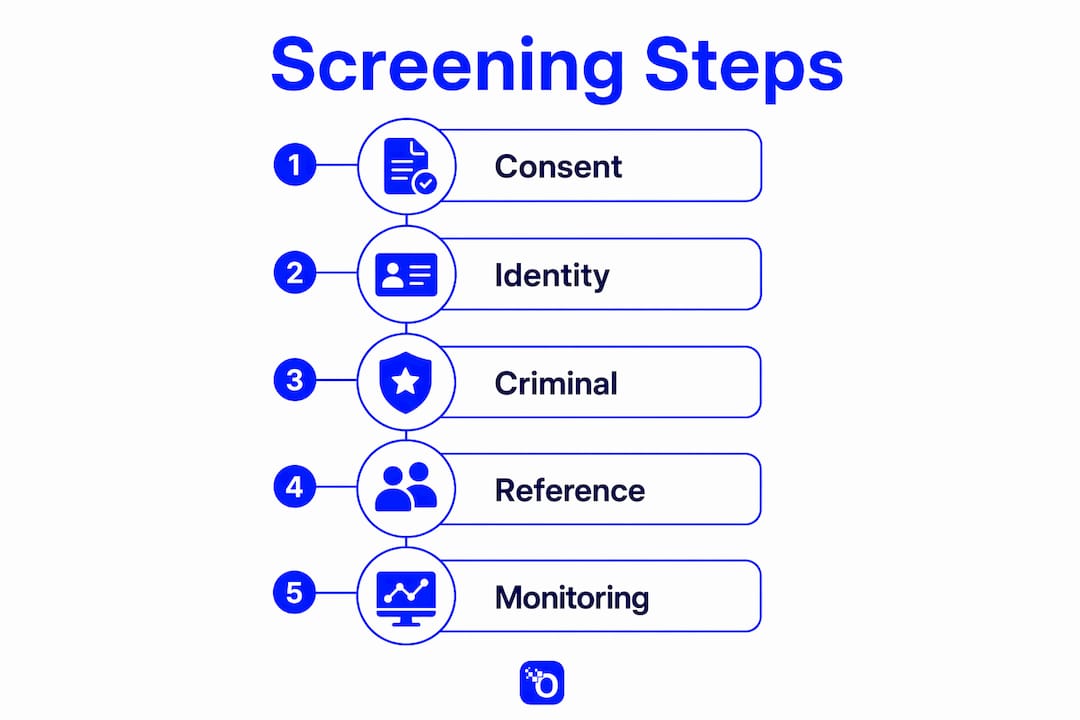
Apply screening uniformly to all comparable roles and document every step. Selective screening — checking paid staff but not volunteers, or screening some coaches but not others — is the single most common legal vulnerability in parks and recreation programs. Legal counsel consistently advises universal application of screening policies to similar roles, with documented exceptions when deviation is justified.
FCRA and EEOC compliance checklist:
- Provide a standalone written disclosure to each applicant or volunteer before initiating a background check
- Obtain signed authorization before any check begins
- Apply screening criteria consistently across comparable roles to satisfy EEOC equal-treatment standards
- Conduct individualized assessments before taking adverse action based on a criminal record (consider nature of offense, time elapsed, and relevance to the role)
- Retain consent forms, screening results, and decision documentation for the period required by state law (commonly three to seven years)
Adverse action procedure (sequential):
- Identify a potentially disqualifying result from the screening report
- Provide the candidate with a pre-adverse action notice, a copy of the report, and a summary of FCRA rights
- Allow a reasonable response period (typically five business days)
- Review any explanation or dispute the candidate submits
- Issue a final adverse action notice if the decision stands, including the consumer reporting agency’s contact information
- Document the rationale in the personnel file
Courts rarely distinguish volunteers from paid staff in negligent hiring litigation, so the adverse-action procedure applies equally to both populations. For guidance on misconduct liability exposure, the legal resources at Calil Law outline the consequences agencies face when screening gaps contribute to incidents.
Pro Tip: Involve legal counsel when drafting your screening policy and maintain a standardized exceptions protocol with written rationale for any deviation. An undocumented exception is indistinguishable from a policy failure in litigation.
Step-by-Step Implementation Playbook
A mid-size department managing 50–200 compliance-eligible people should plan a 60–90 day rollout, using pre-season batch processing to avoid service gaps. Manual background check workflows commonly require 3–5 admin hours per person for submission, follow-up, review, exception handling, and filing. Automating that workflow through an integrated platform recovers those hours and delivers measurable annual savings.
Implementation steps:
- Inventory all roles and classify each as high-contact, low-contact, or administrative
- Set disqualification criteria by role category, reviewed by legal counsel
- Select a screening package that covers county, national, and sex-offender registry checks at minimum
- Draft and finalize consent forms and adverse-action notice templates
- Integrate the screening platform with your applicant tracking system (ATS) or registration software
- Train supervisors and HR staff on policy enforcement, privacy obligations, and adverse-action procedures
- Run a pilot with one program or facility before full department rollout
- Schedule quarterly audits and annual policy reviews
| Phase | Timeline | Key Tasks |
|---|---|---|
| Pilot | Weeks 1–4 | Role inventory, vendor selection, consent form drafting, one-program test |
| Full rollout | Weeks 5–10 | ATS integration, supervisor training, batch pre-season processing |
| Ongoing governance | Quarterly | Audit documentation, re-screening schedule, KPI review |
Recommended Approach: Screening Plus Continuous Monitoring
The most defensible and operationally efficient approach combines comprehensive pre-hire investigations with post-hire continuous monitoring and integrated documentation. Pre-hire checks establish a baseline; continuous monitoring closes the window between re-screening cycles by alerting the department the moment a staff member’s or volunteer’s criminal status changes.
Recommended features for parks and recreation programs:
- Multi-jurisdiction criminal searches (county plus national database)
- National Sex Offender Registry and FBI watchlist checks
- Identity verification tied to government-issued documentation
- Continuous monitoring with automated alerts routed to a designated HR contact
- Secure, auditable record storage with role-based access controls
- Native integration with ATS and program registration platforms
Vendor selection criteria that matter most for parks and recreation: demonstrated expertise in public safety workflows, capacity for batch pre-season processing, transparent per-investigation pricing, and audit log support that satisfies FCRA record-retention requirements.
OMNI Intel is built specifically for public safety agencies and delivers all of these capabilities through a single platform. Its investigator-driven approach applies law enforcement investigation principles to parks and recreation screening, producing results that hold up under legal scrutiny.
Pro Tip: When evaluating vendors, request a sample audit log and ask how the platform handles adverse-action documentation. A vendor that cannot produce a clean audit trail is a liability, not an asset.
Measuring Success and Governance: KPIs and Audit Steps
Measure program effectiveness with specific KPIs and run scheduled audits to prove due diligence. Governance without metrics is unenforceable, and elected officials or boards need quantitative evidence to sustain screening program funding.
KPIs to track:
- Percentage of compliance-eligible population screened on schedule
- Average turnaround time per check by role category
- Number of adverse actions processed per quarter, with disposition documented
- Admin hours recovered through platform automation
- Incident response time from alert to documented resolution
Audit checklist (run quarterly):
- Confirm consent forms are on file for every active staff member and volunteer
- Verify re-screening intervals are being met for high-contact roles
- Conduct random file reviews to confirm documentation completeness
- Review continuous monitoring alert logs for unresolved flags
- Report KPI summary to department leadership and, annually, to the governing board
Incident response flow for post-hire alerts:
- Monitoring platform generates an alert for a flagged criminal record
- HR designee receives notification and opens a confidential review
- Staff member or volunteer is temporarily restricted from participant-contact roles pending review
- HR documents findings and consults legal counsel if the record is potentially disqualifying
- Decision is recorded in the personnel file with full rationale
- Outcome is reported in the next governance KPI cycle
For detailed post-hire monitoring procedures, including how to handle alerts and document remediation, OMNI Intel provides operational guidance aligned with public safety HR standards.
Key Takeaways
Parks and recreation departments that combine pre-hire background investigations with continuous post-hire monitoring achieve the most defensible and cost-effective safety posture available.
| Point | Details |
|---|---|
| Universal screening is required | Screen all staff and volunteers in comparable roles equally to avoid negligent hiring liability and discrimination claims. |
| Minimum checks are defined | Every role requires identity verification, county criminal check, national database supplement, and sex-offender registry search at minimum. |
| Continuous monitoring fills the gap | Automated post-hire alerts detect criminal status changes between re-screening cycles, reducing ongoing risk without added admin hours. |
| Legal compliance is non-negotiable | FCRA disclosure, signed consent, individualized adverse-action review, and documented record retention are mandatory for every check. |
| OMNI Intel delivers the full program | OMNI Intel provides pre-employment investigations, continuous monitoring, and ATS integration purpose-built for public safety agencies. |
A Practitioner’s View on Screening Gaps in Parks and Recreation
The most consistent failure pattern in parks and recreation screening is not malice. It is the assumption that volunteers are categorically different from employees in the eyes of the law. That assumption is wrong, and it has cost municipalities millions of dollars in settlements and defense fees. What makes this particularly frustrating is that the fix is not complicated. A documented, consistently applied screening policy with continuous monitoring closes the vast majority of legal and safety exposure. The departments that struggle are almost always the ones that screened selectively, documented inconsistently, or treated volunteer onboarding as a paperwork shortcut. The NRPA guidelines exist precisely because this sector has a history of underinvesting in vetting infrastructure. Decision makers who treat screening as a compliance checkbox rather than an operational safety system are the ones who end up in front of a city council explaining a preventable incident. The evidence is clear: invest in the program before the incident, not after.
OMNI Intel Supports Safe Hiring for Parks and Recreation Agencies
Departments that need pre-employment investigations, continuous monitoring, and FCRA-compliant documentation in a single platform have a direct path forward with OMNI Intel. Unlike general-purpose background check vendors, OMNI Intel applies law enforcement investigation principles to parks and recreation screening, covering multi-jurisdiction criminal searches, sex-offender registry checks, identity verification, and automated post-hire alerts. Batch pre-season processing handles high-volume onboarding windows without creating administrative backlogs, and native ATS integration connects screening directly to your hiring and registration workflows.

The typical onboarding timeline for a mid-size department is four to six weeks from contract to first batch submission. ROI drivers include recovered admin hours (3–5 per compliance-eligible person), reduced legal exposure, and audit-ready documentation that satisfies both FCRA requirements and governing board oversight. To see how OMNI Intel’s pre-employment screening services fit your department’s program structure, request a demo or contact the team directly.
Useful Sources and Further Reading
Decision makers building or updating a screening policy should anchor their documentation in primary and authoritative sources. The following resources cover legal requirements, operational standards, and real-world failure cases.
| Source | Type | Best Used For |
|---|---|---|
| NRPA BIB Recommended Guidelines for Screening Volunteers | Industry standard | Defining minimum screening elements and volunteer parity |
| NRPA: Who Should You Be Screening and Why? | Operational guidance | Justifying universal screening in policy memos |
| MASC: Background Checks Strengthen Recreation Safety | Risk management | Citing the Napa settlement and vetting procedures |
| New Orleans OIG: Incomplete Background Checks for Youth Coaches | Failure case study | Illustrating documentation failures in municipal programs |
| Background Checks for Parks and Recreation: Legal Compliance | Legal counsel primer | FCRA/EEOC policy drafting and adverse-action procedures |
| Compliance Software ROI for Parks and Recreation | Operational reference | Admin-hour savings estimates and cost-justification |
- The NRPA guidelines and the MASC risk letter are the two documents to attach to any funding or policy request.
- The New Orleans OIG case is the operational failure example most useful for board presentations.
- The legal compliance resource from According Law is a counsel primer, not a substitute for agency-specific legal review.
This article provides general information for educational purposes and does not constitute legal advice. Confirm current FCRA, EEOC, and state-specific screening requirements with qualified legal counsel for your agency’s specific situation.
FAQ
Why do parks and recreation staff need screening?
Parks and recreation staff and volunteers work directly with children and other vulnerable populations, creating significant liability if an individual with a prior record causes harm. Pre-hire background investigations and continuous monitoring are the primary legal and operational defenses against negligent hiring claims.
Do volunteers need the same background checks as paid staff?
Yes. Courts do not distinguish between volunteers and paid employees in negligent hiring litigation, so NRPA guidelines and legal counsel both recommend applying identical screening standards to comparable roles regardless of compensation status.
What checks are required at minimum for parks and recreation roles?
Every role should include identity verification, a county criminal record check, a national criminal database supplement, and a National Sex Offender Registry search. High-contact roles involving youth or vulnerable populations warrant FBI watchlist checks and continuous post-hire monitoring as well.
How does continuous monitoring differ from annual re-screening?
Continuous monitoring generates automated alerts when a staff member’s or volunteer’s criminal status changes at any point during their tenure, while annual re-screening only captures records at a fixed interval. Continuous monitoring closes the gap between scheduled checks without adding proportional admin hours.
What does FCRA compliance require for parks and recreation background checks?
FCRA requires a standalone written disclosure, signed authorization before any check begins, a pre-adverse action notice with a copy of the report if a disqualifying result is found, a reasonable response period for the candidate, and a final adverse action notice if the decision stands. All documentation must be retained per applicable state record-retention requirements.