

Grant Compliance and Staff Screening: What Agencies Must Do
Grant compliance changes staff screening in four concrete ways: it mandates which checks must run, sets the timing before a grant-funded person starts work, designates who adjudicates results, and specifies what records must be retained for audit. The role of grant compliance in staff screening is not advisory. Under 42 U.S.C. § 12645g, AmeriCorps grantees must complete a National Service Criminal History Check (NSCHC) covering three distinct components before any covered individual begins service. Failure to complete and document those checks before the start date can trigger cost disallowance, corrective action, or suspension of funds.
Three immediate actions every decision maker should take now:
- Pull your current award documents and identify every screening condition by role and funding source.
- Confirm that written consent forms, authorized-source check orders, and adjudication sign-offs are in place for every current grant-funded position.
- If any grant-funded hire started work before all checks were completed and adjudicated, flag the gap, document corrective steps, and request a voluntary policy review before your next monitoring visit.
E-Verify is also entering the picture: the Office of Management and Budget has proposed mandatory E-Verify requirements for federal grant recipients, signaling that employment-eligibility verification will increasingly be a standard grant condition alongside criminal history checks.
Table of Contents
- What Screening Checks Do Grant Terms Commonly Require?
- How Do You Align Your Screening Workflow with Grant Terms?
- What Records Do Auditors Expect You to Keep?
- Why Does Post-Hire Monitoring Affect Continued Grant Eligibility?
- How Does a Compliance-Focused Screening Platform Reduce Your Risk?
- Key Takeaways
- The Compliance Gap Most Agencies Don’t See Until It’s Too Late
- OMNI Intel Helps Agencies Meet Grant-Driven Screening Requirements
- Useful Sources
- FAQ
What Screening Checks Do Grant Terms Commonly Require?
Most U.S. public safety grants that involve contact with vulnerable populations require some combination of the following checks. AmeriCorps NSCHC, governed by 42 U.S.C. § 12645g, is the clearest statutory model, but DOJ Office on Violence Against Women (OVW) grants and FEMA-funded programs carry analogous conditions.
Required NSCHC components:
- NSOPW (National Sex Offender Public Website): The NSOPW consolidates sex-offender registry data from states, territories, and many federally recognized Tribes and is specifically named as a required NSCHC component.
- State criminal history check: May be name-based or fingerprint-based depending on state law and grant terms; must cover the states where the individual has lived or worked.
- FBI fingerprint-based check: Required for positions involving vulnerable populations; results routed through approved channels.
Timing and suitability rules:
OVW award conditions specify that checks must be completed no earlier than six months before the suitability determination and must cover at least the five calendar years preceding the search request. Reexamination is required at least every five years or when new information suggests unsuitability. The NSCHC standard is unambiguous: all components must be completed, reviewed, and an eligibility determination made before the individual starts work or service.
Consequences for non-compliance:
AmeriCorps enforcement practice includes cost disallowance for NSCHC noncompliance, typically capped at a limited number of months of costs in recent guidance, with agency discretion to disallow larger amounts for egregious violations. Beyond cost disallowance, agencies face corrective action plans, additional monitoring visits, and potential suspension of reimbursement. The financial and reputational exposure is real enough that treating grant-required screening as optional is not a defensible position.
How Do You Align Your Screening Workflow with Grant Terms?
The sequence below applies from award acceptance through the first day of work. It reflects the NSCHC procedural requirements and is adaptable to DOJ and FEMA grant conditions.
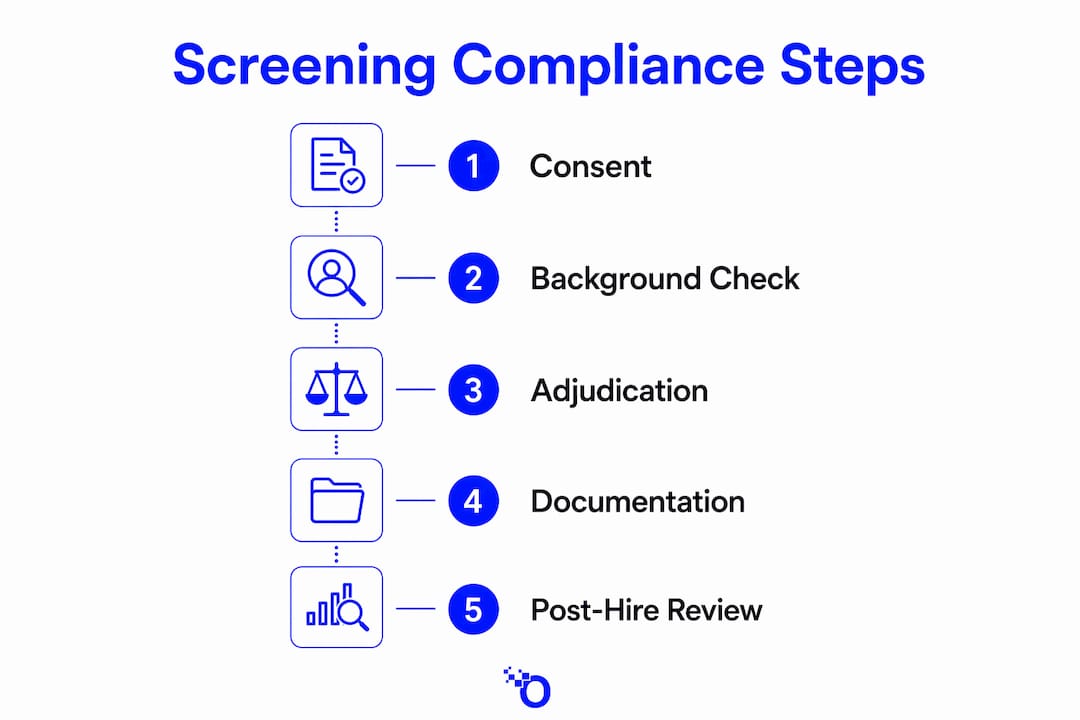
- Review award conditions by role. Read every special condition in the award document. Map required checks to specific positions, noting which roles involve minors or vulnerable populations, since those trigger the most stringent timing and adjudication rules.
- Update your written screening policy. Your policy must name the required checks, the authorized sources, the adjudicator role, and the pre-start requirement. Agencies with complete written policies and annual staff training show materially higher compliance during monitoring.
- Obtain written candidate consent. Consent must be documented before any check is ordered. The notice must state that selection is contingent on NSCHC results and that the candidate has an opportunity to challenge results.
- Order checks through authorized sources only. Using unauthorized vendors is itself a compliance defect. Confirm your screening vendor is on the approved-source list for each check type.
- Track timing against the six-month window. For OVW-covered roles, checks cannot predate the suitability determination by more than six months. Build a calendar that flags expiring checks before the hire date.
- Document the adjudication and suitability determination before the start date. A designated adjudicator (typically HR director, legal counsel, or a named compliance officer) must review results, apply the agency’s written criteria, and sign a suitability determination. That document must be on file before the individual begins work. For guidance on background regulations in public safety hiring, the legal framework and policy-alignment steps are covered in detail.
Pro Tip: Programs may sequence checks within the hiring process to manage high application volumes, but the legal requirement is completion and adjudication prior to the start date. Run NSOPW first since it is free and instant, then layer state and FBI checks as conditional-offer candidates advance. Never allow a grant-funded person to begin work while checks are still pending.
What Records Do Auditors Expect You to Keep?
| Document | Why It Matters | Recommended Retention |
|---|---|---|
| Signed candidate consent form | Proves checks were authorized and candidate was notified | Duration of grant plus 3 years |
| NSOPW search result and date | Confirms sex-offender registry check was completed | Duration of grant plus 3 years |
| State criminal history check result | Documents authorized-source check and timing | Duration of grant plus 3 years |
| FBI fingerprint check result | Verifies federal-level check was completed | Duration of grant plus 3 years |
| Adjudication notes and suitability determination | Shows how the eligibility decision was reached | Duration of grant plus 3 years |
| Training certificates for HR/compliance staff | Demonstrates staff were trained on NSCHC procedures | Duration of grant plus 3 years |
| Evidence of payment for checks | Required where grant funds cover check costs | Duration of grant plus 3 years |

The most common audit failures involve missing adjudication notes and undated consent forms. Auditors look for contemporaneous documentation: a suitability determination signed after the fact, or a consent form with no date, raises immediate questions about whether the check was actually completed before the start date.
Award conditions confirm that reasonable, necessary, and allocable costs to ensure compliance may be charged to the award if they do not supplant non-federal funds. That means check costs and documentation system costs are potentially allowable budget line items.
AmeriCorps encourages grantees to request voluntary policy reviews before a formal monitoring visit. A voluntary review will not trigger disallowance and is one of the most cost-effective pre-audit steps an agency can take. For a practical template on nonprofit screening compliance, the documentation frameworks there translate directly to public safety grant contexts.
Why Does Post-Hire Monitoring Affect Continued Grant Eligibility?
A completed pre-hire check does not satisfy grant conditions indefinitely. OVW award conditions require reexamination at least every five years or when new information suggests unsuitability. Failure to conduct and document reexaminations can affect continued eligibility for grant funding during the period of performance.
Practical monitoring cadence options:
- Periodic rechecks: Schedule reexaminations on a fixed calendar tied to the five-year requirement. Flag each grant-funded position in your HR system with a recheck due date.
- Event-driven checks: Trigger a reexamination when an employee is arrested, named in a complaint, or reassigned to a role involving vulnerable populations.
- Targeted checks for high-risk roles: Positions with direct, unsupervised access to minors warrant more frequent review than administrative roles.
For each reexamination, the same documentation standards apply: authorized-source check results, adjudication notes, and a signed suitability determination. The employee monitoring workflow for public safety agencies covers the operational steps in detail.
Pro Tip: Link your monitoring outputs directly to grant reporting. When your program officer asks for evidence of ongoing compliance, a monitoring log with dates, check types, adjudicator names, and outcomes is far more defensible than a verbal assurance. Build the log format to match your grant’s reporting template from day one.
How Does a Compliance-Focused Screening Platform Reduce Your Risk?
A purpose-built screening platform maps directly to the specific requirements grant auditors check. Here is how the feature-to-requirement alignment works in practice:
- Consent capture: Digital consent workflows timestamp authorization before any check is ordered, satisfying the documentation requirement and eliminating undated paper forms.
- Authorized-source check ordering: A platform configured for NSCHC compliance routes each check type to the correct authorized source, removing the risk of using a non-approved vendor.
- Adjudication workflow: Structured adjudication modules prompt the designated reviewer to document findings against written criteria and sign the suitability determination before the hire is cleared to start.
- Secure records and audit exports: All check results, consent forms, adjudication notes, and training certificates are stored in a single audit-ready record that can be exported on demand for monitoring visits.
- Monitoring cadence support: Automated recheck scheduling flags positions approaching their five-year reexamination window and generates event-driven alerts when new information is entered.
OMNI Intel is built specifically for public safety agencies navigating these requirements. Its pre-employment screening packages include consent workflows, authorized-source check integration, adjudication tracking, and audit-export functionality designed to satisfy NSCHC and DOJ grant conditions. Integration with applicant tracking systems and HRIS platforms means compliance documentation flows into the hiring record automatically, reducing manual entry errors that create audit gaps. For agencies managing drug screening documentation as part of grant conditions, court-admissible results can be incorporated into the same audit file.
Key Takeaways
Grant compliance imposes mandatory checks, timing windows, adjudication requirements, and documentation obligations that must all be satisfied before a grant-funded person begins work.
| Point | Details |
|---|---|
| Confirm award conditions first | Read every special condition by role before ordering any check or updating policy. |
| Complete all NSCHC components before start | NSOPW, state criminal history, and FBI fingerprint checks must be adjudicated prior to the first day of work. |
| Document adjudication contemporaneously | Signed suitability determinations with dates are the single most-examined item in grant audits. |
| Schedule five-year reexaminations | OVW conditions require reexamination at least every five years or when new information arises. |
| OMNI Intel maps to grant requirements | OMNI Intel’s consent workflows, authorized-source checks, and audit exports are designed to satisfy NSCHC and DOJ grant conditions. |
The Compliance Gap Most Agencies Don’t See Until It’s Too Late
The agencies that struggle most with grant screening compliance are not the ones that skip checks entirely. They are the ones that run the right checks but document them poorly. An NSOPW search completed on the right date, by the right person, using the right source, means nothing to an auditor if the result is not printed, dated, and filed with a signed adjudication note.
The second blind spot is timing. Agencies often treat the pre-start adjudication requirement as a formality rather than a hard stop. A grant-funded employee who begins work while a state criminal history check is still pending creates a disallowance exposure for every day of that overlap, regardless of what the check ultimately shows.
The practical fix is not complicated, but it requires discipline: build the adjudication sign-off into your onboarding workflow as a literal gate, not a checkbox. No signed suitability determination on file means no start date. That single procedural change eliminates the most common finding in NSCHC monitoring visits.
OMNI Intel Helps Agencies Meet Grant-Driven Screening Requirements
Public safety agencies managing grant-funded positions face a documentation burden that generic HR software was not designed to handle. OMNI Intel closes that gap with screening and monitoring tools built specifically for the compliance requirements your grant officers will audit.

OMNI Intel’s platform delivers consent capture with timestamps, authorized-source check ordering for NSCHC components, structured adjudication workflows, and one-click audit exports. Post-hire monitoring with automated recheck scheduling keeps your agency ahead of five-year reexamination deadlines without manual calendar management. The result is a complete, audit-ready compliance record for every grant-funded position, from application through the period of performance.
Agencies that have adopted a purpose-built approach to background investigations report fewer audit findings and faster adjudication cycles. Request a compliance review or schedule a demo at OMNI Intel pre-employment screening to see how the platform maps to your specific grant conditions.
Useful Sources
The following primary and program-specific sources were cited in this guide. Keep them in your compliance file for reference during audits and policy reviews.
AmeriCorps NSCHC statutory authority and check requirements: 42 U.S.C. § 12645g governs the National Service Criminal History Check requirement. The AmeriCorps program page at americorps.gov/grantees-sponsors/history-check describes required components and authorized sources.
NSCHC Program Manual (Illinois serve.illinois.gov): Provides the full list of compliant NSCHC elements including consent documentation, authorized-source use, adjudication evidence, and training certificate retention.
DOJ Office on Violence Against Women Award Condition: justice.gov/ovw/award-condition-determination-suitability-required-advance-certain-individuals-who-may-interact specifies the six-month timing window, five-year lookback, and reexamination requirements for roles involving minors.
AmeriCorps Enforcement Update (content.govdelivery.com): Describes the three-month cost-disallowance cap for NSCHC noncompliance and the voluntary policy review process.
The Corps Network NSCHC Guidance: corpsnetwork.org/knowledge-base/guidance-national-service-criminal-history-check-nschc-procedures/ covers sequencing options and the pre-start adjudication requirement.
OMB E-Verify Proposal (Feldesman): feldesman.com/client-alert-omb-proposes-mandatory-e-verify-requirements-for-federal-grant-recipients covers the proposed mandatory E-Verify requirement for federal grant recipients.
FAQ
What checks does grant compliance require before a hire starts?
Under AmeriCorps NSCHC and 42 U.S.C. § 12645g, three checks are required: NSOPW, a state criminal history check, and an FBI fingerprint-based check. All three must be completed, reviewed, and adjudicated before the individual begins work or service.
What happens if an agency skips required screening steps?
AmeriCorps enforcement practice includes cost disallowance typically capped at three months of costs, with discretion to disallow more for egregious violations. Agencies may also face corrective action plans, additional monitoring visits, and suspension of reimbursement.
How often must grant-funded staff be rescreened?
DOJ OVW award conditions require reexamination at least every five years or when new information suggests unsuitability. Checks used for reexamination must cover at least the five calendar years preceding the search request.
Does E-Verify apply to grant-funded public safety hires?
The Office of Management and Budget has proposed mandatory E-Verify requirements for federal grant recipients, signaling that employment-eligibility verification is likely to become a standard grant condition alongside criminal history checks.
How does OMNI Intel support grant compliance documentation?
OMNI Intel provides consent capture, authorized-source check ordering, adjudication workflow tracking, and audit-ready record exports designed to satisfy NSCHC and DOJ grant conditions for public safety agencies.