

Why Nonprofit Boards Need Background Checks
Every nonprofit board should run background checks on its members, full stop. This applies with particular force to public-safety and government-related nonprofits, where a single governance failure can compromise community trust, jeopardize tax-exempt status, and expose the organization to federal scrutiny. BoardSource and the Nonprofit Risk Management Center both treat board-level vetting as a governance baseline, not an optional enhancement.
Two reasons stand above the rest:
- Legal liability: Formal screening demonstrates reasonable due diligence and can limit organizational liability if a board member later engages in misconduct.
- Safety and reputation: Unethical or illegal conduct by a leader alienates donors, staff, and communities, often faster than any communications strategy can contain.
If your agency serves children, people with disabilities, or other vulnerable populations, screening is not discretionary. It is a regulatory expectation and a fiduciary obligation.
Table of Contents
- Why Board Member Vetting Protects Your Nonprofit’s Future
- Which Checks Should You Run, and When?
- What the FCRA and State Laws Require Before You Screen
- How to Screen Fairly Without Creating Disparate Impact
- How to Build and Operationalize a Board Screening Policy
- Higher Standards When Your Mission Serves Vulnerable Populations
- Ongoing Monitoring and Responding to Flagged Results
- Common Pitfalls That Undercut Your Screening Program
- A 30/60/90-Day Checklist to Get Your Policy in Place
- Key Takeaways
- Why Public-Safety Nonprofits Deserve a Higher Standard of Scrutiny
- OMNI Intel Supports Compliant, Investigator-Grade Board Screening
- Useful Sources, Templates, and Authorities
- FAQ
Why Board Member Vetting Protects Your Nonprofit’s Future
Board members carry fiduciary duties: the duty of care and the duty of loyalty. When those duties go unverified, governance gaps accumulate quietly until an audit, a donor inquiry, or a press report forces the issue into the open. Documented vetting is the organization’s first line of defense.
Reputational risk is equally concrete. A board member’s financial misconduct or undisclosed conflict of interest can trigger donor withdrawal and funder scrutiny within days. For public-safety nonprofits that depend on government grants and community credibility, that kind of cascading damage is often unrecoverable. The role of background checks in agency reputation is well documented: organizations that screen consistently signal accountability to every stakeholder who reviews their governance.
Operationally, checks surface fraud risk, undisclosed conflicts of interest, and credential misrepresentation before a problematic individual gains access to financial accounts, client data, or program oversight. Smaller nonprofits often face higher exposure precisely because board members hold broader access with less internal oversight.

Which Checks Should You Run, and When?
The scope of screening should match the risk profile of each board role. A purely advisory member carries different risk than a treasurer with signatory authority over accounts.
| Check Type | Governance Role | Finance/Fiduciary Role | Youth- or Vulnerable-Facing Role |
|---|---|---|---|
| Criminal history (county, state, federal) | Yes | Yes | Yes |
| National sex-offender registry | Situational | Situational | Yes |
| Identity verification | Yes | Yes | Yes |
| Credit/financial history | No | Yes | Situational |
| Education and credential verification | Situational | Yes | Situational |
| Media and reputational search | Yes | Yes | Yes |
| State child-abuse registry | No | No | Yes |
Timing guidance:
- Run a full check before any formal appointment or officer election.
- Conduct a targeted recheck before a member assumes a new role with elevated access (for example, joining the finance committee).
- Schedule periodic rechecks, typically every two to three years, for all seated members.
Because no single all-encompassing U.S. criminal database exists, a thorough search combines county-level court records, statewide repositories, and federal district court records. Relying on a single national database alone leaves meaningful gaps.
What the FCRA and State Laws Require Before You Screen
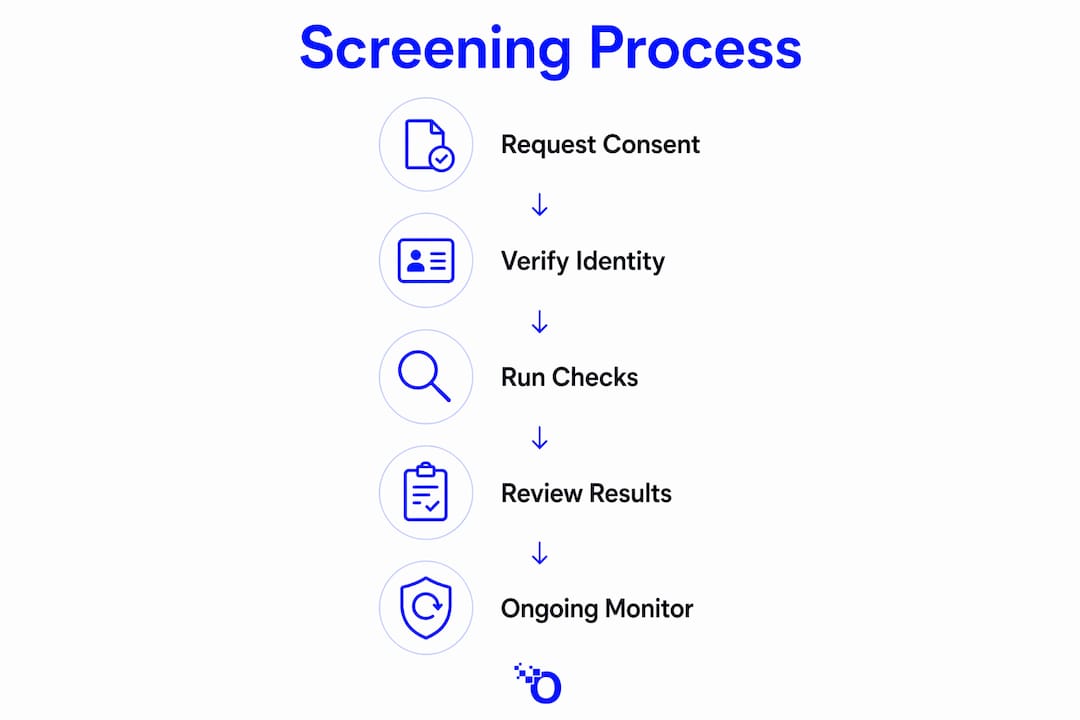
When your organization uses a third-party consumer reporting agency to conduct checks, the Fair Credit Reporting Act applies. The FCRA requirements are specific and non-negotiable:
State law adds another layer. Many states have ban-the-box rules that restrict when and how criminal history may be considered. Some states mandate checks for anyone working with youth or vulnerable adults, including board members with program oversight. BoardSource recommends reviewing local and state law before finalizing any screening policy, and consulting legal counsel when the organization operates across multiple jurisdictions.
Compliance checklist:
- Standalone disclosure form (separate from any application)
- Signed written authorization from the candidate
- Pre-adverse-action notice with report copy and FCRA Summary of Rights
- Reasonable waiting period (typically five business days)
- Final adverse-action notice if the decision stands
- Secure retention of all consent and notice records
For detailed federal and state legal requirements applicable to agencies and nonprofits, the background check laws for agencies resource provides a practical reference. Proper notarization and document handling for formal records may also be relevant; a notary services guide for nonprofits can assist with procedural record-keeping where required.
How to Screen Fairly Without Creating Disparate Impact
Blanket criminal exclusions, applied uniformly to all board candidates, risk disparate impact against people of color, who are disproportionately arrested and convicted relative to the general population. The Nonprofit Risk Management Center recommends role-relevant disqualifying criteria rather than automatic exclusions.
A defensible equity-focused policy includes:
- A defined list of disqualifying offenses tied directly to role duties (for example, financial fraud disqualifies a treasurer candidate; a decades-old minor offense does not automatically disqualify an advisory member)
- Time-and-type thresholds that consider how long ago an offense occurred and whether it is relevant to the specific responsibilities
- An individualized assessment process that gives the candidate an opportunity to respond before a final decision is made
- Documented rationale for every adverse decision, retained in a secure file
Pro Tip: Build a tiered screening matrix so that roles with higher access to funds, clients, or sensitive data trigger more stringent checks. Governance-only roles use a baseline package; finance and program-oversight roles use an expanded package. This approach is both proportionate and defensible to funders and regulators.
How to Build and Operationalize a Board Screening Policy
A policy that exists only in board minutes is not a policy. It needs to be a standalone document, approved by the full board, and integrated into the onboarding process for every new member.
- Scope the risk. Identify every board role, map access levels, and assign a screening tier.
- Draft the policy. Include scope, disqualifying criteria by role, consent process, adverse-action procedure, record retention schedule, and recheck frequency.
- Align with bylaws. Confirm your bylaws include a clear director removal pathway so the organization can act quickly if a check or later conduct requires it.
- Gain board approval. Present the policy at a formal board meeting and record the vote in minutes.
- Obtain consent. Collect signed standalone disclosure and authorization forms before ordering any check.
- Order and review checks. Use an FCRA-compliant vendor; review results against your tiered criteria, not general impressions.
- Document every decision. Record what was reviewed, who reviewed it, what criteria applied, and the outcome. Audit-ready documentation is as important as the check itself.
- Schedule rechecks. Build recheck dates into your governance calendar.
For a practical documentation checklist, the background check documentation list for public safety HR provides a ready-to-use reference.
Higher Standards When Your Mission Serves Vulnerable Populations
For nonprofits serving children, people with disabilities, or other vulnerable groups, screening of leadership is a fundamental obligation and often a regulatory expectation. Several states mandate fingerprint-based FBI checks for anyone in a supervisory or oversight role at a youth-serving organization, and state child-abuse registry searches are commonly required by statute or funder contract.
Recommended additional steps for high-access roles:
- FBI fingerprint-based check through an authorized state channel
- National sex-offender registry search
- State child-abuse and neglect registry search
- More frequent rechecks, typically annually, for board members with direct program oversight
A board member who serves in a purely advisory capacity carries lower risk than one who approves program budgets, visits client sites, or supervises staff. Differentiate the screening package accordingly.
Pro Tip: Before finalizing your screening protocol, review your funder agreements and general liability or D&O insurance requirements. Many funders and insurers specify minimum screening standards for leadership; aligning with those requirements up front avoids compliance gaps that surface during grant audits.
Ongoing Monitoring and Responding to Flagged Results
A pre-appointment check captures a moment in time. Continuous monitoring closes the gap between that moment and a board member’s eventual departure.
Monitoring options:
- Periodic rechecks on a fixed schedule (every one to three years)
- Subscription-based continuous monitoring that flags new criminal records, civil judgments, or watchlist entries in near real time
- Trigger-based searches when a specific concern arises
Incident response flow:
- Flag identified: compliance officer or board chair receives the alert.
- Individual notice: the board member is informed and given an opportunity to respond.
- Temporary restriction: access to sensitive systems or funds is suspended pending review.
- Board action: the full board or executive committee reviews findings and decides on next steps (retention, role change, or removal).
- Documentation: every step, communication, and decision is recorded and retained.
Privacy and proportionality matter throughout. Monitoring should be limited to information relevant to the member’s role and duties, and the process should be applied consistently across all board members to avoid claims of selective enforcement.
Common Pitfalls That Undercut Your Screening Program
Even well-intentioned programs fail when execution is inconsistent. The most common errors:
- Applying checks to new members but not to long-tenured members recruited by referral or reputation
- Skipping FCRA steps because the candidate is a volunteer, not an employee (the FCRA applies to consumer reports used for volunteer placement decisions as well)
- Using unreliable data sources, such as free internet searches, that miss court records and produce false negatives
- Failing to document the review process, leaving the organization unable to demonstrate due diligence in an audit
- Overbroad exclusions that disqualify candidates without individualized review, creating disparate-impact exposure
Red-flag checklist during candidate review:
- Refusal to sign the consent and disclosure form
- Unexplained gaps in leadership or professional history
- Unresolved financial judgments for candidates seeking fiduciary roles
- Evidence of undisclosed conflicts of interest with the organization or its funders
Standardize the review process with a written rubric so that every reviewer applies the same criteria to the same information. Consistency is the single most effective defense against both bias claims and governance challenges.
A 30/60/90-Day Checklist to Get Your Policy in Place
Days 1 to 30: Scope and draft
- Map every board role and assign a screening tier (governance, finance, vulnerable-population-facing)
- Draft the written policy: scope, disqualifying criteria, consent process, adverse-action steps, retention schedule
- Review bylaws for director removal procedures; flag gaps for legal counsel
- Identify FCRA-compliant vendor candidates and evaluate data sources, turnaround times, and pricing
Days 31 to 60: Approve and launch
- Present the policy to the full board for formal approval; record the vote
- Collect signed consent and disclosure forms from all current board members
- Order initial checks on all seated members using the approved vendor
- Brief the board chair and compliance officer on the adverse-action process
Days 61 to 90: Document and sustain
- Review results against tiered criteria; document every decision with rationale
- Communicate the policy to prospective board members as part of the recruitment packet
- Set calendar reminders for periodic rechecks
- File all consent forms, reports, and decision records in a secure, access-controlled location
Key Takeaways
Nonprofit boards that screen members consistently, document decisions thoroughly, and apply equity-focused criteria are better positioned to withstand audits, retain donor confidence, and protect the populations they serve.
| Point | Details |
|---|---|
| Legal due diligence | Formal screening demonstrates reasonable due diligence and can limit liability if a board member engages in misconduct. |
| Equity-focused criteria | Define role-specific disqualifying offenses rather than blanket exclusions to avoid disparate impact. |
| FCRA compliance | Any third-party consumer report requires standalone disclosure, signed consent, and a two-step adverse-action process. |
| Vulnerable-population standard | Organizations serving children or people with disabilities should add FBI fingerprint checks, state registry searches, and annual rechecks for oversight roles. |
| OMNI Intel | OMNI Intel applies law-enforcement investigative principles, continuous monitoring, and audit-ready documentation to support public-safety nonprofits in implementing compliant board screening programs. |
Why Public-Safety Nonprofits Deserve a Higher Standard of Scrutiny
The conventional wisdom treats board background checks as a risk-management checkbox: run a basic criminal search, keep a copy on file, move on. That framing is inadequate for public-safety and government-related nonprofits, and the gap between “checkbox” and “defensible program” is where most governance failures originate.
Board members recruited through professional networks or personal referrals are not lower-risk by virtue of their connections. Insider status can mask financial conflicts, credential misrepresentation, and conduct that a formal investigation would surface. The organizations most likely to skip checks on trusted referrals are often the ones most exposed when something goes wrong.
What actually works is a program built on investigative principles rather than database queries: structured criteria, documented rationale, consistent application, and continuous monitoring that does not stop at the appointment date. That is the standard law enforcement agencies apply to their own personnel, and it is the standard public-safety nonprofits should apply to the leaders who govern them. Anything less is a governance gap waiting to become a liability.
OMNI Intel Supports Compliant, Investigator-Grade Board Screening
Public-safety nonprofits face a specific challenge: the governance standards expected of them are closer to those of a law enforcement agency than a typical charitable organization, yet most background screening vendors are built for general HR use.

OMNI Intel was built for exactly this gap. Its pre-employment screening services apply law-enforcement investigative principles to board and employee vetting, covering criminal history, sex-offender registries, identity verification, financial history for fiduciary roles, and continuous post-appointment monitoring. The platform produces audit-ready documentation at every step, so your organization can demonstrate due diligence to funders, regulators, and insurers without assembling records manually. For agencies ready to move from policy to practice, the OMNIScreen investigative services page outlines the full scope of available checks and how they integrate with your existing hiring workflow. Contact OMNI Intel to build a screening program calibrated to your mission and risk profile.
Useful Sources, Templates, and Authorities
The following resources support policy development, legal compliance, and governance best practices for nonprofit board screening.
- BoardSource: Nonprofit Background Check Policy Considerations Governance framework for criminal background check policies, including equity considerations and sector-specific guidance.
- Nonprofit Risk Management Center: Background Screening for Nonprofits Practical FCRA compliance guidance, individualized assessment frameworks, and role-relevant disqualifying criteria.
- OMNI Intel: Safe Hiring Practices for Nonprofits Compliance guide covering screening policies, documentation, and best practices for nonprofit and public-safety contexts.
- OMNI Intel: Nonprofit Screening Guide Updated screening guidance tailored to nonprofits and public-safety organizations.
- OMNI Intel: Types of Volunteer Background Checks Breakdown of check types, timing, and appropriate use cases for volunteer and board roles.
- FTC FCRA Resources (ftc.gov) Primary federal guidance on consumer report disclosure, consent, and adverse-action requirements under the Fair Credit Reporting Act.
FAQ
Do nonprofit board members count as employees under the FCRA?
Board members are typically volunteers, not employees, but the FCRA still applies whenever a third-party consumer reporting agency produces a report used in a placement or governance decision. Disclosure, consent, and adverse-action requirements apply regardless of employment status.
Which background checks are required for youth-serving nonprofits?
Requirements vary by state, but most youth-serving organizations must conduct FBI fingerprint-based checks, national sex-offender registry searches, and state child-abuse registry searches for anyone in a supervisory or oversight role, including board members with program responsibility.
How often should nonprofit boards recheck seated members?
Most governance guidance recommends rechecks every two to three years for general board members and annually for members in high-access roles such as treasurer or program oversight. Continuous monitoring through a platform like OMNI Intel can supplement scheduled rechecks by flagging new records between cycles.
What happens if a board member refuses to consent to a background check?
Refusal to sign the required disclosure and consent form is itself a significant red flag. The organization should treat it as a disqualifying factor and document the refusal in the candidate’s file before declining the appointment.
Can a nonprofit use free online searches instead of a formal screening vendor?
Free internet searches do not meet FCRA standards and routinely miss county court records, sealed cases, and registry entries. They also produce no audit trail. A formal FCRA-compliant vendor is required whenever the results will inform a governance or placement decision.