

Recruiting Officers: A Strategic Guide for Public Safety HR
Recruiting officers is the process of systematically attracting, vetting, and hiring qualified candidates to public safety agencies through coordinated organizational efforts at three distinct levels: organizational, unit, and individual. Staffing levels at law enforcement agencies sit 2%–5% below authorized strength, and agencies that track metrics like first-year attrition, quality of hire, and cost per hire reallocate resources far more effectively than those that do not. For HR professionals and hiring managers in public safety, the difference between a reactive hiring scramble and a functioning talent pipeline comes down to whether recruitment is treated as a system or an afterthought.
What does effective recruiting officers strategy look like?
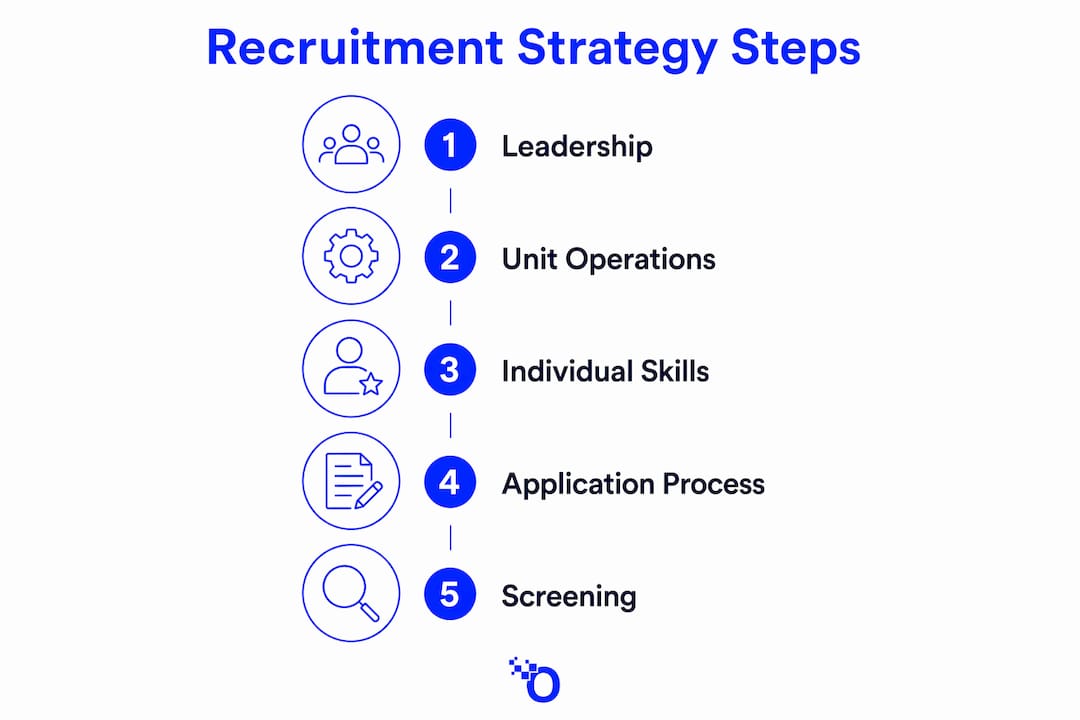
Effective officer recruitment is defined by three coordinated levels: organizational leadership, unit operations, and individual recruiter performance. Each level has distinct responsibilities, and failure at any one of them undermines the entire program. Agencies that treat recruitment as an isolated HR task, rather than an agency-wide priority, consistently lose talent to better-supported departments.
The organizational level sets the conditions. Leadership must commit budget, define measurable goals, and create a culture that candidates actually want to join. The unit level executes daily outreach, manages the applicant pipeline, and tracks performance data. The individual level is where recruiters build relationships, represent the agency brand, and convert interested candidates into sworn officers.
This three-tier framework, developed through research at Michigan State University’s Police Staffing Observatory, gives HR managers a clear structure for diagnosing where their program is underperforming. Most agencies struggle at more than one level simultaneously, which is why isolated fixes rarely produce lasting results.
How does organizational leadership shape officer recruitment?
Leadership commitment is the single most important factor in building effective recruitment programs. Agencies with dedicated recruitment budgets and executive backing consistently outperform those that fund recruitment as a line-item afterthought. Without that top-level support, recruiters lack the tools, time, and authority to compete for qualified candidates.

Culture is the second major driver. Younger candidates, particularly Millennials and Gen Z, prioritize flexible work arrangements and transparent workplace culture over traditional paramilitary messaging. Agencies that lead with rigid hierarchy and vague career paths lose these candidates before the first interview. Departments with healthy reputations attract lateral recruits through word-of-mouth, which is the most cost-effective recruitment channel available.
Employer brand management is not optional. Agencies that control their narrative through authentic social media content and real officer stories fill vacancies faster and attract candidates who are already aligned with the agency’s mission. A recruiter posting scripted department videos competes poorly against an officer sharing an honest account of their career path.
Key organizational actions that support recruitment success:
- Allocate a dedicated recruitment budget with measurable spending targets
- Establish executive sponsorship with a named leader accountable for hiring outcomes
- Audit the agency’s social media presence and correct misrepresentations
- Define and communicate career pathways, promotion timelines, and compensation structures
- Collect and act on exit interview data to address cultural problems before they become public
Pro Tip: Assign one senior leader as the internal champion for recruitment. Agencies where the chief or sheriff publicly endorses the recruitment program see higher candidate trust and faster application completion rates.
How do unit-level strategies improve hiring outcomes?
Unit-level recruitment is where strategy meets execution. The daily work of pipeline development, applicant communication, and process management determines whether organizational goals translate into actual hires. Agencies that measure and adjust at this level consistently outperform those that rely on intuition alone.
Three metrics define unit-level performance:
- First-year attrition: Officers who leave within 12 months signal a mismatch between what was promised during recruitment and what the job actually delivers. High first-year attrition is a recruitment problem, not just a retention problem.
- Quality of hire: Measured by performance reviews, field training outcomes, and supervisor ratings at 6 and 12 months. This metric tells you whether your sourcing channels attract the right candidates.
- Cost per hire: Total recruitment spending divided by the number of officers hired. Agencies that track this number identify inefficiencies that are otherwise invisible.
Process speed is a critical variable. The Metropolitan Police Department cut its hiring timeline from 18 months to under four months through targeted process improvements. That reduction alone dramatically increased candidate conversion rates because fewer applicants dropped out during a prolonged wait.
| Recruitment bottleneck | Common cause | Practical fix |
|---|---|---|
| Long application completion time | Complex forms, testing fees | Simplify forms, waive or subsidize fees |
| Slow background investigation | Manual processes, no tracking | Integrate digital investigation platforms |
| Poor candidate communication | No automated follow-up | Use applicant tracking system with auto-updates |
| High drop-off after conditional offer | Unclear next steps | Assign a dedicated candidate liaison |
Translating outreach materials into the primary languages spoken in your community is a high-return, low-cost improvement. Moving recruitment into community spaces, such as libraries, community centers, and high schools, reaches candidates who would never visit a police station to pick up an application.
Pro Tip: Audit your application process by completing it yourself as a candidate would. Time every step. Identify every fee, upload requirement, and unclear instruction. Most agencies discover at least three unnecessary barriers within the first 20 minutes.
Applicant tracking systems reduce administrative burden and give unit supervisors real-time visibility into pipeline health. Automation handles routine candidate communications, freeing recruiters to focus on relationship-building rather than email management. The public safety recruitment process requires both human judgment and process discipline to function at scale.
What individual recruiter skills drive recruitment success?
The individual recruiter is the agency’s most direct point of contact with potential candidates. Recruiter quality determines whether a promising candidate stays engaged or walks away. Agencies that assign recruitment duties without providing specialized training consistently underperform, regardless of how strong their organizational support is.
The core qualities that define effective law enforcement recruiters:
- Communication skills: The ability to listen, ask open questions, and adapt messaging to different audiences. A recruiter who delivers the same pitch to a 19-year-old college student and a 35-year-old military veteran will lose one of them immediately.
- Belief in the agency’s mission: Candidates detect inauthenticity quickly. Recruiters who genuinely believe in the work they are representing close candidates at higher rates and build longer-lasting relationships.
- Emotional intelligence: Recognizing when a candidate is hesitant, addressing unspoken concerns, and knowing when to follow up versus when to give space. These skills are rarely natural and almost always require training.
- Social media proficiency: Recruiters who cannot engage authentically on platforms like Instagram, LinkedIn, and TikTok miss the primary channels where younger candidates spend their time.
A single recruiter in Chula Vista, California, hired 25% of sworn officers over a two-year period through relationship-building skills alone. That result is not replicable through job postings or career fairs. It comes from consistent, personal engagement with candidates over time.
Recruiter training must include mentorship from experienced officers, candidate roleplaying exercises, and structured feedback on outreach performance. Agencies that skip this training produce recruiters who are enthusiastic but ineffective. The cost of an untrained recruiter is not just a missed hire. It is a candidate who tells others the agency was disorganized or impersonal.
Pro Tip: Pair new recruiters with your highest-performing officers for at least 90 days. Candidates who meet officers they admire during the recruitment process are significantly more likely to complete the application and accept a conditional offer.
Recruiter incentives matter. Agencies that recognize and reward successful recruiters, through commendations, schedule flexibility, or career advancement credit, retain their best talent in the recruitment function rather than cycling them back to patrol after one tour.
How do you execute a full officer hiring process from outreach to hire?
The officer hiring process is defined by whether it runs continuously or reactively. Reactive recruiting, which begins only after a vacancy opens, produces poor results because the pipeline is empty when it is needed most. Continuous pipeline development maintains candidate engagement before vacancies arise, so agencies always have qualified candidates ready to move forward.
A structured recruitment lifecycle follows these steps:
- Define the target candidate profile. Identify the specific qualities, backgrounds, and values the agency needs. Vague profiles produce vague outreach.
- Build community relationships year-round. Youth outreach programs, ride-along opportunities, and community events create warm candidate pools long before a vacancy is posted.
- Simplify the application entry point. Remove testing fees, reduce form complexity, and offer application assistance at community locations.
- Communicate proactively at every stage. Candidates who receive regular updates are far less likely to withdraw. Silence is interpreted as disorganization or disinterest.
- Accelerate the background investigation. Use digital investigation platforms to reduce processing time without reducing thoroughness.
- Set accurate job expectations during recruitment. Turnover costs exceed $50,000 per officer, and a significant portion of that cost traces back to candidates who were oversold on the role during recruitment.
“Recruitment programs that rely on sporadic job fairs after vacancies occur will always struggle. The agencies filling their ranks are the ones that treat community engagement as a year-round operational function, not a reaction to a staffing crisis.”
Diversity in the candidate pool requires deliberate outreach, not passive hope. Agencies that partner with historically Black colleges and universities, Hispanic-serving institutions, and veteran transition programs build pipelines that reflect the communities they serve. This is not a compliance exercise. It is a talent strategy.
Common recruitment mistakes that cost agencies qualified candidates include charging application fees, requiring candidates to travel to a central location for every step, and failing to follow up within 48 hours of an application submission. Each of these mistakes signals to candidates that the agency does not value their time. The best practices for law enforcement hiring address each of these friction points with specific process changes.
Diversity outreach and responsible recruitment practices also reduce legal exposure. Agencies with documented, consistent hiring criteria are better positioned to defend their selection decisions if challenged.
Key Takeaways
Effective officer recruitment requires a coordinated system across organizational, unit, and individual levels, with measurable metrics, skilled recruiters, and continuous pipeline development driving results.
| Point | Details |
|---|---|
| Three-level framework | Organizational, unit, and individual levels must all function together for recruitment to succeed. |
| Leadership and budget | Agencies with executive backing and dedicated recruitment budgets consistently outperform underfunded programs. |
| Process speed matters | Cutting hiring timelines reduces candidate drop-off and increases conversion rates significantly. |
| Recruiter quality is decisive | A single skilled recruiter can account for a disproportionate share of total hires through relationship-building. |
| Continuous outreach wins | Year-round pipeline development prevents the reactive scramble that follows every unexpected vacancy. |
Why I think most agencies are solving the wrong recruitment problem
Most public safety agencies I have observed treat recruitment as a marketing problem. They redesign their website, launch a social media campaign, and wonder why the application numbers do not improve. The real problem is almost always structural, not promotional.
The agencies that consistently fill their ranks are not the ones with the best Instagram presence. They are the ones where a captain can tell you the first-year attrition rate by hire cohort, where recruiters receive 40 hours of specialized training before their first outreach event, and where the chief has personally committed budget to the program for three consecutive fiscal years. Those are structural investments. They are harder to make than a social media post, and they produce results that last.
The other pattern I see repeatedly is agencies that identify one problem and fix only that. They simplify the application, but the background investigation still takes 14 months. They hire a great recruiter, but give that person no budget and no metrics. Recruitment is a system. Fixing one component while leaving the others broken produces marginal improvement at best.
The most practical starting point for any HR manager reading this is a gap analysis across all three levels. Where does your agency lack leadership commitment? Where are your unit metrics weakest? Where are your recruiters undertrained? Answer those three questions honestly, and you have a roadmap that is more useful than any recruitment campaign.
— Matt
How OMNI Intel supports compliant, efficient officer screening
Recruiting qualified officers is only half the equation. Verifying that candidates meet the integrity and character standards required for public safety work is where many agencies lose time and introduce risk.

OMNI Intel provides pre-employment screening services built specifically for law enforcement, fire and EMS, dispatch centers, and private security firms. Its investigator-driven background investigations apply law enforcement principles to candidate vetting, reducing the time agencies spend on manual checks while maintaining the depth that public safety roles demand. OMNI Intel’s applicant screening integration connects directly with hiring workflows, so background investigations run in parallel with recruitment rather than after it. Agencies that integrate screening early reduce their overall hiring timeline and catch disqualifying information before investing further resources in a candidate.
FAQ
What are the three levels of a law enforcement recruitment program?
Effective law enforcement recruitment operates at the organizational, unit, and individual levels. Each level has distinct responsibilities, and all three must function together for the program to succeed.
How do you measure recruitment officer effectiveness?
The three most reliable metrics are first-year attrition, quality of hire, and cost per hire. Agencies that track these numbers can identify which sourcing channels and processes produce the best long-term officers.
What is the biggest barrier to converting applicants to officers?
Long, complex hiring timelines are the primary conversion barrier. Agencies that have cut their hiring process from 18 months to under four months see significantly higher candidate completion rates.
How do individual recruiter skills affect hiring outcomes?
Recruiter communication skills, emotional intelligence, and belief in the agency’s mission directly determine candidate conversion rates. One skilled recruiter in Chula Vista hired 25% of the department’s sworn officers over two years through relationship-building alone.
Why does continuous recruitment outperform reactive hiring?
Continuous outreach builds a warm candidate pool before vacancies arise. Reactive recruiting begins with an empty pipeline, which forces agencies to accept lower-quality candidates or leave positions unfilled for extended periods.