

Why Judiciary Staff Background Checks Matter for Justice
Judiciary staff background checks are defined as formal pre-employment investigations that verify the integrity, qualifications, and suitability of personnel supporting the justice system. These checks are not administrative formalities. They are the foundation on which judicial legitimacy rests. When court administrators, clerks, bailiffs, and support staff lack proper vetting, the entire institution becomes vulnerable to bias, misconduct, and public distrust. Understanding why judiciary staff background checks matter gives administrators the tools to protect their courts, their communities, and the rule of law itself.
Why judiciary staff background checks matter for public trust
Judiciary staff integrity is inseparable from judicial integrity. That connection is direct and consequential. When a court clerk manipulates case files, when a bailiff has undisclosed financial ties to a defendant, or when an administrator with a history of fraud handles sensitive records, the court’s credibility collapses. The public does not distinguish between a judge’s conduct and the conduct of the staff surrounding that judge.
Administrative lapses create the perception of judicial bias even when no judge is personally involved. A single incident of misconduct by a court employee can generate headlines that take years to overcome. The reputational damage extends beyond the individual courthouse to the broader justice system, eroding public confidence in outcomes that depend on perceived fairness.
“Court administrators who fail to uphold ethical standards do not merely harm their own institutions. They undermine the public’s belief that justice is possible. Integrity at every level of court administration is not optional. It is the price of legitimacy.”
Judicial employee screening also addresses the growing challenge of technology and data privacy. Court staff now routinely handle electronic case management systems, sealed records, and sensitive personal data. A staff member with a history of data theft or cybercrime poses a threat that goes far beyond physical misconduct. Thorough vetting must account for digital conduct, not just criminal history.
The impact of staff background checks on agency reputation is well documented in public safety contexts. Courts are no different. Administrators who treat vetting as a compliance checkbox rather than a genuine integrity process accept unnecessary institutional risk.
- Unvetted staff with financial problems are more susceptible to bribery and case manipulation.
- Staff with undisclosed prior employment terminations may repeat the same conduct in a court setting.
- Personnel with conflicts of interest, such as relationships with attorneys or defendants, compromise case neutrality.
- Employees with falsified credentials undermine the professional standards courts depend on.
What legal and ethical standards govern judiciary staff checks?
Judicial staff appointments must be merit-based and impartial to prevent undue political influence and maintain ethical standards. This principle appears across judicial canons of ethics in the United States and in international frameworks including the OECD Anti-Corruption and Integrity Outlook 2026. Merit-based hiring is not simply a best practice. It is an ethical mandate with legal weight.
Regulatory frameworks emphasize merit and objectivity in recruiting judiciary-affiliated roles to prevent undue political influence. Courts that allow patronage hiring, where positions go to political allies rather than qualified candidates, create structural vulnerabilities that no amount of post-hire supervision can fully correct. The problem begins at the point of selection.
Judges carry an affirmative ethical duty that extends beyond their courtrooms. Judges have an ethical duty to supervise court staff to uphold fairness and public confidence in the judiciary’s independence and integrity. This means the responsibility for staff vetting does not belong solely to HR departments. It belongs to the judiciary itself.
The duty of care in hiring creates direct legal exposure for courts that skip or shortcut background investigations. Negligent hiring doctrine holds employers liable when they place an employee in a role where harm was foreseeable, and a reasonable investigation would have revealed the risk. Courts are not exempt from this doctrine.
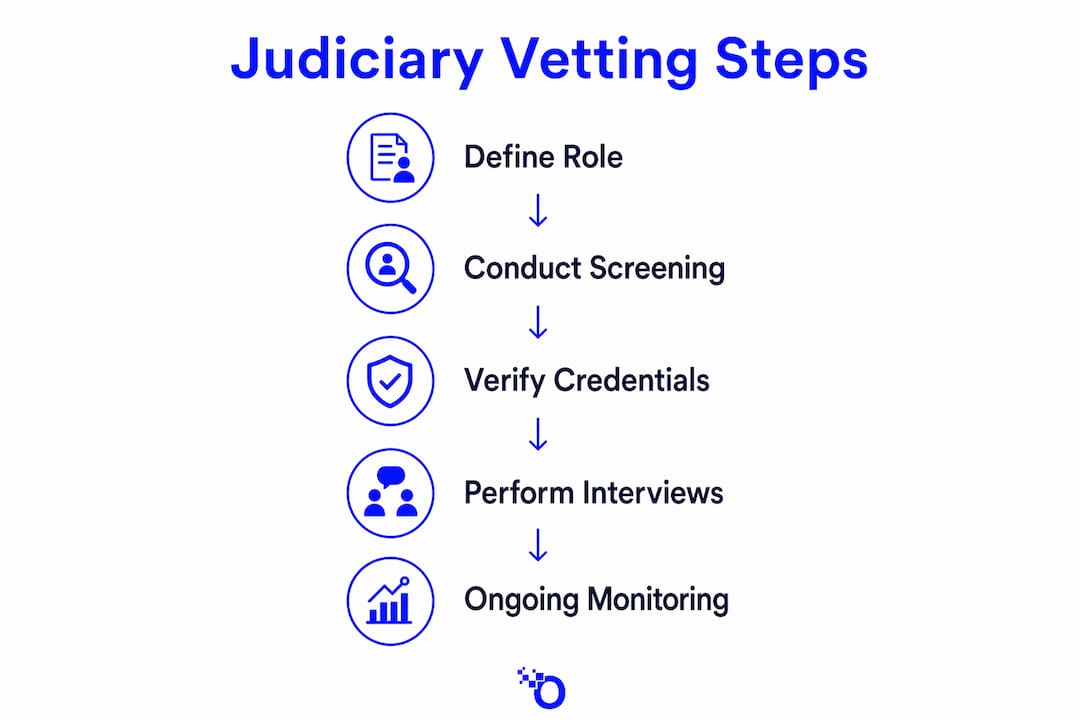
A documented, transparent hiring process is the best defense against negligent hiring claims. The following steps form the legal and ethical baseline for judiciary staff vetting:
- Define the role’s risk profile. Identify what sensitive information, systems, or populations the employee will access before selecting the depth of the investigation.
- Conduct a criminal history review covering all jurisdictions where the applicant has lived or worked, not just the current state of residence.
- Verify all credentials directly. Contact educational institutions and prior employers directly rather than relying solely on applicant-supplied documents.
- Review financial history for roles involving fund management, case records, or access to sealed financial documents.
- Document every step. Record what was checked, when, by whom, and what the findings were. This documentation protects the court in any subsequent legal challenge.
- Apply consistent standards. Every candidate for the same role must go through the same process. Inconsistency creates legal and ethical exposure.
Pro Tip: Align your vetting depth to the sensitivity of the role, not just the seniority of the position. A junior clerk with access to sealed juvenile records carries more institutional risk than a senior administrator with no access to active case files.
What are the risks of insufficient vetting for judiciary staff?
Insufficient vetting creates risks that fall into four distinct categories: legal liability, operational disruption, reputational damage, and systemic corruption. Each category compounds the others. A single unvetted hire can trigger all four simultaneously.

Employers must exercise reasonable care in hiring, particularly when public safety is at risk. Failure to investigate relevant criminal history can lead to direct liability. In Malorney v. B&L Motor Freight, Inc., the court found that an employer’s failure to conduct a reasonable background check on a driver with a prior criminal history created foreseeable harm. The principle applies with equal force in judicial settings, where staff have access to vulnerable individuals and sensitive proceedings.
Political patronage in court hiring is a specific and well-documented risk. When appointments bypass merit-based processes, the resulting staff may lack the qualifications to perform their duties and may carry loyalties that conflict with judicial neutrality. Judges and judicial administrators must avoid favoritism, nepotism, and partiality in hiring and supervision to maintain institutional integrity. Patronage hiring is not just an ethical failure. It is a structural one.
| Risk Category | Source of Risk | Consequence |
|---|---|---|
| Legal liability | Negligent hiring, failure to investigate | Lawsuits, court-ordered damages, regulatory sanctions |
| Operational disruption | Unqualified or dishonest staff | Case delays, records errors, system breaches |
| Reputational damage | Misconduct by unvetted employees | Loss of public trust, media scrutiny, political pressure |
| Systemic corruption | Patronage hiring, undisclosed conflicts | Biased outcomes, compromised case integrity |
Low-cost automated screening tools often miss critical records and do not meet the legal duty of care, increasing negligent hiring risks. Courts that rely exclusively on automated database checks without investigative follow-up accept a false sense of security. A database that is six months out of date, or that lacks records from certain jurisdictions, provides incomplete protection.
The foreseeability standard in negligent hiring law is particularly demanding in judicial contexts. Courts are institutions that the public trusts to protect them. When a court hires someone who then harms a litigant, a witness, or a colleague, the argument that the harm was unforeseeable becomes very difficult to sustain if a basic investigation would have revealed the risk.
What are the best practices for conducting judiciary staff background checks?
Effective judicial employee screening requires depth proportional to the role’s risk, investigative rigor beyond automated tools, and ongoing vigilance after hire. These three principles define the difference between a process that protects the institution and one that merely creates the appearance of compliance.
Vetting procedures must be proportional, respecting legal certainty to safeguard judicial independence without conflating vetting with routine performance reviews. This guidance from the Venice Commission reflects a critical balance. Vetting must be thorough enough to catch genuine integrity risks without becoming so invasive that it chills qualified candidates from applying or undermines the independence of the judiciary itself.
Incomplete or inconclusive background check results require follow-up investigation. An inconclusive result is not a clearance. Administrators who treat an ambiguous finding as a green light expose their institutions to the same liability as those who conduct no check at all. Every gap in a candidate’s history deserves a direct question and a documented answer.
- Verify credentials with original sources. Contact universities, licensing boards, and prior employers directly. Do not accept copies of diplomas or certificates without independent confirmation.
- Conduct reference interviews, not just reference checks. A structured conversation with a prior supervisor reveals behavioral patterns that no database can capture.
- Search all relevant jurisdictions. A candidate who lived in three states over ten years requires searches in all three. Single-state checks create blind spots.
- Review social media and public digital conduct for roles with public-facing responsibilities or access to sensitive communications.
- Implement post-hire monitoring. Background checks protect against known risks at the time of hire. Ongoing monitoring catches new risks that emerge after employment begins.
Background checks should be complemented by ongoing supervisory vigilance to prevent misconduct and ensure ethical compliance. Continuous oversight is not a sign of distrust. It is the professional standard for any institution where integrity is non-negotiable.
Pro Tip: Centralized HR management practices, including those outlined in modern HR compliance guides, can help court administrators standardize vetting workflows and reduce inconsistencies across departments.
The benefits of thorough vetting extend beyond risk avoidance. Courts that conduct rigorous background investigations attract candidates who understand and accept high professional standards. The vetting process itself signals institutional seriousness, which deters applicants whose conduct would not survive scrutiny.
Key Takeaways
Thorough judiciary staff vetting is a legal duty, an ethical mandate, and the most direct protection against misconduct that damages public trust in the justice system.
| Point | Details |
|---|---|
| Integrity is institutional | Staff misconduct damages the entire court’s credibility, not just the individual involved. |
| Merit-based hiring is mandatory | Patronage and favoritism in court hiring create structural vulnerabilities that post-hire supervision cannot fix. |
| Automated tools are insufficient | Database-only checks miss critical records and do not meet the legal duty of care for negligent hiring. |
| Inconclusive results require follow-up | An ambiguous background check finding is not a clearance and must be investigated before a hiring decision is made. |
| Vetting does not end at hire | Ongoing supervisory monitoring is necessary to catch integrity risks that emerge after employment begins. |
The standard no court can afford to ignore
After working in public safety screening for years, the pattern I see most often is not outright negligence. It is complacency. Court administrators run a database check, get a clean result, and move on. They treat the absence of a red flag as confirmation of integrity. That is a category error.
A clean database result tells you what a database knows. It does not tell you whether a candidate falsified their degree, whether a prior employer terminated them for cause and chose not to document it, or whether they have financial pressures that make them susceptible to influence. Those answers require investigation, not just retrieval.
The courts that get this right treat vetting the way a good investigator treats a case. They follow leads. They ask follow-up questions. They verify what candidates tell them rather than simply recording it. And they do not stop when the hire is made. The importance of continuous oversight in judiciary staffing is something administrators consistently underestimate until something goes wrong.
The other mistake I see is treating all roles as equivalent. A file room clerk and a case management administrator do not carry the same risk profile. Applying the same shallow check to both wastes resources on one and creates exposure on the other. Proportionality is not a compromise on standards. It is the application of professional judgment.
The judiciary is the institution that the public trusts to hold everyone else accountable. That trust is not self-sustaining. It requires active, documented, and rigorous effort at every point of entry.
— Matt
How OMNI Intel supports judiciary staff vetting
Judiciary administrators need more than a database subscription. They need an investigative process built for high-stakes public safety environments.

OMNI Intel delivers pre-employment screening services specifically designed for public safety agencies, government entities, and court administration. The platform applies law enforcement investigation principles to every background check, going beyond automated records retrieval to provide investigator-driven verification of credentials, employment history, and integrity indicators. For administrators who need to meet the legal duty of care and the ethical standards of judicial employment, OMNI Intel provides the depth and documentation that compliance requires. Explore background investigations for public safety to see how the process works.
FAQ
What does a judiciary staff background check include?
A judiciary staff background check covers criminal history across all relevant jurisdictions, credential verification, employment history, financial background for sensitive roles, and reference interviews. The depth of each component scales with the risk profile of the position.
Why are background checks essential for court administrative staff?
Court administrative staff handle sealed records, sensitive case data, and direct contact with litigants and witnesses. Unvetted staff in these roles create foreseeable risks of misconduct, data breaches, and compromised case integrity that expose the court to legal liability and reputational harm.
Can a court face legal liability for negligent hiring?
Yes. Negligent hiring doctrine holds employers liable when a reasonable background investigation would have revealed a risk that later caused harm. Courts are not exempt, and the foreseeability standard is particularly demanding in judicial settings where vulnerable individuals are involved.
How often should judiciary staff vetting be updated?
Pre-employment checks should be conducted before every hire. Post-hire monitoring should be continuous for roles with access to sensitive records or systems. Periodic re-vetting at defined intervals is a recognized best practice for high-risk positions.
What is the risk of relying solely on automated background check tools?
Automated database checks miss records from jurisdictions not covered by the database, fail to verify credentials directly, and cannot conduct behavioral reference interviews. Relying on them alone does not meet the legal duty of care and increases negligent hiring exposure.