

Guide to Compliant Recordkeeping for Public Safety Agencies
Compliant recordkeeping is defined as the systematic creation, storage, retention, and destruction of records according to federal regulatory standards, including IRS statutes, OSHA mandates, and data privacy laws such as the California Consumer Privacy Act (CCPA). For public safety agencies and non-profit organizations, this is not an administrative formality. A failed audit, a data breach traced to improperly retained personnel files, or a payroll dispute without contemporaneous documentation can expose your agency to serious legal and financial liability. This guide to compliant recordkeeping gives public safety administrators a direct, practical framework for meeting federal requirements, building defensible retention policies, securing sensitive records, and staying audit-ready every day of the year.
What are the key federal and state record retention requirements for public safety agencies?
Public safety agencies operate under a layered web of federal and state retention mandates. The IRS recommends retaining financial records for at least 7 years as a baseline safety buffer. That 7-year figure accounts for the standard 3-year audit window, the 6-year window triggered when an agency omits more than 25% of its income, and the indefinite window that applies when fraud is suspected.
Federal HR compliance rules add further specificity. Payroll records and I-9 forms must be retained for 3 years. Benefits records require 6 years. OSHA injury and illness logs require 5 years. These are federal minimums. When state law requires a longer period, the stricter standard always governs.
The table below summarizes the core retention periods public safety HR administrators must track.
| Document Type | Federal Retention Period | Governing Standard |
|---|---|---|
| Payroll records | 3 years | FLSA |
| I-9 forms | 3 years post-hire or 1 year post-termination | Immigration Reform Act |
| Benefits records | 6 years | ERISA |
| OSHA injury logs | 5 years | OSHA 29 CFR 1904 |
| Financial / tax records | 7 years (recommended baseline) | IRS guidance |
| Mileage logs and event participant lists | Contemporaneous; retained per IRS audit window | IRS / 2026 updates |
Two 2026 updates deserve direct attention. Starting in 2026, overtime premiums must be tracked separately from base wages. The “half” portion of time-and-a-half pay now requires its own line in payroll records. Mileage logs and event participant lists must also be created contemporaneously, meaning at the time the event occurs, not reconstructed later from memory.
When federal and state rules conflict, default to the stricter standard. A public safety agency in a state that mandates 4-year payroll retention must keep those records for 4 years, not 3. Administrators responsible for federal and state retention requirements should document which standard governs each record category in their written policy.
How to design and implement an effective record retention policy for your agency
A formal Document Retention Policy, commonly called a DRP, is the foundation of any defensible compliance program. A well-structured DRP schedules both retention and destruction, reducing legal e-discovery burdens and minimizing exposure from data breaches. Without a written policy, agencies default to informal habits that rarely survive audit scrutiny.
Building a DRP for a public safety agency follows a clear sequence.
-
Inventory all document types. List every record category your agency creates or receives: payroll files, I-9s, OSHA logs, personnel investigation files, use-of-force reports, grant records, and vendor contracts. Assign each category to a responsible department.
-
Categorize by retention period. Map each document type to its governing federal or state retention requirement. Where both apply, note the stricter standard. Use the table in the previous section as your starting reference.
-
Build automated purge schedules. Manual deletion is unreliable. Configure your document management system to flag records for destruction when their retention period expires. Automated scheduling removes human error from the process.
-
Set an annual review calendar. Regulations change. Schedule a formal policy review every january to capture new federal guidance, state law updates, and any 2026 compliance changes affecting your agency.
-
Document the policy for staff and auditors. A DRP that exists only in a supervisor’s memory is not a DRP. Publish the policy, train staff on it, and retain signed acknowledgment forms as proof of training.
Pro Tip: Retaining records beyond their legally required period is not a safe default. Excessive retention increases liability by expanding the pool of sensitive data exposed in a breach or litigation hold. Define destruction as a compliance obligation, not an optional housekeeping task.
Data privacy laws reinforce this point. CCPA and similar state statutes treat unnecessary retention of personally identifiable information (PII) as a compliance failure in its own right. Your DRP must treat destruction as a scheduled, documented event with the same rigor as initial record creation.
What are best practices for secure storage, access controls, and documentation processes?
Recordkeeping is now a cybersecurity obligation for public safety agencies. PII handling requires encryption and restricted access under state privacy laws including CCPA. Agencies that store personnel investigation files, background check results, and medical records without access controls face regulatory exposure beyond just recordkeeping violations.

Role-based access control (RBAC) is the recognized standard for managing sensitive personnel files. Under RBAC, access to a record is determined by the employee’s job role, not by individual discretion. A dispatcher does not have access to a detective’s personnel investigation file. An HR coordinator does not have access to payroll approval functions. RBAC with automated audit trails on personnel records is now an emerging compliance standard for public safety HR systems.
The following practices define a secure recordkeeping environment for public safety agencies.
- Encrypt all digital records containing PII, including personnel files, background investigation reports, and OSHA logs. Encryption at rest and in transit is the minimum standard.
- Maintain automated access logs. Every record access event, including who accessed a file, when, and what action was taken, should be logged automatically. Manual logs are insufficient for audit defense.
- Separate physical and digital archives. Physical records require locked, climate-controlled storage with a sign-out log. Digital records require a cloud or on-premises system with access controls and backup protocols.
- Retain original source documents. Summaries and recreations do not satisfy IRS or OSHA requirements. Original receipts, original mileage logs, and original incident reports must be preserved in their original form.
- Document business purpose contemporaneously. For any expense, travel, or event record, note the business purpose at the time of the activity. A note added six months later carries far less weight in an audit.
“Data privacy concerns have elevated recordkeeping to a cybersecurity domain, necessitating encrypted storage and strict access controls at public safety agencies.”
Cloud storage offers real advantages for public safety agencies: geographic redundancy, automated backup, and centralized access management. Physical archives remain necessary for original paper documents and records that must be produced in their original format. Most agencies benefit from a hybrid approach, with digital systems handling active records and physical archives holding originals that cannot be digitized without losing evidentiary value.
Administrators managing data privacy in background checks should apply the same access control standards to pre-employment screening records as to active personnel files. Background investigation reports contain some of the most sensitive PII your agency will ever handle.
How to maintain audit readiness with practical recordkeeping workflows
Audit readiness is not a condition you achieve before an audit. It is a condition you maintain through daily and monthly workflows. Most audit failures result from missing contemporaneous documentation, not from missing funds. An agency can have every dollar accounted for and still lose an audit challenge because the supporting records were created after the fact or are incomplete.
The following workflow sequence keeps public safety agencies audit-ready throughout the year.
-
Create records at the time of the event. Log mileage when the trip occurs. Record overtime premiums in the pay period they are earned. Document incident reports on the day of the incident. Contemporaneous records are the single strongest defense in any audit or legal proceeding.
-
Reconcile records monthly. Compare payroll records against time sheets, expense logs against receipts, and OSHA logs against incident reports every month. Monthly reconciliation catches discrepancies while the underlying facts are still fresh and correctable.
-
Conduct quarterly file audits. Assign a compliance officer or HR administrator to review a sample of personnel files, financial records, and operational logs each quarter. This surfaces missing documents before an external auditor does.
-
Train staff on documentation standards annually. Staff who do not understand what constitutes a compliant record will create gaps. Annual training on post-hire compliance requirements should cover contemporaneous logging, business purpose notation, and proper record storage.
-
Test your destruction schedule. Verify that records flagged for destruction are actually being destroyed on schedule. Unexecuted purge schedules are a common audit finding and a real liability.
Pro Tip: IRS audits require original source documents. Recreations and summaries are almost always insufficient and expose your agency to penalty risk. If an original document is lost, document the loss immediately and consult legal counsel before attempting any reconstruction.
Common audit failures in public safety agencies follow predictable patterns. Missing I-9 forms for employees hired more than three years ago. OSHA logs that were not updated within the required 7-day window after an incident. Mileage logs that list destinations but omit business purpose. Payroll records that combine base wages and overtime premiums in a single line, violating the 2026 separate-tracking requirement. Each of these failures is preventable with a living recordkeeping process rather than a reactive annual scramble.
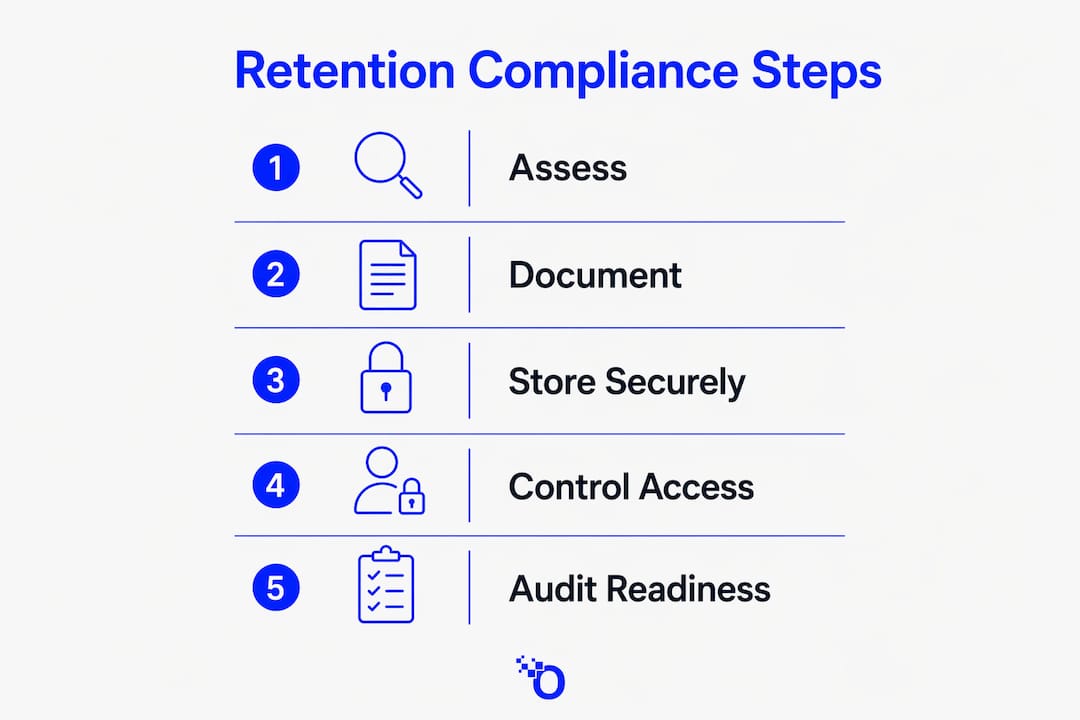
Excessive retention creates its own audit risk. An agency that retains personnel files for 20 years when the governing standard requires 7 years now holds 13 additional years of sensitive PII with no legal justification. That data expands the agency’s breach exposure and complicates any litigation hold. Treat the destruction schedule as a compliance obligation with the same priority as the retention schedule.
Key Takeaways
Compliant recordkeeping for public safety agencies requires written retention policies, contemporaneous documentation, role-based access controls, and scheduled destruction to meet IRS, OSHA, and data privacy standards.
| Point | Details |
|---|---|
| Retain to the stricter standard | When federal and state rules conflict, apply whichever retention period is longer. |
| Document contemporaneously | Create records at the time of the event; recreations rarely satisfy IRS or audit requirements. |
| Enforce role-based access | Restrict personnel file access by job role and maintain automated logs for every access event. |
| Schedule destruction formally | Retaining records beyond required periods increases breach liability and complicates audits. |
| Review the policy annually | Federal updates, including 2026 overtime tracking rules, require at least one formal policy review per year. |
What I’ve learned from real-world compliance audits in public safety
Public safety administrators often treat recordkeeping as a back-office function. After working through compliance reviews with law enforcement agencies, fire departments, and non-profit public safety organizations, I can tell you that framing is the source of most preventable failures.
The agencies that pass audits cleanly are not the ones with the most sophisticated software. They are the ones where every supervisor understands that a record created today is a defense document for a proceeding that may happen three years from now. That cultural shift, from recordkeeping as paperwork to recordkeeping as evidence preservation, is the single most impactful change an administrator can make.
The 2026 overtime tracking requirement is a good example of where agencies are currently exposed. Many payroll systems still combine base wages and overtime premiums in a single field. Separating those figures requires a system configuration change and a policy update, neither of which happens automatically. Agencies that have not addressed this by now are already out of compliance for the current pay periods.
The other pattern I see consistently is over-retention. Administrators assume that keeping everything forever is the safe choice. It is not. Every additional year of retained PII is an additional year of breach exposure, litigation hold complexity, and regulatory scrutiny. A formal destruction schedule, executed on time, is as much a compliance achievement as a complete set of personnel files.
Technology helps, but it does not replace policy. Automated purge schedules only work if someone configured them correctly and tests them regularly. RBAC only works if role definitions are kept current as staff change positions. The human layer of compliance, trained staff, clear written policies, and accountable review cycles, remains the foundation.
— Matt
How OMNI Intel supports compliant recordkeeping for public safety agencies
Public safety agencies carry a dual recordkeeping burden: maintaining compliant HR and operational records while also documenting the background investigation process for every hire.

OMNI Intel’s pre-employment screening services are built to generate audit-ready documentation from the first step of the hiring process. Every background investigation produces FCRA-compliant records with clear chain-of-custody documentation, giving your agency defensible files for personnel audits, legal proceedings, and regulatory reviews. For agencies managing government background checks across municipal employees, volunteers, and non-sworn staff, OMNI Intel provides structured screening workflows that align with the same compliance standards your HR team applies to retention and access control. Contact OMNI Intel to build a screening and documentation process your agency can defend.
FAQ
What is the minimum record retention period for public safety agencies?
The federally recommended baseline is 7 years for financial records, covering the IRS audit window. Payroll and I-9 records require 3 years, OSHA logs require 5 years, and benefits records require 6 years. Always apply the stricter standard when state law requires longer retention.
Can public safety agencies store records digitally instead of in paper form?
Digital storage is acceptable for most record types, provided files are encrypted, access-controlled, and backed up. Original source documents that carry evidentiary value, such as signed I-9 forms or original incident reports, should be retained in their original format when required by the governing regulation.
What happens if an agency retains records longer than required?
Retaining records beyond their legally required period increases data breach liability and expands the scope of any litigation hold. Data privacy laws including CCPA treat unnecessary PII retention as a compliance failure. A formal destruction schedule mitigates this risk.
How does the 2026 overtime tracking rule affect recordkeeping?
Starting in 2026, agencies must track and report the overtime premium portion of time-and-a-half pay separately from base wages. Payroll systems that combine these figures in a single field require configuration updates to meet the new requirement.
What is the most common cause of audit failure for public safety agencies?
Missing contemporaneous documentation is the leading cause of audit failure. Records created after the fact, or reconstructed from memory, rarely satisfy IRS or regulatory standards. Monthly reconciliations and same-day record entry are the most effective preventive measures.