

What Is Reputational Risk and Why It Matters
Reputational risk is defined as the threat of financial loss, reduced market value, or damaged stakeholder trust caused by negative public perception of an organization. This risk does not require a factual basis to cause harm. Perception alone can trigger customer defection, investor withdrawal, and talent loss. Global intangible corporate value exceeds $79 trillion, which means reputation now ranks among the most material assets on any organization’s balance sheet. For professionals in public safety and corporate governance, understanding reputational risk is not optional. It is a prerequisite for organizational survival.
What is reputational risk, and where does it come from?
Reputational risk is the formal term used by risk management professionals and regulatory bodies, including the European Banking Authority, to describe the potential for negative public perception to cause measurable harm to an organization’s earnings, operations, or relationships. The risk is distinct from operational or credit risk, though it frequently amplifies both.
The defining characteristic of reputational risk is its origin in perception rather than fact. An organization can act lawfully and still suffer severe reputational damage if its actions are misunderstood, poorly communicated, or associated with a controversial outcome. This makes it one of the most difficult risk categories to contain once it begins.
Reputational damage can cause losses in earnings, market value, stakeholder trust, and liquidity, operating as an amplifier to other business risks. That amplification effect is what separates reputational risk from most other categories. A compliance failure stays contained until it becomes public. Once it does, the reputational fallout often exceeds the original financial exposure.

Reputation also drives consumer purchasing behavior and talent retention in modern markets. Organizations that underestimate this connection treat reputation as a communications problem. It is, in fact, a financial variable.
What are the main types of reputational risk?
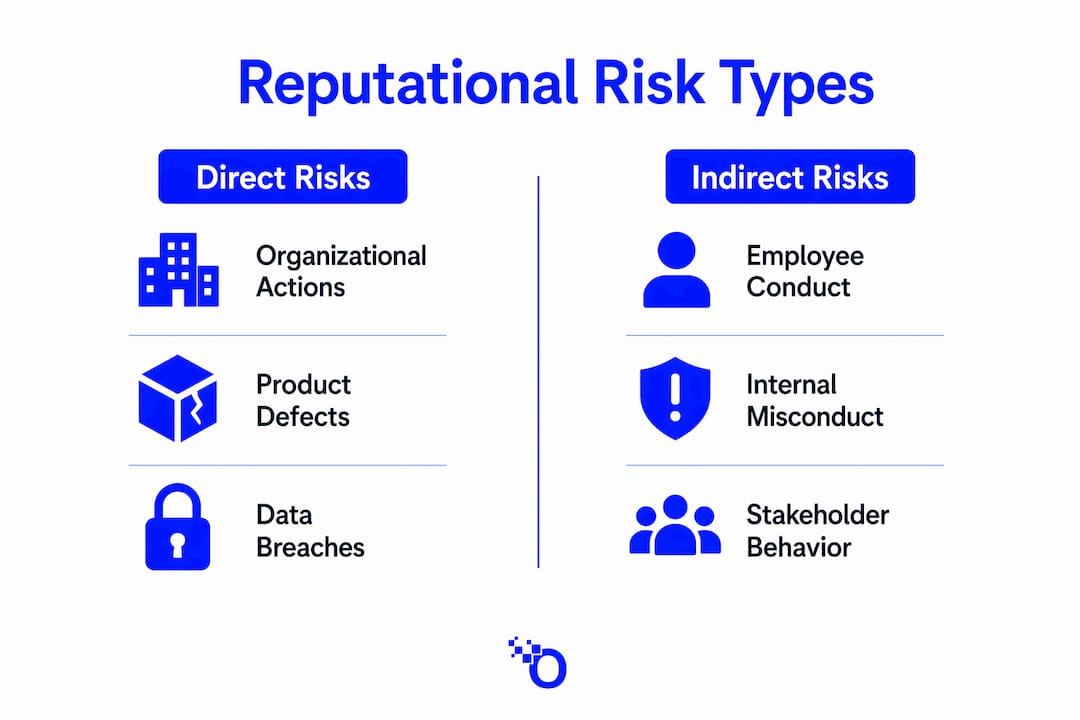
Reputational risk categories include direct, indirect, and tangential risks from actions by the organization, its employees, and third parties. Distinguishing these types is the first step toward building a targeted response.
Direct reputational risks
Direct risks originate from the organization’s own decisions and actions. Product defects, data breaches, discriminatory policies, and regulatory violations all fall into this category. These risks are the most visible and the most frequently discussed in governance frameworks. A law enforcement agency that mishandles evidence, or a fire department that fails to respond within protocol, faces direct reputational exposure tied to its own operational conduct.
Indirect reputational risks
Indirect risks arise from the behavior of employees and internal stakeholders. Misconduct by a single officer, a dispatcher who leaks sensitive information, or a recruiter who violates hiring law can each trigger a reputational crisis the organization did not initiate but must absorb. The role of background checks in agency reputation is most relevant here. Personnel decisions are the primary source of indirect reputational exposure in public safety contexts.
Tangential reputational risks
Third-party partners and suppliers pose significant tangential reputational risks requiring continuous monitoring and vetting. Failures by external parties can trigger damaging public crises beyond organizational control. A vendor that mishandles sensitive records, a training partner with a history of misconduct, or a staffing agency that places unvetted personnel all represent tangential exposure.
The three categories frequently overlap. A supplier failure (tangential) may expose an internal policy gap (direct) that was enabled by inadequate oversight (indirect). Organizations that treat these as separate problems miss the compounding dynamic.
| Risk type | Origin | Example |
|---|---|---|
| Direct | Organizational actions | Data breach, policy violation, product defect |
| Indirect | Employee or internal stakeholder conduct | Officer misconduct, HR policy violation |
| Tangential | Third-party partners or suppliers | Vendor data mishandling, contractor misconduct |
Pro Tip: Map your organization’s vendor and partner relationships annually. Tangential risks are the most commonly overlooked category in reputational risk assessments, and they are often the first to trigger a public crisis.
How does reputational risk affect financial performance?
Reputational damage produces financial consequences that are delayed, compounding, and often longer-lasting than the original incident. This is the feature that makes it uniquely dangerous for governance professionals.
The immediate effects include customer attrition, reduced sales, and declining investor confidence. These are measurable within weeks of a public crisis. The secondary effects, including difficulty recruiting qualified personnel, increased regulatory scrutiny, and higher borrowing costs, can persist for years. Operational failures are often the root of reputational crises, usually stemming from cumulative internal issues rather than isolated incidents. Headline scandals are the visible result of long-term internal breakdowns.
For public safety agencies, the financial stakes extend beyond revenue. Budget allocations, grant eligibility, and legislative support are all sensitive to public trust. A police department or fire service that loses community confidence faces reduced political support, which translates directly into resource constraints.
“Reputational risk operates as a volatility amplifier. When operational or compliance risk materializes, the reputational fallout multiplies the total damage. Organizations that manage reputation only after a crisis has begun are already behind.”
Market capitalization losses following reputational events in the private sector routinely exceed the direct financial cost of the underlying incident. For public sector organizations, the equivalent is the erosion of public mandate, which is the authority and community support that makes operations possible. That erosion is difficult to quantify but impossible to ignore.
The delayed nature of reputational damage creates a false sense of security. An organization may navigate an incident without immediate consequence, only to find that trust has eroded quietly over months. By the time the damage becomes visible in performance metrics, the underlying cause is often well established.
What strategies effectively manage reputational risk?
Effective reputational risk management requires integrating legal, HR, and compliance into governance decisions. Reputation protection cannot be delegated to a communications team. It must be embedded in daily operations across every department.
The following strategies form the foundation of a functional reputational risk management program:
-
Establish operational reliability as the primary defense. Operational reliability, rather than marketing, is the most effective protection for a brand’s reputation. Consistency in processes and complaint resolution builds a reputational buffer that withstands isolated incidents.
-
Integrate governance, legal, HR, and compliance. Reputation protection must be a cross-departmental effort. Siloed departments create policy gaps that become reputational vulnerabilities. A unified governance framework ensures that hiring decisions, vendor contracts, and public communications reflect consistent standards.
-
Monitor early warning signals continuously. Online reviews and customer complaints act as early warning signals before formal reputational crises develop. Monitoring sentiment shifts enables early corrective action. Leaders should treat shifts in online sentiment as alerts requiring investigation, not noise to be filtered.
-
Conduct rigorous third-party vetting and ongoing oversight. Organizations must proactively manage third-party reputational risks through rigorous vetting and ongoing oversight, as these relationships are common sources of crisis triggers. Vendor contracts should include conduct standards, and compliance should be verified periodically, not just at onboarding.
-
Communicate transparently, especially in sensitive decisions. Even lawful, risk-based decisions can cause reputational damage if public communication lacks transparency. Poorly documented decisions can be misinterpreted, worsening reputation. Clear, timely communication is not a PR tactic. It is a governance requirement.
-
Conduct formal reputational risk assessments. A reputational risk assessment maps the organization’s exposure across direct, indirect, and tangential categories. It identifies which operational areas carry the highest reputational sensitivity and assigns ownership for monitoring and response.
Pro Tip: Do not wait for a crisis to build your response framework. Organizations that document their reputational risk protocols in advance respond faster, communicate more clearly, and recover more completely than those that improvise under pressure.
How does reputational risk apply to public safety and governance?
Reputational risk carries a higher operational stake in public safety than in most other sectors. Public safety agencies derive their authority from public trust. When that trust erodes, the agency’s ability to perform its core mission is directly compromised.
The specific risk factors in public safety include:
- Personnel conduct. Officer misconduct, dispatcher errors, and HR violations generate indirect reputational risks that are amplified by media coverage and community sensitivity. A single incident involving a poorly vetted hire can define an agency’s public image for years.
- Compliance failures. Compliance shortcomings in public safety hiring amplify reputational risk significantly. Violations of FCRA-compliant screening requirements, civil rights standards, or use-of-force policies each carry reputational consequences that extend beyond legal liability.
- Hiring practices. The hiring risk mitigation strategies used during recruitment directly determine the quality and integrity of the workforce. Inadequate pre-employment screening is one of the most preventable sources of indirect reputational risk in public safety.
- Partner and supplier conduct. Agencies that rely on third-party training providers, technology vendors, or staffing services inherit tangential reputational risk from those relationships. Continuous vetting protocols are required, not optional.
- Transparency in public-facing decisions. Agencies that communicate clearly about use-of-force incidents, disciplinary actions, and policy changes build a reputational buffer. Agencies that do not communicate clearly invite speculation, which is consistently more damaging than the underlying facts.
The connection between reputation and mission success is direct in public safety. Community cooperation, witness participation, and voluntary compliance with law enforcement all depend on public trust. Reputational damage does not stay in the headlines. It shows up in reduced cooperation, increased oversight, and diminished operational effectiveness.
Pro Tip: Treat every hiring decision as a reputational risk decision. The personnel you place in public-facing roles are the most visible expression of your agency’s values. Thorough background investigations are the most cost-effective reputational risk management tool available to public safety leaders.
Key Takeaways
Reputational risk is a material financial and operational threat that requires cross-departmental governance, proactive monitoring, and rigorous personnel vetting to manage effectively.
| Point | Details |
|---|---|
| Definition and scope | Reputational risk is the threat of financial loss or trust erosion caused by negative public perception, regardless of factual accuracy. |
| Three risk categories | Direct, indirect, and tangential risks each require distinct identification and mitigation strategies. |
| Financial amplification | Reputational damage compounds other risk categories and produces delayed, long-lasting financial consequences. |
| Operational reliability | Consistent processes and complaint resolution build a reputational buffer that marketing alone cannot create. |
| Public safety stakes | Personnel conduct and hiring practices are the primary sources of reputational exposure in public safety agencies. |
Reputation is a governance discipline, not a communications function
The most persistent mistake I see in public safety and governance organizations is treating reputation as something the communications office manages. It is not. Reputation is the aggregate output of every operational decision, every hire, every vendor contract, and every public interaction the organization makes. Communications can shape how those decisions are perceived. It cannot substitute for the decisions themselves.
What I have found consistently is that organizations with strong reputations rarely think of reputation management as a separate program. They think of it as operational discipline. They vet personnel thoroughly. They document decisions clearly. They respond to complaints before those complaints become patterns. They treat a single negative review or community complaint as a signal worth investigating, not an outlier to dismiss.
The organizations that face the most severe reputational crises are almost never surprised by a single catastrophic event. They are surprised by how quickly cumulative internal failures become public. The misconduct that makes the news was usually visible internally for months. The vendor that caused the crisis had warning signs that were not acted on. The hire that became a liability had a background that a thorough investigation would have flagged.
Governance professionals who treat reputational risk as a financial variable, with the same rigor applied to credit risk or operational risk, build organizations that are genuinely resilient. Those who treat it as a PR concern discover its true cost only after the damage is done.
— Matt
How OMNI Intel supports reputational risk management in public safety
Public safety agencies face a specific and serious reputational risk exposure through their personnel. Every hire is a direct expression of the agency’s standards, and every inadequately vetted employee is a potential source of indirect reputational damage.

OMNI Intel’s pre-employment screening services are built specifically for law enforcement, fire and EMS, dispatch centers, and government entities. The platform applies investigator-driven background investigation principles to every candidate, integrating FCRA-compliant checks with AI-driven recruiting tools to reduce hiring time without reducing rigor. Post-hire monitoring extends that protection beyond the onboarding stage, providing continuous oversight that catches emerging risks before they become public crises. For agencies that treat reputation as a governance priority, OMNI Intel provides the personnel vetting infrastructure that makes that commitment operational.
FAQ
What is reputational risk in simple terms?
Reputational risk is the potential for an organization to suffer financial or operational harm because of negative public perception. The perception does not need to be accurate to cause real damage.
What are the three main types of reputational risk?
The three types are direct risks from organizational actions, indirect risks from employee conduct, and tangential risks from third-party partners or suppliers. Each requires a different mitigation approach.
Why is reputational risk important for public safety agencies?
Public safety agencies depend on community trust to perform their core mission. Reputational damage reduces public cooperation, invites increased oversight, and can restrict budget and legislative support.
How do organizations conduct a reputational risk assessment?
A reputational risk assessment maps exposure across direct, indirect, and tangential risk categories, identifies high-sensitivity operational areas, and assigns ownership for monitoring and response protocols.
How does hiring affect reputational risk?
Personnel decisions are the primary source of indirect reputational risk. Inadequate pre-employment screening places individuals in public-facing roles whose conduct can define the organization’s public image for years.