

What Is Workforce Reliability and Why It Matters
Workforce reliability is defined as the consistent demonstration of behaviors that enable employees to fulfill commitments, communicate proactively, and support organizational goals with a steady work ethic. The industry term for this concept is employee reliability, and it encompasses observable indicators such as punctuality, schedule adherence, follow-through on tasks, and proactive problem-solving. Unlike technical skills, reliability is a character trait considered impossible to teach after hiring, which makes pre-hire screening the most critical intervention available to HR leaders. Organizations that treat reliability as an operational capability rather than an incidental outcome gain a measurable competitive advantage in workforce stability, reduced turnover costs, and sustained productivity.
What is workforce reliability, and how is it defined?
Workforce reliability is the persistent ability of employees to meet commitments, execute assigned tasks, communicate in a timely manner, and support organizational goals through consistent, observable behavior. The key word is observable. Reliability is not a self-reported trait or a personality test score. It shows up in attendance records, task completion rates, communication logs, and peer feedback over time.
Labor market analysts distinguish employee reliability from technical competence. A skilled employee who misses shifts, fails to communicate delays, or abandons tasks under pressure creates operational risk regardless of their credentials. Reliability, by contrast, persists across varying conditions and does not fluctuate with external market pressures. That persistence is what makes it an organizational asset rather than a personal virtue.
For public safety agencies, fire departments, law enforcement, and dispatch centers, this distinction carries serious consequences. A dispatcher who is technically proficient but chronically late creates coverage gaps that affect emergency response times. A patrol officer who avoids proactive communication during incidents creates liability. Reliability, in these contexts, is not a soft skill. It is an operational requirement.

What behaviors and traits define reliable employees?
Reliable employees share a specific cluster of observable behaviors that distinguish them from high-skill but inconsistent performers. These behaviors are measurable, documentable, and screenable before a hire is made.
The core reliability behaviors include:
- Punctuality and consistent attendance: Arriving on time and maintaining a predictable schedule, even under personal stress or inconvenient conditions.
- Follow-through on commitments: Completing assigned tasks by agreed deadlines without requiring repeated follow-up from supervisors.
- Proactive communication: Alerting supervisors or teammates early when a problem arises, rather than waiting until a deadline is missed.
- Steady work ethic under pressure: Maintaining output quality and pace during high-demand periods, not just during normal operations.
- Proactive problem-solving: Identifying obstacles before they escalate and proposing solutions without being prompted.
- Accountability: Acknowledging errors directly and correcting them without deflection or excuse.
The distinction between reliability and skill is critical for HR professionals to internalize. Skills can be developed through training programs, certifications, and on-the-job experience. Reliability, by contrast, is fundamentally a character trait that reflects how a person operates when no one is watching. An organization can teach a new hire to use a records management system. It cannot teach them to care about showing up.
This is why behavioral interviewing techniques that probe for past reliability indicators, such as asking candidates to describe a time they had to deliver on a commitment under difficult circumstances, produce more predictive hiring data than skills assessments alone. The answer reveals character, not just capability.
Pro Tip: During structured interviews, ask candidates to describe a specific instance when they had to communicate bad news to a supervisor early. Reliable candidates recall the situation in detail and emphasize the communication step. Unreliable candidates focus on the outcome and minimize the communication gap.
Why is workforce reliability important for organizational performance?
Workforce reliability directly determines an organization’s ability to operate predictably, retain talent, and sustain performance without constant crisis management. The financial case is unambiguous. Turnover costs range from 50% to 200% of an employee’s annual salary. That figure includes recruiting, onboarding, lost productivity, and the operational disruption caused by coverage gaps.
Disengaged employees compound the problem. Workers who feel unsupported or burned out are three times more likely to actively seek other employment, accelerating turnover cycles and destabilizing teams. The connection between reliability and engagement runs in both directions. Reliable employees tend to be more engaged, and engaged employees tend to be more reliable. Breaking that cycle requires deliberate organizational design, not motivational messaging.
“Reliability focuses on minimizing variance, not just average labor availability. Organizations that design for reliability anticipate disruptions rather than react to them.” — Bayswater Transflow Insights
The operational impact extends beyond cost. In safety-sensitive environments, unreliable staffing creates direct risk. A fire station running below minimum staffing because of chronic absenteeism cannot respond to simultaneous calls. A security firm with high turnover deploys undertrained officers to posts that require experienced judgment. Employees who feel protected by safe work environments are measurably more reliable, which means safety culture and workforce reliability reinforce each other.
Reliability also affects the employees who stay. When unreliable colleagues create coverage gaps, reliable employees absorb the extra workload. Over time, that burden produces burnout, resentment, and eventual turnover among the organization’s most dependable people. The hidden cost of unreliability is not just the absent employee. It is the erosion of the reliable workforce surrounding them.
Organizations that prioritize reliability over raw labor cost reduction gain a structural advantage. They operate with lower variance in labor availability, which enables predictable scheduling, consistent service delivery, and stronger client or community trust.
How can organizations measure and assess workforce reliability?
Measuring workforce reliability requires moving beyond headcount data. Absenteeism and turnover create hidden capacity gaps that reduce operational effectiveness before they appear in staffing reports. HR leaders need metrics that surface these gaps in real time, not after a crisis has already developed.
The most effective workforce reliability assessment combines objective tracking with behavioral screening at the point of hire.
| Assessment method | Use case | Limitation |
|---|---|---|
| Punctuality and attendance logs | Identify chronic lateness and absenteeism patterns | Does not capture quality of work during attendance |
| Schedule adherence tracking | Measure shift coverage consistency over time | Requires integrated scheduling software to be accurate |
| Task completion and follow-through records | Track whether commitments are met on time | Depends on manager documentation discipline |
| Behavioral interview scoring | Screen for reliability indicators before hire | Requires trained interviewers and structured rubrics |
| AI-driven predictive analytics | Forecast absenteeism risk and flag early warning signs | Requires sufficient historical data to generate reliable predictions |
| Post-hire continuous monitoring | Detect behavioral changes after onboarding | Must comply with applicable privacy and labor law standards |
Modern HR platforms now offer geo-fenced clock-ins and predictive analytics that allow managers to identify attendance risks before they become coverage crises. These tools do not replace human judgment. They give HR leaders the data needed to act early rather than react late.
For public safety agencies, the workforce integrity workflow adds another layer. Continuous post-hire monitoring flags behavioral changes, new criminal activity, or policy violations that signal declining reliability in personnel who hold positions of public trust.
Pro Tip: Track schedule adherence and frontline turnover as separate metrics. An agency can maintain headcount while experiencing severe reliability strain if the same positions cycle through new hires every 90 days. The turnover rate at the position level reveals structural instability that aggregate headcount data conceals.
What strategies can HR and leadership implement to improve workforce reliability?
Building a reliable workforce requires deliberate action at every stage of the employment lifecycle, from candidate screening through ongoing culture management. Reactive approaches, such as filling vacancies quickly after turnover spikes, address symptoms rather than causes.
The following strategies produce measurable, sustained improvements in workforce reliability:
-
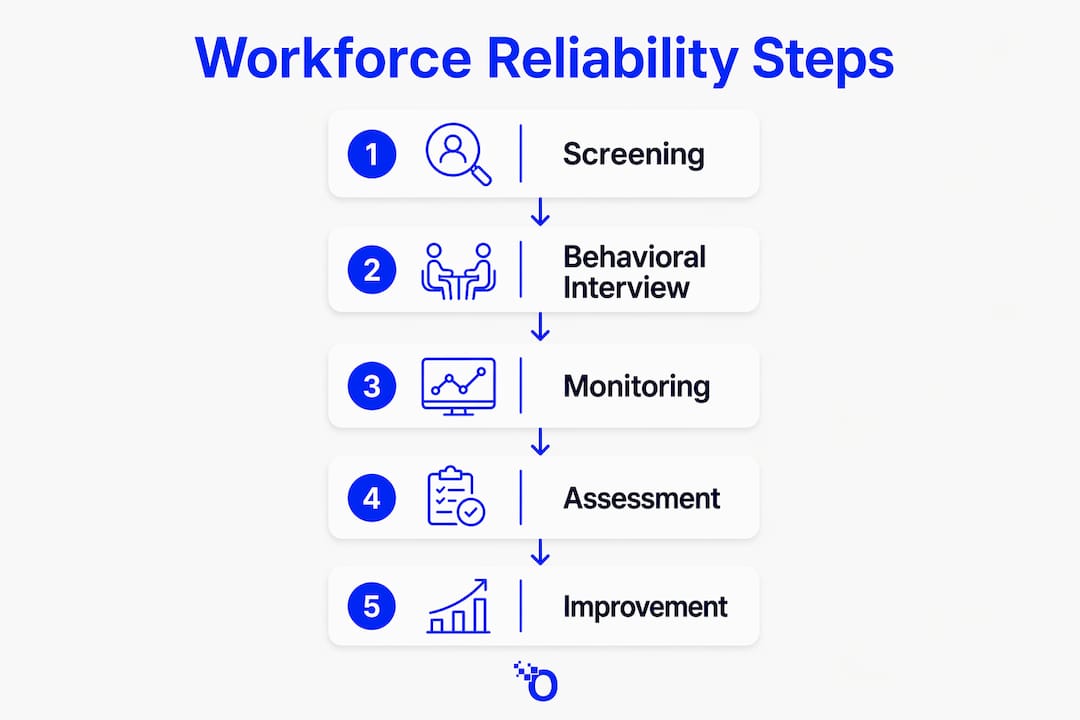
Screen for reliability behaviors before hire. Use structured behavioral interviews and investigator-driven background checks to identify candidates with documented histories of punctuality, follow-through, and accountability. Hiring for reliability first, then investing in technical training, produces more stable workforces than hiring for credentials and hoping reliability follows.
-
Build a safety culture that protects employees. Workers who feel physically and psychologically safe are more reliable. This means clear reporting channels for workplace hazards, consistent enforcement of conduct standards, and leadership that responds to concerns without retaliation. Reliability depends on mutual trust and safety culture as much as it depends on individual character.
-
Invest in professional growth opportunities. Employees who see a clear path forward within an organization have stronger motivation to perform consistently. Mentorship programs, certification support, and internal promotion pipelines reduce the disengagement that precedes turnover.
-
Implement cross-training and structured flexibility. Cross-training ensures multiple employees can perform critical tasks during absences, reducing reliance on last-minute hires and limiting operational downtime. Structured flexibility, such as shift-swapping protocols with advance notice requirements, reduces unplanned absences without sacrificing coverage predictability.
-
Deploy AI-powered workforce management tools. Platforms with real-time alerts, gamified attendance tracking, and predictive absenteeism modeling give HR leaders early warning before reliability problems compound. AI in recruitment also accelerates the identification of candidates whose behavioral profiles align with high-reliability roles.
-
Audit reliability metrics on a regular schedule. Quarterly reviews of schedule adherence rates, turnover by position, and absenteeism frequency reveal structural patterns that individual manager reports miss. Consistent auditing builds the organizational transparency that sustains reliability over time.
-
Align leadership communication with reliability expectations. Supervisors who communicate expectations clearly, follow through on their own commitments, and address reliability failures consistently model the behavior they expect from their teams. Unreliable leadership produces unreliable teams regardless of the policies in place.
Workforce reliability emerges from intentional organizational design, not from individual character alone. Screening, leadership communication protocols, and supportive work environments each contribute to a system that produces consistent performance across varying conditions.
Key Takeaways
Workforce reliability is an operational capability built through deliberate screening, organizational design, and sustained leadership, not an incidental outcome of good hiring luck.
| Point | Details |
|---|---|
| Reliability is a character trait | Screen for observable behaviors like punctuality and follow-through before hire, not after. |
| Turnover costs are severe | Replacing an employee costs 50%–200% of their annual salary, making reliability a direct financial priority. |
| Hidden capacity gaps precede visible shortages | Track schedule adherence and position-level turnover, not just total headcount, to detect reliability strain early. |
| Safety culture drives reliability | Employees who feel protected and empowered perform more consistently and stay longer. |
| Technology enables early intervention | AI-driven analytics and real-time monitoring allow HR leaders to address absenteeism risk before it disrupts operations. |
The reliability gap most HR leaders are not measuring
After working closely with public safety agencies and organizational HR teams, one pattern stands out clearly. Most leaders diagnose their workforce problems as hiring shortages. The actual diagnosis, in the majority of cases, is a reliability gap hiding inside existing headcount.
An agency can be fully staffed on paper and still operate at 70% effective capacity because of chronic absenteeism, high turnover in critical positions, and the downstream burnout it creates among the reliable employees who cover the gaps. That is not a recruiting problem. It is a reliability problem, and it requires a different set of interventions.
The second thing I have observed is that reliability is a two-way contract. Organizations that demand consistency from employees while failing to provide safe conditions, clear communication, or professional growth opportunities will not retain reliable people. The most dependable employees have options. They leave environments that do not hold up their end of the agreement.
The practical implication is that HR leaders need to audit their own organizational conditions before attributing turnover to external labor market factors. Are supervisors modeling the follow-through they expect from their teams? Are reliability failures addressed consistently, or only when they become crises? Are employees given the tools and authority to solve problems proactively? The answers to those questions predict workforce reliability more accurately than any single hiring decision.
The organizations that get this right treat reliability as a system output, not a personal virtue. They design for it, measure it, and hold leadership accountable for it at every level.
— Matt
How OMNI Intel supports reliable public safety hiring
Public safety agencies face a higher standard for workforce reliability than most sectors. A law enforcement officer, dispatcher, or security professional who is unreliable does not just create an operational gap. They create a public safety risk.

OMNI Intel provides pre-employment screening services specifically designed for public safety environments, using investigator-driven background investigations that go beyond standard database checks to surface behavioral history, character indicators, and documented reliability patterns. The platform also supports continuous post-hire monitoring, so agencies can identify emerging risks before they become incidents. Whether you lead a law enforcement agency, a fire department, or a private security firm, OMNI Intel’s background investigations for agencies give your hiring process the depth it requires to build a workforce you can count on.
FAQ
What is the workforce reliability definition?
Workforce reliability is defined as the consistent ability of employees to meet commitments, execute tasks, communicate in a timely manner, and support organizational goals through observable behaviors such as punctuality, follow-through, and proactive problem-solving.
Why is reliability considered impossible to teach after hiring?
Reliability reflects core character traits, not learned skills. Skills can be developed through training, but the underlying disposition to show up consistently, communicate proactively, and follow through on commitments is formed before employment and cannot be reliably instilled after the fact.
What metrics best measure workforce reliability?
The most effective workforce reliability metrics include schedule adherence rates, position-level turnover frequency, absenteeism patterns by team or shift, and task completion rates tracked over time. These metrics surface structural reliability problems that headcount data alone does not reveal.
How does burnout affect workforce reliability?
Burnout triples the likelihood that an employee will actively seek other employment. When unreliable colleagues create coverage gaps, reliable employees absorb excess workload, accelerating burnout and increasing turnover among the organization’s most dependable personnel.
How does pre-employment screening improve workforce reliability?
Structured pre-employment screening identifies candidates with documented histories of punctuality, accountability, and follow-through before they are hired. Investigator-driven checks, such as those provided by OMNI Intel, surface behavioral patterns that standard resume reviews and reference calls do not capture, reducing the risk of hiring candidates whose reliability record contradicts their self-presentation.