

What Is Compliance in Volunteer Vetting for Public Safety
Compliance in volunteer vetting is defined as the process of meeting legal, ethical, and organizational standards to safely and fairly screen volunteers before placement in roles that carry public trust or safety responsibilities. For public safety organizations, including law enforcement agencies, fire and EMS departments, dispatch centers, and nonprofits serving vulnerable populations, this process is not optional. It is a legal obligation and a safeguarding imperative. The Fair Credit Reporting Act (FCRA), the Nonprofit Risk Management Center’s screening guidance, and role-specific disqualification frameworks each shape what compliance looks like in practice. Understanding what is compliance in volunteer vetting means recognizing that it spans legal disclosures, risk-based screening, data privacy, and adverse action procedures, all applied consistently across every volunteer role in your organization.
What is compliance in volunteer vetting, and why does it matter?
Compliance in vetting volunteers is the structured adherence to federal law, organizational policy, and ethical screening standards when evaluating individuals for volunteer roles. It is not simply running a background check. It is a documented, repeatable process that protects vulnerable populations, limits organizational liability, and respects the legal rights of every volunteer applicant.
The FCRA is the primary federal statute governing background checks in the United States, and it applies to volunteer screening when a consumer reporting agency (CRA) is used to obtain background information. FCRA compliance requires organizations to provide a clear written disclosure, obtain signed authorization before ordering a report, and follow specific adverse action procedures if a background check influences a decision to deny a volunteer. Skipping any of these steps exposes your organization to federal liability, regardless of whether the volunteer was paid.

Beyond federal law, the importance of compliance in vetting extends to ethical obligations. Volunteer programs in public safety contexts frequently place individuals in contact with children, elderly adults, crime victims, or individuals in crisis. A failure to screen appropriately is not a procedural oversight. It is a direct risk to the people your organization is sworn to protect.
Role-relevant disqualifying criteria make criminal-record screening more defensible and ethically sound, because they tie screening outcomes to the actual responsibilities of the role rather than applying blanket exclusions that may not hold up legally or ethically. This distinction matters enormously when your organization faces an audit, a legal challenge, or a public inquiry.
What are the core legal and ethical requirements for compliance?
The legal foundation of volunteer vetting compliance rests on three pillars: federal law, state-specific statutes, and your organization’s own documented policies. Each layer carries distinct obligations, and a gap in any one of them creates exposure.
Federal FCRA requirements apply whenever your organization uses a third-party CRA to conduct background checks on volunteers. The law requires a standalone written disclosure, separate from any application materials, and a signed authorization from the volunteer before any report is ordered. If the background check results in a decision to deny or restrict a volunteer, FCRA mandates a two-step adverse action process, which is covered in detail later in this article.
State law adds another layer. Many states have enacted “ban the box” legislation or specific rules governing the use of criminal history in volunteer and employment decisions. California, New York, and Illinois each have statutes that restrict when and how criminal records can be considered, and public safety organizations operating across state lines must account for each jurisdiction’s requirements.
Ethical screening standards require that your disqualifying criteria be directly tied to the volunteer role. The Nonprofit Risk Management Center recommends identifying convictions relevant to specific volunteer tasks to avoid blanket exclusions that could expose organizations to discrimination claims. A conviction for financial fraud may be disqualifying for a volunteer treasurer but irrelevant for a volunteer firefighter. Applying the same exclusion to both roles is neither legally defensible nor ethically sound.
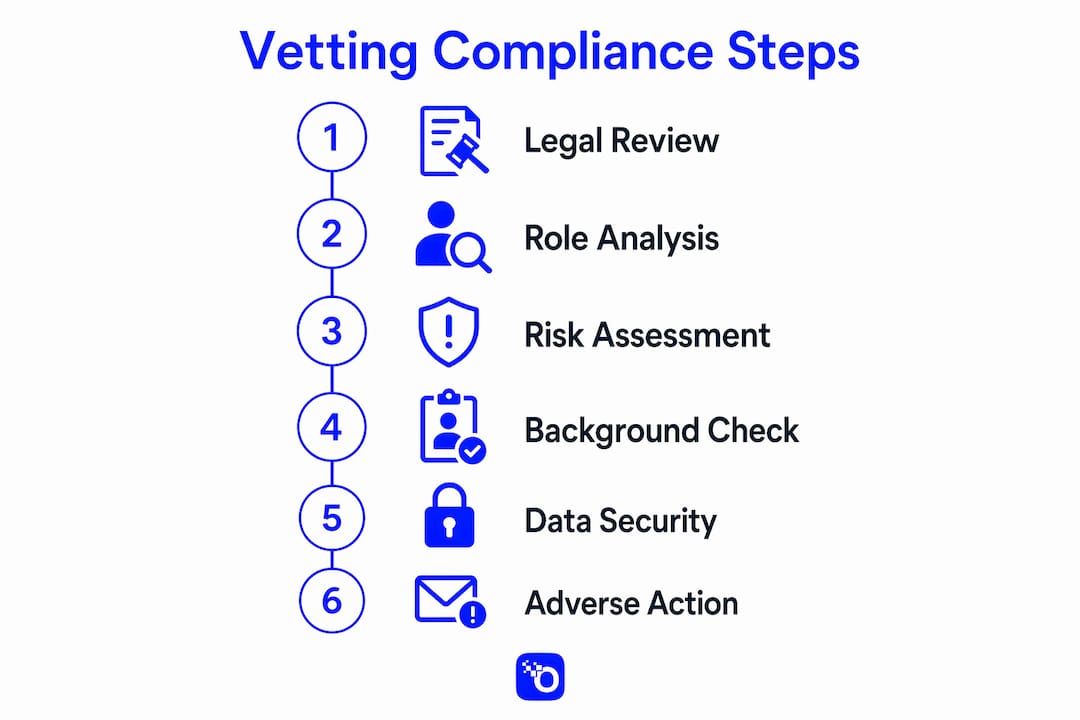
Consistent policy enforcement across all volunteer roles is equally critical. Policies that apply overly broad disqualifiers or inconsistent enforcement risk legal and ethical compliance failures that are difficult to defend in court or before a regulatory body.
Key legal and ethical requirements for volunteer vetting compliance:
- Provide a standalone FCRA disclosure and obtain written authorization before ordering any background report
- Apply role-specific disqualifying criteria rather than blanket criminal record exclusions
- Enforce screening policies consistently across all volunteers in similar roles
- Document every screening decision with a written rationale tied to role requirements
- Follow state-specific laws governing criminal history use, including ban-the-box statutes
- Train staff who administer screening on both legal requirements and bias-avoidance practices
Pro Tip: Develop a written volunteer screening policy that lists specific disqualifying offenses for each volunteer role category. Review it with legal counsel annually and update it whenever your state enacts new criminal history legislation. A documented policy is your first line of defense in any compliance audit.
How to create a risk-based volunteer vetting process
A risk-based vetting process assigns screening intensity to each volunteer role based on the actual risks that role presents, rather than applying identical screening to every volunteer regardless of their responsibilities. This approach is both more legally defensible and more operationally practical for public safety organizations managing large volunteer programs.
Defining risk levels for volunteer roles
Risk levels in volunteer vetting are typically categorized as low, medium, or high, based on factors such as direct contact with vulnerable populations, access to sensitive information or facilities, and the degree of unsupervised authority the role carries.
A low-risk role might involve a volunteer assisting with administrative tasks in a supervised office environment. A medium-risk role could include a community outreach volunteer who interacts with the public at organized events. A high-risk role, such as a volunteer crisis counselor, a fire and rescue auxiliary member, or a volunteer working directly with juveniles in a diversion program, carries significant safeguarding responsibilities and requires the most intensive screening.
Risk-based vetting structures screening intensity to match volunteer role responsibilities and risks, improving both safeguarding outcomes and compliance defensibility. Lower-risk roles may require only identity verification or a self-disclosure form, while higher-risk roles require full criminal background checks, structured reference checks, and documented training completion.
Screening components by risk level
The table below outlines the screening steps aligned to each volunteer risk level in public safety organizations.
| Risk level | Screening components |
|---|---|
| Low | Identity verification, self-disclosure form, basic reference check |
| Medium | Identity verification, criminal background check, two structured reference checks, self-disclosure form |
| High | Full criminal background check, identity verification, sex offender registry check, structured reference checks, interview, training verification, ongoing monitoring |
Structured reference checks following clear permission statements and consistent criteria remain one of the most valuable screening tools, complementing criminal history data and helping assess a volunteer’s suitability for a specific role. Reference checks are frequently underused in volunteer programs, yet they surface behavioral patterns that a background report cannot capture.
For volunteer background checks in fire and rescue organizations, the high-risk tier is the default starting point, given the physical access, community trust, and emergency response responsibilities those roles carry.
Pro Tip: Communicate your screening requirements to volunteers before they apply, not after. Transparency about screening policies improves volunteer trust and reduces dropout rates during the vetting process. A brief written summary of what checks will be conducted, why they are required, and how the data will be used sets a professional tone and demonstrates organizational integrity from the first point of contact.
Best practices for securing and documenting volunteer vetting data
Collecting background check data creates a compliance obligation that extends well beyond the screening decision itself. How your organization stores, accesses, retains, and ultimately disposes of that data determines whether your vetting program is legally defensible over time.
Secure handling of volunteer screening data using role-based access controls, defined retention schedules, and secure disposal procedures is a non-negotiable element of compliance readiness. VolunteerMatters notes that the smallest gap in privacy controls can undermine the entire screening program’s defensibility. That is not an abstract risk. It is the practical reality that organizations face when an audit or litigation requires them to produce documentation they cannot locate or verify as unaltered.
Volunteer management software solutions consolidate records such as background check reports, identity scans, self-disclosure forms, and reference letters in a centralized system with audit trails. This is a significant operational advantage over storing documents in shared email folders or unsecured network drives, both of which are common and serious compliance failures in volunteer programs.
Ensuring background-check documentation is stored with role-based access prevents unintentional breaches that can invalidate an entire compliance program. Not every staff member who interacts with volunteers needs access to their background check results. Limiting access to authorized personnel is both a legal requirement under FCRA and a data security best practice.
Data management best practices for volunteer vetting compliance:
- Store all screening records in a password-protected, encrypted system with role-based access controls
- Define a written retention schedule specifying how long each document type is kept and when it is securely destroyed
- Maintain a complete audit trail of who accessed each record and when
- Never store background check reports in shared email inboxes, general network drives, or printed files in unlocked cabinets
- Document the consent and disclosure process for each volunteer, including the date authorization was obtained
- Conduct an annual review of your data storage practices against current FCRA and state privacy law requirements
For organizations managing nonprofit screening programs at scale, purpose-built volunteer management platforms provide the access controls, retention automation, and audit trail functionality that generic document storage systems cannot replicate.
How to handle adverse decisions in volunteer screening
An adverse action in volunteer vetting occurs when a background check result contributes to a decision to deny, restrict, or revoke a volunteer’s placement. Under FCRA, organizations that use a CRA to obtain background reports must follow a two-step adverse action process before that decision is finalized.
FCRA requires that organizations provide a pre-adverse action notice and a final adverse action notice when background checks influence decisions to deny volunteers. Failure to provide these notices correctly is one of the most common compliance violations among organizations using third-party background check providers.
The steps for a legally compliant adverse action process are as follows:
- Obtain the background report from a FCRA-compliant consumer reporting agency, using a signed authorization and standalone disclosure obtained in advance.
- Review the report against your documented, role-specific disqualifying criteria. Do not make a final decision at this stage.
- Issue a pre-adverse action notice to the volunteer. This notice must include a copy of the background report, a copy of the FTC’s “A Summary of Your Rights Under the Fair Credit Reporting Act,” and a written statement that a decision has not yet been finalized.
- Allow a reasonable waiting period, typically five business days, for the volunteer to review the report and initiate a dispute if they believe the information is inaccurate or incomplete.
- Conduct an individualized assessment if the volunteer disputes the findings or provides mitigating context. Document this assessment in writing, noting the nature of the offense, the time elapsed, evidence of rehabilitation, and the relevance of the record to the specific role.
- Issue the final adverse action notice if the decision to deny or restrict the volunteer is upheld. This notice must identify the CRA that provided the report and inform the volunteer of their right to obtain a free copy of the report and dispute its accuracy.
Skipping the pre-adverse action step or compressing the waiting period are the two most frequent procedural failures in volunteer vetting programs. Both expose your organization to FCRA litigation, and neither saves meaningful time in the overall process. For criminal record screening in public safety contexts, documented individualized assessments are particularly important because they demonstrate that your organization applied judgment rather than a blanket policy.
Key takeaways
Compliance in volunteer vetting requires legal adherence, role-specific screening criteria, secure data management, and documented adverse action procedures applied consistently across every volunteer role.
| Point | Details |
|---|---|
| FCRA governs volunteer screening | Any CRA-based background check requires written disclosure, consent, and a two-step adverse action process. |
| Role-specific criteria are legally stronger | Disqualifiers tied to actual role responsibilities are more defensible than blanket criminal record exclusions. |
| Risk-based screening improves efficiency | Assign screening intensity to match role risk, from identity checks for low-risk roles to full investigations for high-risk placements. |
| Data security is a compliance requirement | Role-based access, encrypted storage, and defined retention schedules protect both volunteers and your organization. |
| Adverse action steps cannot be skipped | Pre-adverse notice, a waiting period, and individualized assessment are legally required before finalizing a denial. |
Why compliance in volunteer vetting is harder than it looks
I have worked with public safety organizations that had written screening policies, used reputable background check providers, and still found themselves exposed during an audit. The gap was almost never in the background check itself. It was in the documentation that surrounded it.
The most common failure I see is organizations treating the background check as the compliance event, when in reality the check is just one component of a much larger documented process. The disclosure, the authorization, the adverse action notices, the individualized assessment, the data retention schedule, these are the elements that determine whether your program holds up under scrutiny. A clean background check result does not protect you if you cannot produce a signed authorization form or demonstrate that your disqualifying criteria were applied consistently.
The second pattern I see regularly is role-specific criteria that exist on paper but are never actually applied in practice. An organization will have a policy listing disqualifying offenses for high-risk volunteer roles, but when a specific case arises, the decision gets made informally, without reference to the policy, and without documentation. That informal decision is the one that creates liability.
My practical advice is to treat your volunteer vetting program the way you would treat a law enforcement hiring process: document every step, apply every policy consistently, and review the entire program with legal counsel at least once a year. The volunteers your organization places in public safety roles carry your agency’s reputation into the community. The compliance framework you build around their vetting is what makes that trust defensible.
— Matt
How Omniintel supports volunteer vetting compliance for public safety
Public safety organizations need more than a generic background check portal. They need a screening partner that understands FCRA compliance, role-based risk assessment, and the specific safeguarding demands of law enforcement, fire and EMS, dispatch, and nonprofit public safety programs.

Omniintel’s pre-employment and volunteer screening services are built specifically for public safety agencies, combining investigator-driven background checks with secure data handling and compliance-ready documentation. From identity verification and criminal record checks to structured reference checks and ongoing post-placement monitoring, Omniintel provides the full vetting infrastructure your organization needs to meet volunteer vetting requirements with confidence. If your current screening process lacks documented adverse action procedures, role-specific criteria, or secure data management, Omniintel’s volunteer and non-sworn screening solutions are designed to close those gaps efficiently.
FAQ
What is compliance in volunteer vetting?
Compliance in volunteer vetting is the process of meeting legal, ethical, and procedural standards when screening volunteers before placement, including FCRA requirements, role-specific disqualifying criteria, informed consent, and secure data management.
Does FCRA apply to volunteer background checks?
FCRA applies whenever an organization uses a consumer reporting agency to obtain background information on a volunteer, requiring written disclosure, signed authorization, and a two-step adverse action process if the report influences a placement decision.
What is a risk-based volunteer vetting process?
A risk-based vetting process assigns screening intensity to each volunteer role based on its actual responsibilities and risks, with low-risk roles receiving basic identity checks and high-risk roles requiring full criminal background checks, reference checks, and ongoing monitoring.
How should organizations store volunteer screening records?
Volunteer screening records must be stored in encrypted, access-controlled systems with defined retention schedules, audit trails, and secure disposal procedures. Storing records in shared email folders or unsecured drives is a common compliance failure that undermines legal defensibility.
What happens if an organization skips the adverse action notice?
Failing to provide a pre-adverse action notice or final adverse action notice as required by FCRA exposes the organization to federal litigation. The volunteer retains the right to dispute the background check findings, and skipping the notice process removes the organization’s legal protection in that dispute.