

Why Screen Public Safety Volunteers: A Manager’s Guide
Volunteer screening in public safety is defined as the formal process of evaluating individuals before and during their service to verify identity, assess criminal history, and confirm suitability for roles that carry direct community responsibility. The industry term for this process is pre-placement background investigation, and it applies to unpaid personnel with the same rigor as sworn or paid staff. Public safety managers who understand why screen public safety volunteers matters will recognize that the stakes extend well beyond HR procedure. A single unvetted volunteer placed in a sensitive role can expose your agency to negligent supervision claims, regulatory penalties under the Fair Credit Reporting Act (FCRA), and irreparable damage to community trust. Platforms like Omniintel and compliance frameworks like the FCRA exist precisely because the consequences of skipping this step are not theoretical.
Why screen public safety volunteers: the core case for vetting
Screening public safety volunteers protects three distinct interests simultaneously: the community members those volunteers serve, the agency that deploys them, and the volunteers themselves. Background checks reduce risk of unsuitable individuals serving in sensitive roles such as public safety, protecting vulnerable populations and building trust with stakeholders. That finding carries a direct operational implication: failure to screen is not a neutral decision. It is an active choice to accept unknown risk on behalf of the people your agency is chartered to protect.
The benefits of volunteer screening fall into five concrete categories that every public safety manager should be able to articulate to leadership:
- Community protection. Volunteers in fire, EMS, dispatch, and law enforcement support roles interact with children, elderly residents, and individuals in crisis. A criminal history check is the minimum safeguard for these interactions.
- Liability reduction. Documented consistent screening strengthens an agency’s defense against negligent hiring or supervision claims by demonstrating reasonable care. Courts look for evidence that the agency acted responsibly before placing an individual in a position of trust.
- Public trust. Communities grant public safety agencies significant authority. Demonstrating that every person operating under your agency’s banner has been vetted signals institutional integrity.
- Volunteer accountability. Screening establishes role clarity from day one. When volunteers know their responsibilities are documented and their backgrounds have been reviewed, behavioral standards are understood rather than assumed.
- Incident and allegation reduction. Pairing background checks with defined role expectations reduces both the likelihood of incidents and the risk of false allegations, because documentation creates a clear record of what was authorized and what was not.
Pro Tip: Frame volunteer screening to your leadership team as a risk management investment, not an administrative cost. The expense of one negligent supervision lawsuit far exceeds the annual cost of a structured screening program.
How does legal compliance shape volunteer screening?
The FCRA governs background checks conducted by third-party consumer reporting agencies, and it applies to volunteers with the same force it applies to paid employees. Many public safety managers assume unpaid status creates a legal exemption. It does not. Understanding the procedural sequence is non-negotiable for any agency using an outside screening vendor.
The required steps under FCRA-compliant volunteer screening are as follows:
- Standalone disclosure. FCRA compliance requires a standalone disclosure document separate from all other onboarding forms. Combining the disclosure with a volunteer application, liability waiver, or role agreement is a documented violation that the FTC actively enforces. Many agencies make this exact mistake.
- Written authorization. The volunteer must provide written consent before any background check is initiated. This consent must reference the specific type of check being conducted.
- Pre-adverse action notice. If the background check reveals information that may disqualify the volunteer, the agency must provide a pre-adverse action notice along with a copy of the report and a summary of FCRA rights before making a final decision.
- Adverse action notice. If the agency proceeds with disqualification, a formal adverse action notice must follow, identifying the consumer reporting agency used and confirming the volunteer’s right to dispute the report.
- Individualized assessment. Agencies should evaluate disqualifying findings in context, considering the nature of the offense, how much time has passed, and the specific demands of the volunteer role. This step reduces legal exposure and supports fair access.
“A defensible screening program balances safety, compliance, and fair access. It positions screening as a combination of legal compliance, risk management, and documentation rather than relying on screening as a sole liability shield.” — Nonprofit Volunteer Screening Best Practices
Beyond the FCRA, state-specific requirements add another layer of complexity. Several states mandate fingerprint-based checks for volunteers working with children or vulnerable adults. Others maintain sex offender registries and abuse registries that must be queried independently of a standard criminal history check. Agencies operating across county or state lines face compounding requirements that a single national database search will not satisfy. The FCRA compliance implications for public safety are detailed enough that most agencies benefit from legal counsel or a specialized screening partner to audit their current process.
Background check authorization and clear disclosure are non-negotiable in roles involving children or vulnerable adults because these volunteers hold positions of trust requiring additional safeguards. This standard reflects both legal mandate and ethical obligation.
What screening components are most effective for public safety volunteers?
Not every volunteer role carries the same risk profile, and screening processes should reflect that reality. A volunteer who assists with administrative filing in a non-public-facing role does not require the same depth of investigation as a volunteer who rides along with EMS crews or works directly with at-risk youth in a community policing program. Role-based risk categorization is the foundation of an effective screening program.
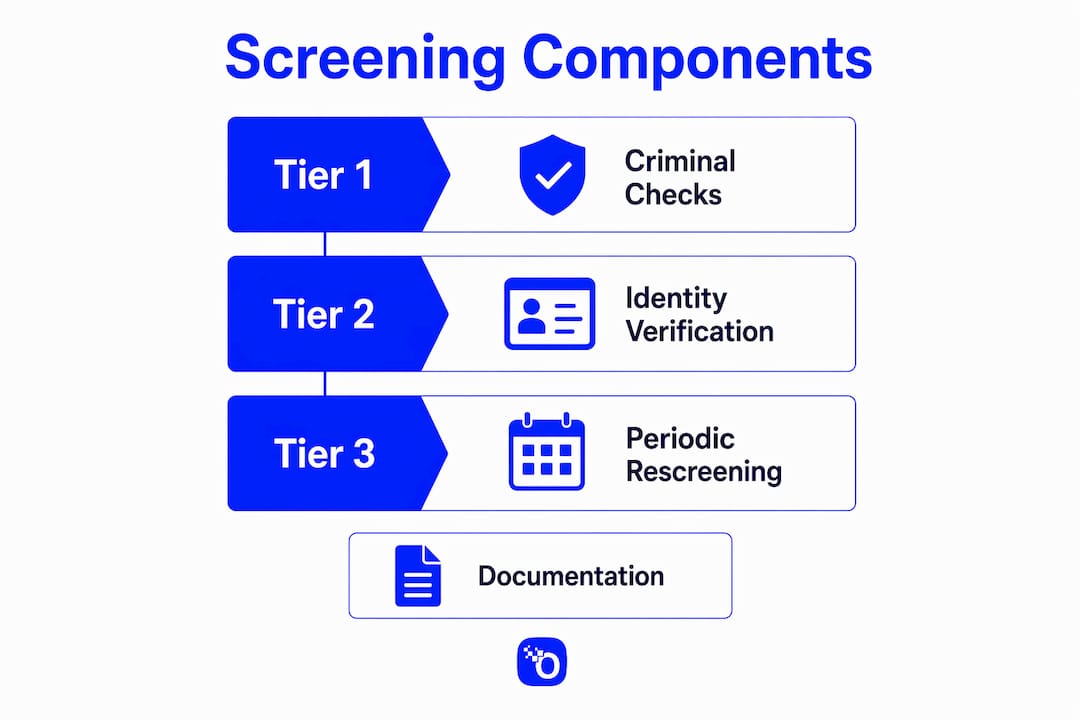
The table below outlines how screening components typically align with volunteer risk tiers:
| Risk tier | Example roles | Core screening components |
|---|---|---|
| High | EMS ride-along, juvenile programs, crisis response | Criminal history (national + state), sex offender registry, identity verification, reference checks, driving record |
| Medium | Community outreach, event support, dispatch assistance | Criminal history (county + state), identity verification, reference checks |
| Low | Administrative, fundraising, non-public-facing support | Identity verification, basic criminal history check |
Criminal history checks should query multiple databases. A county-level search catches records that national databases miss, because not all court records are digitized or reported to federal repositories. Identity verification confirms that the person submitting the application is who they claim to be, which matters more than many agencies realize. Reference checks, often skipped for volunteers, provide qualitative insight into reliability and behavior that no database can supply.

Frequency matters as much as depth. Consistent screening applies not only initially but also through periodic rescreening to maintain standards and reduce liability exposure. A volunteer who passed a clean check three years ago may have a subsequent arrest that your agency has no visibility into without a rescreening protocol. Annual or biennial rescreening for high-risk roles is the recognized standard among public safety agencies with mature programs.
Documentation is the final pillar. Every screening decision, whether it results in approval or disqualification, should be recorded with the rationale, the components reviewed, and the date. This audit trail is what protects your agency when a claim arises months or years after a volunteer’s placement. The public safety vetting process for sworn personnel provides a useful template that can be adapted for volunteer roles.
Pro Tip: Build your volunteer screening tiers into your onboarding system so that role assignment automatically triggers the correct screening package. Manual selection creates inconsistency, and inconsistency creates legal exposure.
What are best practices for implementing a volunteer screening program?
A screening policy that exists only on paper provides no protection. Implementation requires integration with onboarding workflows, clear communication with volunteers, and consistent application across every role and every individual. These are the operational practices that separate agencies with defensible programs from those that are exposed.
- Integrate screening with onboarding from the first touchpoint. Volunteers should receive the standalone FCRA disclosure and authorization form as part of their initial application packet, before any role assignment occurs. Waiting until after a volunteer has started orientation creates both a compliance gap and an awkward operational situation.
- Use digital workflows for compliance and record keeping. Paper-based screening processes introduce errors, create storage problems, and make audit responses slow and incomplete. Digital platforms that timestamp consent, store reports securely, and generate automated reminders for rescreening cycles reduce administrative burden and improve defensibility.
- Communicate screening policies clearly and in advance. Volunteers who understand why they are being screened, what the process involves, and how their information will be used are more likely to complete the process accurately and less likely to withdraw. Transparency also signals organizational professionalism.
- Apply screening consistently across all volunteers without exception. Inconsistent application is one of the most common sources of legal exposure in volunteer programs. If a long-tenured volunteer is exempt from rescreening while newer volunteers are checked annually, that disparity can be used against the agency in litigation. Consistency is both a legal protection and an equity standard.
- Establish automated reminders for rescreening and policy updates. Volunteer programs often operate with lean administrative staff. Automated reminders tied to each volunteer’s screening date prevent rescreening from falling through the cracks. Policy updates, such as new state registry requirements or changes to FCRA guidance, should trigger a review of all active volunteer records.
- Pair screening with documented role expectations. Comprehensive screening involves pairing background checks with clearly defined role expectations and documentation, so that volunteers understand responsibilities and risks. This approach reduces incidents and false allegations by establishing behavioral boundaries in writing before service begins.
Agencies that are building or rebuilding their programs should review the top ways to improve volunteer screening as a structured starting point. For fire and rescue organizations specifically, the operational context and legal considerations differ enough from general public safety that role-specific guidance on fire and rescue volunteer screening is worth consulting directly.
Key takeaways
Screening public safety volunteers requires a documented, role-based, FCRA-compliant process that combines criminal history checks, identity verification, periodic rescreening, and clearly defined role expectations to protect communities and agencies alike.
| Point | Details |
|---|---|
| FCRA applies to volunteers | Standalone disclosure and written consent are required before any third-party background check. |
| Role-based risk tiers | Match screening depth to volunteer responsibilities, with the highest scrutiny for roles involving vulnerable populations. |
| Rescreening is mandatory | Annual or biennial rescreening for high-risk roles maintains current records and equal accountability. |
| Documentation is your defense | Recorded screening decisions with rationale protect agencies against negligent supervision claims. |
| Consistency prevents liability | Applying screening uniformly across all volunteers eliminates the legal exposure created by selective enforcement. |
Screening is risk management, not a character verdict
From where I sit, the single biggest mistake public safety managers make with volunteer screening is framing it as a trust issue. When you frame screening as “we need to check if we can trust you,” you create friction with well-intentioned volunteers and you miss the actual purpose of the process entirely.
Volunteer screening should be framed as risk management rather than a judgment of character. That reframe changes everything operationally. It means you screen everyone, not just the people who seem suspicious. It means you document everything, not just the disqualifications. And it means you treat the process as an ongoing organizational responsibility rather than a one-time intake step.
What I have observed in agencies with mature programs is that the documentation discipline matters more than the screening components themselves. When a claim arises, and in public safety it is a matter of when rather than if, the agency that survives it intact is the one that can produce a complete record showing what was checked, when it was checked, what was found, and what decision was made with what rationale. That record is built through consistent process, not through any single background check result.
The evolving regulatory environment adds urgency to this discipline. State legislatures continue to expand registry requirements and fingerprinting mandates for volunteer roles. FCRA enforcement has grown more active. Agencies that built their screening programs five years ago and have not reviewed them since are likely out of compliance in at least one dimension. Continuous improvement is not a best practice aspiration. It is a legal necessity.
The uncomfortable truth is that no screening program eliminates all risk. A defensible program balances legal compliance with fairness and operational practicality, focused on documented policies rather than assuming screening alone guarantees safety. The goal is not a perfect filter. The goal is a documented, consistent, legally sound process that demonstrates your agency acted with reasonable care.
— Matt
How Omniintel supports compliant volunteer screening
Public safety agencies need more than a generic background check vendor. They need a platform built around the investigative standards and compliance requirements specific to their operating environment.

Omniintel’s volunteer background check services are purpose-built for public safety organizations, covering criminal history, identity verification, registry queries, and ongoing monitoring in a single FCRA-compliant workflow. The platform supports role-based screening packages, automated rescreening reminders, and digital record keeping that produces the audit trail your agency needs when a claim arises. For agencies looking to build or rebuild their volunteer screening program, Omniintel’s pre-employment screening services provide the compliance infrastructure and investigator-driven methodology that generic HR platforms cannot match. Whether you manage a volunteer fire company, a community policing program, or an EMS auxiliary, the right screening partner reduces liability and strengthens the integrity of every person operating under your agency’s name.
FAQ
Why do public safety volunteers need background checks?
Public safety volunteers interact with vulnerable populations and operate in positions of trust, making background checks the baseline safeguard against placing unsuitable individuals in sensitive roles. Failure to screen exposes agencies to negligent supervision claims and serious reputational consequences.
Does the FCRA apply to volunteer background checks?
Yes. FCRA procedural requirements apply when background checks are conducted by third-party agencies for volunteers, including standalone disclosure, written authorization, and adverse-action procedures. Unpaid status does not create an exemption from these requirements.
How often should public safety volunteers be rescreened?
High-risk volunteer roles should be rescreened annually or biennially to maintain current records and equal accountability across all volunteers. Rescreening long-tenured volunteers is as important as screening new ones, because criminal records can change after initial placement.
What components should a public safety volunteer screening include?
A thorough screening program includes criminal history checks at the county, state, and national levels, identity verification, sex offender and abuse registry queries, reference checks, and for driving-related roles, a motor vehicle record review. The specific components should match the risk tier of the volunteer role.
What is the biggest legal risk in volunteer screening programs?
Inconsistent application is one of the most common legal vulnerabilities, because selective enforcement of screening policies can be used as evidence of discriminatory practice or negligence. Agencies must apply the same screening standards to every volunteer in a given role tier without exception.