

Why Compliance Is Critical in EMS Hiring
Compliance in EMS hiring is defined as the systematic adherence to federal, state, and local employment laws governing how emergency medical services agencies recruit, screen, and select personnel. When compliance fails, the consequences extend far beyond a regulatory fine. A single EEOC discrimination charge costs a median of $30,000 to $50,000 to defend before litigation even begins, and that figure climbs past $500,000 for complex class actions. For EMS agencies operating under tight municipal budgets and public scrutiny, understanding why compliance is critical in EMS hiring is not an abstract legal exercise. It is the operational foundation that determines whether your agency can staff ambulances, retain qualified paramedics, and avoid the kind of legal exposure that derails entire departments.
Why compliance is critical in EMS hiring: the legal framework
EMS hiring regulations draw from a dense web of federal statutes, each carrying its own penalty structure and enforcement mechanism. Title VII of the Civil Rights Act of 1964 prohibits discrimination based on race, color, religion, sex, and national origin throughout every stage of recruitment. The Equal Employment Opportunity Commission enforces Title VII and investigates charges filed against employers, including public safety agencies. The Fair Credit Reporting Act governs how background check information is obtained and used, requiring written consent, pre-adverse action notices, and candidate dispute rights before any FCRA-compliant screening report influences a hiring decision.
Beyond federal law, EMS HR professionals must track a growing body of state and local requirements. Ban-the-box statutes, now active in more than 35 states, restrict when criminal history questions can appear in the application process. Pay transparency laws in states including Colorado, California, and New York require salary ranges to be disclosed in job postings. Illinois and New York City have enacted AI bias audit mandates that require employers to conduct independent audits of automated hiring tools and notify candidates when such tools are used.
The table below summarizes the most common legal requirements for EMS hiring compliance and the associated penalty ranges:
| Requirement | Governing law | Penalty range |
|---|---|---|
| Employment eligibility verification | I-9 and E-Verify | Up to $2,500 per unauthorized worker |
| Anti-discrimination in recruitment | Title VII, EEOC | $30,000 to $500,000+ in defense and settlement costs |
| Background check consent and disclosure | FCRA | $100 to $1,000 per willful violation |
| Criminal history inquiry timing | Ban-the-box statutes | Varies by state; civil penalties and litigation exposure |
| AI hiring tool audits and notifications | Illinois, NYC AI laws | Fines and regulatory enforcement actions |
Documentation is not optional under this framework. Consistent documentation of every hiring step is a legal obligation that supports defense against discrimination claims. When an agency cannot produce records, the burden of proof shifts unfavorably to the employer in any EEOC litigation. This is a structural vulnerability that no EMS agency can afford to carry.
Pro Tip: Maintain a centralized hiring file for every candidate that includes the job posting, application, interview notes, background check consent forms, and any adverse action notices. This file is your primary defense document if a charge is ever filed.
What are the financial and operational risks of noncompliance in EMS hiring?
The financial exposure from compliance failures in EMS recruitment is specific, documented, and severe. Defense costs for an EEOC charge range from $30,000 to $50,000 without litigation, and some discrimination lawsuit settlements exceed $365,000. These figures represent direct costs. They do not account for the internal staff hours consumed by investigations, the outside counsel fees that accumulate during discovery, or the reputational damage that follows a public discrimination finding.

Employment eligibility violations carry their own financial logic. Failure to verify employment eligibility through I-9 and E-Verify can result in penalties up to $2,500 per unauthorized worker per instance. For an agency that processes dozens of hires annually without a rigorous verification protocol, cumulative exposure compounds quickly. Federal contractors face additional scrutiny under affirmative action requirements, where documentation gaps translate directly into audit findings.
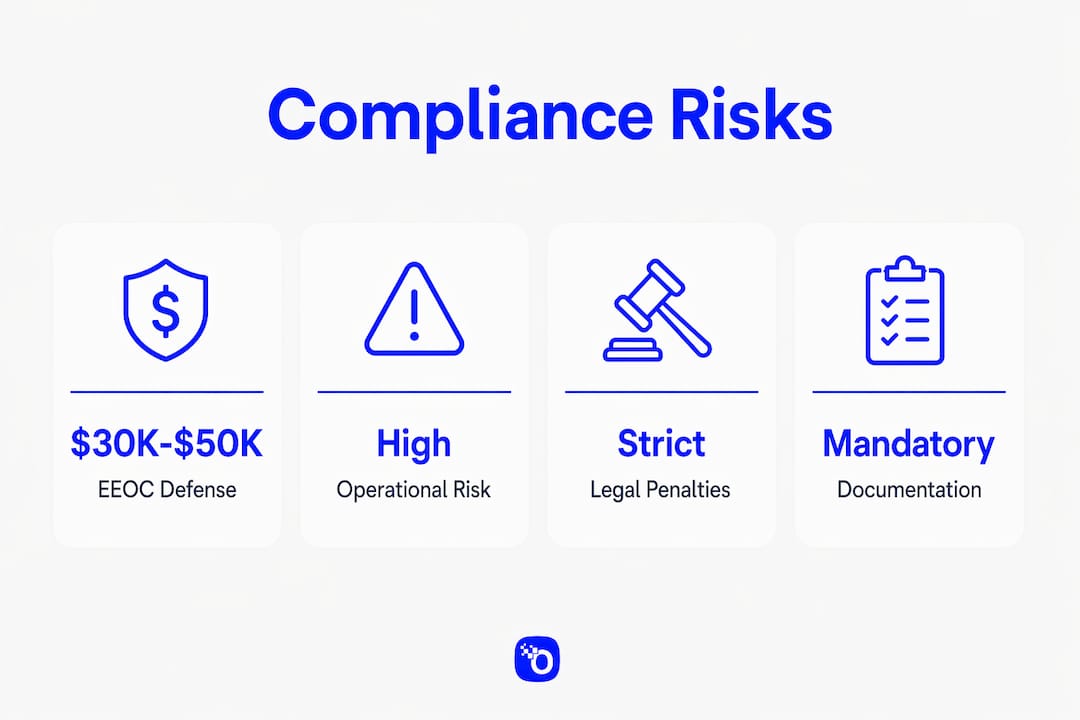
The operational consequences of noncompliance are equally damaging, though they are harder to quantify on a balance sheet. Non-compliance with recruitment laws leads to reputational damage, legal liabilities, employee dissatisfaction, and reduced operational efficiency. Agencies that develop a reputation for unfair or legally questionable hiring practices lose access to the strongest candidate pools. Qualified paramedics and EMTs choose employers with transparent, professional hiring processes. When compliance breaks down, turnover increases, recruitment cycles lengthen, and the cost per hire rises.
The following sequence illustrates how a single compliance failure can cascade across an organization:
- A hiring manager asks a prohibited criminal history question during an initial application review, violating a state ban-the-box statute.
- A rejected candidate files a complaint with the state civil rights agency.
- The agency initiates an investigation, requiring the EMS organization to produce all hiring records for the relevant period.
- Incomplete documentation shifts the burden of proof to the employer.
- The agency settles the complaint to avoid litigation, paying legal fees and a settlement amount that exceeds the annual budget for recruiter training.
- Local media coverage of the settlement discourages qualified candidates from applying in the next hiring cycle.
“Companies not prioritizing recruitment compliance risk losing top talent and facing increased turnover.” — People Managing People
This is not a hypothetical sequence. It reflects the documented pattern of compliance failures that EMS HR professionals encounter when legal requirements are treated as secondary to operational urgency. The 14x risk multiplier associated with non-compliant public safety hiring underscores how quickly exposure accumulates.
How can EMS hiring managers implement effective compliance practices?
Building a defensible compliance program in EMS recruitment requires structure, technology, and consistent human oversight. The following steps represent the framework that EMS HR professionals should implement and maintain:
-
Conduct annual full compliance audits. Review all job postings, application forms, interview question banks, and offer letter templates against current federal and state requirements. Annual audits and quarterly metrics reviews, including adverse impact analysis at each hiring stage, are the documented best practice for maintaining compliant hiring programs.
-
Configure your applicant tracking system for compliance enforcement. An ATS should do more than organize resumes. Technology such as ATS should log every candidate interaction, generate adverse impact reports, and separate demographic data from hiring decisions. Systems that lack these capabilities create documentation gaps that become liabilities during audits.
-
Establish a documented consent and disclosure process for background checks. Every FCRA-compliant background investigation requires written authorization from the candidate before screening begins. Pre-adverse action notices must be sent before a final decision is made, giving candidates the opportunity to dispute inaccurate information. This process must be applied consistently across every hire.
-
Implement human oversight for any AI-assisted screening tools. Employers cannot delegate compliance responsibility to a vendor. Employers can’t outsource responsibility for AI hiring tool compliance and must conduct their own monitoring to avoid disparate impact violations. This means reviewing AI tool outputs for demographic patterns and documenting the review process.
-
Deliver ongoing compliance training to every recruiter and hiring manager. Hiring managers and recruiters must receive ongoing compliance training, particularly regarding updated laws and automated hiring tools. Training reduces inadvertent violations and strengthens consistent hiring practices across the organization.
Pro Tip: After any new law takes effect or any new hiring tool is deployed, schedule a targeted compliance audit within 60 days. Do not wait for the annual review cycle. New tools and new laws create new exposure that requires immediate assessment.
Agencies that treat EMS recruitment best practices as a compliance function rather than a purely operational one consistently report lower turnover and fewer candidate disputes. The investment in structured compliance processes pays dividends in workforce stability and legal defense readiness.
What are the emerging challenges in EMS hiring compliance?
The compliance environment for EMS hiring is not static. Three developments are reshaping the legal requirements that EMS HR professionals must manage in 2026: AI-driven hiring tools, expanding state-level legislation, and the growing complexity of fair chance hiring frameworks.
AI tools and employer liability
The EEOC issued 2023 guidance confirming that employers remain liable under Title VII for any disparate impact produced by AI hiring tools, regardless of whether a third-party vendor developed the tool. This is a significant legal shift. An EMS agency that uses an AI-powered resume screener or automated interview scoring platform cannot transfer liability to the software provider if the tool produces discriminatory outcomes. The agency owns the outcome.
Several states have moved beyond federal guidance to enact specific AI hiring legislation. Illinois and New York City now require employers to conduct independent bias audits of AI hiring tools and notify candidates when such tools influence hiring decisions. These requirements create new administrative obligations for EMS HR teams that have adopted automated screening technology.
Expanding state law complexity
The following compliance areas are expanding most rapidly across state jurisdictions:
- Pay transparency requirements: California, Colorado, New York, and Washington now require salary ranges in job postings. Several additional states have pending legislation that will take effect within the next 12 months.
- Fair chance hiring laws: Ban-the-box statutes continue to expand, with some jurisdictions now requiring individualized assessments before any criminal history can be used to disqualify a candidate.
- Salary history bans: More than 20 states prohibit employers from asking candidates about prior compensation, a requirement that directly affects how EMS agencies structure their initial screening conversations.
The table below summarizes the emerging compliance areas and the recommended agency response:
| Emerging area | Current scope | Recommended response |
|---|---|---|
| AI bias audits | Illinois, NYC; expanding | Annual third-party audits of all AI screening tools |
| Pay transparency | 4+ states active; more pending | Update all job postings to include salary ranges |
| Fair chance hiring | 35+ states with ban-the-box | Delay criminal history inquiry to conditional offer stage |
| Salary history bans | 20+ states | Remove salary history questions from all intake forms |
Balancing automation and compliance responsibility
The rise of AI hiring tools introduces risks that demand human oversight and periodic audits to confirm non-discrimination and fair practices. EMS agencies that deploy automation to accelerate hiring cycles must build parallel oversight processes to monitor those tools for disparate impact. Efficiency gains from automation are real, but they do not reduce legal exposure. They redistribute it. The agency that moves fastest without monitoring its tools is the agency most likely to face a systemic discrimination finding.
Treating HR compliance as a strategic function enhances transparency and attracts top candidates aligned with EMS agency missions. This framing matters because it positions compliance not as a constraint on hiring speed but as a signal of organizational integrity that top candidates recognize and value.
Key takeaways
Compliance in EMS hiring is the single most effective defense against legal liability, financial loss, and workforce instability in public safety recruitment.
| Point | Details |
|---|---|
| Legal exposure is specific and costly | EEOC defense costs range from $30,000 to $500,000+; I-9 violations reach $2,500 per worker. |
| Documentation is a legal obligation | Incomplete hiring records shift the burden of proof to the employer in EEOC litigation. |
| AI tools do not transfer liability | Employers remain fully liable under Title VII for disparate impact from AI screening tools. |
| Audits must follow new tools and laws | Schedule targeted compliance reviews within 60 days of deploying new technology or regulations. |
| Compliance attracts stronger candidates | Agencies with transparent, lawful hiring processes report lower turnover and fewer disputes. |
The compliance foundation EMS agencies can’t afford to skip
After working with public safety agencies through audits, investigations, and hiring overhauls, one pattern stands out consistently: the agencies that struggle most with compliance are not the ones that ignored the law. They are the ones that treated compliance as a checklist rather than a system.
A checklist gets completed once. A system runs continuously. The distinction matters enormously when a state agency requests three years of hiring records in response to a single complaint. Agencies with systems produce the documentation immediately. Agencies with checklists spend weeks reconstructing records that may or may not satisfy the investigator’s request.
The other lesson I would share is this: compliance and operational excellence are not competing priorities. Every EMS agency I have worked with that built a genuine compliance infrastructure reported the same outcome. Their hiring cycles became more predictable, their candidate quality improved, and their legal exposure dropped. The reason is straightforward. Structured compliance processes force clarity about what you are looking for in a candidate, how you evaluate applicants consistently, and how you document decisions. That clarity produces better hires, not just safer legal positions.
The emerging AI compliance requirements deserve particular attention from EMS HR professionals. The instinct to adopt automated screening tools to accelerate hiring is understandable. The candidate volume in EMS recruitment is high, and manual review is time-consuming. But the legal framework is unambiguous: your agency owns the outcome of every tool you deploy. Before adopting any AI-assisted screening platform, conduct a bias audit, establish a human review protocol, and document both. The efficiency gain is not worth the liability if the tool produces disparate impact across protected classes.
Finally, compliance is a trust signal. Candidates notice when an agency runs a professional, transparent, and legally sound hiring process. In a field where integrity is the baseline expectation, the way you hire communicates the values of your organization before a new employee ever responds to their first call.
— Matt
How Omniintel supports compliant EMS hiring

Omniintel builds background screening programs specifically for public safety agencies, including fire and EMS departments that need investigator-driven checks aligned with FCRA requirements, Title VII standards, and state-specific hiring regulations. Every screening package is configured to the role, not adapted from a generic commercial template. Omniintel’s pre-employment screening services integrate with existing ATS platforms, generate documentation that supports adverse action compliance, and provide the audit trail that EMS agencies need when regulatory inquiries arise. For agencies managing the growing complexity of AI bias audits, pay transparency requirements, and fair chance hiring laws, Omniintel provides the structured screening infrastructure that keeps hiring decisions defensible. Explore how Omniintel’s EMS-specific investigations reduce legal risk and improve the quality of every hire your agency makes.
FAQ
What are the main legal requirements for EMS hiring compliance?
EMS agencies must comply with Title VII, EEOC anti-discrimination requirements, I-9 and E-Verify employment eligibility verification, and FCRA rules governing background checks. State-specific requirements including ban-the-box statutes, pay transparency laws, and AI bias audit mandates add additional obligations depending on jurisdiction.
How much does an EEOC violation cost an EMS agency?
Defending an EEOC charge costs a median of $30,000 to $50,000 before litigation begins, with complex class action cases exceeding $500,000. Some discrimination lawsuit settlements exceed $365,000, making proactive compliance significantly less expensive than reactive defense.
Can EMS agencies use AI tools in hiring without additional compliance obligations?
No. The EEOC confirmed in 2023 that employers remain liable under Title VII for any disparate impact produced by AI hiring tools, regardless of vendor involvement. Agencies using AI screening must conduct bias audits and maintain human oversight of all automated decisions.
How often should EMS agencies conduct hiring compliance audits?
Annual full compliance audits combined with quarterly adverse impact metrics reviews represent the documented best practice. Agencies should also conduct targeted audits within 60 days of deploying any new hiring tool or after any significant change in applicable law.
What is the penalty for I-9 violations in EMS hiring?
Failure to properly verify employment eligibility through I-9 and E-Verify can result in penalties up to $2,500 per unauthorized worker per instance. Agencies that process multiple hires without a rigorous verification protocol face cumulative exposure that grows with each unverified hire.