

What Is Activity Monitoring for Agencies: A Manager’s Guide
Activity monitoring for agencies is the systematic collection, categorization, and analysis of employee work data to improve operational efficiency, ensure compliance, and maintain oversight across public safety and security organizations. The industry term for this practice is workforce activity tracking, though agency administrators increasingly use it to describe both automated time capture and post-hire behavioral oversight. Tools like calendar-integrated logging, AI-powered tagging, and platforms such as Google Calendar and ClickUp now make it possible to capture work activity in real time without burdening staff with manual entry. For law enforcement, fire and EMS, dispatch centers, and private security firms, this data is not a luxury. It is the operational foundation that protects agency integrity, supports accurate billing, and enables evidence-based staffing decisions.
What is activity monitoring for agencies and why does it matter?
Activity monitoring for agencies is defined as the structured process of recording, tagging, and reviewing how personnel spend their time across clients, projects, and operational functions. It differs from general employee surveillance in one critical way: the goal is capacity planning and financial accuracy, not individual policing.
Public safety agencies operate under intense scrutiny. Every hour logged by a dispatcher, investigator, or field officer carries accountability implications. When activity data is captured accurately, administrators can verify that staffing levels match operational demand, that billable work is invoiced correctly, and that compliance obligations are met without gaps. When it is not captured, the consequences range from lost revenue to audit failures.

Manual time tracking underreports billable hours by 10-30%, a gap that costs agencies substantial revenue and distorts resource planning. That figure means a 10-person team logging 40 hours per week could be missing up to 120 hours of billable or accountable work every week. For public safety agencies with strict budget oversight, that level of inaccuracy is operationally unacceptable.
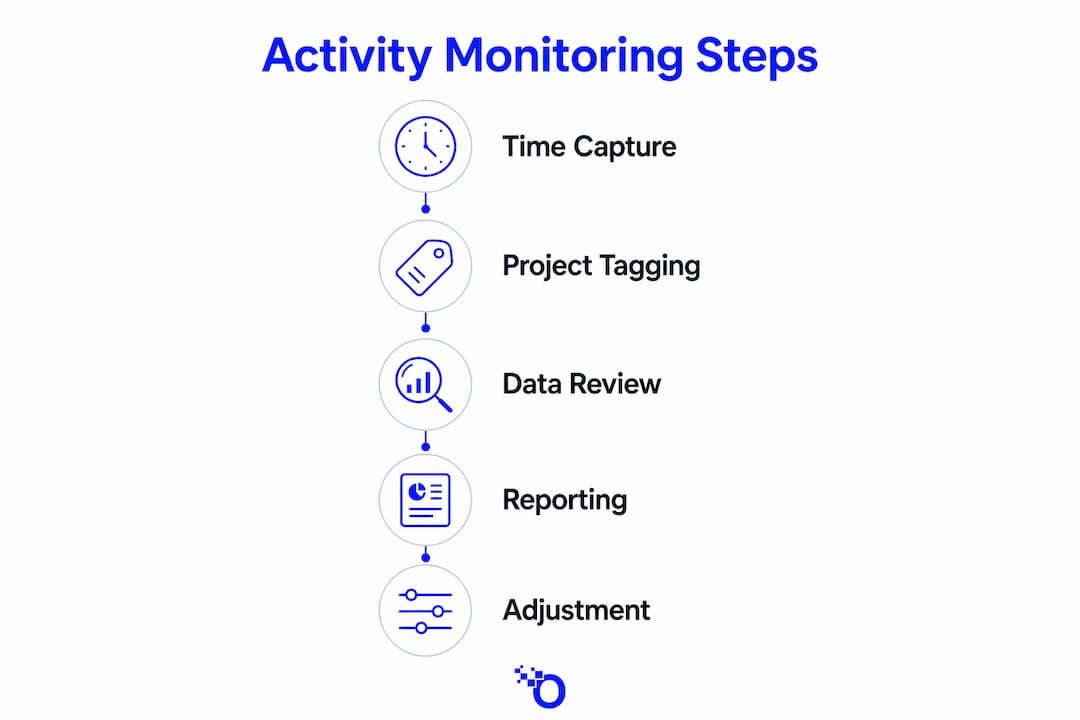
The core components of agency activity tracking include time capture (automated or manual), project and client tagging, utilization reporting, and periodic review cycles. Each component feeds the next. Capture without tagging produces noise. Tagging without review produces reports no one acts on. Review without a defined cadence produces delayed corrections that cost money.
How does activity monitoring improve operational efficiency and billing accuracy?
Operational efficiency in agencies is measured primarily through utilization rates. A utilization rate below 65% signals over-staffing or significant idle time, while the healthy target range is 70-80% for most agency environments. That benchmark gives administrators a concrete threshold to manage against, rather than relying on subjective assessments of team productivity.
Automated activity logging addresses the single largest source of billing inaccuracy in agency operations. Automated calendar-integrated logging increases billable hours by 10-20% by capturing work that employees forget to log manually, such as short client calls, email threads, and review tasks. For a mid-sized public safety agency billing at $75 per hour, a 15% recovery in previously unrecorded hours across a 20-person team represents tens of thousands of dollars in annual revenue that would otherwise disappear.
The administrative waste from manual entry is equally significant. Staff who spend 20 minutes per day reconciling timesheets across a 50-person agency consume over 170 hours per month in non-billable overhead. Automated tools that pull data from calendar events, project management platforms, and communication tools eliminate most of that burden.
Key operational benefits of automated agency activity tracking include:
- Accurate billing: Work captured in real time reduces invoice disputes and scope creep conversations with clients or oversight bodies.
- Resource visibility: Managers see which teams are over-capacity and which have bandwidth before problems escalate.
- Audit readiness: Timestamped activity logs provide defensible records during compliance reviews or external audits.
- Scope management: When project burn rates are visible weekly, managers can renegotiate scope or reallocate staff before budgets are exhausted.
- Reduced revenue leakage: Automated capture closes the gap between work performed and work invoiced.
Pro Tip: Integrate your activity monitoring tools directly with your existing calendar and project management platforms from day one. Tools that pull data automatically from Google Calendar or ClickUp reduce the manual entry burden to near zero and produce more consistent, auditable records.
What are the primary tools and methods for monitoring agency work?
The two dominant approaches to agency activity tracking are manual timesheets and automated calendar-driven logging. They differ substantially in accuracy, staff burden, and data quality.
| Method | Accuracy | Staff burden | Privacy risk | Best use case |
|---|---|---|---|---|
| Manual timesheets | Low to moderate | High (daily entry required) | Low | Small teams, simple projects |
| Automated calendar logging | High | Low (passive capture) | Low to moderate | Multi-client agencies, public safety ops |
| Surveillance software (screenshots, keylogging) | High (granular) | Low | High | Not recommended for agency use |
| AI-powered tagging with PM integration | High | Very low | Low | Complex agencies with multiple clients |
Automated calendar-driven logging works by connecting activity monitoring tools to platforms like Google Calendar, Microsoft Outlook, or project management tools like ClickUp and Asana. The tool reads event metadata, duration, and participant data, then tags each block against a client or project. AI and automation within activity monitoring tools connect with calendars and PM apps to classify work automatically, reducing the need for employees to categorize their own time.
Privacy-conscious tools represent the standard for public safety agency environments. Tools like Rize capture app names, URLs, and calendar events but avoid screenshots or keystroke logging, preserving individual privacy while still generating accurate utilization data. This distinction matters enormously in agencies where personnel trust is foundational to operational effectiveness.
Surveillance-grade software that captures screenshots, records keystrokes, or monitors personal communications creates legal exposure and destroys morale. Effective activity monitoring must differentiate from employee surveillance to preserve the trust that public safety agencies depend on. The goal is operational data, not behavioral control.
Over-collection of granular user activity data creates a different problem. Aggregated project-level reports are more actionable and less overwhelming than minute-by-minute raw logs. Managers who receive 500-row spreadsheets of raw activity data make worse decisions than those who receive a weekly summary showing utilization by team and project burn rate by client.
Pro Tip: When evaluating agency tracking software, eliminate any tool that requires screenshot capture or keystroke logging from your shortlist immediately. The morale cost outweighs any data benefit, and the legal risk in public safety environments is substantial.
How can agencies use activity data to enhance compliance and oversight?
Compliance in public safety agencies is not optional, and activity data is one of the most reliable mechanisms for demonstrating it. Financial transparency is the first application. Discrepancies of over 1-2% in platform-level spend versus invoiced amounts signal transparency issues or undisclosed markups, a threshold that applies equally when agencies audit external vendors or when oversight bodies audit the agency itself.
Using activity monitoring data for compliance and operational oversight requires a structured approach:
- Establish baseline metrics. Before implementing monitoring, document current utilization rates, billing accuracy, and project completion times. These baselines make it possible to measure improvement and identify anomalies.
- Define compliance checkpoints. Identify which activities require documented proof for regulatory or contractual purposes, such as training hours, case documentation time, or vendor interaction logs.
- Audit external partner invoices. Cross-reference vendor invoices against activity logs to verify that billed hours align with recorded work. A 2% variance threshold is a defensible audit standard.
- Review utilization by role. Identify whether specific roles are consistently over or under their target utilization range. Persistent under-utilization in a public safety context may indicate staffing misalignment or workflow bottlenecks.
- Generate activity reports for agencies on a defined schedule. Weekly reports for operational managers, monthly summaries for leadership, and quarterly audits for compliance officers create a tiered review structure that keeps data relevant at every level.
- Communicate findings to staff. Transparency about what is being measured and why prevents misconceptions about surveillance and builds the organizational trust needed for accurate self-reporting.
The distinction between monitoring and surveillance is not semantic. Monitoring captures aggregated operational data to improve systems. Surveillance targets individual behavior to enforce control. Public safety agencies that conflate the two face resistance, reduced data accuracy, and potential legal challenges. Monitoring framed as capacity planning and pricing protection gains higher staff acceptance and produces more reliable data as a direct result.
Ethical implementation also requires clear data governance policies. Personnel should know what is captured, how long it is retained, who has access, and how it will be used. These policies are not just good practice. They are increasingly required by state-level privacy regulations that apply to public sector employers.
What best practices should agency managers follow when implementing activity monitoring?
Successful implementation of agency performance monitoring depends more on process design than on tool selection. The most sophisticated platform produces no value if staff do not trust it, managers do not review the data, or the tagging structure does not match how work actually flows.
Start with the simplest possible tagging taxonomy. Three tags cover most agency needs: client or department, project or case type, and billable status. Adding more categories before the team has adopted basic logging creates friction that reduces compliance and data quality. Complexity can be added incrementally once the baseline habit is established.
Passive data without ongoing review has little business value. The review and adjustment process is where financial benefits are actually realized. Agencies that collect activity data but review it only monthly miss the window to correct scope overruns, reallocate staff, or address billing gaps before they compound. Weekly review and action on monitoring data transforms raw time logs into decisions about scope, pricing, and staffing that protect agency profitability and operational integrity.
Best practices for implementing monitoring agency productivity include:
- Automate data capture wherever possible. Manual entry is the weakest link in any activity monitoring system. Calendar integrations and PM platform connections should be configured before rollout.
- Communicate purpose before launch. Staff who understand that monitoring data is used for capacity planning and accurate billing, not individual performance scoring, adopt tools faster and log more accurately.
- Review burn rates weekly, not monthly. Late review of project burn rates causes missed opportunities to correct scope and budget issues before they become financial losses.
- Act on the data. Monitoring that does not change decisions is a cost center, not an asset. Every weekly review should produce at least one operational adjustment, whether that is a staffing reallocation, a scope conversation, or a pricing correction.
- Protect data access. Activity logs contain sensitive operational information. Access should be role-based, with field-level personnel seeing only their own data and administrators seeing aggregated team reports.
- Audit your tagging rules quarterly. Automation reduces administrative overhead, but managers must carefully configure tagging rules to maintain data consistency as projects and clients change.
The employee monitoring best practices for public safety context adds one additional layer: documentation standards. In law enforcement, fire, EMS, and dispatch environments, activity logs may be subject to public records requests, legal discovery, or internal affairs review. Logs must be accurate, timestamped, and retained according to applicable records management policies.
How does activity monitoring fit within public safety agency hiring and oversight workflows?
Activity monitoring does not operate in isolation. In public safety agencies, it is one component of a broader operational integrity framework that begins before an employee’s first day and continues throughout their tenure. The connection between pre-employment screening and post-hire monitoring is direct: the same standards of accuracy, documentation, and accountability that govern background investigations apply to ongoing workforce oversight.
Accurate activity logs support recruitment and performance decisions in several concrete ways:
- Performance benchmarking: Activity data from current personnel establishes realistic productivity baselines that inform job descriptions, staffing ratios, and performance expectations for new hires.
- Probationary oversight: New hires in public safety roles are often subject to enhanced oversight during probationary periods. Activity monitoring provides objective data to support or challenge performance assessments.
- Incident documentation: When conduct issues arise, timestamped activity logs provide factual context that supports fair, evidence-based disciplinary processes.
- Compliance verification: For roles with mandatory training, certification, or documentation requirements, activity data confirms that obligations are being met without relying solely on self-reporting.
- Vendor and contractor oversight: Public safety agencies that contract with external service providers can use activity data to verify that contracted hours and deliverables align with invoiced amounts.
The post-hire monitoring function is where activity tracking intersects most directly with public safety compliance. An officer, dispatcher, or investigator whose post-hire behavior diverges from their pre-employment profile represents a risk that activity data can surface before it becomes a liability. This is not surveillance. It is the same evidence-based approach that governs background investigations, applied to the ongoing employment relationship.
Implementing a monitoring workflow for public safety requires coordination between HR, operations, and legal counsel to define what is captured, how it is reviewed, and what triggers a formal response. Agencies that treat monitoring as a standalone IT function, rather than an integrated HR and compliance process, consistently underutilize the data they collect.
Pro Tip: Use activity monitoring data proactively to identify workload imbalances and compliance gaps before they become conduct issues. The goal is to protect your agency and your personnel, not to build a case against them.
Key takeaways
Activity monitoring for agencies delivers its full value only when automated data capture, structured tagging, and disciplined weekly review operate together as an integrated system.
| Point | Details |
|---|---|
| Define monitoring vs. surveillance | Frame activity tracking as a capacity and billing tool, not individual oversight, to secure staff adoption. |
| Automate data capture | Calendar and PM integrations eliminate manual entry errors and recover 10-20% of previously unrecorded billable hours. |
| Review data weekly | Weekly burn rate reviews prevent scope overruns and budget losses that monthly reviews consistently miss. |
| Use privacy-conscious tools | Tools that capture metadata without screenshots or keylogging protect morale and reduce legal exposure. |
| Integrate with hiring workflows | Post-hire activity data supports performance management, compliance verification, and incident documentation in public safety roles. |
Why the framing of activity monitoring determines whether it works
From my experience working with public safety agencies, the single most common reason activity monitoring programs fail is not the tool. It is the framing. Administrators who introduce monitoring as a productivity enforcement mechanism get exactly what they deserve: incomplete logs, resentful staff, and data that reflects what employees think managers want to see rather than what actually happened.
The agencies that get this right present activity tracking as a protection mechanism for the team. When a dispatcher can show exactly how many hours they spent on a complex incident, they are protected from scope disputes and workload misrepresentation. When a fire department can document training hours and response activity, they are protected during audits and grant reviews. That framing changes the entire adoption dynamic.
I have also seen agencies over-invest in granular data collection and under-invest in the review process. A platform that captures every app switch and URL visit generates impressive-looking dashboards that no one has time to interpret. The agencies with the best outcomes focus on three numbers: utilization rate, billable hour recovery, and project burn rate against budget. Everything else is noise until those three are under control.
The ethical dimension is real and should not be minimized. Public safety personnel operate in high-stress, high-accountability environments. Adding monitoring without transparency and clear purpose adds stress without adding value. The continuous employee monitoring steps that work in practice are the ones built on communication, consent, and a clear connection to operational outcomes rather than individual scoring.
— Matt
How OMNI Intel supports agency monitoring and compliance
OMNI Intel specializes in background screening and post-hire monitoring solutions built specifically for public safety agencies, including law enforcement, fire and EMS, dispatch centers, and private security firms. If your agency is working to connect pre-employment screening with ongoing activity oversight, OMNI Intel’s investigator-driven approach provides the compliance infrastructure to do both accurately.

OMNI Intel’s pre-employment screening services and background check solutions are designed to meet the integrity standards that public safety roles demand, from initial candidate vetting through continuous post-hire monitoring. Whether you are building a new monitoring program or strengthening an existing one, OMNI Intel provides the tools, expertise, and FCRA-compliant processes to protect your agency and the communities it serves. Contact OMNI Intel to discuss a monitoring and screening solution tailored to your agency’s specific operational requirements.
FAQ
What is activity monitoring for agencies?
Activity monitoring for agencies is the systematic tracking and analysis of employee work data, including time spent on tasks, projects, and clients, to improve operational efficiency, billing accuracy, and compliance. It is distinct from employee surveillance in that it focuses on aggregated operational data rather than individual behavioral control.
How does automated activity tracking differ from manual timesheets?
Automated activity tracking captures work data passively through calendar integrations and project management platforms, while manual timesheets rely on employee self-reporting. Manual tracking underreports billable hours by 10-30%, making automated tools significantly more accurate for agency billing and compliance purposes.
What utilization rate should public safety agencies target?
A utilization rate below 65% indicates operational inefficiencies or over-staffing, while the healthy target range for most agencies is 70-80%. Monitoring utilization rates weekly allows administrators to identify and correct staffing imbalances before they affect service delivery or budget performance.
How do agencies use activity monitoring for compliance?
Agencies use activity data to verify that billable hours match invoiced amounts, confirm that mandatory training and documentation requirements are met, and provide timestamped records for audits or legal review. A variance of more than 1-2% between recorded activity and invoiced amounts signals a transparency issue that warrants investigation.
What is the difference between activity monitoring and employee surveillance?
Activity monitoring captures aggregated operational data, such as hours by project or utilization by team, to support management decisions. Employee surveillance targets individual behavior through screenshots, keystroke logging, or real-time location tracking. Public safety agencies should use privacy-conscious monitoring tools that avoid surveillance-grade data collection to preserve staff trust and reduce legal exposure.