
Master the Public Safety Recruitment Process Easily
Recruitment in public safety is never just about filling empty seats. Every decision made impacts your agency’s operational effectiveness, compliance, and standing with the communities you serve. For human resources professionals, the difference between a reliable workforce and costly hiring mistakes lies in building evidence-based, competency-driven recruitment practices from the start. This guide breaks down each crucial step so your team can recruit confidently, guard against legal pitfalls, and attract candidates who will strengthen your agency long term.
Table of Contents
- Step 1: Assess Recruitment Needs And Define Candidate Criteria
- Step 2: Implement Effective Screening And Background Checks
- Step 3: Integrate Ai-Driven Tools Into Recruitment Workflow
- Step 4: Verify Qualifications And Compliance Requirements
- Step 5: Finalize Hiring Decisions And Monitor Employee Activity
Quick Summary
| Key Insight | Explanation |
|---|---|
| 1. Define clear recruitment criteria | Assess current needs and desired skills to identify the best candidates effectively. |
| 2. Implement standardized screening | Establish uniform protocols for background checks to ensure candidates’ trustworthiness and compliance. |
| 3. Leverage AI for candidate evaluation | Use AI-driven tools to streamline screening while ensuring human oversight to avoid biases. |
| 4. Verify qualifications thoroughly | Confirm all educational and professional claims to avoid hiring liabilities and ensure integrity. |
| 5. Enhance post-hire monitoring | Track new employees’ performance and well-being to foster growth and prevent issues early on. |
Step 1: Assess recruitment needs and define candidate criteria
Before you post a single job opening, you need a clear picture of what your agency actually needs and what qualities will make someone succeed in that role. This step separates agencies that hire strategically from those that simply fill vacancies. Start by examining your current staffing levels against your operational demands. What calls for service is your dispatch handling? How are patrol response times? Where are your coverage gaps? Look at your current roster and identify not just the positions you need to fill, but also any skills or experience that might strengthen your team’s capabilities moving forward.
Next, move beyond traditional credential requirements. Many agencies still anchor hiring criteria to education levels and years of experience, but this approach often narrows your candidate pool unnecessarily and can perpetuate existing gaps in diversity. Instead, focus on job-related competencies that directly impact performance. For a patrol officer, you might prioritize decision-making under pressure, communication skills, and physical capability rather than defaulting to a four-year degree. For a dispatcher, prioritize multitasking ability, stress management, and clarity of voice over specific work history length. Document the actual knowledge, skills, and abilities your position requires by talking to current high performers in similar roles, reviewing job responsibilities, and considering where candidates struggle most during training. This creates a competency-based framework that attracts capable candidates you might otherwise overlook.
Collaborate with operational leadership to align recruitment criteria with your agency’s priorities and values. If community trust is a top concern, perhaps emotional intelligence and conflict de-escalation matter more than tactical certifications in early screening. If staffing gaps are driving overtime costs, you might prioritize candidates near completion of their training rather than waiting for the “perfect” applicant. Research from law enforcement agencies shows that innovative hiring practices and revised standards significantly improve your ability to recruit qualified candidates from broader talent pools while meeting operational needs more effectively.
Pro tip: Create a weighted scoring document that lists your top five must-have competencies and assign point values to each. Use this consistently when screening applications and conducting interviews to reduce bias and ensure every candidate is evaluated against the same meaningful criteria.
Here’s a comparison of traditional credential-based hiring versus competency-based recruitment approaches:
| Criteria Type | Traditional Credential-Based | Competency-Based Approach | Impact on Candidate Pool |
|---|---|---|---|
| Focus of Evaluation | Education, experience years | Skills, abilities, traits | Broader, more diverse |
| Screening Flexibility | Strict requirements | Adaptable, job-specific | Increased inclusivity |
| Bias Risk | Higher, less objective | Lower, based on evidence | Minimizes exclusion |
| Performance Prediction | Indirect | Direct | Improved accuracy |
Step 2: Implement effective screening and background checks
Effective screening and background checks form the backbone of responsible public safety hiring. This step transforms your candidate pool into verified applicants you can trust with critical responsibilities. Your screening process needs to be thorough, consistent, and legally compliant to protect both your agency and the communities you serve. The goal is not just to eliminate unsuitable candidates but to gather verified information that confirms a candidate’s suitability, trustworthiness, and ability to perform the role.
Start by establishing a standardized screening protocol that all candidates move through equally. Your process should include criminal history checks, fingerprinting, financial history review through credit checks, employment verification, and reference checks from previous supervisors. When implementing these checks, you must understand Fair Credit Reporting Act requirements that govern how you collect, use, and store background information. This means obtaining written consent from candidates before conducting checks, providing transparency about what you will investigate, and ensuring you do not apply screening criteria inconsistently across different groups of applicants. Bias can creep into screening decisions even when you intend to be fair, so documenting your criteria ahead of time and applying them uniformly creates accountability and protects your agency from discrimination claims.

Beyond basic criminal and financial checks, consider what additional investigation deepens your confidence in a candidate’s reliability. Social media review, although controversial, can reveal conduct or associations that contradict the candidate’s stated values or your agency’s standards. Speak directly with previous employers and supervisors rather than accepting written references alone; conversations reveal nuances that paperwork cannot capture. For public safety roles, a thorough personnel vetting process determines whether candidates have the trustworthiness and judgment your agency requires. Background investigators should be trained to follow leads, ask probing questions, and verify information independently rather than accepting applicant claims at face value. This investigator driven approach catches inconsistencies and reveals red flags that automated screening tools might miss. The investment in comprehensive screening now saves you from costly misconduct, litigation, or community trust damage later.
Pro tip: Create a checklist for your background investigators that prioritizes which findings are automatic disqualifiers versus which warrant further discussion with the hiring manager. This clarity prevents inconsistent decision making and ensures candidates are rejected only for legitimate job related reasons.
Step 3: Integrate AI-driven tools into recruitment workflow
AI-driven tools can transform how you evaluate candidates and match them to positions, but only when integrated thoughtfully into your existing recruitment process. This step accelerates candidate screening, reduces unconscious bias, and surfaces patterns you might otherwise miss in large applicant pools. Modern public safety agencies are discovering that AI handles repetitive evaluation tasks efficiently, freeing your hiring team to focus on subjective judgment calls and relationship building with promising candidates. The goal is not to replace human decision making but to augment it with data-driven insights that make your hiring faster and fairer.
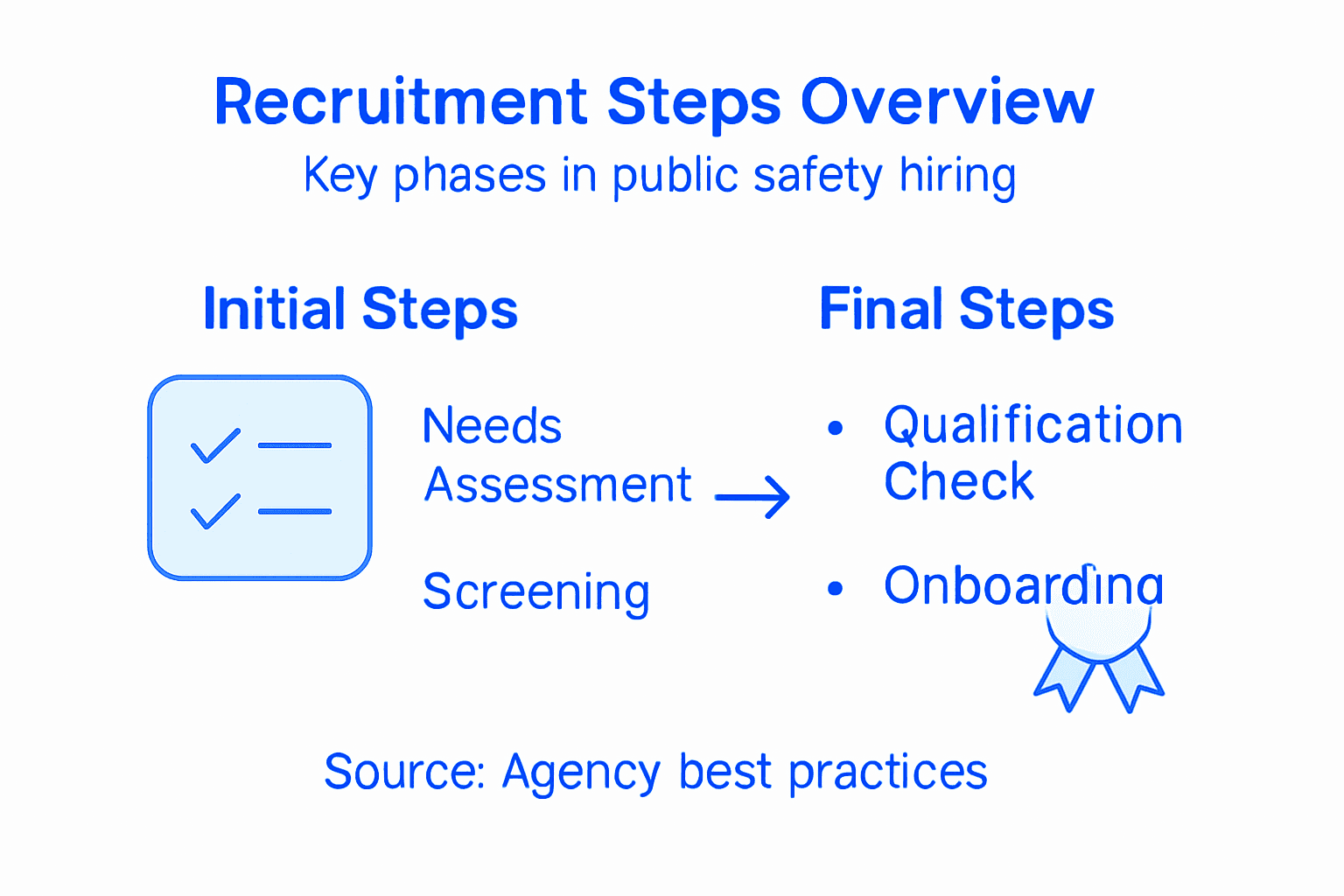
Start by identifying which recruitment tasks are most time consuming or prone to inconsistency. If your team spends hours manually reviewing applications to verify that candidates meet baseline qualifications, an AI screening tool can handle that work in minutes while flagging candidates who match your defined competencies. If reference checking is inconsistent because some interviewers ask different questions than others, AI-assisted evaluation frameworks can standardize what you’re assessing across all candidates. Tools can analyze applicant responses to interview questions, comparing language patterns and competency signals against successful performers already in your agency. You can also leverage AI applications in public safety operations to forecast which candidates are likely to succeed based on how operational demands align with their demonstrated abilities and background. This predictive capacity helps you prioritize candidates with the highest likelihood of job fit and retention.
When implementing AI tools, build in transparency and oversight mechanisms to prevent bias from being embedded into your hiring decisions. AI systems learn from historical data, and if your agency has historically hired candidates from narrow demographic groups, the AI will replicate those patterns unless you actively counteract it. Require that your AI tools provide explainable results so you understand why a candidate was ranked higher or lower. Compare outcomes across demographic groups to ensure the tool is not systematically disadvantaging protected classes. Human hiring managers should review and approve all final hiring decisions rather than accepting algorithmic rankings as definitive. Your AI integration should reduce grunt work, surface objective patterns, and create audit trails that document your hiring decisions, but your team retains the authority to override AI recommendations when good judgment demands it.
Pro tip: Pilot any new AI recruitment tool with a subset of open positions before rolling it out agency wide. Track whether candidates the tool flagged as strong performers actually succeed in their roles and whether the tool’s decisions align with your agency’s stated diversity and inclusion goals before committing to full implementation.
Step 4: Verify qualifications and compliance requirements
Verifying qualifications and compliance requirements protects your agency from legal exposure and ensures you hire only candidates who meet the rigorous standards public safety demands. This step confirms that candidates possess the actual credentials, certifications, and legal standing to perform the role safely and lawfully. Many agencies assume applicants are truthful about their qualifications, but verification reveals discrepancies that matter tremendously when public safety is at stake. You cannot afford to discover after hire day that a candidate misrepresented their education, falsified certifications, or has undisclosed legal issues that should have disqualified them.
Begin by establishing baseline compliance requirements for every position. All candidates must meet federal eligibility standards including United States citizenship or permanent residency status, no felony convictions, a valid driver’s license for appropriate roles, and compliance with drug and alcohol policies. Beyond these baseline requirements, verify the specific qualifications your job description demands. If you require a high school diploma or GED, request official documentation from the issuing institution rather than accepting the candidate’s word. If the position mandates professional certifications such as EMT certification, police academy completion, or fire safety training, verify these directly with the certifying bodies using their online databases or verification requests. Contact previous employers to confirm dates of employment, job titles, and performance history. Request official transcripts for any educational credentials claimed. This verification process takes time but catches fraudulent applications before they become hiring liabilities. Candidates who lie about qualifications on applications often exhibit the same dishonesty in their work, making this screening step a proxy for integrity.
For positions requiring access to sensitive information or secure facilities, understand that security clearance eligibility involves additional vetting beyond standard background checks. Some candidates may disqualify themselves by having undisclosed foreign connections, financial instability, or substance abuse history that contradicts their application statements. Create a verification checklist specific to each position type and require hiring managers to confirm every item before extending offers. Document your verification process thoroughly so you have evidence that you conducted due diligence if a hiring decision is ever challenged. The time invested in meticulous verification now protects your agency from negligent hiring claims, security breaches, and the disruption of terminating an unqualified employee months after hire.
Pro tip: Build relationships with verification contacts at key institutions like police academies, EMT training programs, and your state licensing boards. Having direct contacts who can expedite verification requests will significantly accelerate your hiring timeline without sacrificing thoroughness.
Below is a summary of key verification and compliance steps for public safety recruitment:
| Step | Purpose | Methods Used | Outcome Expected |
|---|---|---|---|
| Credential Verification | Confirm qualifications | Direct contact, databases | Ensure honest applicants |
| Compliance Assessment | Meet legal requirements | Document checks, transcripts | Avoid legal exposure |
| Security Clearance Vetting | Access sensitive facilities | Background probes, interviews | Safeguard agency integrity |
| Documentation Audit | Create defensible process | Checklists, records review | Evidence for due diligence |
Step 5: Finalize hiring decisions and monitor employee activity
Finalizing hiring decisions marks a critical transition point from recruitment into onboarding and ongoing oversight. This step requires you to move confidently forward with your best candidates while establishing the monitoring systems that will protect your agency throughout their employment. The hiring decision itself should feel informed and defensible, backed by your comprehensive assessment process. But the work does not end when you extend an offer. Successful public safety agencies recognize that post-hire monitoring and employee engagement are just as important as initial screening for maintaining a competent, trustworthy workforce over the long term.
Before making your final hiring decision, conduct a holistic review of each finalist’s entire file. Have your hiring team and leadership meet to discuss top candidates against your defined criteria and competency framework. Compare how each candidate performed across interviews, background checks, reference calls, and any assessment tools you used. If candidates are close, consider which one demonstrated stronger alignment with your agency’s values and operational priorities. Document your reasoning for the final selection so you have a clear record of why you chose this person. Once you have decided, extend your offer contingent on successful completion of medical clearance, psychological evaluation if required, and final background confirmation. Then begin your onboarding immediately. New officers and staff need mentoring, clear training pathways, and explicit expectations about conduct and performance. Research on public safety workforce retention shows that ongoing support and mentoring of new employees significantly improves retention and job satisfaction.
As your new employee begins work, establish monitoring systems that track performance, behavior, and well-being throughout their tenure. This is not surveillance but rather systematic attention to how they are performing against expectations, how they are acclimating to the role, and whether any concerning patterns emerge. Monitor their training progress, performance reviews, conduct complaints, and interactions with the public and colleagues. Wellness programs, regular check-ins with supervisors, and clear pathways for raises and advancement demonstrate organizational investment in your employees. Creating growth opportunities and fostering employee voice within your agency builds resilience and reduces turnover. Early intervention when issues arise prevents small problems from becoming termination scenarios. An officer struggling with stress needs support and resources, not just disciplinary action. By combining rigorous hiring with genuine post-hire engagement, you build a workforce that stays, performs well, and reflects your agency’s commitment to public safety excellence.
Pro tip: Assign each new hire a mentor or sponsor within the first week who checks in regularly about how they are adjusting, answers questions, and helps them navigate agency culture. This relationship accelerates their integration and gives you early warning if someone is struggling before problems compound.
Streamline Your Public Safety Recruitment with Proven Best Practices
Mastering the recruitment process in public safety agencies is challenging due to the critical need for integrity, thorough vetting, and compliance at every step. The article highlights core issues like implementing competency-based hiring, conducting detailed background investigations, integrating AI tools to reduce bias, verifying credentials, and ensuring ongoing employee monitoring. These processes can overwhelm even the most experienced teams, risking costly delays and reputational damage if not handled meticulously.
OMNI Intel is designed to solve these exact challenges by offering a comprehensive platform tailored specifically for public safety recruitment. With our AI-driven screening solutions aligned to the latest Hiring Best Practices | OMNI Intel, you gain tools that accelerate candidate evaluation, reduce unconscious bias, and ensure consistent application of standards. Our thorough background investigation services safeguard your agency’s integrity by verifying credentials and compliance with legal standards. Plus, continuous employee monitoring helps you maintain a trustworthy workforce long after hire day.

Start transforming your hiring process today with OMNI Intel. Get faster, more reliable decisions while protecting your agency’s reputation and keeping communities safer. Discover how to bring precision and transparency into every recruitment phase by visiting OMNI Intel – Get Started now. Don’t let hiring complexities slow you down. Take control with trusted solutions built for public safety professionals.
Frequently Asked Questions
How can I assess my agency’s recruitment needs effectively?
To assess your agency’s recruitment needs, evaluate current staffing levels against operational demands, such as response times and coverage gaps. Start by documenting specific skills and competencies required for open positions based on discussions with high performers in similar roles.
What is the importance of competency-based recruitment in public safety?
Competency-based recruitment focuses on skills and abilities rather than traditional credentials, allowing for a broader and more diverse candidate pool. Prioritize competencies relevant to job performance, such as decision-making capabilities for patrol officers or communication skills for dispatchers.
How can I implement effective background checks in the hiring process?
Establish a standardized background check process that includes criminal history checks, employment verification, and reference calls. Ensure transparency and compliance with legal requirements by obtaining written consent from candidates and documenting your evaluation criteria.
What role does AI play in streamlining the recruitment process?
AI can streamline your recruitment process by handling repetitive screening tasks, allowing your hiring team to focus on candidate relationships and subjective evaluations. Utilize AI tools to analyze applicant data and identify patterns that suggest potential success in your agency based on defined competencies.
How do I verify candidates’ qualifications effectively?
Verify candidates’ qualifications by directly contacting educational institutions, certification bodies, and previous employers to confirm credentials. Create a verification checklist for each position type, ensuring that you thoroughly document this process to mitigate any legal risks associated with hiring discrepancies.
What steps can I take to support new hires after they are hired?
Support new hires by assigning them a mentor who can guide them through their initial weeks and help them acclimate to the agency culture. Monitor their performance and provide resources for any struggles they encounter, enhancing retention and job satisfaction.
Recommended
- OMNIHire™ Public Safety Recruiting Solutions | OMNI Intel
- Avoid Hiring Risks: Master Pre-Employment Background Investigations for Public Safety Professionals • OMNI Intel
- Fire & EMS Recruiting, Background Checks & Post-Hire Monitoring | OMNI Intel
- OMNI Intel | Public Safety Background Investigations, Recruiting & Employee Monitoring