

Criminal Record Screening: Ensuring Public Safety Integrity
Every hiring decision in public safety comes with significant responsibility and scrutiny. For recruiters and HR managers in American agencies, understanding the importance of criminal history record information screening is vital for protecting both community trust and institutional integrity. With regulations guided by federal law and support from the FBI’s Criminal Justice Information Services, thorough screening ensures that only qualified individuals fill sensitive positions. This overview clarifies key screening processes and highlights compliance strategies that reduce hiring risks while upholding rigorous standards.
Table of Contents
- Defining Criminal Record Screening In Public Safety
- Types Of Criminal Records And Screening Levels
- Criminal Record Search Process Explained
- Legal Requirements And Regulatory Compliance
- Risks, Liabilities, And Best Practices
Key Takeaways
| Point | Details |
| Importance of Criminal Record Screening | Effective criminal record screening is essential for ensuring public safety and making informed hiring decisions in sensitive roles. |
| Legal Compliance | Organizations must navigate complex federal and state laws to ensure fair and legal screening processes. |
| Screening Levels | Utilizing different screening levels—basic, comprehensive, and specialized—tailors background checks to specific job requirements. |
| Best Practices | Implementing nuanced screening procedures, including verifying criminal history contextually, promotes fairness and minimizes liability. |
Defining Criminal Record Screening in Public Safety
Criminal record screening represents a critical process for protecting public safety by systematically evaluating an individual’s criminal history before employment in sensitive positions. This comprehensive investigation involves analyzing an individual’s criminal history record information (CHRI), which encompasses data on arrests, formal charges, legal dispositions, convictions, and corrections supervision.
The process of criminal record screening is carefully regulated by federal guidelines, with the FBI’s Criminal Justice Information Services playing a central role in facilitating secure information exchange between jurisdictions. Law enforcement agencies, government entities, and public safety organizations rely on these screening mechanisms to make informed hiring decisions that protect community welfare and institutional integrity.
These screenings typically involve multiple layers of investigation, including national criminal database searches, state-level record checks, fingerprint identification, and verification of past legal proceedings. Public safety agencies use these comprehensive background investigations to identify potential risks, understand an applicant’s complete legal history, and ensure that only qualified, trustworthy individuals are entrusted with critical roles protecting communities.
Pro tip: Always conduct multi-jurisdictional criminal record checks to uncover potential risks that might not appear in local or state-level screenings.
Types of Criminal Records and Screening Levels
Criminal records represent complex documentation of an individual’s interactions with the legal system, ranging from minor infractions to serious felonies. These records typically include arrest records, formal charges, dispositions, and conviction details that provide a comprehensive overview of a person’s legal history across different jurisdictions and time periods.
Public safety agencies utilize multiple screening levels tailored to specific organizational needs. National criminal record databases offer varying depths of investigation, from basic employment checks to extensive background investigations requiring fingerprint analysis and federal-level security clearances. These screening processes help organizations assess potential risks and make informed hiring decisions.
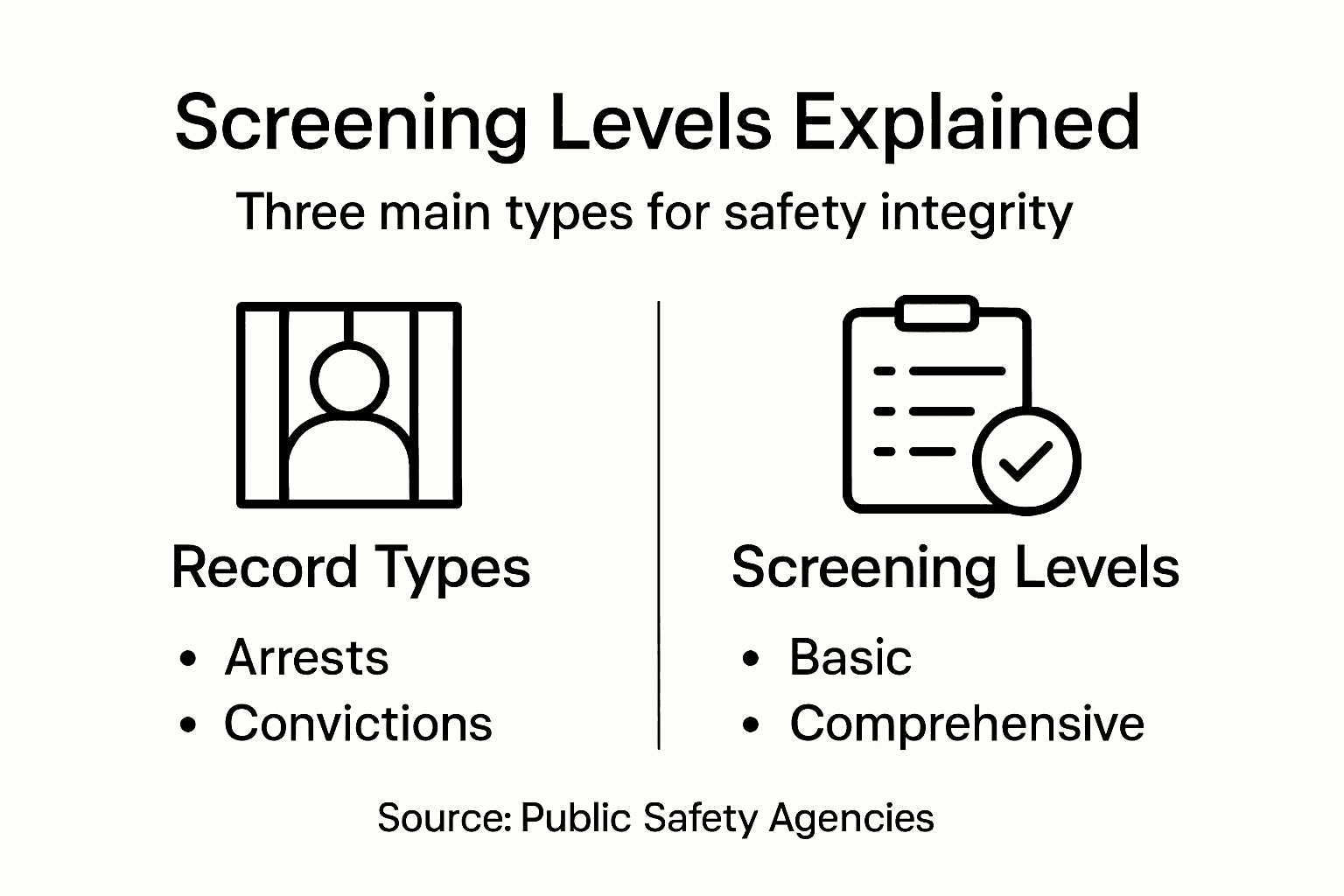
The screening levels can be categorized into three primary tiers: basic, comprehensive, and specialized screening. Basic screenings typically involve state-level criminal record checks, while comprehensive screenings incorporate national database searches, fingerprint identification, and cross-jurisdictional verification. Specialized screenings, often required for high-security positions like law enforcement or government roles, involve additional layers of investigation, including federal background checks and in-depth personal history reviews.
Below is a comparison of the three main levels of criminal record screening and their typical scope:
| Screening Level | Jurisdictional Scope | Common Methods | Suitable Roles |
| Basic | State only | State records check | Entry-level positions |
| Comprehensive | State & national | Fingerprints, database search | Education, healthcare, safety |
| Specialized | State, national, federal | Federal checks, in-depth review | Law enforcement, security clearance |
Pro tip: Request multilevel background checks that include state, national, and federal records to ensure the most thorough candidate evaluation possible.
Criminal Record Search Process Explained
The criminal record search process involves a systematic approach to retrieving and verifying an individual’s legal history through multiple governmental channels. This intricate investigation typically begins with submitting detailed personal identification information, including full legal name, date of birth, and fingerprint records to facilitate comprehensive background checks.
Public safety agencies conduct criminal record searches across three primary jurisdictional levels: local, state, and federal. Local searches involve county court records and municipal police department databases, while state-level investigations compile comprehensive criminal histories from statewide repositories. Federal-level searches, managed by agencies like the FBI, provide the most extensive background information, including national criminal databases and specialized screening mechanisms.

The search process requires multiple verification steps, including identity confirmation, fingerprint analysis, and cross-referencing information across different governmental systems. Authorized agencies can access detailed records that include arrest histories, court dispositions, sentencing information, and potential ongoing legal proceedings. Each level of search provides increasingly detailed insights, allowing organizations to make informed decisions about candidate suitability for sensitive public safety positions.
Pro tip: Request signed authorization from candidates before initiating background checks to ensure legal compliance and maintain transparent hiring practices.
Legal Requirements and Regulatory Compliance
Legal requirements for criminal record screening are complex and multifaceted, governed by a comprehensive framework of federal and state regulations designed to protect both public safety and individual privacy rights. Federal laws and statutes establish critical guidelines that mandate how criminal background information can be collected, accessed, and utilized by public safety agencies and employers.
The Fair Credit Reporting Act (FCRA) and Equal Employment Opportunity Commission (EEOC) regulations form the cornerstone of legal compliance in background screening processes. These regulations require employers to obtain explicit written consent from candidates, provide transparent adverse action notifications, and ensure that screening practices do not discriminate based on protected characteristics such as race, gender, age, or national origin. Public safety organizations must navigate these requirements carefully to maintain legal integrity while conducting thorough background investigations.
Compliance involves multiple critical steps, including proper documentation, consent management, and adherence to specific procedural requirements. Agencies must implement robust protocols that verify the accuracy of criminal records, protect individual privacy, and ensure that background checks are conducted uniformly and without bias. This includes maintaining strict confidentiality, using only verified sources of information, and following precise legal standards for record retention and use.
Here is a summary of key regulatory requirements and their organizational impact:
| Requirement | Legal Basis | Impact on Organizations | Compliance Challenge |
| Written candidate consent | FCRA | Protects rights, avoids lawsuits | Tracking authorizations |
| Non-discriminatory screening | EEOC | Ensures fairness in hiring | Bias prevention, documentation |
| Secure handling of records | State/Federal Law | Maintains privacy and trust | Data security, retention rules |
Pro tip: Develop a standardized, written background screening policy that explicitly outlines your compliance procedures and is reviewed annually by legal professionals.
Risks, Liabilities, and Best Practices
Criminal record screening presents complex organizational risks that extend far beyond simple background investigations. Criminal record data accuracy represents a critical challenge, with potential consequences ranging from negligent hiring lawsuits to perpetuating systemic employment barriers for individuals with prior legal histories.
Organizational liabilities emerge through multiple potential pathways, including discriminatory screening practices, failure to follow proper consent protocols, and improper handling of sensitive personal information. Public safety agencies must develop nuanced screening approaches that balance comprehensive risk assessment with individual fairness, avoiding blanket disqualification policies that could exclude otherwise qualified candidates based on outdated or contextually irrelevant criminal records.
Best practices in criminal record screening demand a sophisticated, multifaceted approach. This includes implementing robust verification processes, maintaining transparent evaluation criteria, providing mechanisms for candidates to contest inaccurate information, and developing evidence-based assessment frameworks that consider rehabilitation potential and individual circumstances. Organizations should prioritize individualized assessments that examine the nature and relevance of past legal incidents to current employment requirements, rather than relying on simplistic, binary acceptance or rejection models.
Pro tip: Develop a comprehensive screening matrix that weighs criminal history factors contextually, allowing for individual circumstances and demonstrating rehabilitation potential.
Strengthen Your Public Safety Hiring with Trusted Criminal Record Screening
Ensuring integrity and reliability in public safety personnel requires a precise and thorough criminal record screening process that addresses the challenges of data accuracy, legal compliance, and risk mitigation outlined in this article. If your agency faces the pressure of balancing comprehensive background investigations with speed and transparency, OMNI Intel offers tailored solutions designed specifically for public safety agencies. Our platform leverages AI-driven tools and law enforcement investigation principles to deliver accurate, multi-jurisdictional screening while supporting fair hiring practices and ongoing employee monitoring.
Discover how to integrate advanced background screening into your hiring strategy without compromise. Avoid costly mistakes and reduce recruitment timelines by using a system built to uphold privacy, security, and compliance with federal and state laws. For guidance on establishing effective hiring protocols, explore Hiring Best Practices | OMNI Intel.
Take action now to protect your agency’s reputation and ensure community safety through reliable candidate evaluation. Visit OMNI Intel to learn how comprehensive screening solutions empower you to hire with confidence and maintain workforce integrity.
Frequently Asked Questions
What is criminal record screening?
Criminal record screening is a process that evaluates an individual’s criminal history, encompassing data such as arrests, charges, legal dispositions, and convictions, to ensure public safety when hiring for sensitive positions.
Why is it important to conduct criminal record screenings?
Conducting criminal record screenings helps protect community welfare by ensuring that only qualified and trustworthy individuals are hired for positions that require integrity and responsibility.
What are the different levels of criminal record screening?
Criminal record screening can be categorized into three levels: basic (state-only checks), comprehensive (state and national checks with fingerprints), and specialized (including federal checks, often for high-security roles).
What legal requirements must organizations follow when conducting screenings?
Organizations must comply with legal regulations such as obtaining written consent from candidates, ensuring non-discriminatory practices, and securely handling sensitive records to protect individual privacy rights.
Recommended
- Avoid Hiring Risks: Master Pre-Employment Background Investigations for Public Safety Professionals • OMNI Intel
- Why Employment Screening for Government Employees Is Crucial Now • OMNI Intel
- What the National Decertification Index Means for You Now • OMNI Intel
- OMNIScreen™ | Public Safety Background Investigations for Agencies