
Why Pre-Employment Vetting Matters for Public Safety
Every law enforcement agency relies on personnel whose integrity and commitment define public trust. Yet, hiring for critical roles brings real challenges. Effective pre-employment vetting goes far beyond checking resumes. It involves a systematic screening process that examines criminal history, employment credentials, and personal reliability, creating a strong barrier against organizational risk. This article explores steps and standards that help American agencies safeguard both their communities and reputation.
Table of Contents
- Defining Pre-Employment Vetting For Agencies
- Types Of Vetting In Public Safety Roles
- Key Steps In Effective Vetting Processes
- Legal Standards And Compliance Obligations
- Mitigating Risks, Costs, And Agency Liability
Key Takeaways
| Point | Details |
|---|---|
| Comprehensive Screening | Pre-employment vetting includes criminal checks, reference validation, and psychological assessments to ensure candidate suitability for public safety roles. |
| Legal Compliance | Agencies must adhere to regulations like the Fair Credit Reporting Act and Title VII to protect candidate rights while conducting thorough investigations. |
| Continuous Monitoring | Implementing periodic assessments helps agencies proactively identify risks and maintain high standards of conduct throughout an employee’s career. |
| Risk Mitigation Strategy | Effective vetting minimizes organizational risks, preventing potential misconduct and reducing liability costs associated with hiring unsuitable candidates. |
Defining Pre-Employment Vetting for Agencies
Pre-employment vetting represents a systematic screening process designed to evaluate potential candidates’ backgrounds, qualifications, and suitability for public safety roles. This critical procedure goes far beyond basic resume verification, serving as a comprehensive risk mitigation strategy for law enforcement, fire departments, emergency services, and government agencies.
At its core, pre-employment vetting involves several key components:
- Criminal background checks to identify potential legal issues
- Employment history verification to confirm professional credentials
- Reference checks to validate candidate character and performance
- Professional credential authentication to ensure legitimate qualifications
- Psychological assessments to evaluate emotional and mental fitness
Background investigations represent more than administrative paperwork. Pre-employment screening requirements involve complex legal and ethical considerations designed to protect both organizational integrity and public safety. These investigations help agencies identify potential risks before hiring, preventing unsuitable candidates from entering sensitive professional environments.
The screening process typically requires comprehensive documentation and adherence to strict legal standards. Legal compliance with background check regulations mandates obtaining candidate consent, applying screening criteria consistently, and following federal guidelines like the Fair Credit Reporting Act (FCRA). Agencies must balance thorough investigation with candidate privacy rights, creating a nuanced approach to personnel selection.
Pro tip: Develop standardized vetting protocols that can be consistently applied across all candidate evaluations to ensure fairness and legal compliance.
Types of Vetting in Public Safety Roles
Public safety roles demand sophisticated and multi-layered vetting approaches that go beyond standard employment screening. Personnel vetting processes require nuanced strategies tailored to specific organizational risk profiles and job responsibilities, ensuring comprehensive candidate evaluation across multiple dimensions.
The primary types of vetting in public safety environments include:
- Background investigations examining criminal history
- Security clearance evaluations for sensitive positions
- Financial responsibility checks
- Psychological fitness assessments
- Continuous monitoring programs
- Professional credential verification
Each vetting type serves a unique purpose in mitigating organizational risks. Suitability investigations focus on identifying potential behavioral red flags that might compromise an individual’s ability to perform critical public safety functions. These assessments examine factors like past disciplinary actions, moral character, emotional stability, and demonstrated professional reliability.
Continuous vetting represents an advanced approach in modern public safety hiring. Unlike traditional one-time background checks, this method involves ongoing monitoring of personnel through periodic screenings, ensuring that employees maintain the highest standards of professional conduct throughout their careers. This dynamic process allows agencies to proactively identify potential risks and address them before they escalate into significant organizational challenges.
Here’s how different types of vetting in public safety roles address organizational needs:
| Vetting Type | Primary Focus | Typical Frequency |
|---|---|---|
| Background investigation | Criminal history review | Once, during hiring |
| Security clearance evaluation | Access to sensitive data | Periodic, role-dependent |
| Financial responsibility check | Debt and financial risk | During hiring and updates |
| Psychological fitness assessment | Emotional stability | Hiring and as needed |
| Continuous monitoring | Ongoing performance risks | Regularly after hiring |
Pro tip: Develop a comprehensive, multi-tiered vetting strategy that combines initial screening with periodic reassessments to maintain personnel integrity.
Key Steps in Effective Vetting Processes
Navigating the complex landscape of public safety personnel screening requires a systematic and comprehensive approach. Personnel vetting processes demand meticulous attention to detail and a structured methodology that goes beyond surface-level background checks.
The core steps in an effective vetting process include:
- Information collection from multiple authoritative sources
- Criminal background verification
- Employment history review
- Reference validation
- Financial responsibility assessment
- Professional credential authentication
- Psychological fitness evaluation
Initial screening begins with comprehensive information gathering. Vetting documentation requirements emphasize the critical nature of collecting accurate, verifiable data from multiple sources. Agencies must develop robust systems that cross-reference information, looking for potential discrepancies or red flags that might indicate reliability issues or potential risks to organizational safety.
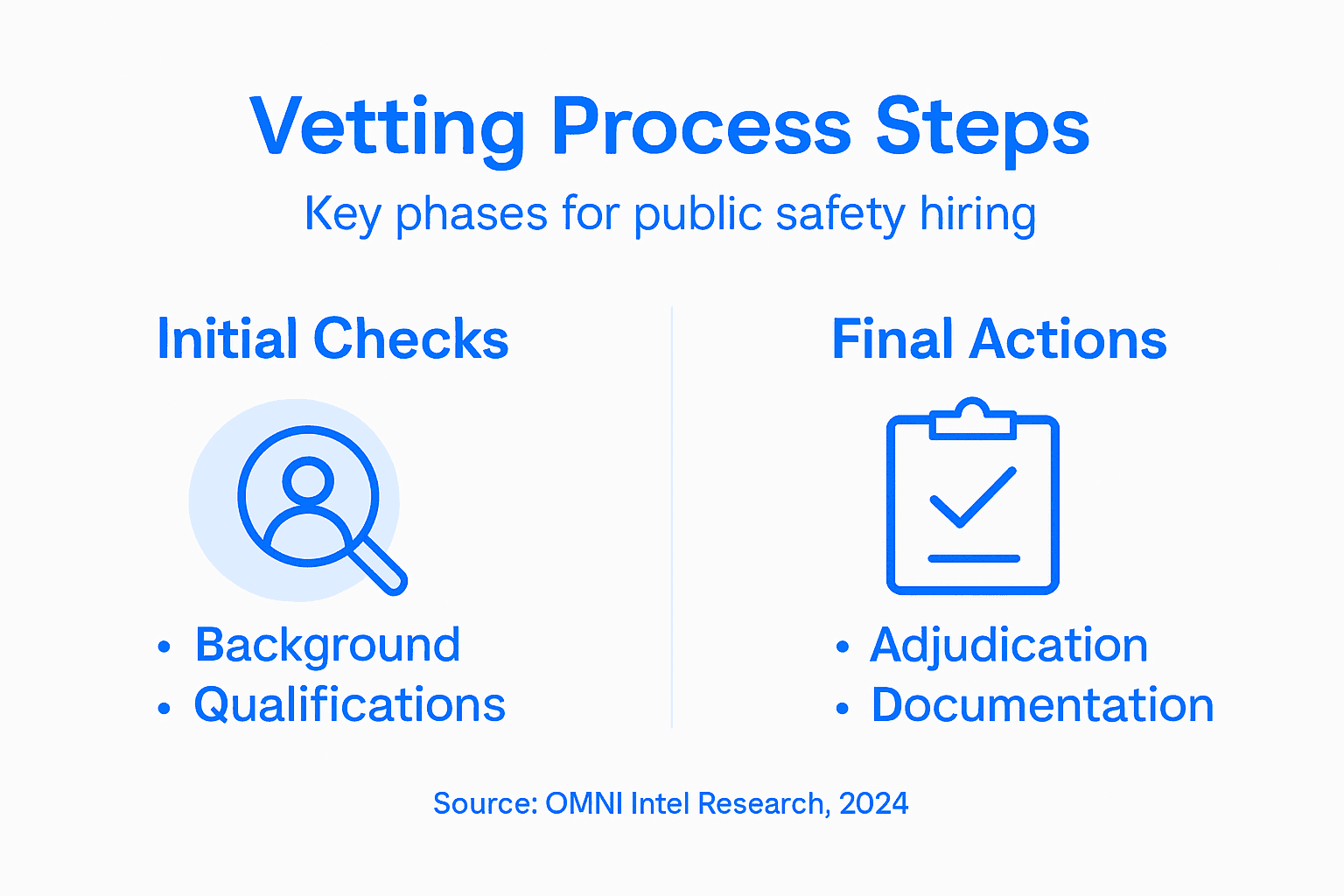
The adjudication process represents the most critical phase of personnel vetting. Trained investigators carefully evaluate collected information against established standards, considering not just individual incidents but patterns of behavior that might compromise an individual’s ability to perform critical public safety functions. This comprehensive approach allows agencies to make informed decisions that protect both organizational integrity and public safety.
Pro tip: Create a standardized scorecard that objectively evaluates candidate information across multiple dimensions to ensure consistent and fair vetting assessments.
Legal Standards and Compliance Obligations
Public safety agencies must navigate a complex landscape of legal requirements that govern pre-employment screening. Pre-employment screening laws establish critical boundaries that protect both organizational interests and individual rights, requiring a delicate balance between thorough investigation and legal compliance.
Key legal standards for public safety vetting include:
- Fair Credit Reporting Act (FCRA) requirements
- Title VII anti-discrimination protections
- Ban the Box legislation
- Privacy protection regulations
- State-specific background check restrictions
- Whistleblower protection guidelines
- Equal Employment Opportunity Commission (EEOC) standards
Consent and disclosure represent fundamental legal obligations in the screening process. Agencies must obtain written authorization from candidates before conducting background investigations, provide clear disclosures about the scope of checks, and ensure that all screening practices remain transparent and non-discriminatory. Failure to follow these protocols can result in significant legal vulnerabilities and potential litigation.
Federal personnel vetting regulations mandate comprehensive documentation and legally justifiable decision-making processes. Public safety organizations must develop robust adjudication frameworks that can withstand legal scrutiny, ensuring that every screening decision is supported by objective criteria and maintains both organizational safety and individual privacy rights.
Below is a summary of legal standards and their effects on agency screening processes:
| Legal Standard | Main Requirement | Impact on Agencies |
|---|---|---|
| FCRA | Written consent, fairness | Structured reporting, candidate rights |
| Title VII | Non-discrimination | Consistent, bias-free criteria |
| Ban the Box | Delay criminal history inquiry | Promotes fair initial evaluation |
| Privacy regulations | Data protection | Secure record keeping |
| EEOC guidance | Equal opportunity | Transparent decision processes |
Pro tip: Develop a standardized legal compliance checklist that documents each step of the vetting process to protect against potential legal challenges.
Mitigating Risks, Costs, and Agency Liability
Comprehensive pre-employment vetting serves as a critical defensive mechanism for public safety agencies, protecting against potentially catastrophic organizational risks. Background screening strategies represent a proactive approach to identifying and mitigating potential threats before they can compromise agency operations.
Key risk mitigation strategies include:
- Identifying potential employee misconduct indicators
- Preventing negligent hiring scenarios
- Reducing workplace violence potential
- Protecting organizational reputation
- Minimizing financial liability exposure
- Ensuring candidate reliability and trustworthiness
- Maintaining high professional standards
The financial implications of inadequate screening can be substantial. Public safety agencies face potential costs associated with employee misconduct, including legal expenses, reputational damage, potential civil litigation, and indirect productivity losses. A single poorly vetted employee can expose an organization to millions of dollars in potential liability, making comprehensive background investigations a critical investment in organizational risk management.

Continuous monitoring represents an advanced risk mitigation strategy that extends beyond initial hiring screenings. By implementing ongoing assessment protocols, agencies can proactively identify emerging behavioral risks, track potential performance issues, and maintain a consistently high standard of personnel integrity throughout an employee’s tenure.
Pro tip: Develop a comprehensive risk scoring model that quantifies potential employee risks across multiple behavioral and professional dimensions.
Strengthen Your Public Safety Hiring with Trusted Vetting Solutions
Pre-employment vetting is essential to protecting public safety agencies from costly hiring risks and ensuring only the most qualified, trustworthy candidates are selected. This article highlights common challenges such as legal compliance, continuous monitoring, and comprehensive background checks to prevent negligent hiring. If you want to reduce risk, cut hiring costs, and maintain integrity across your agency, embracing proven best practices is critical.
Hiring Best Practices | OMNI Intel offers strategic insights that align perfectly with these vital vetting standards.

Take control of your recruitment process today by leveraging OMNI Intel’s tailored background screening platform built specifically for public safety agencies. Benefit from AI-driven candidate vetting, integration with your hiring tools, and ongoing employee monitoring that safeguards your organization’s reputation and community trust. Act now to transform your hiring with compliant, thorough, and efficient vetting solutions at https://omniintel.co/get-started.
Frequently Asked Questions
What is pre-employment vetting?
Pre-employment vetting is a systematic screening process that evaluates potential candidates’ backgrounds, qualifications, and suitability for public safety roles. It includes criminal background checks, employment history verification, reference checks, psychological assessments, and more.
Why is pre-employment vetting important for public safety agencies?
Pre-employment vetting is crucial for public safety agencies as it helps identify potential risks and unsuitable candidates before they are hired, ensuring organizational integrity and protecting public safety.
What are the different types of vetting used in public safety roles?
The primary types of vetting include background investigations, security clearance evaluations, financial responsibility checks, psychological fitness assessments, and continuous monitoring programs.
How can agencies ensure legal compliance in the vetting process?
Agencies can ensure legal compliance by obtaining written consent from candidates, following the Fair Credit Reporting Act (FCRA), adhering to anti-discrimination laws, and maintaining transparency throughout the screening process.
Recommended
- Avoid Hiring Risks: Master Pre-Employment Background Investigations for Public Safety Professionals • OMNI Intel
- Background Investigation Insights | OMNI Intel
- Why Employment Screening for Government Employees Is Crucial Now • OMNI Intel
- Struggling with Post Employment Background Verification? Here’s the Fix • OMNI Intel