

Avoid Mistakes Before Offer: Police Reference Checks for Public Safety
A defensible police reference check combines mandatory records checks (fingerprints, criminal history, driving records) with structured interviews of supervisors, co-workers, and developed references, all documented under FCRA and EEOC constraints. Agencies that skip developed references or ask disability-related questions before a conditional offer create legal exposure and weaker hires. The fastest fix is a written checklist modeled on POST guidance, supported by a platform like OMNI Intel that builds compliance into the workflow.
TL;DR:
- Reference interviews must be behavior-based, with verified details and immediate documentation to ensure accuracy and legal compliance.
- Checks require signed consent, and disability-related questions are prohibited until a conditional offer is made, to avoid EEOC violations.
- Files should include all records, interview summaries, and authorizations, retained for multiple years to withstand audits and legal scrutiny.
- Red flags like undisclosed terminations or repeated infractions must be carefully documented, with escalation procedures for adverse findings.
- Automating the process with platforms like OMNI Intel integrates checks into workflows, reduces errors, and supports post-hire monitoring for ongoing compliance.
Table of Contents
- Core Components of a Police Reference Check
- Legal and Procedural Compliance Checklist
- How to Run Reference Interviews and Investigations
- Documentation Standards and Retention
- Decision Framework and Red Flags
- Handling Discrepancies and Appeals
- Timeline Expectations for Police Reference Checks
- Integrating Police Reference Checks Into Hiring Systems
- Training and Qualifications for Reference Check Staff
- Investigator Perspective: Mistakes to Avoid
- How OMNI Intel Operationalizes This Checklist
- Sources
- FAQ
Core Components of a Police Reference Check
A public safety background investigation is not one check. It is a layered set of records reviews and human interviews, each catching something the others miss. Miss one layer and you inherit its blind spot.
The California POST Background Investigation Manual lists the required elements for peace officer candidates, and most agencies extend the same framework to fire, EMS, dispatch, and security roles with minor adjustments. Build your checklist around these categories:
- Identity and records verification: DOJ/FBI fingerprint returns, criminal history, and confirmation the candidate is who they claim to be.
- Driving records: DMV history where the role involves vehicle operation, weighted separately since a clean criminal record can still hide a pattern of reckless driving.
- Employment and education verification: confirm dates, titles, reasons for separation, and degree completion directly with the institution, not the candidate’s summary.
- Reference interviews: supervisors first (they saw performance under pressure), then co-workers (they saw daily conduct), then secondary or developed references the candidate did not list.
- Open-source review: lawful social media checks, scoped narrowly and documented consistently across every candidate to avoid disparate treatment.
- Psychological screening inputs: fed into the file after clinical evaluation, never used to justify pre-offer inquiries by investigators themselves.
Every one of these checks needs a signed consent and authorization on file before you run it. The Minnesota POST Background Investigation and Hiring Checklist treats this as a gating step, not paperwork to backfill later. A breakdown of the seven check types public safety agencies rely on shows how these categories map onto sworn versus non-sworn roles.
Legal and Procedural Compliance Checklist
Timing is where most agencies get into trouble, not the checks themselves. The line that matters most is the conditional offer.
Before a conditional offer, EEOC guidance prohibits disability-related inquiries of the applicant and of third parties you contact, including references and former supervisors. That means your interview questions cannot probe medical history, prior workers’ compensation claims, or fitness-for-duty concerns until the candidate has a conditional offer in hand. Investigators sometimes phrase a question carelessly (“Was there ever a medical issue affecting attendance?”) and unintentionally cross this line with a reference who has no idea they’re triggering exposure for the agency.
Run through this sequence for every candidate file:
- Confirm written authorization is signed before any consumer-report-style check begins, per FCRA disclosure requirements.
- Screen your interview question bank for disability-related language and strip it out before pre-offer contact.
- Complete fingerprinting and the minimum investigative elements your state POST mandates.
- If a check leads to potential adverse action, follow FCRA’s pre-adverse and adverse-action notice sequence before finalizing a rejection.
- Log the identity of every reference contacted, with date, method, and a written summary of the conversation.
One compliance detail that trips up smaller agencies: POST guidance in multiple states requires you to be prepared to furnish investigation records to other authorized agencies on request, which means your file has to be complete enough to stand on its own outside your building. Review FCRA compliance requirements specific to public safety HR before you finalize your consent forms.
How to Run Reference Interviews and Investigations
A reference call that produces a one-word “he was fine” answer wasted everyone’s time. The difference between a useless reference check and a revealing one is almost always in how the investigator opens and follows up.
- Prepare first. Verify the reference’s identity and relationship to the candidate before the call. Confirm dates and role against what the candidate listed.
- Open with verification, not opinion. Confirm employment dates, title, and supervisory relationship before asking anything evaluative.
- Ask behavior-based questions. Instead of “Was he honest?” ask “Describe a time this candidate had to report a mistake to a supervisor. What happened?”
- Probe for specifics. A vague positive answer deserves a follow-up: “Can you give me an example?” Vague answers that resist follow-up are themselves a data point.
- Corroborate. If two references describe the same incident differently, that discrepancy goes in the file, not in the trash.
- Document immediately. Write the summary the same day, while the tone and details are fresh.
Sample question themes that work across law enforcement, fire, EMS, and dispatch roles: integrity (“Tell me about a time this candidate faced a choice between the easy answer and the honest one”), decision-making under stress, judgment around use of force or de-escalation for sworn roles, reliability and attendance patterns, and any history of bias complaints or disciplinary incidents.
Developed references, meaning contacts the candidate did not list but who know them through the workplace, often surface conduct concerns primary references omit. The POST manual’s own guidance on this point is blunt: a candidate’s chosen references are rarely going to volunteer the worst story.
Pro Tip: Ask every reference the same closing question: “Is there anyone else I should talk to who worked closely with this person?” That single line is how you build your developed-reference list without ever announcing that’s what you’re doing.
For social media review, document your search parameters and apply them identically to every candidate. A partner resource on social media investigation practices covers evidence-handling discipline worth borrowing, even though it was written for a different jurisdiction’s legal context.
Documentation Standards and Retention
An investigation file that cannot survive an audit is not really an investigation, it is a liability with a candidate’s name on it.
Your file should contain, at minimum:
- Signed authorization and consent forms for every check performed.
- The candidate’s personal history statement, in their own words.
- Identity verification records and any government-issued ID copies retained per policy.
- Written summaries of every reference contact, including the identity of the contact.
- Retrieved records: fingerprint returns, DMV printouts, employment and education confirmations.
- Psychological screening inputs, stored separately with restricted access.
Retention windows vary by state and agency policy, but multi-year retention is the norm for background files given how often they resurface in audits, litigation, or lateral-transfer requests from other agencies. Keep originals or certified copies, not photocopies of photocopies, and index files so a specific record can be pulled in minutes rather than hours. An investigator role overview walks through how investigators structure files to stay audit-ready without adding administrative overhead.
Decision Framework and Red Flags
Not every negative finding should end a candidacy, and not every clean file should end the scrutiny. You need a consistent way to weigh what you find.
A simple weighting model looks at five factors: recency (a disciplinary issue from twelve years ago carries less weight than one from last year), severity, corroboration (one source versus three independent sources describing the same pattern), impartiality of the source, and relevance to the specific role. Score bands can be as simple as three tiers: clear to proceed, investigate further, or disqualify pending review.
Red flags that should trigger deeper investigation include falsified employment or education history, undisclosed discipline or a termination for cause the candidate omitted, repeated driving infractions for roles requiring vehicle operation, and any Brady or Giglio disclosure history for sworn candidates. Seattle Fire’s published hiring process is a useful public example: negative findings are evaluated case-by-case rather than triggering automatic disqualification, and some agencies use point systems for driving-record infractions rather than a flat pass/fail cutoff.
| Red Flag | Typical Response |
|---|---|
| Falsified history on application | Disqualify, document evidence |
| Undisclosed termination for cause | Investigate further, allow candidate response |
| Repeated driving infractions (driver role) | Score against point system, weigh recency |
| Brady/Giglio disclosure | Escalate to command review |
Whatever framework you use, document your mitigation reasoning and give the candidate a chance to respond before any adverse action, consistent with FCRA’s notice requirements. A guide to recruitment warning signs breaks down how to spot these patterns earlier in the funnel, before they reach the final file review.
Handling Discrepancies and Appeals
Discrepancies between references, or between a reference and the candidate’s own account, are not failures of the process. They are the process working.
When two sources describe an incident differently, document both accounts verbatim rather than picking the one that fits your preferred narrative. Go back to the candidate with the specific discrepancy and give them a chance to explain, in writing if possible. Their response, or lack of one, becomes part of the file.
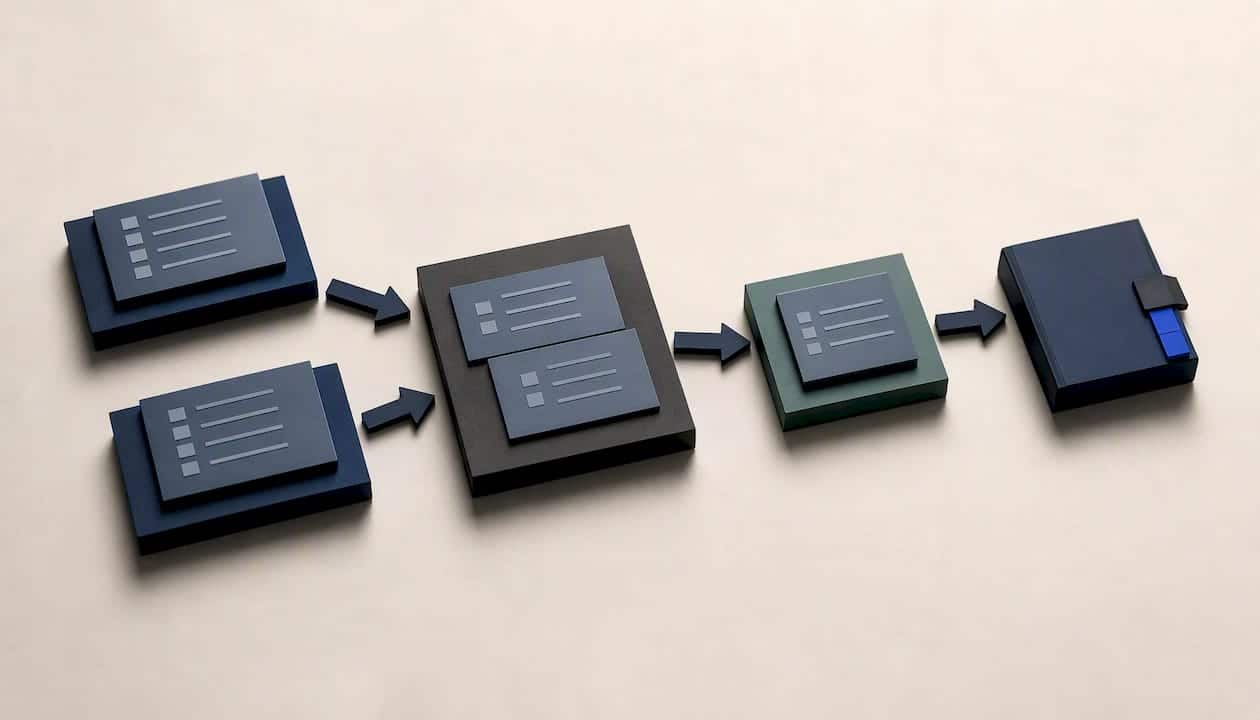
Appeals typically arise when a candidate disputes a finding used in an adverse decision. Under FCRA, if a consumer-report-style check contributed to the decision, you already owe the candidate a pre-adverse action notice and a copy of the report before finalizing anything, which gives them a built-in opportunity to dispute inaccurate information with the reporting source. Internal agency appeals processes, separate from FCRA notices, should specify who reviews a disputed finding, what new evidence can be submitted, and a firm timeline for resolution, typically five to ten business days.
The agencies that handle this well treat discrepancy resolution as a documented sub-process, not an ad hoc conversation between a hiring manager and a frustrated candidate. Write down who has final authority to overturn an investigator’s recommendation, and require that reversal to include a written rationale in the file. Without that structure, appeals become inconsistent from one candidate to the next, and inconsistency is exactly what turns a defensible process into a discrimination claim.
Timeline Expectations for Police Reference Checks
Candidates and command staff both want to know one thing: how long will this take? The honest answer depends on how many reference layers you run and how responsive your sources are.
A streamlined process covering fingerprint returns, criminal and driving records, employment and education verification, and three to five reference interviews typically runs two to four weeks for a cooperative candidate with easily reachable references. Add developed references, out-of-state record requests, or a candidate with multiple prior employers, and the timeline stretches to six weeks or more. Sworn law enforcement roles, where POST-mandated elements and polygraph or psychological evaluations stack on top of the reference process, commonly take multiple weeks end to end.
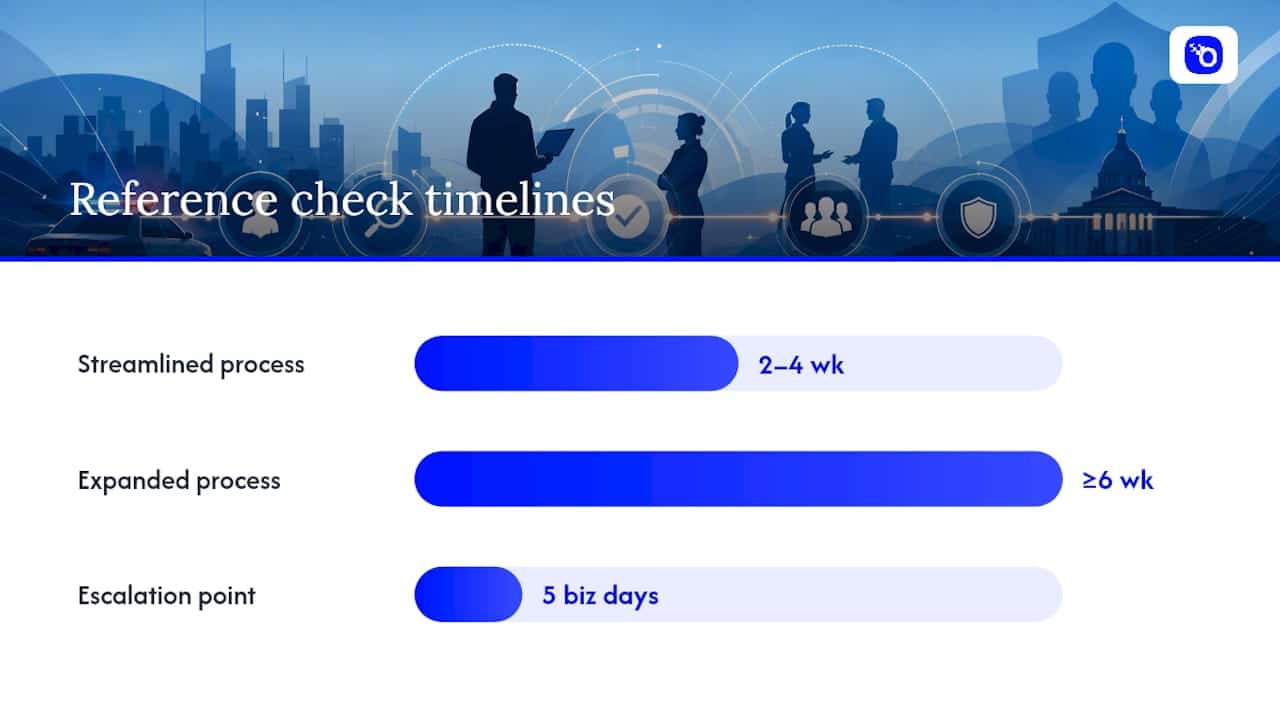
The biggest timeline killer is not the records checks, it is reference nonresponse. A supervisor who does not return three phone calls can stall a file for a week by themselves. Build in a standard escalation: if a primary reference has not responded within five business days, move to a developed reference from the same era of employment rather than waiting indefinitely.
Set candidate expectations early and in writing. A written timeline reduces the number of “just checking in” calls your investigators field, and it gives your agency a documented benchmark to point to if a candidate later claims the process dragged unreasonably. Building a few days of buffer into any quoted timeline, rather than promising the fastest possible outcome, protects your credibility when a reference goes quiet or a records request hits a backlog.
Integrating Police Reference Checks Into Hiring Systems
A reference check that lives in a separate spreadsheet from your applicant tracking system is a reference check that gets lost the moment someone goes on leave.
The strongest integration pattern connects three systems: your applicant tracking system for candidate flow, your investigation workbench for reference contacts and record checks, and your post-hire monitoring system for anything that surfaces after the candidate becomes an employee. When these three are disconnected, agencies routinely lose the thread between “what we found in the background check” and “what we’re watching for after hire,” which defeats the purpose of screening in the first place.
Practical integration steps that work regardless of your current tech stack:
- Trigger the background investigation automatically at the conditional-offer stage in your applicant tracking system, rather than relying on a manual handoff.
- Route reference contact logs and record retrievals into one file per candidate, accessible to both HR and the assigned investigator.
- Flag any red flag findings for command or HR review before the file closes, with a clear escalation owner.
- Carry relevant background findings forward into post-hire monitoring so an ongoing concern (a driving infraction pattern, a lapsed certification) does not have to be rediscovered from scratch.
Agencies running paper files or disconnected spreadsheets tend to repeat the same verification work at multiple stages because nobody can quickly confirm what was already checked. A connected system, where investigators and HR see the same file in real time, cuts that duplication and shortens the overall timeline discussed above.
Training and Qualifications for Reference Check Staff
Not every HR generalist is equipped to run a defensible reference interview for a public safety role, and pretending otherwise is how agencies end up with thin files.
Staff conducting reference checks need training in three areas: legal boundaries (what EEOC and FCRA permit at each hiring stage), interview technique (behavior-based questioning that elicits specifics rather than character summaries), and documentation discipline (writing a summary that would make sense to someone reading the file two years later with no context). Many agencies model this training directly on the POST Background Investigation Manual’s sample questionnaires, using them as a training script before investigators build their own.
Supervisors overseeing the process need a working knowledge of adverse-action procedures under FCRA, since a mishandled notice sequence can undo an otherwise solid investigation. They also need enough judgment to recognize when a file needs escalation, such as a Brady or Giglio disclosure, rather than letting a junior investigator make that call alone.
Smaller agencies without a dedicated background investigator often assign this work to an HR generalist stretched across a dozen other duties. That is workable if the agency provides structured training and a checklist to follow, but it breaks down fast without either. Cross-training at least two staff members on the full process, not just one, prevents a single absence from stalling every open file in the pipeline.
Investigator Perspective: Mistakes to Avoid
The single most common failure I see in agency background files is thin secondary reference coverage. Investigators call the two references the candidate listed, get pleasant but generic answers, and close the file. That’s not an investigation, it’s a formality with a signature on it.
The second failure is documentation written too late and too thin. A summary jotted three days after the call, from memory, is worth far less than one written the same afternoon. The third, and most legally dangerous, is a pre-offer question that wanders into medical or disability territory because the investigator was improvising instead of working from an approved script.
The fix for all three is the same: build the checklist once, train every investigator on it, and stop treating reference checks as a box to check rather than the part of the process most likely to surface what records alone cannot.
— Matt
How OMNI Intel Operationalizes This Checklist
Building every piece of this checklist by hand, spreadsheet by spreadsheet, is exactly the gap OMNI Intel was built to close for public safety agencies specifically, not general HR departments retrofitting a police process. OMNI Intel bakes FCRA disclosure and authorization steps into the workflow itself, so a consent form can’t be skipped or backdated, and it gives investigators a structured workbench for logging reference contacts, developed references, and written summaries the same day a call happens.

The platform’s continuous monitoring carries background findings forward into post-hire tracking, so a driving infraction pattern or a lapsed certification doesn’t have to be rediscovered from scratch years later. It also integrates directly with applicant tracking systems, which means the handoff from conditional offer to background investigation happens automatically instead of through a manual email chain. That reflects the same law enforcement investigation principles the POST manual encodes, applied through software built for agencies rather than adapted from generic corporate screening tools.
If your current process still lives across three disconnected spreadsheets, start with OMNI Intel’s pre-employment screening services built specifically for public safety hiring, and request a look at how the investigator workbench handles your next candidate file.
Sources
Most agencies contact at least one supervisor, one co-worker, and one or more developed references not listed by the candidate, since developed references frequently surface conduct concerns primary references omit.
- Pre-Employment Inquiries and Disability | U.S. Equal Employment Opportunity Commission
- Background Investigation Manual | California POST
- Background Investigation and Hiring Checklist | Minnesota POST
- Seattle Fire Hiring process and background checks
FAQ
What Is a Police Reference Check?
A police reference check is a structured investigation of a public safety candidate’s history through supervisors, co-workers, and developed references combined with mandatory records checks like fingerprints and driving history, to verify integrity and fitness for the role.
How Do You Obtain Police Reference Checks Legally?
Agencies obtain them by securing signed FCRA authorization, running required POST-mandated records checks, and conducting reference interviews that avoid disability-related questions until after a conditional offer, per EEOC guidance.
What Is the Police Vetting Process?
The police vetting process combines identity verification, criminal and driving records checks, employment and education confirmation, and structured reference interviews, documented in a file that can withstand a compliance audit.
How Long Should Background Investigation Files Be Retained?
Retention windows vary by state and agency policy, but multi-year retention is standard practice given how often background files resurface in audits or lateral-transfer requests from other agencies.
Can OMNI Intel Help Automate These Checks?
Yes. OMNI Intel builds FCRA compliance, investigator documentation, and continuous post-hire monitoring into one platform designed specifically for law enforcement, fire, EMS, and other public safety agencies.