
Avoid Arbitration: 3 Steps to U.S. Firefighter Drug Testing Compliance
Yes, most U.S. fire departments test firefighters through a combination of pre-employment, random, reasonable suspicion, and post-incident screening. Federal DOT rules only apply where a CDL is federally required, so state law and collective bargaining agreements typically govern enforcement. Certified laboratories, split-specimen protocols, and Medical Review Officer review remain the operational backbone that keeps any positive result legally defensible.
TL;DR:
- Urine remains the most common specimen type because it detects a broad range of drugs over several days, while oral fluid provides recent use detection and hair testing is mainly useful for pre-employment screening.
- All specimen collections must be conducted through certified labs, split-specimen protocols retained, and reviewed by a Medical Review Officer to ensure legal defensibility of positive results.
- Federal drug testing rules apply only to employees with a federal CDL requirement, meaning many fire departments are governed solely by state law and collective bargaining agreements.
- Enforceable policies should clearly define prohibited conduct, testing triggers, disciplinary actions, and include documented procedures for prescription medications and rehabilitation pathways.
- Random testing is lawful for safety-sensitive roles if clearly authorized by policy and CBA, but DOT requirements only apply to employees with a CDL, not all firefighters.
Table of Contents
- What a Firefighter Drug Testing Program Actually Includes
- Which Specimen Type Should Your Department Require?
- Do Federal Rules Apply to Your Fire Department?
- How to Structure a Defensible Drug Testing Policy
- How Collection and Confirmation Actually Work
- Implementation Checklist for Hiring Managers and Policy Authors
- Balancing Enforcement, Rehabilitation, and Retention
- How OMNI Intel Supports Compliant Screening Programs
- Sources
- FAQ
What a Firefighter Drug Testing Program Actually Includes
A complete program relies on four distinct testing triggers, each doing different work. Pre-employment screening keeps unqualified candidates out before they touch equipment or patients. Random testing, drawn from a fixed pool at unannounced intervals, deters ongoing use in a job where impairment can kill a crew. Reasonable suspicion testing kicks in when a supervisor observes specific, documented behavior, slurred speech, erratic driving, visible impairment. Post-incident testing follows a crash, injury, or near miss involving safety-sensitive duties.
The IAFC’s position on drug and alcohol-free awareness recommends departments adopt written procedures covering all four categories, with periodic testing built into safety-sensitive roles rather than treated as an afterthought.
Departments typically structure the program around:
- Pre-employment screening tied to a conditional job offer
- Random selection pulled from a computer-generated, unannounced pool
- Reasonable suspicion testing triggered by supervisor observation and documentation
- Post-incident testing following injuries, apparatus accidents, or critical events
Which Specimen Type Should Your Department Require?
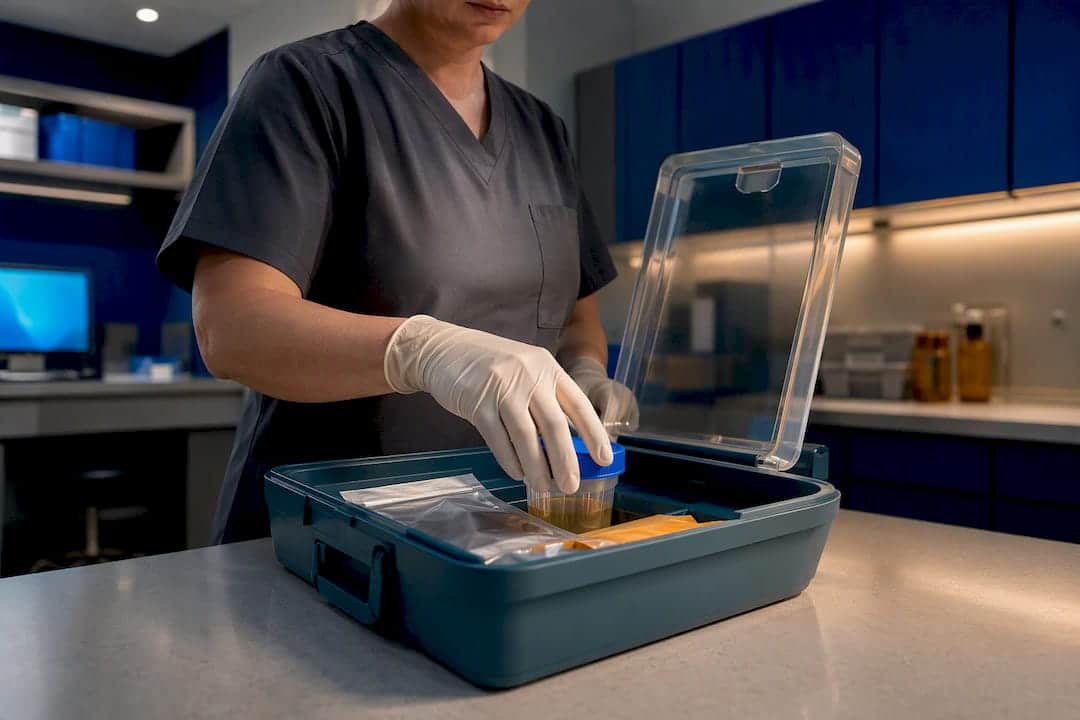
Urine remains the default for most fire department drug screening because it is well studied, court tested, and detects a broad drug panel over several days. Oral fluid has gained ground for post-incident and reasonable suspicion testing because collection is directly observed, harder to adulterate, and reflects very recent use rather than a use window stretching back days. Hair testing detects a longer history, often 90 days, which makes it useful for pre-employment screening but far less useful for confirming a same-shift impairment.
HHS/SAMHSA data point: the HHS Mandatory Guidelines have authorized oral fluid as a permitted specimen type in federal workplace programs since 2020, alongside urine.
Every specimen collected under a defensible program needs three safeguards:
- Collection and testing through a laboratory holding current NLCP certification
- A split specimen retained for independent retesting if a donor disputes a result
- Mandatory review by a Medical Review Officer before any positive is reported to the department
Skipping the MRO step is the fastest way to turn a legitimate result into a grievance. The MRO exists specifically to rule out legal prescriptions and lab error before anyone faces discipline.
Do Federal Rules Apply to Your Fire Department?
Federal law does not blanket every fire department the way many hiring managers assume. FMCSA guidance on part 382 limits DOT testing requirements to employees required to hold a commercial driver’s license under federal law. If your state does not mandate a CDL for apparatus operators, DOT’s part 382 testing regime may simply not apply, leaving your department’s own policy and state law as the operative framework.
State marijuana legalization complicates that framework further. Pew Research found that most Americans now live in a state with legal recreational or medical marijuana, which means a positive THC result no longer automatically signals unlawful conduct off duty. Departments can still lawfully enforce zero-tolerance rules for safety-sensitive positions, but only when policy language and the collective bargaining agreement explicitly classify a positive test as a policy violation independent of the substance’s legal status in that state.
Build enforceable language around these principles:
- Define impairment and prohibited conduct separately from state criminal law
- State explicitly that safety-sensitive duty status, not off-duty legality, governs enforcement
- Negotiate CBA language that names testing as a condition of continued safety-sensitive assignment
Vague or silent CBA language is the single biggest liability gap departments carry into arbitration.
How to Structure a Defensible Drug Testing Policy
A policy that survives legal challenge covers specific ground, not general intentions. The WSFCA sample drug and alcohol policy guideline and resources like PowerDMS’s fire department policy guidance both point to the same core structure.
- Definitions and scope naming covered substances, covered personnel (career, volunteer, part-time), and safety-sensitive roles.
- Prohibited conduct, including a 0.0 BAC standard while on duty and explicit prescription medication reporting requirements.
- Testing triggers and specimen protocol matching the categories and specimen types described above.
- Disciplinary ladder distinguishing a first confirmed positive from repeat violations or refusal to test.
- Appeal and retest rights, including access to the split specimen.
- Rehabilitation and return-to-duty pathway, with a defined follow-up testing cadence, typically unannounced testing for a set period after reinstatement.
Pro Tip: Require medical documentation for any prescription that could impair duty performance rather than relying on self-certification. Self-certified exemptions are the clause most often exploited in grievance hearings.
Policies aligned with CFAI accreditation standards tend to hold up better under scrutiny because they force the documentation discipline accreditation already demands.
How Collection and Confirmation Actually Work
Vendor selection determines whether your program holds up under challenge. Confirm NLCP or HHS lab certification, ask about turnaround time, and verify the lab supports split-specimen collection and gives your MRO direct access to raw data, not just summarized results.
- Collection staff document specimen temperature, seal integrity, and donor identification at the point of collection
- Chain-of-custody forms travel with the specimen through transport, lab intake, and testing
- A non-negative screen goes to gas chromatography-mass spectrometry confirmation before anyone is notified
- The MRO contacts the donor directly to rule out a legitimate medical explanation before reporting a verified positive
- Confirmed positives trigger the disciplinary ladder, a referral to treatment, and a scheduled follow-up testing period
One caution worth building into every policy: OSHA guidance warns that post-incident testing applied in a way that punishes injury reporting can trigger anti-retaliation violations. Write post-incident triggers around objective criteria, not around whether an employee filed an injury report.
Implementation Checklist for Hiring Managers and Policy Authors
Standing up or auditing a program comes down to three phases.
- Pre-adoption: review the policy against your CBA, draft or update written procedures, contract with a certified lab and MRO, and issue applicant notices before testing begins.
- Operational: build the random-testing pool, train supervisors to document reasonable suspicion observations, standardize chain-of-custody templates, and line up a rehabilitation referral vendor.
- Governance: set an annual policy review cadence, define record retention timelines, and connect testing data with your broader background check and monitoring process.
Balancing Enforcement, Rehabilitation, and Retention
The hardest calls I see departments face aren’t the clear-cut positives. They’re the volunteer who tests positive for marijuana legal in that state, or the medic on a legitimate opioid prescription flagged by an automated screen. Good policy treats these as documentation problems, not character judgments. Keep the safety rationale explicit, apply the same standard to every rank, and build rehabilitation into the ladder instead of treating every positive as a termination event.
— Matt
How OMNI Intel Supports Compliant Screening Programs
Building a defensible testing program takes more than a policy document. It takes clean documentation at every handoff, from applicant notice through MRO review to post-hire monitoring, and that’s where most departments actually lose ground during an audit or a grievance.

OMNI Intel is the alternative to piecing together your own vendor stack for fire and EMS screening. Instead of managing a lab contract, an MRO relationship, and a background investigation process as three separate vendors, OMNI Intel builds FCRA-compliant pre-employment screening tailored to fire and EMS roles into a single system, with post-hire monitoring that keeps your documentation trail intact if a policy ever gets challenged. That means less administrative scrambling when an arbitrator asks for chain-of-custody records from eighteen months ago. If your department is drafting or auditing its screening program this year, start by reviewing your fire and EMS screening options with OMNI Intel.
This article is general information, not a substitute for advice from a qualified lawyer. Consult a qualified legal professional about your own circumstances before acting on anything here.
Sources
- IAFC position: Drug and Alcohol-Free Awareness
- SAMHSA: Drug-Free Workplace FAQs and Mandatory Guidelines
- FMCSA guidance on part 382 applicability to firefighters
- WSFCA sample drug and alcohol policy guideline
FAQ
Is Random Drug Testing Legal for Firefighters?
Yes, random testing for safety-sensitive fire department roles is generally lawful when written policy and, where applicable, the collective bargaining agreement clearly authorize it.
Does DOT Require Drug Testing for All Firefighters?
No. FMCSA’s part 382 testing requirements only apply to employees required to hold a CDL under federal law, so many firefighters fall outside DOT’s testing mandate entirely.
Can a Firefighter Be Fired for a Marijuana Prescription in a Legal State?
Departments can generally still enforce zero-tolerance rules for safety-sensitive duty even where marijuana is legal, provided the policy and CBA language explicitly classify a positive result as a violation regardless of state legality.
What Happens After a Confirmed Positive Drug Test?
A confirmed positive typically triggers Medical Review Officer notification, a disciplinary process defined by the department’s policy, a referral to treatment, and a scheduled period of follow-up testing before return to full duty.