
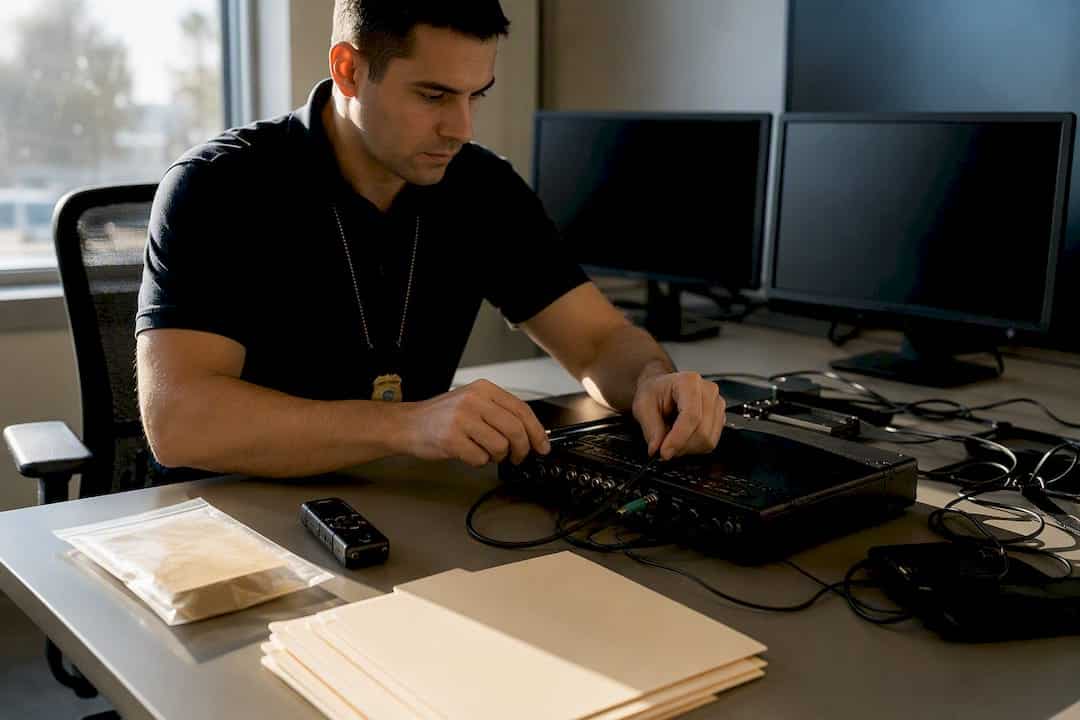
U.S. Police Applicants: MMPI, ADA Timing, and the Psychological Exam
The police psychological exam is a post-offer medical evaluation, typically a battery of validated personality tests, a review of your personal history, and a clinical interview, used to confirm psychological fitness for duty. It happens after you receive a conditional job offer, not before. Your best move is simple: answer honestly, gather your medical and treatment documentation ahead of time, and understand your appeal rights before you walk in.
TL;DR:
- Most disqualifications result from patterns of concern across multiple sources, not a single test failure or isolated issue.
- Agencies rely on at least two validated psychological tests, background review, and a clinical interview to assess suitability, with variations by state and department.
- Honest, well-documented responses about employment gaps, treatment history, and past incidents improve chances of passing, especially when clarifying flagged areas.
- Psychological evaluations occur only after a conditional offer, as required by the ADA, to protect applicants from discrimination before qualifying for the role.
- Thorough, standardized background data supported by integrated reports helps agencies make defensible decisions and reduces the risk of later appeals.
Table of Contents
- What The Psychological Evaluation Includes: Tests, Interview, And Background Data
- Legal Timing And Your Protections Under The ADA
- Common Tests Used And What They Measure
- The Clinical Interview And How Data Gets Integrated
- How Results Are Interpreted And Why Candidates Get Disqualified
- How To Prepare Honestly For Your Exam
- If You Fail: Appeals And Next Steps
- OMNI Intel’s Agency-Side View On Defensible Screening
- How Exam Procedures Differ Across Police Agencies
- Confidentiality And Data Privacy In The Evaluation Process
- Why Psychological Fitness Affects Officer Safety And Performance
- Common Myths About The Police Psychological Exam
- Editorial Take: What Applicants Actually Need To Prioritize
- How OMNI Intel Helps Agencies Build A Defensible Hiring Process
- Sources
- FAQ
What The Psychological Evaluation Includes: Tests, Interview, And Background Data
A compliant evaluation pulls from three separate sources, and no single one carries the whole decision. The IACP’s preemployment psychological evaluation guidelines call for written testing, personal history review, and a face-to-face interview, integrated by a qualified evaluator, not treated as three separate checkboxes.
Here’s what each source typically contributes:
- Written psychological tests measure personality traits, psychopathology indicators, and response consistency through standardized, validated instruments.
- Background and personal-history data comes largely from your background investigator: driving records, employment history, criminal history, and any prior discipline summaries.
- The clinical interview lets a licensed psychologist ask about anything that stood out on paper, from a gap in employment to a pattern in your driving record.
Some agencies also use a biodata inventory, a structured questionnaire covering financial stability, relationship history, and prior job conduct, which gives the psychologist context that a personality test alone can’t capture.
Legal Timing And Your Protections Under The ADA
Federal law dictates exactly when this exam can happen, and agencies that skip the sequence expose themselves to liability. Under the Americans with Disabilities Act, psychological evaluations count as medical examinations, which means they can only occur after a conditional offer of employment.
This isn’t bureaucratic caution. It protects you from being screened out based on a disability before an agency has even evaluated your qualifications, and it preserves your right to request reasonable accommodation during the process.
- Pre-offer stage: agencies may use non-medical personality assessments tied strictly to job-relevant traits, not diagnostic psychological testing.
- Post-offer stage: full psychological/medical evaluation, including clinical interviews and diagnostic-capable instruments, becomes legally permissible.
- Practical effect: if you’re asked to complete a psychological battery before receiving a conditional offer, that’s a red flag worth raising with HR or an employment discrimination attorney.
Common Tests Used And What They Measure
Most agencies rely on a small set of well-studied instruments rather than inventing their own. The MMPI family, specifically the MMPI-2-RF and the newer MMPI-3, dominates this space because it indexes abnormal-range indicators like paranoia, impulsivity, and substance-related risk with decades of validation behind it.
For police candidates specifically, many psychologists use the MMPI-2-RF Police Candidate Interpretive Report, which adds police-specific comparison data so your scores are measured against other candidates in the field, not the general population.
- MMPI-2-RF / MMPI-3: flags abnormal-range psychopathology and personality risk factors.
- CPI (California Psychological Inventory): measures normal-range traits tied to job performance, like social poise and responsibility.
- IPI (Inwald Personality Inventory): built specifically for law enforcement, screening for traits linked to on-the-job problems.
- Cognitive and situational-judgment tests: occasionally added to assess decision-making under pressure.
Every one of these instruments carries built-in validity scales designed to catch inconsistent or coached responding, so overreporting problems or underreporting them both show up as flags. State POST manuals, including California’s, generally require at least two validated tests plus a semi-structured interview before a psychologist can render an opinion.
Pro Tip: Don’t try to guess what a “good” answer looks like. Validity scales on the MMPI-2-RF are specifically built to catch pattern-matching, and inconsistent responses often raise more concern than an honest, slightly imperfect answer ever would.
The Clinical Interview And How Data Gets Integrated
The interview isn’t a formality tacked onto the end of testing. It’s where the psychologist reconciles what the tests suggested with what your background file shows and what you say in the room.
- Test clarification. The psychologist asks about any elevated scale, giving you a chance to provide context a number can’t capture.
- Stress and coping history. Expect direct questions about how you’ve handled pressure, conflict, and setbacks in past roles.
- Substance and employment history. Gaps, terminations, or disciplinary actions in your file typically come up here first.
- Interpersonal functioning. How you describe relationships with supervisors and coworkers matters as much as what the file says.
A single abnormal scale rarely disqualifies anyone on its own. Psychologists look for convergence, meaning the same concern showing up in the test data, the background file, and your own account, before it becomes the basis for an adverse finding.
How Results Are Interpreted And Why Candidates Get Disqualified
Disqualification is almost never a one-factor decision. A study of 653 candidate evaluations found that adverse recommendations most often cited convergent concerns across multiple sources rather than a single failed test.
The same research identified specific patterns that showed up repeatedly in disqualifying files:
- Problematic employment history, particularly repeated terminations or unexplained gaps.
- Concerning driving records, especially patterns suggesting impulsivity or poor judgment.
- Validity concerns on testing, including evidence of deliberate underreporting or overreporting.
- Safety-related psychopathology indicators that showed up consistently across test and interview data.
Evaluators are generally screening for job-relevant psychological suitability, not handing out clinical diagnoses, according to guidance summarized by researchers reviewing police selection practices. That distinction matters for how you frame your own history.
Pro Tip: If you have one area of legitimate concern, don’t panic and don’t hide it. Candidates with a single flagged area frequently remain eligible when they provide clarifying documentation and evidence of remediation up front.
How To Prepare Honestly For Your Exam
Preparation here doesn’t mean gaming the test. It means showing up organized, consistent, and ready to explain your history in plain terms.
- Document your mental health history. If you’ve received treatment, gather dates, provider names, medications, and outcomes. Bring records if the agency or an appeal process requests them.
- Run a full-length practice test under time pressure. Familiarity with pacing prevents rushed, inconsistent answers, which validity scales are built to catch. This is about format comfort, not coaching your responses.
- Build a factual interview narrative. For any red-flag item, whether it’s a past DUI or a rocky employment stretch, prepare a short, factual account that emphasizes what changed and how you’ve functioned since.
- Treat the morning of the exam like a shift, not a test. Take prescribed medications as directed, get a full night’s sleep, and arrive early.
- Expect direct questions and answer them directly. Vague or defensive answers about a flagged item read worse than a calm, specific explanation ever will.
Validity scales on modern instruments like the MMPI-2-RF make deliberate “faking good” easier to detect than most candidates assume. Honest, consistent answers tend to produce better long-term outcomes than any attempt to manage the impression you’re making.
If You Fail: Appeals And Next Steps
An adverse recommendation isn’t automatically the end of the process. Start by reading your agency’s disqualification notice line by line. Many jurisdictions build in specific appeal procedures and deadlines, and missing a deadline can forfeit your right to challenge the finding at all.
- Request a second-opinion evaluation if your jurisdiction permits it, which many do.
- Gather objective supporting evidence: medical records, provider letters, and documented proof of rehabilitation or stability since any flagged incident.
- Consult an employment law resource if you believe the evaluation ran afoul of ADA protections.
- Understand that outcomes vary. Some appeals reverse the original finding; others uphold it, and results depend heavily on agency policy and your specific case file.
OMNI Intel’s Agency-Side View On Defensible Screening
Agencies don’t build psychological evaluations in a vacuum. They lean on background data to corroborate what a test or interview suggests, and the quality of that data determines how defensible the final hiring decision is.
- OMNI Intel supplies the integrated background information, including driving, employment, and criminal history, that psychologists rely on to check test findings and interview claims against documented fact.
- Standardized documentation and clear evidence chains reduce ambiguity in suitability decisions, which matters when a disqualification gets appealed months later.
- Agencies using consolidated background investigation workflows can produce a cleaner audit trail if a candidate challenges the process.
For applicants, the takeaway is simple: your background file is more thorough than you might expect, and inconsistencies between what you disclose and what’s documented are exactly what convergent-evidence models are built to catch.
How Exam Procedures Differ Across Police Agencies
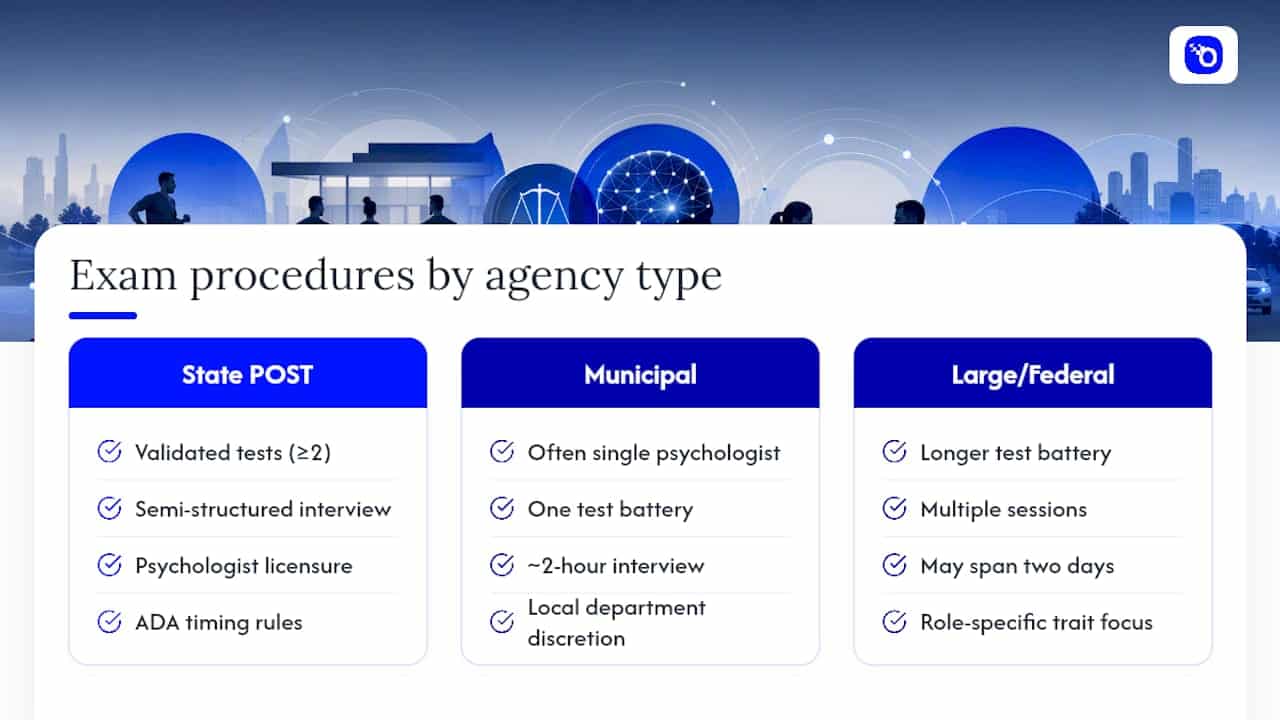
There’s no single national standard for the police psychological exam, and that surprises a lot of first-time applicants. Every state sets its own baseline through its POST commission (Peace Officer Standards and Training), and individual agencies can add requirements on top of that floor.
California’s POST manual, for instance, mandates at least two validated tests and a semi-structured interview, along with specific psychologist licensure and documentation standards. Other states set lighter minimums, and some leave more discretion to individual departments. A small municipal department might contract a single psychologist for a two-hour interview and one test battery. A large metropolitan agency or a state patrol might run a longer battery across multiple sessions, sometimes over two separate days.
Federal agencies, sheriff’s offices, and municipal police departments also weigh different job-relevant traits depending on the role. A tactical unit might emphasize stress tolerance and impulse control more heavily than a records or dispatch-adjacent position would. Agencies serving communities with specific risk profiles, high-density urban policing versus rural patrol, sometimes adjust which behavioral traits get the closest scrutiny during the interview phase.
What stays consistent, regardless of jurisdiction, is the underlying legal framework. Every agency operating in the U.S. has to observe ADA timing rules and generally follows the three-source model the IACP guidelines recommend, even when the specific tests and session length vary. If you’re applying to multiple agencies, expect the legal guardrails to look the same everywhere and the operational details, test length, number of sessions, specific instruments, to shift from one department to the next.
Confidentiality And Data Privacy In The Evaluation Process
Your psychological evaluation results don’t become public record, and they aren’t shared casually within the hiring agency either. Most state guidelines, including New York’s Municipal Police Training Council standards, require informed consent before testing begins, along with clear disclosure of who will see the results and why.

That typically means your raw test data and interview notes stay with the evaluating psychologist and a narrow set of hiring decision makers, usually a background unit supervisor or hiring committee, rather than circulating through the entire department. The psychologist’s report generally states a recommendation (suitable, not suitable, or conditional) rather than a full diagnostic writeup, which limits how much clinical detail gets shared with non-clinical staff.
Retention rules vary by state and agency, but most jurisdictions require evaluation records to be kept for a defined period and stored separately from general personnel files, precisely because the material qualifies as medical information under the ADA. That separation matters if you ever need to request your own records for an appeal.
One practical concern applicants raise often: does a disqualification from one agency follow you to the next? Generally, no. Each agency conducts its own independent evaluation, and psychological findings from a prior application aren’t automatically shared between departments unless you disclose that history yourself or a specific information-sharing agreement exists. That said, always answer background history questions honestly. Undisclosed prior applications or terminations discovered later create far bigger validity concerns than a disclosed one ever would.
Why Psychological Fitness Affects Officer Safety And Performance
The screening exists because the job carries real, well-documented risk, both to officers and to the public they serve. Split-second decision-making under stress, sustained exposure to trauma, and unpredictable confrontations put a premium on stable judgment that a resume alone can’t verify.
Officers who struggle with impulse control or unmanaged stress responses face elevated risk in use-of-force encounters, a concern that shows up directly in why agencies weigh CPI and IPI scores tied to impulsivity and stress tolerance so heavily. Poor coping mechanisms under chronic stress also correlate with higher rates of burnout, which in turn affects decision quality on patrol and interactions with the community an officer is sworn to protect.
This isn’t abstract risk management. An officer who can’t regulate stress responses under pressure is more likely to escalate a routine stop, mishandle a domestic violence call, or make a use-of-force decision that damages both public trust and their own career. Screening for these traits before deployment, rather than discovering them after an incident, is the entire rationale behind the three-source evaluation model.
It cuts the other way too. Candidates dismissed as “too rigid” by informal department lore often score well on measures of consistency and rule adherence, traits that matter enormously in evidence handling and use-of-force reporting accuracy. Psychological fitness isn’t about screening for a single personality type. It’s about matching job-relevant traits, stress tolerance, judgment, and interpersonal stability, to the specific demands of a role where mistakes carry outsized consequences.
Common Myths About The Police Psychological Exam
A lot of bad advice circulates about this exam, usually from candidates repeating secondhand rumors rather than reading actual POST guidance. Here’s where the myths break down against how the process actually works.
Myth: There’s a “right way” to answer test questions. Validity scales on instruments like the MMPI-2-RF are specifically engineered to catch pattern-matched or socially desirable responding. Coaching yourself toward what you think evaluators want to hear tends to produce inconsistent response patterns that raise flags rather than lower them.
Myth: Any mental health history is an automatic disqualifier. It isn’t. Evaluators generally screen for current job-relevant functioning, not lifetime diagnostic history. Documented treatment with evidence of stability and remediation often satisfies an evaluator’s concerns entirely.
Myth: One weird answer sinks your whole application. Disqualification patterns identified in the 653-case study show convergent concerns across multiple sources drive most adverse findings, not a single isolated response.
Myth: The psychologist is trying to diagnose you with a disorder. The evaluation exists to assess suitability for a specific job’s demands, not to produce a clinical diagnosis. That framing shift matters when you’re deciding how much detail to share about past struggles.
Myth: Every agency uses the exact same test. As covered above, instruments and session structure vary by state and department, even though the underlying legal timing rules stay constant everywhere in the U.S.
Editorial Take: What Applicants Actually Need To Prioritize
Most advice aimed at police applicants treats the psychological exam like a puzzle to solve, find the right answers, avoid the wrong ones, beat the test. That framing is backward, and the research on disqualification patterns makes the case clearly. Convergent evidence across tests, background, and interview drives most adverse findings, which means the test itself is rarely the vulnerability candidates think it is. Your background file is.
Where conventional advice falls short is in treating honesty as a risk to manage rather than a strategy. Candidates who document their history, treatment records, employment gaps, past incidents, and can speak to it plainly tend to fare better than candidates who hope nothing surfaces. Validity scales exist precisely because evaluators have seen every version of “managed” responding, and it rarely reads as clean as candidates hope.
If there’s one priority worth naming, it’s this: get your paperwork in order before you ever sit for testing. The candidates who struggle most aren’t the ones with a complicated history. They’re the ones who show up unprepared to explain it.
— Matt
How OMNI Intel Helps Agencies Build A Defensible Hiring Process
Everything covered above depends on one thing hiring authorities rarely talk about publicly: the quality of the background data feeding into the psychological evaluation. A psychologist can only integrate what a background investigation actually surfaces, and gaps in that data create exactly the kind of ambiguity that turns a clean hiring decision into a disputed one.

OMNI Intel builds that foundation for public safety agencies specifically, consolidating employment history, driving records, criminal history, and discipline summaries into standardized reports that psychologists and hiring committees can act on with confidence. Instead of piecing together fragmented records from multiple sources, agencies get one consistent documentation workflow that holds up when a disqualification decision gets appealed or scrutinized later.
If you’re a hiring authority looking to strengthen the background side of your psychological screening process, start with OMNI Intel’s pre-employment screening services to see how consolidated background data supports a more defensible evaluation from the first application through the final hiring decision.
This article is general information, not a substitute for advice from a qualified doctor. Consult a qualified healthcare professional about your own circumstances before acting on anything here.
Sources
- EEOC: Pre-Employment Inquiries and Disability
- Study of sources of concern in preemployment psychological evaluations
FAQ
Do Police Officers Have To Take A Psychological Test?
Yes, nearly all U.S. law enforcement agencies require a psychological evaluation as a condition of employment, typically administered after a conditional job offer under ADA requirements.
How Many People Fail The Police Psych Exam?
Failure rates vary widely by agency and aren’t tracked through a single national database, but disqualification research shows most adverse findings stem from convergent concerns across multiple data sources rather than a single test result.
What Is Asked On A Police Psychological Exam?
Expect a combination of validated personality test items (often from the MMPI-2-RF or similar instruments), background-related questions about employment, driving, and criminal history, and interview questions about stress management, substance history, and interpersonal functioning.
What Causes You To Fail A Police Psychological Evaluation?
Disqualification typically results from convergent concerns across sources, including problematic employment or driving history, validity issues suggesting inconsistent or deceptive responding, and safety-related psychopathology indicators that appear consistently across the test, interview, and background data.