
FBI Rap Back: A State-by-State Enrollment Guide for Agencies
FBI Rap Back is the notification capability inside the Next Generation Identification (NGI) system that alerts authorized agencies when someone already fingerprinted for a job, license, or investigation is later arrested, charged, or flagged in a records update. Enrollment happens through your state’s Identification Bureau, not the FBI directly, and it replaces the old cycle of resubmitting fingerprints every few years. Once enrolled, your agency needs a documented process for receiving and acting on alerts.
TL;DR:
- Enrollment is managed by the state’s Identification Bureau, not the FBI, and requires a statutory basis for each agency and individual to retain fingerprints and access criminal history records.
- Continuous comparisons and automatic alerts are triggered by specific events such as new arrests, charge updates, warrants, sex offender registry changes, and death notices, but some notifications only provide a trigger without full record details.
- Agencies must follow a multi-step process including legal verification, fingerprint collection, privacy disclosures, setting up subscription controls, and appointing a process owner to ensure compliance and effective management.
- Subscription validity typically lasts from one to five years, requiring annual validation, fee management, and a clear response protocol for alerts to maintain compliance and operational readiness.
- Rap Back enhances ongoing risk detection for supervised or licensed populations, but agencies need solid SOPs, documentation, and operational workflows to ensure alerts translate into meaningful oversight.
Table of Contents
- What Fbi Rap Back Is and How It Differs From a One-Time Check
- Which Events Trigger a Rap Back Notification?
- Who Can Enroll, and Why the State ID Bureau Runs the Program
- How to Enroll Your Agency’s Population in Rap Back
- Managing the Subscription Lifecycle: Validation, Fees, and Response Time
- Criminal Justice vs. Noncriminal Rap Back: Where Each One Fits
- Building Your Agency’s Rap Back Implementation Checklist
- An Editorial Take on What Rap Back Actually Changes
- Where Rap Back Enrollment Fits Alongside Continuous Employee Monitoring
- Sources
- FAQ
What Fbi Rap Back Is and How It Differs From a One-Time Check
A standard background check is a snapshot. It tells you what shows up in someone’s record on the day you run it, and nothing after. Rap Back changes that math entirely.
The service works inside NGI by retaining civil fingerprints when the submitting agency selects that option at intake, then continuously comparing new incoming criminal or civil fingerprint transactions against that retained print. The PIA for the NGI Rap Back Service confirms this consolidates civil and criminal submissions into a single identity record rather than treating each fingerprint event as an isolated transaction.
That single design choice eliminates a recurring administrative burden for agencies:
- No need to resubmit fingerprints on a fixed cycle to catch new arrests
- One retained print supports ongoing searching against every new booking or civil submission nationwide
- Notifications arrive automatically when a match occurs, rather than requiring a manual re-check
The FBI’s NGI overview describes this as a genuine shift from periodic snapshots to continuous, real-time risk detection. For agencies managing hundreds of licensed or supervised individuals, that shift alone can justify enrollment.
Which Events Trigger a Rap Back Notification?
Not every record change generates an alert. Rap Back has a legally defined list of “triggering events” and understanding that list matters more than most agencies realize when they’re deciding what to monitor.
According to FBI CJIS guidance on Rap Back, the qualifying events include:
- New arrests, bookings, and criminal charges
- Disposition updates, including convictions, dismissals, and expungements
- Warrant issuance or recall
- Sex-offender registry changes
- Death notices
Some notifications deliver the full identity history record, while others are trigger-only alerts that simply flag that something changed and direct the subscribing agency to request the details through proper channels. That distinction matters operationally: a trigger-only notice on an active investigative subscription still requires your staff to follow up through the SIB rather than assume the alert itself satisfies documentation requirements.
Pro Tip: Build your notification-response SOP around the assumption that some alerts will arrive without full detail. Staff who expect a complete record every time will miss the follow-up step, and that gap is where compliance problems start.
Who Can Enroll, and Why the State ID Bureau Runs the Program
Agencies cannot walk up to the FBI and enroll a roster of employees. Every one of them needs a documented statutory basis to receive criminal history record information (CHRI) and retain fingerprints for continuous searching, and that authority almost always flows through state law, not federal law.

The PIA for the NGI Rap Back Service confirms the program is state-administered: your State Identification Bureau, often housed inside State Police, acts as the intermediary that submits fingerprints to NGI and enforces state-specific policy on top of federal rules. Virginia, Washington, and Oregon each run this exact model through their own CJIS offices, and the details on fees, forms, and turnaround differ by state even though the underlying NGI service is identical.
Entities that typically qualify for noncriminal Rap Back enrollment include:
- Licensing boards overseeing nurses, teachers, and childcare providers
- School districts and healthcare systems vetting staff in positions of public trust
- Law enforcement and corrections agencies supervising probationers or parolees
- Volunteer organizations working with vulnerable populations, where state statute permits
If your agency hasn’t confirmed its specific statutory authority yet, that’s the first call to make, and it should go to your state’s CJIS office before anything else.
How to Enroll Your Agency’s Population in Rap Back
Enrollment isn’t a single form. It’s a sequence of legal, technical, and administrative steps that has to happen in order, and skipping ahead tends to create rework later.
- Confirm legal authority. Work with legal counsel and your state CJIS/SIB contact to verify your agency’s statute permits fingerprint retention and CHRI access for the specific population you want to enroll.
- Collect fingerprints and request retention. Submit prints through Livescan or an approved vendor, and explicitly select retention in NGI at the time of submission. Retention isn’t automatic.
- Deliver required privacy disclosures. Individuals must receive a Privacy Act notice and a 28 CFR 50.12 disclosure covering retention and ongoing searching, with a signed acknowledgment kept on file.
- Set up subscriptions with your SIB. Choose whether to use a Unique Case Number (UCN) or Transaction Control Number (TCN), define which trigger events apply, and confirm notification format.
- Establish secure delivery and access controls. Configure a role-based, access-controlled inbox or system for staff responsible for reviewing and acting on Rap Back alerts.
Pro Tip: Assign a single named owner for the Rap Back inbox before your first subscription goes live. Alerts that sit unread for even a few days can turn a manageable disposition update into a documentation gap during an audit.
Managing the Subscription Lifecycle: Validation, Fees, and Response Time
A Rap Back subscription isn’t permanent, and treating it that way is one of the more common mistakes agencies make after their initial enrollment push.
State implementation guides describe common default expiration periods, though states set their own specific rules. The WSP Criminal Justice Rap Back Guide notes examples where investigative subscriptions default to one year while subscriptions tied to supervised populations can run five years, with annual validation required to confirm the subscription still has a legitimate basis.
Expect these recurring obligations:
- Annual validation: confirm the subject is still under supervision or employed in the qualifying role, and cancel the subscription the moment that authorization ends
- Fees: most states charge an initial enrollment fee plus an annual subscription fee, though criminal-justice subscriptions are sometimes exempt; Virginia’s Rap Back program publishes its own fee schedule as a working example
- Response protocol: on receiving a notification, confirm your continued authority, request the full identity history if permitted, or cancel the subscription if it no longer applies
- Audit readiness: maintain training records and CHRI handling logs consistent with CJIS Security Policy, since auditors will ask for them
Criminal Justice vs. Noncriminal Rap Back: Where Each One Fits
Rap Back splits into two distinct tracks, and conflating them is a fast way to trigger a compliance finding.
Criminal Justice Rap Back subscriptions are restricted to individuals under active investigation or authorized supervision, tied to a specific case number, and subject to statute-of-limitations awareness. The NGI Rap Back Criminal Justice Policy and Implementation Guide draws this line clearly: an open-ended investigative subscription with no active case attached is a misuse risk, not a gray area.
Noncriminal Rap Back covers employment, licensing, and positions of public trust:
- Probation and parole officers tracking supervised individuals for new arrests or warrant activity
- Licensing boards keeping nurses, teachers, or contractors in continuous compliance with fitness-to-serve standards
- School districts and healthcare employers monitoring staff who work directly with children or vulnerable patients
The benefit in both tracks is the same: faster detection of a disqualifying event and less administrative rescreening. The constraint is also the same. Every subscription needs a statutory basis, a documented notice to the individual, and a state policy that governs how long it can run.
Building Your Agency’s Rap Back Implementation Checklist
Most agencies that stall out on Rap Back don’t fail at the technical step. They fail at documentation, because nobody wrote down who owns which part of the process before the first fingerprint went through Livescan.
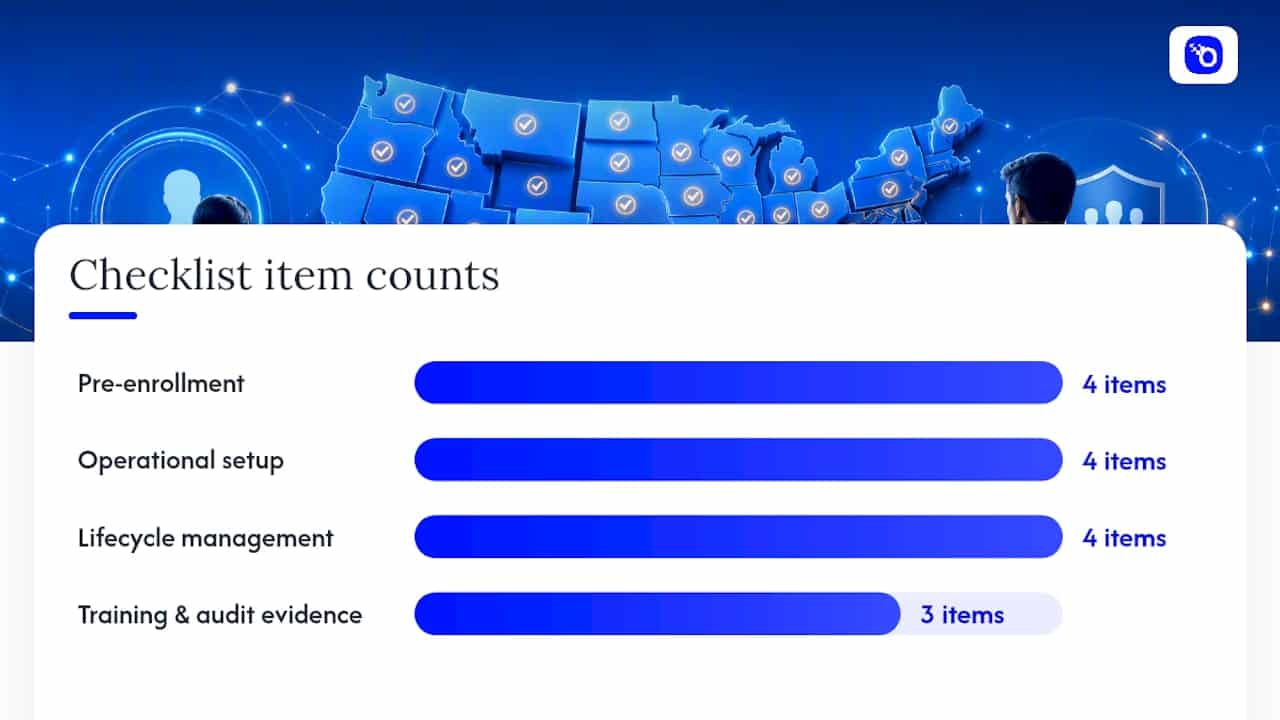
- Pre-enrollment: confirm your governing statute, draft an MOU with your SIB, secure policy sign-off, and plan your ORI and TCN structure in advance.
- Operational setup: finalize your Livescan workflow, build a roster management process, stand up a secure notification mailbox, and lock down role-based access controls.
- Lifecycle management: put a validation calendar on the books, define renewal procedures, set clear cancellation triggers, and document record retention timelines.
- Training and audit evidence: log CJIS Security Policy training completions, keep signed privacy acknowledgments on file, and maintain a change-control log for subscription updates.
Pro Tip: Treat your validation calendar as a living document, not a one-time setup task. Agencies that revisit it quarterly catch lapsed authorizations months before an annual audit forces the issue.
OMNI Intel works with agencies on the roster management and audit-documentation side of this exact workflow, helping background screening teams keep the paper trail organized once Rap Back subscriptions go live.
An Editorial Take on What Rap Back Actually Changes
Continuous notification changes the risk calculus for supervised populations and positions of public trust, because it converts background screening from a point-in-time judgment into an ongoing signal. That’s genuinely valuable. But value only shows up if an agency pairs enrollment with a written SOP and an honest privacy notice, not a rubber-stamped form nobody reads. My caution: don’t over-enroll investigative subscriptions just because the technology allows it. A subscription without an active case number is a liability wearing a compliance costume.
— Matt
Where Rap Back Enrollment Fits Alongside Continuous Employee Monitoring
Rap Back handles the notification side of continuous monitoring, but it doesn’t manage your roster, your audit trail, or the day-to-day workflow of confirming authority every time an alert lands in someone’s inbox. That operational layer is where a lot of agencies quietly fall behind, especially smaller departments without a dedicated CJIS analyst.

OMNI Intel builds continuous post-hire monitoring and background investigation workflows specifically for public safety agencies, fire and EMS departments, dispatch centers, and municipal HR teams who need to operationalize exactly the kind of notification handling Rap Back generates. The platform helps you document validation cycles, manage role-based access to sensitive alerts, and keep your training and privacy-acknowledgment records audit-ready alongside your investigative caseload. Where state enrollment is limited or your agency needs a broader screening layer beyond what Rap Back covers, OMNI Intel’s pre-employment screening services give background screening managers a single system for roster tracking and case documentation. Request a walkthrough of how the platform supports agencies managing Rap Back alerts and see where it fits into your current SOP.
Sources
- PIA: NGI Rap Back Service
- Next Generation Identification (NGI) — FBI
- Virginia Rap Back Service – Virginia State Police
FAQ
What Does Rap Back Mean in a Background Check?
Rap Back refers to the FBI’s NGI capability that keeps a fingerprint on file and automatically notifies your agency when that person is later arrested, charged, or otherwise flagged, rather than requiring a new background check each time.
How Far Back Does an FBI Rap Sheet Go?
An FBI identity history record generally reflects arrests and dispositions on file since the person’s fingerprints were first entered into the FBI’s system, which can span decades depending on when they were first fingerprinted.
What States Only Go Back 7 Years on Background Checks?
Several states cap how far back certain employer background checks can report non-conviction or older records under state fair-credit-reporting rules, but these limits apply to consumer reporting agencies, not to FBI identity history records accessed through Rap Back or CHRI channels; check your state’s specific statute before relying on a fixed number.
Where Can I Get My FBI Rap Sheet?
Individuals can request their own FBI identity history summary directly through the FBI’s Identity History Summary Checks program, which is separate from the agency-level Rap Back enrollment process described in this guide.
Does OMNI Intel Enroll Agencies in Rap Back?
OMNI Intel does not replace your State Identification Bureau’s role in Rap Back enrollment, but it supports the roster management, notification documentation, and continuous monitoring workflow agencies need once subscriptions are active.