Livescan Fingerprinting: What It Is and How to Get It Done
Live Scan fingerprinting is the electronic capture and secure transmission of your fingerprints to state and federal criminal history systems, replacing the old ink-and-card method. If an employer, licensing board, or court ordered you to complete Live Scan, your first move is simple: get the requesting agency’s Live Scan service request form and confirm the site you plan to visit is certified to submit prints electronically.
Agencies request Live Scan for a wide range of reasons:
- Employment, especially in schools, healthcare, childcare, and public safety
- Licensing, from contractor licenses to firearms permits to state professional boards
- Immigration proceedings through USCIS
- Court-ordered or volunteer screening, including nonprofit and coaching roles
California’s Department of Justice reports that about 80% of electronically submitted applicant fingerprint transactions clear within three business days, a pace that mailed ink cards rarely come close to matching. Before your appointment, verify your ID meets the requesting agency’s standard and bring the completed service request form. Showing up without it is the single most common reason applicants get turned away at the door.
Key Takeaways
Live Scan fingerprinting works because it replaces slow, error-prone ink cards with encrypted digital capture that reaches state and FBI records in days instead of weeks.
| Point | Details |
|---|---|
| Get the right form first | Obtain the requesting agency’s exact Live Scan service request form before scheduling to avoid rejection. |
| Confirm site authorization | Use your state DOJ’s location directory to verify a site is certified for electronic transmission. |
| Expect a fast appointment | Most Live Scan sessions take 10 to 15 minutes, with real-time quality checks on each print. |
| Know the fee split | Rolling fees pay the operator; separate state and FBI processing fees pay for the actual background check. |
| Track your ATI number | Keep your transaction number to check status or resolve any rejection with the requesting agency. |
| OMNI Intel supports hiring teams | OMNIScreen™ integrates Live Scan results into FCRA-compliant investigations for public safety agencies. |
Table of Contents
- What Is Livescan Fingerprinting and How Does It Differ From Ink Cards?
- Who Actually Needs a Live Scan Background Check?
- What Do You Need to Bring to a Live Scan Appointment?
- What Happens During a Live Scan Fingerprint Appointment?
- Where Can You Get Live Scan Fingerprinting Done?
- How Much Does Live Scan Cost and How Long Does It Take?
- Why Do Live Scan Prints Get Rejected and What Do You Do Next?
- What if You Live Out of State, Are a Noncitizen, or Have Damaged Fingerprints?
- Why Fingerprint Checks Matter More Than Ever in Public Safety Hiring
- Is Your Fingerprint Data Actually Safe During Live Scan?
- What Rights Do You Have as a Live Scan Applicant?
- How Do You Get Clean Prints on the First Try?
- How Does Live Scan Work for Minors or People Who Can’t Visit a Center?
- A Practical Note From Someone Who Has Watched This Process From the Hiring Side
- How OMNI Intel Turns Fingerprint Results Into Faster, Safer Hires
- Sources
- FAQ
What Is Livescan Fingerprinting and How Does It Differ From Ink Cards?
Live Scan captures your fingerprints digitally instead of rolling them in ink onto a paper card. An operator scans each finger individually, then takes flat “slap” impressions of all four fingers on each hand plus both thumbs. The system converts these images into a standardized digital file, encrypts it, and transmits it electronically to the appropriate state repository and, in most cases, the FBI.
That routing matters. Fingerprint-based checks identify a specific individual through ridge detail that cannot be faked or confused with someone else’s record. Name-based background checks, by contrast, search on identifiers like name and date of birth, which means common names, aliases, or minor data entry errors can produce false matches or missed records entirely. An employer relying on a name search alone might miss a disqualifying record filed under a slightly different spelling.
Most Live Scan submissions in the United States are searched against two systems:
- The state’s own criminal history repository (such as the California DOJ’s records)
- The FBI’s Next Generation Identification (NGI) system, which replaced the older IAFIS platform and provides automated fingerprint search capabilities across federal, state, and local records
Because the results route to two separate repositories, a single Live Scan appointment can satisfy both a state licensing requirement and a federal background check requirement at once. That is a meaningful efficiency gain over the ink-card process, which required separate mailings and manual data entry at each destination.
Who Actually Needs a Live Scan Background Check?
If you are applying for a job or license and hear the words “fingerprint clearance,” there is a good chance Live Scan is the method your state or employer uses. The requirement shows up far more often than most applicants expect, and it rarely comes with much explanation about why.
Common categories that require Live Scan include:
- Education and childcare: teachers, school staff, daycare workers, and after-school program employees
- Healthcare: nurses, home health aides, and licensed medical professionals
- Public safety: police officers, firefighters, EMTs, dispatchers, and corrections staff
- Finance and fiduciary roles: bank employees, notaries, and some insurance license holders
- Licensing boards: contractors, real estate agents, cosmetologists, and firearms permit applicants
- Immigration and legal processes: certain USCIS applications and court-ordered background checks
- Volunteers and contractors: youth sports coaches, nonprofit volunteers, and vendors with facility access
If your role involves contact with children, vulnerable adults, cash handling, firearms, or sensitive facilities, assume fingerprinting is coming and prepare early rather than scrambling once an offer is on the table.
What Do You Need to Bring to a Live Scan Appointment?
Rejections and delays almost always trace back to the same handful of preventable mistakes. Handling these five items before you walk in saves you a second trip and, in many cases, a second fee.
- Get the correct service request form from the requesting agency. Every Live Scan submission needs an agency-specific form carrying the correct originating agency identifier (ORI) code and reason for the request. A generic or outdated form is one of the fastest ways to get your submission rejected before you even sit down. Confirming the exact form and required fields with the requesting agency beforehand avoids a wasted appointment.
- Bring a valid, government-issued photo ID. A driver’s license, state ID, passport, or military ID typically works as a primary form. Some agencies require a secondary ID if your primary ID is expired or does not match the name on your application.
- Know how the fee is split and who pays what. Most Live Scan appointments involve two separate charges: the operator’s “rolling fee” for capturing your prints, and separate state and FBI processing fees set by the requesting agency’s fingerprint type. Some employers pre-pay the processing fee; others require applicants to pay everything upfront and seek reimbursement.
- Take care of your hands beforehand. Dry, cracked, or heavily calloused skin makes ridges harder to capture cleanly.
- Bring copies of your paperwork. Extra copies of your ID and service request form speed up the front-desk process, especially at busy law enforcement sites.
Pro Tip: Avoid applying lotion right before your appointment. It feels like it should help dry skin, but it actually fills in the ridge detail and increases your odds of a rejected print.
What Happens During a Live Scan Fingerprint Appointment?
Most Live Scan appointments run 10 to 15 minutes from check-in to walkout, a pace that electronic capture makes possible in a way mailed ink cards never could. Here is the sequence you can expect at nearly any certified site.
- Check-in and verification. Staff confirm your photo ID against your service request form and verify the agency code and reason for the request match.
- Payment. You pay the operator’s rolling fee, and if required, the state and FBI processing fees at this point.
- Rolled and slap prints. The operator scans each finger individually against a glass platen, then captures flat “slap” impressions of four fingers at a time on each hand, plus both thumbs.
- Real-time quality check. The Live Scan system flags smudged, incomplete, or low-contrast prints on the screen immediately, so the operator can recapture a finger on the spot rather than send a flawed submission.
- Transaction number assignment. You receive an ATI (Automated Transaction Identifier) number tied to your submission. Keep this. It is your reference point if you need to check status or resolve a rejection later.
- Signature and transmission. You sign to confirm the information is accurate, and the encrypted file transmits electronically to the state repository and, where applicable, FBI NGI.
Results route directly to the requesting agency, not to you. If your employer or licensing board hasn’t heard back within the normal window, they are the ones who follow up on your transaction, using your ATI number.
Where Can You Get Live Scan Fingerprinting Done?
The most reliable starting point is always your state’s own Department of Justice location finder, not a general web search. California’s DOJ, for example, maintains an official directory of certified Live Scan sites along with current fee schedules, and most other states run comparable directories through their own DOJ or state police agencies.
You generally have two categories of sites to choose from:
- Police and sheriff department stations, which often charge lower rolling fees and are trusted defaults, though hours can be limited and appointments may book out days in advance
- Private, third-party Live Scan vendors, which frequently offer walk-in or same-day appointments across broader location networks, usually at a higher rolling fee than a public safety agency charges
Whichever you choose, confirm the site is authorized to transmit electronically for the specific agency requesting your check. Not every certified Live Scan operator is approved for every transaction type, and local sheriff guidance consistently recommends verifying authorization and required IDs before scheduling, since using an unauthorized site can mean your results never reach the requesting agency at all.
Pro Tip: Call ahead, even if the site lists walk-in hours online. Equipment goes down, operators call in sick, and a five-minute phone call beats a wasted trip across town.
How Much Does Live Scan Cost and How Long Does It Take?
Live Scan pricing has two distinct pieces, and confusing them is why so many applicants feel blindsided by the total.
- The rolling fee goes to whoever operates the scanning equipment, whether that’s a sheriff’s department or a private vendor. This fee varies by location and typically runs higher at private third-party centers than at law enforcement sites.
- State and FBI processing fees go to the government agencies actually running your background check, and the amount depends on the type of clearance the requesting agency is authorized to request.
Turnaround times vary by system:
- State-level results often return within about three business days, and California DOJ specifically reports roughly 80% of electronic transactions clear within that window
- FBI NGI results typically take 3 to 5 business days for standard employment and licensing checks
- Mailed ink-card submissions can take weeks, since they require manual data entry at every stage instead of instant electronic transmission
If your results are taking noticeably longer than these windows, the delay usually sits with the requesting agency’s internal review process rather than the fingerprint system itself. Contact the agency’s HR or licensing office directly, and have your ATI transaction number ready. That number is what lets them trace your submission through the state and federal pipeline.
Why Do Live Scan Prints Get Rejected and What Do You Do Next?
A rejection is not a red flag on your record. It almost always means the system could not extract clean ridge detail from the print image, and it happens more often than most applicants expect.
Common causes include:
- Dry, worn, or damaged skin, particularly among manual laborers, older applicants, or anyone with worn fingertip ridges from years of physical work
- Excess moisture or sweat, which blurs ridge contrast on the platen
- Operator or equipment issues, including a platen that needs cleaning or a technician new to the system
- Poor finger placement, often correctable in the moment with pressure or angle adjustments
Before you leave the appointment, ask the operator to try adjusting pressure, finger angle, or cleaning the platen. Many rejections are fixable on the spot if you flag skin concerns before scanning begins rather than after a rejection notice arrives.
If a submission is rejected and you need to resubmit, keep the rejection notice. It documents that you already attempted the process and may qualify you for a reduced or waived fee on resubmission depending on the requesting agency’s policy. After two fingerprint-based rejections, FBI guidance allows the submitting agency to request a name-based check as a fallback, provided the agency supplies the correct transaction numbers and identity information.
What if You Live Out of State, Are a Noncitizen, or Have Damaged Fingerprints?
Nonstandard situations come up more than people assume, and each has an established path.
- Out-of-state applicants: if the requesting agency is in a state different from where you live, you may need an ink-card conversion service, since not every state’s Live Scan system communicates electronically with every other state’s repository the way in-state submissions do.
- Immigration biometrics: USCIS handles fingerprinting for immigration applications through its own Application Support Centers, which is a separate system from state Live Scan. Acceptable IDs for USCIS appointments typically include a passport, green card, or state-issued photo ID, and requirements can differ from what a state Live Scan site accepts.
- Missing or damaged fingers: operators document which fingers cannot be captured and note the condition on the transmission record. The requesting agency then reviews the file with that documentation attached rather than treating an incomplete card as a rejection.
Why Fingerprint Checks Matter More Than Ever in Public Safety Hiring
Public safety agencies cannot afford a mistaken identity slipping through a name-based search. A single misspelled alias or shared common name can let a disqualifying record pass unnoticed, and in law enforcement, fire, EMS, and dispatch hiring, that margin for error simply does not exist.
Fingerprint-based checks close that gap because ridge detail identifies one specific person, not a name that might match several people. That is why fingerprint checks now anchor most public safety hiring pipelines rather than sitting as a secondary step.
For agencies building FCRA-compliant investigation workflows, integrating Live Scan results cleanly means requiring applicants to submit the exact agency-issued service request form and tracking every submission by its ATI number until results arrive.
A background investigation is only as reliable as the identity match behind it. When agencies pair Live Scan’s fingerprint accuracy with structured, investigator-driven review, they close the gap that name-based checks alone leave open.
Is Your Fingerprint Data Actually Safe During Live Scan?
Applicants routinely ask what happens to their biometric data once it leaves the scanning platen, and it’s a fair question given how permanent a fingerprint is compared to a password.
Live Scan systems encrypt fingerprint files before transmission, and certified sites are required to follow the transmission standards set by the state repository and FBI NGI. That encryption step matters because the file travels through multiple systems, from the local operator’s terminal to the state criminal history repository and often on to the federal level, before a result returns to the requesting agency.
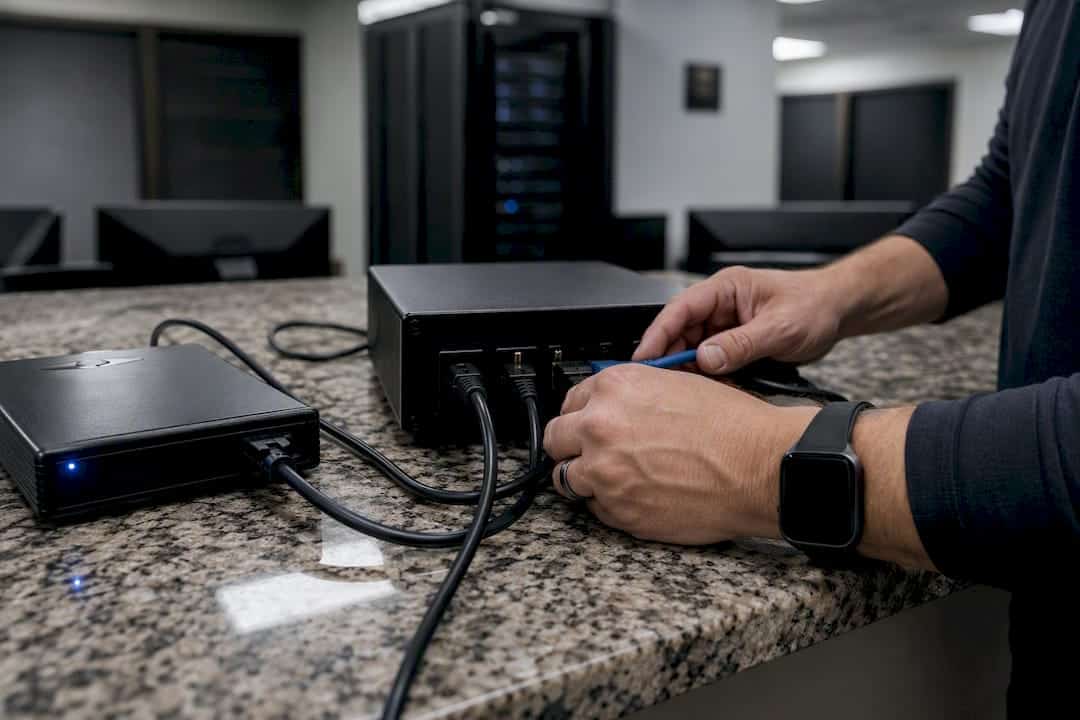
Your fingerprint data itself is not stored by the Live Scan operator after transmission in most cases. It resides in the state and federal criminal history systems, which are governed by their own data retention and access rules, separate from whatever police department or private vendor happened to capture your prints. Operators are not authorized to keep copies of your print images for their own use, and using an unauthorized or uncertified site is one of the real risks worth avoiding, since data handling and encryption standards are not guaranteed outside certified networks.
If you are concerned about where your data goes, ask the operator directly whether the site is certified for electronic transmission to your specific requesting agency. A certified site operating within state guidelines is bound to transmission and security protocols that an uncertified one may not follow.
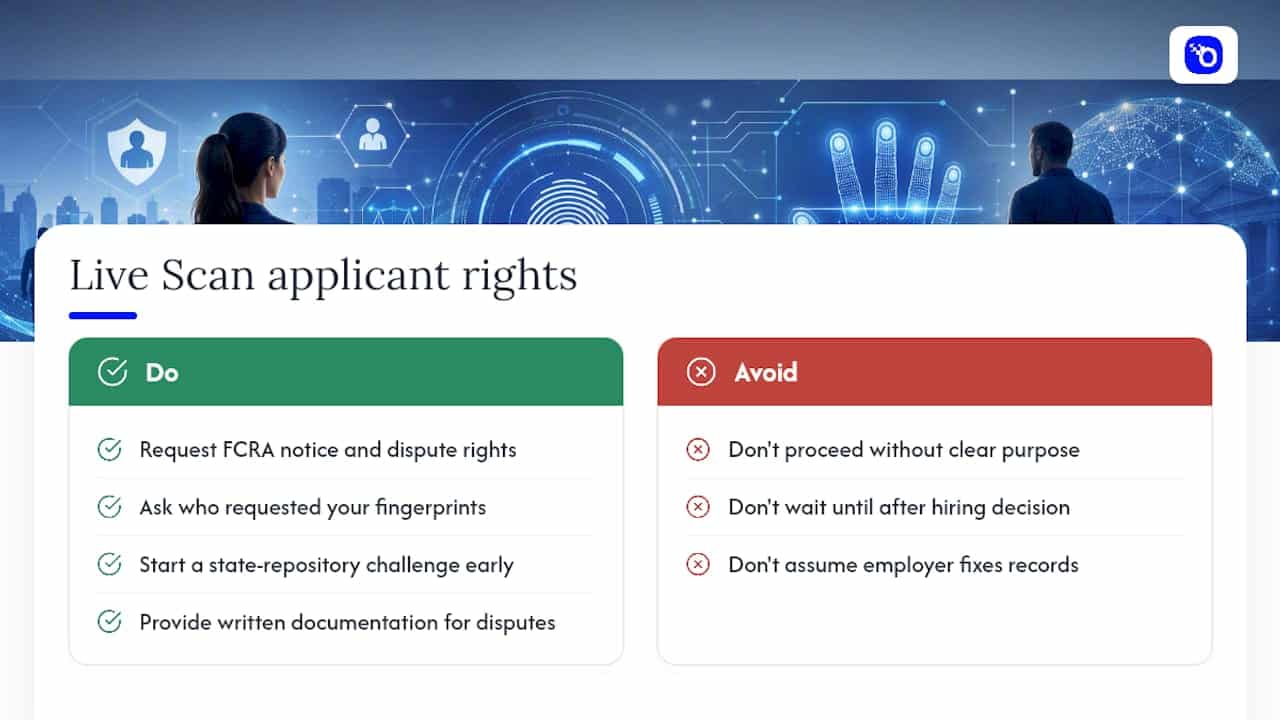
What Rights Do You Have as a Live Scan Applicant?
You have specific rights tied to how your fingerprint results get used, and most applicants never hear about them unless something goes wrong.
Under the Fair Credit Reporting Act, when fingerprint results feed into a broader background check used for employment decisions, you generally have the right to be notified if information from your record is used to deny you a position, and the right to dispute inaccurate information in your criminal history file. This applies whether the fingerprint check runs through a private employer, a licensing board, or a government agency, though the exact procedural steps vary by the type of requesting entity and state law.
You also have the right to know which agency requested your fingerprints and for what purpose, since that information appears directly on your service request form. If you are ever asked to complete Live Scan without a clear explanation of the requesting agency or reason code, that is worth questioning before you proceed, since your prints and results are tied to that specific stated purpose.
If your fingerprints come back with a record you believe is inaccurate or belongs to someone else, most states provide a formal process to challenge and correct your criminal history record through the state repository, separate from any appeal you might file with the requesting employer or licensing board. That process typically requires written documentation and can take weeks, so address it as early as possible rather than waiting until a hiring decision is already final.
How Do You Get Clean Prints on the First Try?
A clean capture on your first attempt saves you time, money, and the mild anxiety of wondering whether a rejection means something is wrong with your background check. It almost never does. It usually just means the ridges didn’t scan clearly.
A few habits make a real difference:
- Hydrate your skin in the days before your appointment, not right before it. Dry skin the week of your appointment is harder to fix in the moment than dry skin you addressed with regular moisturizer over several days.
- Avoid harsh soaps, excessive hand washing, or manual labor immediately before your appointment, since fresh cuts, calluses, or raw skin all reduce ridge clarity.
- Tell the operator about any hand conditions upfront, including eczema, calluses from manual labor, or old scarring. Operators can adjust pressure, angle, or platen cleaning routines to work around these issues if they know in advance rather than discovering it mid-scan.
- Keep your hands at room temperature. Cold, clammy hands from walking in from winter weather can affect print contrast until your skin warms up.
- Do not rush the operator. A few extra seconds per finger to get a clean capture the first time beats a full recapture cycle later.
None of these guarantee a perfect submission, since equipment and operator experience play a role too. But they eliminate the variables you actually control, which is most of what causes preventable rejections in the first place.
How Does Live Scan Work for Minors or People Who Can’t Visit a Center?
Minors occasionally need Live Scan for specific licensing, adoption, or volunteer program requirements, and the process generally requires a parent or legal guardian present with proof of guardianship in addition to the minor’s own ID. Requirements vary by state and by the requesting agency, so confirm the exact documentation needed before scheduling.
For applicants who cannot physically visit a Live Scan site due to illness, disability, or incarceration, some states and requesting agencies allow mobile fingerprinting services, where a certified operator brings portable Live Scan equipment to the applicant’s location. This option is not universal and typically needs to be arranged directly through the requesting agency or a private vendor equipped for mobile service, often at a higher cost than a standard site visit.
If neither option is available, some agencies will accept an ink-card submission as a fallback, though this reintroduces the longer mailing and processing timeline that Live Scan was designed to eliminate.
A Practical Note From Someone Who Has Watched This Process From the Hiring Side
Public safety agencies live or die on the reliability of the people they hire, and fingerprint accuracy is one of the few parts of the process that isn’t a judgment call. My honest read: applicants lose more time to paperwork mistakes than to actual disqualifying records. If you’re applying, get the exact form from the agency before you schedule anything. If you’re hiring, require that ATI number as part of your intake checklist. It saves everyone a second trip.
— Matt
How OMNI Intel Turns Fingerprint Results Into Faster, Safer Hires
Fingerprint results only help an agency if they’re captured, tracked, and reviewed correctly, and that’s the gap OMNI Intel closes for public safety hiring teams.

OMNI Intel is built for agencies that already rely on Live Scan as a foundation of their hiring process, not as an isolated compliance box to check. OMNIScreen™ ingests fingerprint-based results directly into FCRA-compliant investigation workflows, so your team isn’t manually cross-referencing ATI numbers against separate spreadsheets while a candidate’s start date slips further out. That means fewer data mismatches between the agency-issued service request form and your internal applicant file, and fewer delays traced back to a form field that didn’t match.
For agencies ready to see how fingerprint-based screening fits into a complete pre-employment investigation, OMNI Intel’s public safety pre-employment screening services walk through exactly what to expect at intake. Have your current Live Scan volume and requesting agency codes ready when you reach out. It’s the fastest way to scope a workflow that fits how your department actually hires.
Sources
A handful of official pages cover nearly everything you’ll need throughout the process.
- What Is Live Scan? Electronic Fingerprinting Explained – LegalClarity
- Next Generation Identification (NGI) – FBI Law Enforcement
- Applicants | State of California – Department of Justice
- Live Scan Services Frequently Asked Questions – Sacramento County Sheriff
FAQ
Is Live Scan Only Available in California?
No. Live Scan is used nationwide, though state-run directories and specific fees vary. California’s DOJ system is one of the most documented, but most states operate comparable electronic fingerprinting programs through their own DOJ or state police agencies.
What Is Florida Live Scan Fingerprinting?
Florida uses the same electronic capture and transmission method as other states, routing results through the Florida Department of Law Enforcement and, when required, FBI NGI. The core process, capture, quality check, and encrypted transmission, works the same way it does anywhere else in the country.
What Is the Difference Between Live Scan and Regular Fingerprinting?
Live Scan captures prints digitally and transmits them electronically, while traditional ink fingerprinting rolls prints onto a paper FD-258 card that must be mailed for manual processing. Live Scan is faster, has instant quality checks, and typically returns results in days rather than the weeks ink cards can take.
Why Is Live Scan So Expensive?
Live Scan pricing combines two separate charges: an operator rolling fee for the appointment itself and separate state and FBI processing fees for the actual background check. The total can feel steep, but it reflects two distinct services rather than one inflated charge, and private vendors typically charge higher rolling fees than law enforcement sites.
Recommended
- The Role Of Fingerprint Checks In City Public Safety Hiring
- Law Enforcement Background Checks | FCRA-Compliant Screening for Police, Sheriff & Public Safety Agencies
- Fire & EMS Background Checks | FCRA-Compliant Screening for First Responders
- Identity Verification Essentials For Public Safety Agencies