

Identity Verification Essentials for Public Safety Agencies
Most public safety agencies treat identity verification as a checkbox, a one-time document review completed during onboarding and promptly forgotten. That assumption is not just outdated. It is a measurable liability. Fraudulent credentials, impersonation at hiring, and identity-related misconduct are real threats that undermine community trust and expose agencies to significant legal and operational risk. This article cuts through the confusion surrounding identity verification by defining what it actually means, how modern systems work, what advanced techniques agencies should evaluate, and how to build an ongoing verification posture that genuinely protects your personnel pipeline and your community.
Table of Contents
- Defining identity verification: What it is and why it matters
- Core components: How digital identity verification works
- Advanced techniques: Biometric, document, and remote methods
- Applying identity verification: Recruitment and ongoing monitoring best practices
- Where identity verification fits and what most agencies miss
- Enhance your hiring and monitoring: Next steps for public safety agencies
- Frequently asked questions
Key Takeaways
| Point | Details |
|---|---|
| Identity verification basics | Identity verification confirms individuals are who they claim, using evidence and authoritative checks. |
| Mechanics matter | Reliable IDV programs require evidence collection, validation, biometric linkage, and anti-spoofing controls. |
| Biometric and document pitfalls | Advanced methods like biometrics and document validation can fail without proper liveness detection and error-rate testing. |
| Continuous assurance reduces risk | Ongoing identity verification and reevaluation are essential to prevent fraud and impersonation in public safety agencies. |
| Layer controls for safety | Identity verification alone is not enough—combine it with background checks and credential verification for best results. |
Defining identity verification: What it is and why it matters
Let’s start with the foundational definition before addressing the operational implications for your agency. According to NIST Digital Identity Guidelines, “identity verification is the process of establishing that a person who claims an identity is actually that individual.” That sentence sounds simple. In practice, it describes a multi-step process that far too many agencies reduce to a photocopied driver’s license and a quick visual inspection.
For public safety agencies, this distinction matters enormously. A patrol officer, a 911 dispatcher, or an EMT is granted access to sensitive systems, vulnerable populations, and public trust. If the person filling that role is not who they claim to be, the consequences reach far beyond a single bad hire. They ripple through community confidence, agency liability, and the safety of personnel working alongside that individual.
The three foundational phases of identity verification
Understanding the lifecycle of identity verification helps decision-makers assess where their current process falls short. The three core phases are:
- Identity proofing: Collecting and validating evidence that a claimed identity actually exists and belongs to the applicant. This phase involves checking government records, biographic data, and authoritative databases.
- Enrollment: Binding a validated identity to a specific individual through a credential, such as a login, badge, or biometric template, so that future interactions can be reliably attributed to that person.
- Authentication: Ongoing confirmation that the person presenting credentials at any given moment is still the same individual who was originally verified.
Most agencies do a reasonable job at the proofing phase, though even that is often incomplete. Enrollment and authentication are where the process typically breaks down entirely, leaving a significant gap in long-term identity assurance.
Common misconceptions that create risk
The most pervasive misconception in public safety hiring is that a verified identity at the point of hire remains valid indefinitely. People change their legal status, acquire new aliases, or misrepresent certifications over time. A static identity check captures a single moment. It tells you nothing about who that person is twelve months or five years into their tenure.
Another common error is conflating identity verification with a background check. These are related but distinct processes. When agencies verify applicant credentials at the pre-hire stage, they are confirming that the person exists and matches their documents. A background check then examines what that verified person has done in the past. Both are necessary. Neither alone is sufficient.
Key insight: Identity verification answers “Is this person who they claim to be?” Background checks answer “What has this verified person done?” Conflating these two questions leads to critical gaps in your risk management posture.
Agencies that treat credential verification as optional or informal are, in effect, accepting unknown risk every time they make a hire or grant continued system access to a long-term employee.
Core components: How digital identity verification works
With the foundational definition established, let’s look at how identity verification actually works step by step. Understanding the mechanics allows you to ask better questions of vendors, build more rigorous internal processes, and recognize where your current approach may have vulnerabilities.
According to NIST SP 800-63A, a reliable IDV program requires evidence collection, authoritative validation, biometric match, and anti-spoofing controls. Each component serves a distinct function in the overall assurance chain.
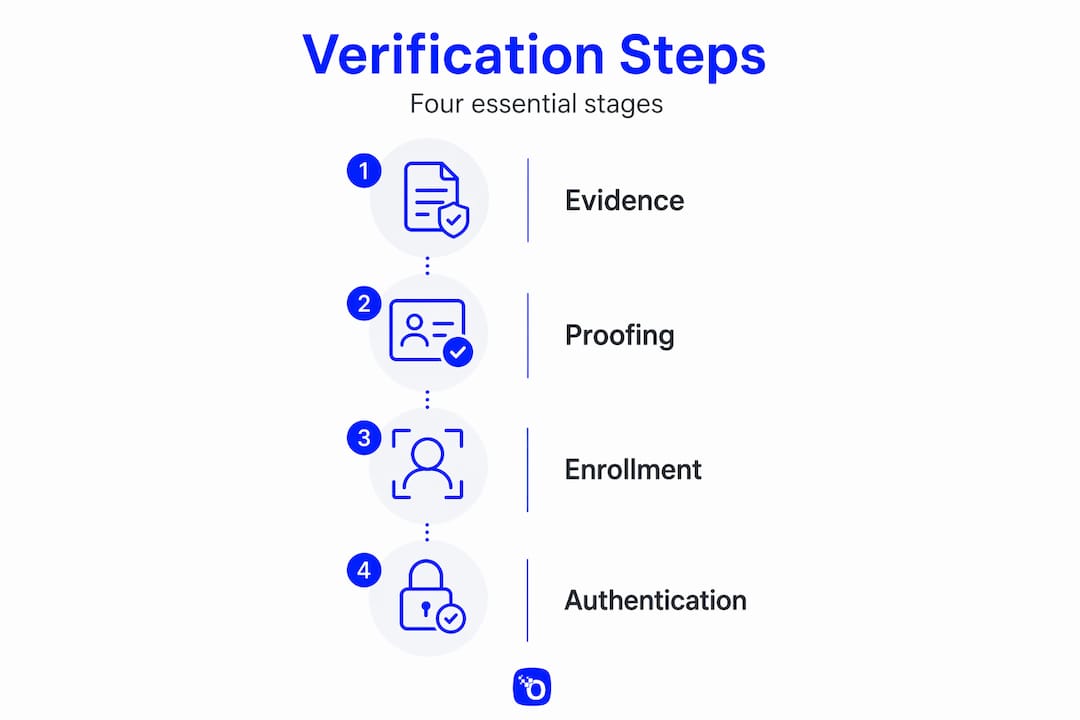
The four essential steps of identity verification
- Evidence collection: The applicant presents one or more identity documents, such as a passport, driver’s license, or government-issued ID. In digital systems, this often involves photographing or scanning the document using a mobile device or dedicated hardware.
- Authoritative validation: The collected evidence is checked against authoritative sources, such as the Social Security Administration, motor vehicle records, or other government databases, to confirm the document is genuine and the identity it represents actually exists.
- Biometric matching: The applicant’s live biometric sample, typically a facial scan, is compared against the photo on the identity document to confirm physical correspondence.
- Anti-spoofing and fraud controls: Liveness detection and other fraud mitigation techniques are applied to ensure the biometric sample is from a real, present individual rather than a photograph, video replay, or synthetic deepfake.
Each of these steps corresponds to a specific failure mode. Skipping evidence collection creates document fraud risk. Skipping validation allows fake identities to pass. Skipping biometric matching allows impersonation with genuine documents. Skipping anti-spoofing creates a pathway for technology-assisted fraud.
Identity assurance levels and why they matter
NIST organizes identity assurance into three levels (IAL1, IAL2, and IAL3), ranging from self-asserted identity with no verification to in-person proofing with biometric binding. Public safety agencies typically need to operate at IAL2 or IAL3, given the sensitivity of the roles being filled and the access those roles carry.

Knowing where your verification program sits on the assurance level scale directly informs procurement decisions. A vendor offering IAL1-equivalent processing is appropriate for low-risk consumer applications but wholly inadequate for law enforcement or emergency services hiring. Understanding background check laws governing your jurisdiction will also clarify which assurance standards you may be legally required to meet.
Comparison of identity verification approaches
| Approach | Assurance Level | Biometric Match | Liveness Detection | Suitable for Public Safety? |
|---|---|---|---|---|
| Manual document review | Low (IAL1) | No | No | Not recommended |
| Digital scan with database check | Moderate (IAL2) | Optional | No | Partial, with caveats |
| Biometric + document + liveness | High (IAL2/IAL3) | Yes | Yes | Recommended |
| In-person supervised proofing | Highest (IAL3) | Yes | Yes (supervised) | Ideal for critical roles |
Pro Tip: Do not rely solely on a vendor’s marketing claims when evaluating identity verification solutions. Request measurable performance data, specifically false accept rates (FAR) and false reject rates (FRR), and compare those figures against your operational tolerance for risk. A system that incorrectly admits even a small percentage of fraudulent identities is unacceptable in a public safety context.
For a broader look at how these controls integrate with your pre-hire process, reviewing background checks explained provides useful operational context.
Advanced techniques: Biometric, document, and remote methods
Having covered the basic workflow, let’s examine advanced digital and biometric methods, and what procurement teams must know before selecting systems or vendors for agency use.
Biometric matching and liveness detection
Biometric identity verification has advanced significantly over the past decade, but the risks have advanced alongside it. Facial recognition matching, when implemented correctly, offers a high degree of accuracy in confirming that an applicant physically corresponds to their identity document. However, the system is only as reliable as its anti-spoofing layer.
As liveness detection specialists have documented, liveness and presentation-attack detection is critical for remote, biometric-based IDV to reduce spoofing. Without it, a bad actor can present a high-resolution photograph or a video loop of the legitimate person’s face and defeat the biometric match entirely. This is not a theoretical risk. It is a documented attack vector used in both financial fraud and, increasingly, employment fraud.
Modern liveness detection techniques fall into two categories: passive and active. Passive detection analyzes the presented image for artifacts of spoofing without requiring the user to perform any action. Active detection prompts the user to blink, turn their head, or follow a moving target, which a static image or simple video cannot replicate. The strongest systems combine both approaches.
Document validation variability: A critical procurement concern
Document validation is often treated as the most straightforward step, but research findings challenge that assumption significantly. According to DHS RIVR results, document validation performance can vary significantly by device context, ID type/state, and vendor subsystem design. In some tested scenarios, commercial document validation tools performed at rates that would be considered disastrously ineffective for high-stakes applications.
This finding has direct implications for public safety agencies evaluating remote identity verification tools. A system that performs well with standard driver’s licenses from common states may fail significantly with out-of-state IDs, tribal IDs, military IDs, or documents presented on older or lower-resolution devices.
Key performance metrics agencies must evaluate
When assessing a biometric or document verification system, consider the following critical metrics:
- False acceptance rate (FAR): The percentage of fraudulent or non-matching identity presentations that the system incorrectly approves. For public safety hiring, this rate must be extremely low.
- False rejection rate (FRR): The percentage of legitimate applicants the system incorrectly flags or denies. A high FRR creates operational friction and candidate attrition, which matters in a competitive hiring market.
- Document coverage: The range of document types, issuing jurisdictions, and document generations the system can reliably validate.
- Device agnosticism: Whether performance degrades significantly on lower-end cameras or older mobile devices, which may be what some applicants actually use.
- Vendor audit trail: Whether the system generates reviewable records of each verification attempt, which matters for FCRA compliance and legal defensibility.
Critical note on candidate integrity: Protecting candidate integrity is not just about catching fraud. It is about creating a defensible, documented process that demonstrates your agency exercised appropriate diligence at every stage of the hiring cycle. This matters in litigation, audits, and certification reviews.
Agencies must also account for data privacy in background checks when deploying biometric tools, given that facial imagery and biometric templates carry heightened sensitivity under state privacy laws, including those in Illinois, Texas, and Washington.
Applying identity verification: Recruitment and ongoing monitoring best practices
With technology options explored, let’s move to practical application. How agencies integrate identity verification into their operational practices determines whether the investment produces real risk reduction or just the appearance of compliance.
Rethinking verification as a continuous process
The single most important conceptual shift for public safety agencies is treating identity verification not as a one-time task but as an ongoing assurance framework. According to NIST’s updated guidance, identity assurance best practice combines initial proofing and enrollment with periodic or continuous authentication and reevaluation to reduce impersonation and identity fraud over time.
In practice, this means that the identity you verified at onboarding must be periodically reconfirmed, especially for employees who hold sensitive access, carry firearms, operate emergency vehicles, or interact with vulnerable populations. An officer who passed verification in 2020 may have acquired disqualifying information since then, including name changes tied to legal proceedings, credential lapses, or even fraudulent supplemental certifications.
A practical framework for the employee lifecycle
- Pre-application screening: Establish minimum identity document requirements before applications are accepted. This filters fraudulent applicants early and reduces downstream processing burden.
- Pre-employment investigations: Conduct full identity proofing using multi-factor evidence (document plus biometric plus database validation) as part of your pre-employment investigations process.
- Onboarding enrollment: Bind the verified identity to a physical credential, digital access profile, or biometric template that will be used to authenticate the employee throughout their tenure.
- Periodic reevaluation: Establish scheduled intervals, annually at a minimum, for identity and credential reevaluation. Trigger additional checks for key lifecycle events such as promotions, assignment changes, or reported misconduct.
- Post-employment verification: Maintain monitoring protocols for former employees who retain any system access, licensing, or certification during transition periods. Post-employment verification is one of the most overlooked vulnerabilities in public safety workforce management.
Pro Tip: When designing your reevaluation schedule, don’t rely on a calendar alone. Build risk triggers into your monitoring program. Events such as a name change in HR records, a reported DUI, or an unusual access pattern in your systems should automatically flag an employee for early identity reevaluation, regardless of where they sit in the standard cycle.
False assumptions that increase risk
Several common beliefs in public safety hiring actively undermine identity assurance, and decision-makers should approach them critically:
- “We’ve known this person for years, so verification is unnecessary.” Personal familiarity does not equal verified identity, and it certainly does not capture changes in legal status or credential validity.
- “Our applicant tracking system handles identity verification.” Most applicant tracking systems handle data collection, not authoritative identity validation. These are fundamentally different capabilities.
- “One background check is enough.” A background check is a point-in-time snapshot. Without ongoing monitoring, it cannot detect what happens after the hire date.
- “Remote verification is less reliable, so we do everything in-person.” In-person verification done poorly (without biometric matching or database validation) is no more reliable than a well-designed remote process.
Understanding the full range of types of background checks available for public safety roles makes it much easier to build a tiered, role-appropriate verification framework rather than applying one universal standard to every position.
Where identity verification fits and what most agencies miss
Before closing, it is worth examining how identity verification actually fits into the broader hiring and risk management picture, and where agencies consistently go wrong in their approach.
Here is the uncomfortable reality: identity verification, no matter how sophisticated, does not make an agency safe. It makes an agency safer, under specific conditions, when layered with other controls. The agencies that invest in excellent biometric proofing but skip rigorous background investigation are building a security posture with a critical gap at the center.
The EEOC’s guidance on background checks makes clear that IDV reduces impersonation risk but does not replace background checks, credential and license verification, or HR compliance processes. This is not a nuance buried in regulatory fine print. It is a foundational principle that experienced hiring professionals understand but that is often lost in vendor conversations about technology.
The market for identity verification technology is dynamic and, at times, overpromising. Vendors selling AI-driven document scanning systems may emphasize accuracy statistics derived from controlled testing conditions that do not reflect the variability of real-world applicant populations. Decision-makers who treat a vendor’s claimed performance metrics as operational guarantees are setting up their agencies for unpleasant surprises.
Layered risk controls are not a luxury. For public safety agencies, they are the standard of care. Identity verification is the first layer, answering the question of who someone is. Background investigations, which OMNI Intel specializes in, answer what that person has done. Credential verification confirms they actually hold the certifications they claim. Ongoing monitoring ensures that nothing material changes after the hire. Remove any one of these layers, and the others carry disproportionate and unsustainable risk.
The agencies that perform best on this dimension are those that approach background check trends with genuine curiosity rather than minimal compliance. They ask not “What do we have to do?” but “What does adequate diligence actually require given our roles and our community obligations?” That shift in framing changes everything about how verification resources are allocated and how hiring decisions are defended when challenged.
The other dimension most agencies miss is post-hire continuity. Investing heavily in pre-employment verification but maintaining no ongoing assurance creates a profile of diminishing returns. An agency that verifies perfectly at hire but never reevaluates is not protected against the person their employee becomes over five or ten years of service. Maintaining consistent verification standards across the full employee lifecycle, with verify applicant credentials protocols that extend through the employment relationship, is the mark of a mature, professional hiring program.
Enhance your hiring and monitoring: Next steps for public safety agencies
If you’re ready to strengthen your agency’s recruitment and monitoring, here’s how to take action with proven screening and investigation solutions.
Identity verification is only as effective as the broader screening ecosystem it operates within. OMNI Intel was built specifically for the operational reality of public safety agencies, combining investigator-driven pre-employment screening with continuous post-hire monitoring to close the gaps that technology alone cannot address.

Whether you lead a law enforcement agency managing complex hiring cycles, a fire department building a volunteer vetting program, or a dispatch center navigating high-turnover recruitment, OMNI Intel’s tailored background checks for public safety provide the depth and accuracy your community deserves. Our background investigations platform integrates identity proofing, credential verification, criminal history analysis, and ongoing monitoring into a single, FCRA-compliant workflow designed around the standards public safety demands. Reach out today to discuss how a layered verification approach can reduce your hiring risk and accelerate your recruitment cycles without cutting corners on integrity.
Frequently asked questions
What documents are typically required for identity verification?
Most agencies require a government-issued photo ID plus additional supporting documents for thorough initial proofing, such as a Social Security card, passport, or utility record to corroborate biographic data. The specific combination depends on the assurance level required for the role.
How often should public safety agencies conduct ongoing identity verification?
Annual reevaluation is the baseline recommendation, but continuous evaluation metrics from NIST’s updated guidelines also support risk-triggered reassessments tied to lifecycle events such as promotions, credential renewals, or flagged behavioral changes.
How do biometric liveness checks prevent impersonation?
Liveness detection confirms that the submitted biometric sample is from a live, present individual rather than a photograph, video replay, or synthetically generated image, which blocks the most common spoofing attacks used in identity fraud.
What risks can occur if identity verification is poorly implemented?
Poorly designed systems may accept fraudulent documents or fail to detect impersonation, and as DHS RIVR testing showed, document validation performance varies widely enough across vendor systems that agencies relying on inadequate tools may unknowingly admit false identities into their hiring pipeline.