
Data Privacy in Background Checks: Protecting Public Safety
Every HR manager in public safety grapples with the challenge of protecting personal data while thoroughly vetting candidates. In the United States, a complex network of federal laws such as the Fair Credit Reporting Act and the Privacy Act of 1974 governs how agencies collect, store, and use sensitive information during background checks. This guide lays out key principles of data privacy, helping you align investigative practices with legal standards and build trust within your community.
Table of Contents
- Defining Data Privacy In Background Checks
- Key Legal Standards And U.S. Regulations
- Types Of Background Checks And Data Collected
- Core Data Security Practices For Agencies
- Risks, Breaches, And Agency Responsibilities
- Balancing Privacy With Public Safety Needs
Key Takeaways
| Point | Details |
|---|---|
| Data Privacy Principles are Essential | Implement data minimization, purpose limitation, fairness, and legal compliance to protect individual rights during background checks. |
| Compliance with Regulations is Critical | Adhere to federal laws such as FCRA, Privacy Act, and HIPAA while navigating state-level regulations for lawful information gathering. |
| Robust Data Security Practices Required | Establish strict access controls, data encryption, and regular security audits to safeguard sensitive information effectively. |
| Balance Privacy with Public Safety | Ensure minimal data collection and transparent processes while maintaining robust protections during background investigations. |
Defining Data Privacy in Background Checks
Data privacy in background checks represents a critical intersection between organizational needs and individual rights. At its core, data privacy involves protecting personal information during investigative processes while ensuring fair and legal collection of relevant details.
The fundamental principles of data privacy in background checks include:
- Data Minimization: Collecting only essential information directly relevant to the screening purpose
- Purpose Limitation: Using personal data exclusively for specified, legitimate objectives
- Fairness: Ensuring transparent and equitable information gathering processes
- Legal Compliance: Adhering to regulations like the Privacy Act guidelines
Understanding these principles helps public safety agencies balance comprehensive background investigations with robust individual privacy protections. Data minimization principles require organizations to carefully assess what information is genuinely necessary for effective candidate evaluation.
Public safety organizations must implement strict protocols that protect sensitive personal data throughout the background check lifecycle. This involves secure data storage, limited access controls, and clear policies governing information usage and potential disclosure.
Pro tip: Develop a comprehensive data privacy framework that explicitly defines acceptable information collection parameters and establishes clear boundaries for background investigation processes.
Key Legal Standards and U.S. Regulations
Background checks in the United States are governed by a complex network of federal and state regulations designed to protect individual privacy while enabling legitimate information gathering. Legal standards play a critical role in defining the boundaries of background investigation practices across public safety agencies.
Key federal laws that shape data privacy in background checks include:
- Fair Credit Reporting Act (FCRA): Regulates how consumer reporting agencies collect and report personal information
- Privacy Act of 1974: Establishes guidelines for federal agency data management
- Health Insurance Portability and Accountability Act (HIPAA): Protects sensitive medical information
- Gramm-Leach-Bliley Act: Governs financial data privacy and security
Federal privacy legislation creates a patchwork of regulations that address specific data types and industries. Unlike some countries with comprehensive privacy laws, the United States relies on sector-specific protections that require agencies to carefully navigate complex legal requirements.
The following table summarizes how key U.S. laws apply to data privacy in background checks:
| Law or Regulation | Data Focus Area | Impact on Background Checks |
|---|---|---|
| FCRA | Consumer report data | Requires consent, accuracy, dispute procedures |
| Privacy Act of 1974 | Federal agency records | Sets limitations on federal data use |
| HIPAA | Medical information | Restricts access to health data |
| Gramm-Leach-Bliley Act | Financial information | Imposes secure handling for financial records |
The regulatory landscape is further complicated by state-level privacy laws that can impose additional restrictions on background check processes. Public safety agencies must develop robust compliance strategies that account for both federal guidelines and state-specific regulations to ensure lawful and ethical information gathering.
Pro tip: Consult with legal experts specializing in privacy law to develop a comprehensive compliance framework that addresses both federal and state background check regulations.

Types of Background Checks and Data Collected
Background checks for public safety agencies encompass a comprehensive range of investigative processes designed to ensure organizational integrity and community protection. Data collection involves multiple layers of verification that help agencies make informed hiring decisions while maintaining strict privacy standards.
Typical background check components include:
- Criminal History Checks: Revealing past legal infractions
- Employment Verification: Confirming previous work experience and professional conduct
- Education Authentication: Validating academic credentials
- Credit Reports: Assessing financial responsibility
- Drug Screening: Identifying potential substance abuse risks
- Motor Vehicle Records: Examining driving history and potential safety concerns
Background check guidelines require employers to navigate complex legal requirements that prevent discrimination while gathering essential information. Public safety agencies must carefully balance comprehensive investigation with individual privacy protections, ensuring that data collection remains fair and legally compliant.
The scope of background investigation data extends beyond traditional records, potentially including social media profiles, professional references, and specialized screening relevant to specific public safety roles. Agencies must implement rigorous protocols to verify information accuracy and protect sensitive personal data throughout the investigation process.
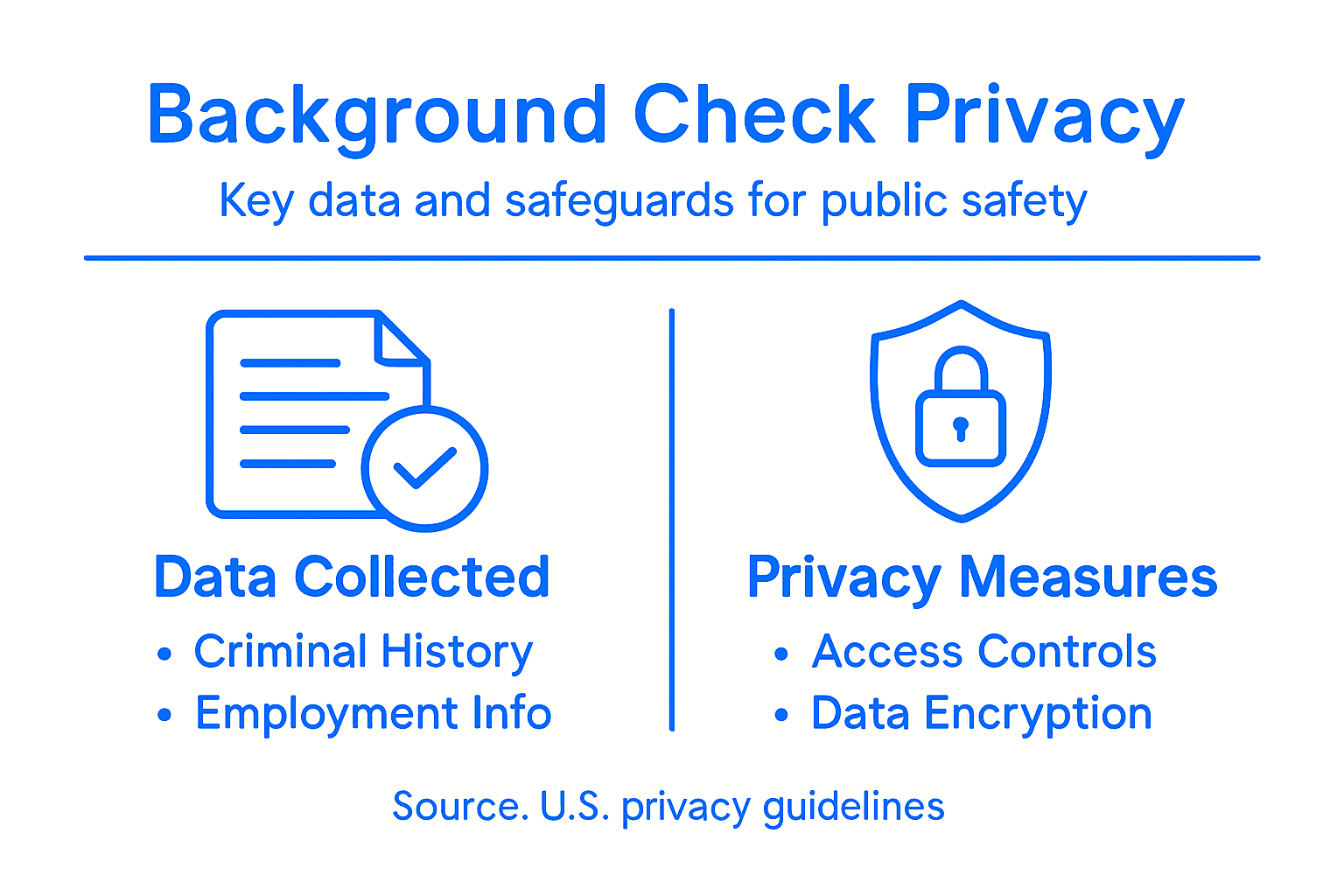
This table compares typical background check components by data sensitivity and recommended security approach:
| Component | Sensitivity Level | Recommended Security Measure |
|---|---|---|
| Criminal History | High | Strong encryption, restricted access |
| Employment Verification | Medium | Audit logs, staff training |
| Education Records | Low | Standard access controls |
| Credit Reports | High | Multi-factor authentication |
| Social Media | Variable | Contextual review, clear policy |
Pro tip: Develop a standardized background check protocol that consistently applies the same comprehensive screening process across all candidate evaluations to ensure fairness and legal compliance.
Core Data Security Practices for Agencies
Protecting sensitive information requires a multi-layered approach to data security that goes beyond basic technological solutions. Public safety agencies must implement comprehensive strategies that safeguard personal data throughout the background check process, ensuring both organizational integrity and individual privacy.
Key data security practices include:
- Access Control: Limiting system entry to authorized personnel
- Data Encryption: Protecting information during storage and transmission
- Regular Security Audits: Identifying and addressing potential vulnerabilities
- Incident Response Planning: Developing protocols for potential data breaches
- Employee Training: Educating staff on data protection protocols
- Secure Network Infrastructure: Implementing robust technological safeguards
FTC Safeguards Rule guidelines provide a comprehensive framework for developing robust security programs. These regulations emphasize the importance of creating systematic approaches to protecting sensitive information, with particular focus on controlling access and monitoring potential security risks.
Cybersecurity experts recommend implementing critical security controls that go beyond basic protection measures. This includes continuous vulnerability management, detailed audit logging, and maintaining comprehensive inventories of all data assets and access points. Public safety agencies must adopt a proactive stance, treating data security as an ongoing process rather than a one-time implementation.
Pro tip: Conduct quarterly comprehensive security assessments that combine technological audits with staff training to maintain a dynamic and adaptive data protection strategy.
Risks, Breaches, and Agency Responsibilities
Data breaches represent existential threats to public safety agencies, potentially compromising individual privacy and institutional credibility. Security vulnerabilities can expose sensitive background check information, creating significant legal and operational risks that demand proactive management and immediate response strategies.
Potential risks in background check data management include:
- Unauthorized System Access: External hackers compromising network security
- Internal Data Mishandling: Employees improperly accessing or sharing sensitive information
- Inadequate Encryption: Leaving digital records vulnerable to interception
- Outdated Security Protocols: Failing to update technological safeguards
- Third-Party Vendor Vulnerabilities: Exposing data through external system weaknesses
- Accidental Data Exposure: Unintentional information disclosure through human error
Data breach response strategies emphasize the critical importance of developing comprehensive incident management protocols. Agencies must establish rapid response teams capable of quickly securing compromised systems, conducting forensic investigations, and implementing necessary notification procedures.

Federal regulatory bodies play crucial roles in breach management by enforcing privacy regulations and holding organizations accountable for protecting sensitive information. Public safety agencies must develop robust frameworks that not only prevent breaches but also demonstrate transparency and accountability when incidents occur.
Pro tip: Create a detailed incident response plan with predefined roles, communication protocols, and step-by-step recovery procedures to minimize potential damage during a data security event.
Balancing Privacy With Public Safety Needs
The fundamental challenge for public safety agencies lies in navigating the delicate equilibrium between individual privacy and collective security requirements. Background checks represent a critical intersection where personal data protection must be carefully weighed against broader community safety objectives.
Key considerations in maintaining this balance include:
- Minimal Data Collection: Gathering only essential information
- Transparent Processes: Clearly communicating data usage intentions
- Consent Mechanisms: Ensuring informed individual agreement
- Strict Access Controls: Limiting data visibility to authorized personnel
- Regular Privacy Impact Assessments: Continuously evaluating data collection practices
- Proportional Information Gathering: Matching investigative depth to specific role requirements
Privacy and security frameworks emphasize the importance of developing nuanced approaches that respect individual rights while enabling effective risk management. Public safety agencies must implement sophisticated strategies that go beyond simple compliance, actively protecting both institutional and personal interests.
During emergencies or high-risk scenarios, privacy considerations become even more complex. Agencies must demonstrate exceptional transparency, ensuring that any expanded data collection meets strict ethical standards and serves genuine public safety objectives without unnecessary intrusion.
Pro tip: Develop a comprehensive privacy governance framework that includes clear escalation protocols, ensuring each data collection decision undergoes rigorous ethical and legal review.
Strengthen Your Public Safety Hiring While Protecting Data Privacy
Balancing the need for thorough background checks with stringent data privacy protections is a major challenge for public safety agencies today. This article highlights essential concepts like data minimization, legal compliance, and secure information handling—all crucial to maintaining individual privacy and public trust. Agencies face pressure to gather comprehensive candidate information without jeopardizing sensitive data or risking costly breaches.
OMNI Intel understands these challenges and offers a background screening platform tailored specifically for public safety organizations. Our solutions integrate AI-driven candidate vetting with strict data security controls modeled on law enforcement investigation principles. By following hiring best practices, agencies can reduce risks while accelerating recruitment and ensuring every candidate meets high standards of integrity and compliance.

Take control of your background check process today with OMNI Intel’s secure and transparent platform. Visit Get Started now to implement trusted screening that protects both privacy and public safety.
Frequently Asked Questions
What are the key principles of data privacy in background checks?
The key principles include data minimization, purpose limitation, fairness, and legal compliance. These principles ensure that personal information is collected responsibly and used only for legitimate purposes.
How do federal laws impact data privacy in background checks?
Federal laws such as the Fair Credit Reporting Act (FCRA) and the Privacy Act of 1974 establish guidelines for how personal information is handled during background checks, ensuring individuals’ privacy is protected while allowing necessary information gathering.
What types of data are typically collected during background checks?
Common data collected includes criminal history, employment verification, education authentication, credit reports, drug screening, and motor vehicle records, all aimed at ensuring informed hiring decisions while adhering to privacy standards.
What measures can agencies take to ensure data security during background checks?
Agencies should implement access controls, data encryption, regular security audits, incident response planning, employee training, and maintain secure network infrastructure to protect sensitive personal data throughout the background check process.