

The Advantages of AI-Driven Vetting for Modern Hiring Teams
AI-driven vetting improves speed, consistency, and predictive hire quality, but only when paired with validated models and human oversight. That’s the finding across recent public safety hiring research, and it holds true whether you’re screening 50 applicants a year or 5,000. The technology doesn’t replace judgment. It removes the bottlenecks that keep good judgment from scaling.
Here’s what the evidence actually shows once you strip away vendor marketing:
- Time-to-hire drops measurably. Automated parsing, scoring, and triage let recruiters focus on qualified finalists instead of manual resume review, and automation in background checks can cut record-query turnaround dramatically.
- Consistency improves. Standardized scoring reduces the variability that comes from different reviewers applying different (often unconscious) standards to the same applicant pool.
- Quality-of-hire signals get sharper. Predictive models trained on validated outcome data can flag fit indicators that a rushed manual review misses entirely.
The caveat that too many rollout plans skip: none of this works without representative training data, documented validation, and a human who can override or explain every automated decision. Federal guidance on algorithmic evaluation and monitoring treats this as baseline practice for high-risk hiring decisions, not an optional add-on.
Key Takeaways
AI-driven vetting delivers measurable gains in speed and consistency only when validated models, audit trails, and human review are built into the process from day one.
| Point | Details |
|---|---|
| Speed scales with volume | Automated parsing and triage cut time-to-fill without proportional increases in recruiter headcount. |
| Standardization reduces bias | Validated scoring applies identical criteria to every candidate, but only when regularly audited. |
| Human review stays mandatory | Every automated hold or disqualification needs a documented path to human adjudication and appeal. |
| Pilot before you scale | Baseline your metrics, run a holdout comparison, and set rollback criteria before agencywide rollout. |
| OMNI Intel supports audit-ready screening | OMNI Intel pairs AI-driven candidate screening with investigator-grade checks and continuous post-hire monitoring for public safety agencies. |
Table of Contents
- The Advantages of AI-Driven Vetting, Explained and Measured
- How AI-Driven Vetting Tools Actually Work
- What Can Go Wrong: Limitations and Legal Risk
- Evaluating Vendors and Running a Safe Pilot
- Where the Stakes Are Highest: Public Safety Hiring
- If You Need an Audit-Ready AI-Driven Screening Partner
- Sources
- FAQ
The Advantages of AI-Driven Vetting, Explained and Measured
The advantages of AI-driven vetting aren’t abstract. Each one maps to a specific operational metric you should already be tracking, or should start tracking before you sign a vendor contract.
1. Speed and scalability at high volume
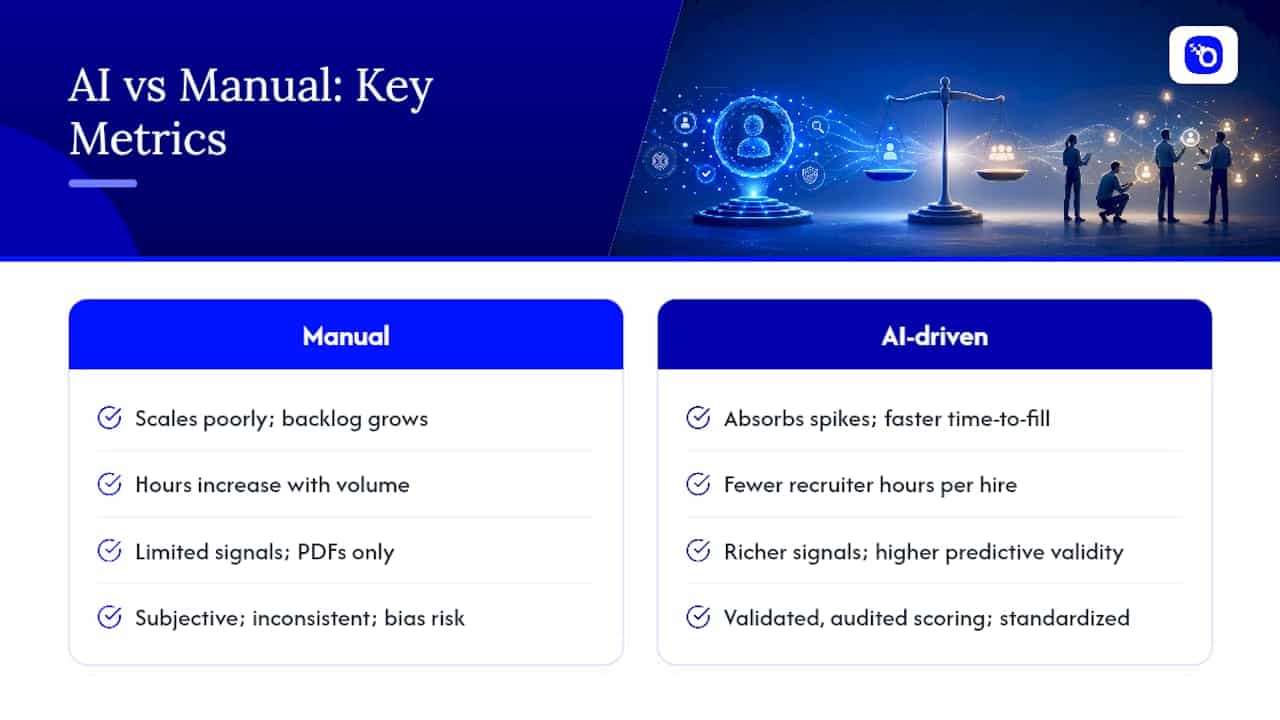
Manual resume review does not scale linearly. Double your applicant pool and you either double your review staff or double your backlog. AI-driven parsing and scoring absorb volume spikes without proportional headcount growth. Public safety agencies feel this acutely: long hiring timelines and high attrition during background investigations already strain understaffed recruiting teams, and a hiring freeze during a surge in applications compounds the problem fast.
Metric to track: time-to-fill and recruiter hours per hire, measured before and after automation.
2. Improved candidate matching and predictive fit
Automated employment decision tools can process more applicant data points, faster and at lower cost, than a recruiter working through stacks of PDFs. That includes newer signals like structured video interview responses and cyber-vetting data, which research on automated decision tools in law enforcement hiring identifies as a growing category of predictive input, provided the models undergo bias-mitigation review before deployment.

Metric to track: predictive validity, meaning how well a candidate’s pre-hire score correlates with actual on-the-job performance or retention at 12 months.
3. Standardization that reduces subjective bias
This is the advantage most hiring managers underrate. A validated, audited scoring model applies the same criteria to every applicant, every time. It doesn’t have a bad Monday, and it doesn’t unconsciously favor candidates who remind the reviewer of themselves. Industry analysis on AI in recruitment for law enforcement frames the core value as standardizing assessments so hiring decisions become legally defensible and evidence based, not just faster.
Standardization only works if you can prove it. Ask any vendor for their bias audit results broken down by demographic group, and for the testing methodology behind those results.
4. Lower cost per hire
Automating repetitive tasks (resume screening, initial scoring, scheduling) shifts recruiter time toward higher-value work: interviews, reference checks, and final adjudication. Calculate ROI by comparing recruiter hours saved per requisition against the subscription or per-use cost of the tool, then factor in adjudication efficiency (how many fewer manual reviews it takes to reach a hiring decision).
Metric to track: cost-per-hire, before and after, isolated to the screening and initial-review stage.
5. Better candidate experience through automated engagement
Automated scheduling and status updates keep candidates informed instead of guessing whether their application vanished into a black hole. That matters for public safety recruiting especially, where qualified candidates often have competing offers and won’t wait three weeks for a callback.
Metric to track: candidate drop-off rate between application and first interview.
Pro Tip: Before you evaluate any vendor’s speed or accuracy claims, pull your own current baseline numbers first: time-to-fill, cost-per-hire, and offer-acceptance rate for the last four quarters. Without a baseline, every vendor claim is unverifiable.
How AI-Driven Vetting Tools Actually Work
Most platforms follow a similar pipeline, even if the marketing language differs from vendor to vendor.
- Intake and parsing: Resumes, applications, and structured HRIS data get normalized into a consistent format the system can score.
- Feature engineering and scoring: The model weighs specific attributes (certifications, experience, assessment results, background-check flags) against a validated scoring framework.
- Augmented interviews: Some platforms layer in structured video or chatbot-based interviews to standardize the questions every candidate answers.
- Background-data enrichment: Criminal justice records, credential verification, and public records get pulled and cross-referenced automatically.
- Decisioning and triage: Candidates get sorted into tiers (advance, hold, disqualify) based on the composite score.
- Human review: A recruiter or investigator reviews flagged cases, edge cases, and final-tier decisions before any offer or disqualification becomes official.
Data quality determines everything downstream. A model trained on incomplete or non-representative historical hiring data will replicate whatever bias existed in that data, just faster and with a veneer of objectivity. That’s why explainability layers and audit logs aren’t a nice-to-have. They’re what lets you trace a specific decision back to the specific inputs that produced it.
Pro Tip: Never let an automated system make the final disqualification decision on its own for a public safety role. Build the workflow so every automated “hold” or “disqualify” outcome routes to a human investigator before it becomes final.
What Can Go Wrong: Limitations and Legal Risk
The advantages of AI-driven vetting come with real trade-offs, and pretending otherwise sets your agency up for a bad surprise during an audit or a discrimination complaint.
The main risks fall into a few buckets:
- Biased or non-representative training data, which produces models that systematically disadvantage certain groups even when no one intended that outcome.
- Opaque, unexplainable models, where nobody, including the vendor, can tell you why a specific candidate scored the way they did.
- Insufficient validation, meaning the model was never tested against outcome data specific to your roles and your candidate pool.
- Privacy and data-handling gaps, particularly when tools pull social media or public record data without clear retention and consent policies.
- Adverse impact on protected groups, which can trigger legal exposure even when the disparity was unintentional.
Federal guidance on algorithmic systems recommends benchmark testing, demographic performance analysis, and ongoing monitoring for heightened-risk uses, and hiring is squarely in that category. Skipping this isn’t just a compliance risk. It’s an operational one: false positives (rejecting qualified candidates) and false negatives (advancing poor fits) both cost money, and a clunky candidate experience drives your best applicants to a competing agency.
Pro Tip: Require your AI vetting workflow to include a documented appeal process. Any candidate flagged or disqualified by an automated decision should have a clear path to request human review, and you should log every appeal outcome for audit purposes.
The mitigations aren’t complicated, but they take discipline: pre-deployment bias testing against your actual applicant demographics, ongoing performance monitoring after go-live, documentation thorough enough to survive a legal challenge, and privacy-by-design data handling from day one.
Evaluating Vendors and Running a Safe Pilot
Don’t buy an AI vetting platform off a sales deck. Run it through a checklist first, then pilot it before you scale it agency-wide.
Vendor evaluation checklist:
- Can they show explainability documentation, meaning you can trace any score back to its contributing factors?
- Have they published validation results, including performance broken down by demographic group?
- What data sources feed the model, and can they document where each feature originated?
- Does the platform integrate with your existing applicant tracking or HRIS system without a custom build?
- Do they maintain audit logs and version history for every model update?
- What do the contract terms say about model retraining, data ownership, and data retention after the contract ends?
Running the pilot:
- Define one specific use case (initial resume screening, for example) rather than automating your entire pipeline at once.
- Set a baseline using your last two to four quarters of hiring data before the pilot starts.
- Run a holdout comparison: score the same applicant pool with both the old process and the new tool, then compare outcomes.
- Set a fixed timeline, typically one full hiring cycle, with clear success metrics agreed on in advance.
- Build in rollback criteria: if adverse impact appears or time-to-hire doesn’t improve, you pull the plug without penalty.
Watch for red flags during vendor conversations: unwillingness to share validation data, vague answers about where training data comes from, no human-review workflow built into the product, or no version history for model changes. Vendor-reported case data can show real operational gains in processing speed and adjudication accuracy, but treat those figures as a starting point for your own pilot, not a substitute for testing on your own applicant data.
Pro Tip: Ask every finalist vendor the same question: “Show me a sample audit report from an existing client.” A vendor that can produce one immediately has actually built the auditability into their product. A vendor that hesitates has not.
Where the Stakes Are Highest: Public Safety Hiring
Public safety agencies operate under a different risk calculus than a typical corporate hiring desk. A bad hire in a law enforcement or EMS role isn’t just a performance problem. It’s a public trust and safety liability, and agencies already face long hiring timelines and steep attrition during background investigations, which is exactly where automation earns its keep by triaging applicant volume without cutting corners on scrutiny.
High-risk roles demand a governance layer most corporate hiring never bothers with:
- Representative validation testing specific to the roles and candidate demographics your agency actually hires from.
- Benchmark testing aligned with federal algorithmic evaluation guidance, including documented adjudication rules.
- Continuous post-hire monitoring, since screening risk doesn’t end at the offer letter and models need periodic retraining as outcome data accumulates.
- Transparent reporting practices where community oversight or public accountability requirements apply.
Retraining matters more here than anywhere else. A model that performed well two years ago on a different applicant pool can drift, and public safety agencies can’t afford to discover that drift after a hiring mistake becomes a headline.
A public-safety screening perspective
The agencies getting the most value from AI-driven vetting aren’t the ones chasing the fastest time-to-hire. They’re the ones that baseline their metrics first, pilot on one role before scaling agencywide, and demand model documentation before signing anything. Start there: measure what you have now, test small, and require proof, not promises.
If You Need an Audit-Ready AI-Driven Screening Partner
OMNI Intel built its screening approach around the exact gap this article covers: platforms that promise speed but can’t produce a validation report when a hiring decision gets challenged.

OMNI Intel combines AI-driven candidate screening with investigator-grade background checks, audit-ready reporting, and continuous post-hire monitoring, purpose built for public safety agencies rather than adapted from generic corporate HR software. That means integration with your existing hiring platform, documented adjudication workflows, and human oversight built into the process rather than bolted on after a complaint. Agencies using OMNI Intel’s public safety recruiting tools have seen meaningful reductions in time-to-hire without sacrificing the thoroughness a badge, a uniform, or a dispatch console demands. If you’re evaluating vendors, start with a pilot: request a walkthrough of OMNI Intel’s pre-employment screening services and ask to see a sample audit report before you commit to anything agencywide.
Sources
- How artificial intelligence can transform recruitment in law enforcement
- Federal guidance on evaluation and monitoring of algorithmic systems (excerpt)
- The Potential of Automated Employment Decision Tools (AEDTs) in Law Enforcement Hiring
- Faster, Safer Checks: Automated Background Check Tools for Law Enforcement
FAQ
What are the main benefits of AI-driven vetting?
The core advantages are faster time-to-hire, standardized and auditable scoring, and improved predictive fit when models are validated against representative outcome data.
What are the pros and cons of using AI for hiring decisions?
The pros include speed, consistency, and scalability at high applicant volume; the cons include risks from biased training data, opaque models, and legal exposure without proper validation and human oversight.
Does AI-driven vetting actually reduce bias in hiring?
It can reduce subjective bias when the model is validated, regularly audited for demographic performance gaps, and paired with human review, but an unvalidated model can just as easily introduce new bias.
What should I ask a vendor before adopting an AI vetting tool?
Ask for validation results broken down by demographic group, documentation of data sources, sample audit reports, and details on how the platform supports human review and appeals.
Is AI-driven vetting appropriate for public safety hiring?
Yes, when it includes representative validation testing, documented adjudication rules, and continuous post-hire monitoring, since public safety roles carry higher liability than typical corporate hires. OMNI Intel builds these safeguards directly into its screening workflow for law enforcement, fire, EMS, and dispatch agencies.