

Integrity Assessment Methods: A Defensible Process for Public Safety Hiring
A defensible integrity assessment program combines four elements: validated written integrity tests paired with cognitive checks, structured background investigations targeting job-relevant history, integrity-focused behavioral interviews, and continuous post-hire monitoring. Skip any one of these stages and you weaken the evidence trail you need if a hiring decision is ever challenged.
Here is the stage-by-stage checklist:
- Initial screen: automated resume review plus a validated overt or personality-based integrity test
- In-depth background investigation: criminal history, employment verification, education, references, driving record
- Structured interview and targeted psychological screening: integrity-focused behavioral questions, clinical evaluation where required
- Conditional-offer checks: medical, psychological, and final document verification
- Post-hire monitoring: periodic refreshes and incident-triggered reassessment
The POST Background Investigation Manual lists integrity as a core background dimension, OPM’s guidance on integrity testing requires business-necessity justification for any test used in selection, and instruments like the Critical Hire-Screen show what a validated tool actually looks like in a corrections or law enforcement setting.
Key Takeaways
A defensible integrity assessment program requires validated testing, structured background investigation, targeted interviewing, and post-hire monitoring working together, not any single method alone.
| Point | Details |
|---|---|
| Pair tests with cognitive measures | Validated integrity tests predict counterproductive behavior best when combined with cognitive ability checks, per OPM guidance. |
| Use validity indices | Impression management scales, like the one in the Critical Hire-Screen, help flag likely faking before it reaches a final decision. |
| Write decision rules first | Set cut scores, red flags, and follow-up triggers in writing before you start hiring, not during it. |
| Monitor after hire | Tie reassessment to specific triggers like credible allegations, new charges, or discovered document fraud. |
| Consider an integrated platform | OMNI Intel’s OMNIScreen and OMNIHire centralize testing, investigation workflows, and monitoring for public-safety agencies. |
Table of Contents
- What Do Integrity Assessment Methods Cover in Public Safety Hiring?
- Which Integrity Assessment Methods Actually Work?
- How Do You Build a Legally Defensible Multi-Stage Process?
- How Should You Weigh Conflicting Evidence?
- When Should You Reassess Integrity After Hire?
- What Does It Take to Roll This Out?
- Where Agencies Get This Wrong
- Where Does OMNI Intel Fit Into This Process?
- Sources
- FAQ
What Do Integrity Assessment Methods Cover in Public Safety Hiring?
Integrity assessment methods are the tools and procedures agencies use to evaluate honesty, trustworthiness, dependability, and job-related ethical behavior before and after hire. That is the definition this guide works from, and it is worth being explicit about scope: this is not about physical asset inspection or infrastructure integrity testing. It is about people, specifically the people your agency trusts with weapons, evidence, vulnerable populations, and public funds.
The scope here includes pre-employment integrity testing, background investigations, structured interviews, and post-hire monitoring. It does not include unrelated compliance audits or facility inspections.
Why multi-stage matters: POST’s own background investigation framework identifies integrity, impulse control, substance abuse risk, stress tolerance, conscientiousness, and decision-making as overlapping background and psychological screening dimensions. No single test or interview reliably captures all six. That is the entire argument for combining methods rather than picking one.
A few scope notes worth flagging up front:
- Integrity testing and psychological screening measure overlapping but not identical constructs
- Background investigation findings should corroborate, not replace, test and interview data
- Post-hire monitoring is part of the assessment lifecycle, not an afterthought
Which Integrity Assessment Methods Actually Work?
Public-safety agencies have eight practical tools available. Each does something different, and none does everything.
Overt integrity tests ask direct questions about theft, drug use, and rule-following attitudes. Candidates know exactly what is being measured. Personality-based integrity inventories measure related traits (conscientiousness, impulse control) without stating their purpose outright. OPM’s assessment guidance confirms both formats predict counterproductive behaviors like theft, absenteeism, and substance use, and both work better when paired with a cognitive ability measure rather than used alone.
Structured behavioral and situational interviews focused on integrity and ethics ask candidates to describe how they actually handled a past ethical conflict, not how they would handle a hypothetical one. Background investigations verify criminal history, employment, education, references, and driving records, ideally cross-referenced against the candidate’s Personal History Statement. Open-source due diligence covers social media and public-record checks. Document verification confirms credentials are real. Conditional-offer medical and psychological evaluations close the loop for sworn roles.
The Critical Hire-Screen illustrates what a purpose-built instrument looks like: subscales targeting substances, theft, authority attitudes, and rule-following, plus an impression management scale that flags likely faking.
| Method | Predictive Validity | Faking Risk | Adverse Impact Risk | Typical Administration |
|---|---|---|---|---|
| Overt integrity test | Moderate, higher with cognitive pairing | High without validity scale | Generally low | Online, pre-screen stage |
| Personality-based inventory | Moderate to good | Moderate | Generally low | Online, pre-screen stage |
| Structured integrity interview | Good when standardized | Low to moderate | Low if scoring is consistent | In-person or video, panel |
| Background investigation | High for corroborated findings | Low (fact-based) | Varies by scope | Investigator-driven, weeks |
| Open-source/social media check | Limited on its own | Low | Elevated if not standardized | Investigator or software-assisted |
Pro Tip: Never trust a raw integrity test score in isolation. Cross-check any elevated risk flag against a validity or impression management index, then send it to the interview panel as a specific follow-up probe rather than an automatic disqualifier.
The best return on integrity testing shows up in high-volume applicant pools and positions of trust: sworn officers, dispatchers with database access, and anyone handling evidence or funds. For a low-volume specialty role, a rigorous background investigation and interview may carry more weight than a test battery.
How Do You Build a Legally Defensible Multi-Stage Process?
Sequence matters as much as method selection. Here is the practical flow agencies use from posting to hire:
- Pre-screen: resume review and minimum-qualification checks
- Group testing: validated integrity test and cognitive ability measure, administered together
- Prioritized background investigation: full criminal history, employment, education, and reference checks, weighted by role sensitivity
- Structured integrity interview: panel-based, scored against a fixed rubric
- Conditional-offer checks: medical and psychological evaluation, final document verification
- Final decision and documentation: decision rules applied, rationale recorded
- Onboarding and monitoring: baseline established for post-hire checks
Decision rules need to be written down before you start hiring, not improvised mid-process. A workable starting set: a cut score on the integrity test below which candidates move to extended review rather than automatic rejection; specific red flags (falsified application, undisclosed termination for cause, pattern of dishonesty in references) that trigger a full background investigation regardless of test score; critical-factor flags that require a follow-up interview before any adverse decision; and a documented remediation path for minor, isolated discrepancies that don’t rise to disqualifying.
Your legal compliance checklist should cover:
- Job-relatedness documentation for every test and interview question used
- A written business-necessity rationale tied to specific job duties, consistent with OPM’s integrity testing guidance
- Identical administration procedures across all candidates for the same role
- A clear accommodation pathway for candidates who request one
- Retained records showing who scored what, and why a decision was made
Map POST’s background dimensions to specific stages: integrity and decision-making surface in the background investigation and interview; impulse control and stress tolerance surface more clearly in psychological evaluation. No single stage should carry the full weight of any one dimension.
How Should You Weigh Conflicting Evidence?
When a test flag, a background finding, and an interview answer don’t agree, you need a rubric, not a gut call.
A workable weighting approach: corroborated background findings (two or more independent sources confirming the same fact) carry the most weight. A single elevated test score without corroboration warrants a targeted follow-up interview question, not automatic rejection. An interview discrepancy that contradicts a documented background fact is treated as a credibility issue and investigated further before any decision.

Validity scale elevations deserve specific handling. An elevated impression management score does not prove the candidate lied. It means the profile needs a second look, ideally through a follow-up interview probe that tests the specific area of concern.
Your documentation checklist should record:
- Who scored each instrument and on what date
- Which sources were consulted for each background finding
- The specific rationale for any follow-up interview, extended background check, or rejection
- Applicant notification records where required by law
When Should You Reassess Integrity After Hire?
Integrity assessment does not end at the start date. Public-safety roles carry ongoing risk, and monitoring needs to reflect that.
Build a monitoring cadence around these options:
- Periodic background refreshes on a fixed schedule (annually or biennially, role-dependent)
- Targeted checks triggered by a specific incident or complaint
- Role-based monitoring tied to access level: weapons, evidence, funds, or sensitive databases warrant tighter cycles
- Continuous open-source checks where your jurisdiction and policy permit them
Reassessment triggers should be written into policy before you need them: a credible allegation of misconduct, an arrest or new charge, discovery of a falsified document from the original application, or a documented pattern of workplace dishonesty. Recent research on screening expansion flags a real trade-off here: broader ongoing monitoring, especially financial and online reputation checks, can create employability barriers if applied inconsistently. Document the policy, apply it the same way to everyone in a given role, and keep the scope tied to job relevance rather than convenience.
What Does It Take to Roll This Out?
Implementation runs in a predictable sequence. Prioritize in this order:
- Select validated integrity and cognitive instruments matched to your role types
- Define cut scores, red flags, and decision rules in writing
- Train interviewers on the structured integrity interview rubric
- Confirm your background investigation workflow, whether in-house investigators or a vendor
- Update policy language covering testing, monitoring, and accommodation
A small agency (under 25 sworn positions annually) can pilot a new process in 4 to 6 weeks and reach full rollout within a quarter. A mid-size agency typically needs 8 to 12 weeks for pilot plus training before full rollout. A large agency or multi-department municipal system often needs two full hiring cycles to calibrate assessors and validate cut scores against actual outcomes.
Cost drivers to budget for:
- Per-applicant test licensing fees
- Investigator time for background work
- Software and ATS integration costs
- Assessor and interviewer training
- Legal review of test selection and policy language
Where Agencies Get This Wrong
The most common mistake is over-relying on one measure, usually a personality test, and treating a passing score as clearance rather than one data point among several. A candidate can clear an integrity test cleanly and still have a documented pattern in their employment history that the test was never designed to catch.
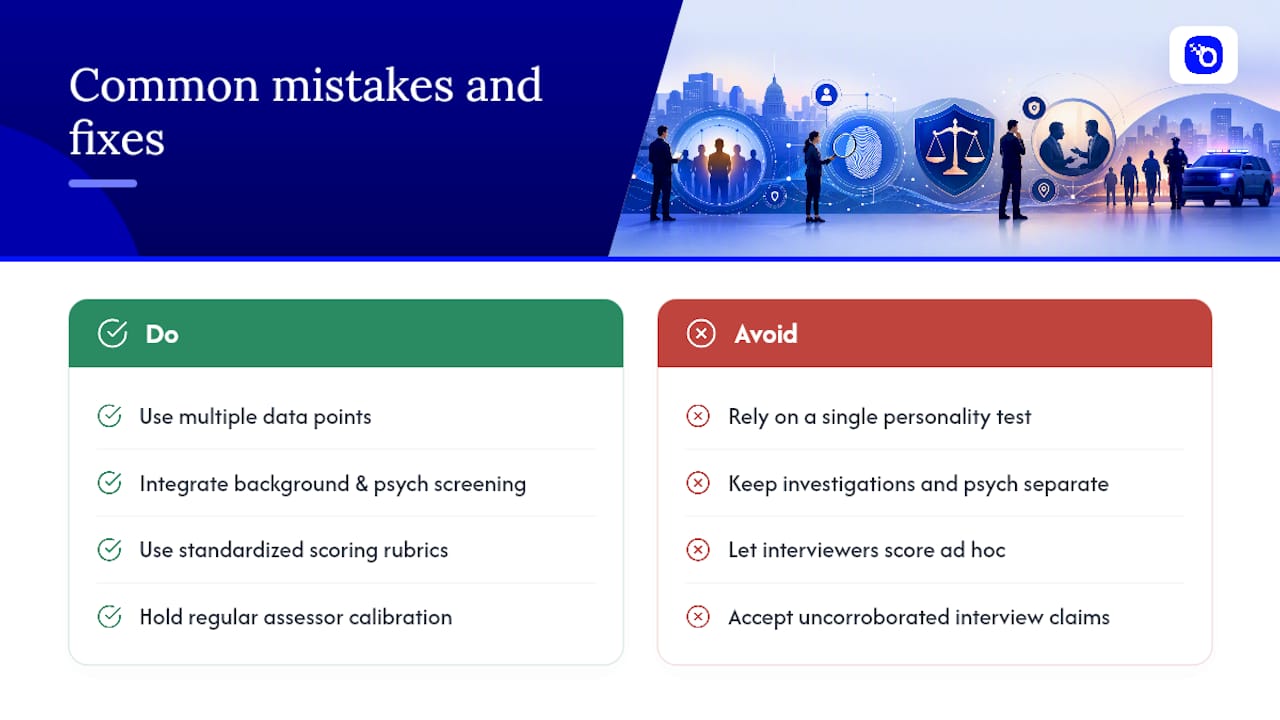
The second mistake is poor integration between background investigation and psychological screening. These two processes often run in separate departments that never compare notes, even though POST’s own framework treats them as overlapping.
Inconsistent interviewer training is the third gap. Two panels asking the same integrity question in different ways produce scores that cannot be defended as equivalent. Fix it with standardized scoring rubrics, a requirement that interview claims get corroborated against background findings before weighing them, mandatory validity indices on every written test, and regular calibration sessions where assessors score the same sample case and compare notes.
Where Does OMNI Intel Fit Into This Process?
Running four or five distinct stages by hand, across separate vendors and spreadsheets, is where most agencies lose consistency and where documentation gaps creep in. An integrated platform centralizes test administration, evidence collection, decision-rule automation, and post-hire monitoring in one system, which cuts the time-to-hire and gives you a single audit trail if a decision is ever questioned.

OMNI Intel builds specifically for public-safety agencies rather than general corporate HR. OMNIScreen™ handles background investigation workflows, from criminal history to employment verification, using investigative principles built around objective, fact-based reporting. OMNIHire™ ties test administration, applicant tracking integration, and your documented decision rules together so cut scores and red flags trigger consistent next steps instead of ad hoc judgment calls. Together they support the exact multi-stage sequence this guide walks through, without forcing your team to stitch together separate vendors for testing, investigations, and monitoring.
If your agency is ready to move from a patchwork process to one defensible system, start with OMNI Intel’s pre-employment screening services and request a walkthrough of how OMNIScreen and OMNIHire map to your current hiring stages.
Sources
- Background Investigation Manual
- Integrity/Honesty Tests
- Predictive Accuracy of the Critical Hire-Screen
- Screening and the expansion of integrity assessment
FAQ
What Are Integrity Assessment Methods in Public Safety Hiring?
They are the tests, background checks, interviews, and monitoring procedures agencies use to evaluate honesty, dependability, and ethical behavior in candidates and employees.
Should Integrity Tests Be Used Alone or With Other Methods?
Alone, integrity tests miss too much. OPM guidance recommends pairing them with cognitive ability measures and corroborating flags through background investigation and interviews.
How Do You Detect Candidate Faking on Integrity Tests?
Validated instruments like the Critical Hire-Screen include an impression management scale that flags elevated faking risk for follow-up review.
How Often Should Agencies Reassess Employee Integrity?
Cadence depends on role sensitivity, but most agencies run periodic refreshes annually or biennially, plus incident-triggered checks for credible allegations or new charges.
Can a Single Platform Manage the Whole Integrity Assessment Process?
Yes. OMNI Intel’s OMNIScreen and OMNIHire integrate test administration, investigation workflows, and post-hire monitoring into one system built for public-safety agencies.