

Sealed Records Employment: What Public Safety Agencies Must Know
Public safety agencies can often see sealed and expunged criminal history through fingerprint-based, law-enforcement channels, even when that same record never shows up on a commercial background check. That’s the operational reality HR teams at police departments, fire and EMS agencies, dispatch centers, and licensed security firms need to plan around. 5 U.S.C. § 9101 defines criminal history record information to include state records sealed by law, as long as those records stay accessible to state and local criminal justice agencies for background checks.
Consumer reporting agencies operate under a different rulebook. The CFPB’s 2024 guidance on background screening makes clear that CRAs should not report sealed or expunged items, and must maintain procedures that keep legally restricted records out of consumer reports.
Don’t treat a clean CRA report as proof of a clean record for any role with fingerprint-based clearance requirements. If your agency is hiring for a sworn, armed, or custodial position, run the fingerprint or state repository check regardless of what the commercial report shows.
- Run agency-authorized fingerprint or state repository checks for sensitive roles, not just a commercial CRA report.
- If a sealed record surfaces, document it and start an individualized assessment before making any adverse decision, per EEOC guidance.
- Never assume a “no record found” CRA result means no record exists for law-enforcement or licensing purposes.
Key Takeaways
Public safety agencies frequently have lawful access to sealed records through fingerprint and state repository channels, but that access only protects them when paired with documented targeted screens and individualized assessments.
| Point | Details |
|---|---|
| Fingerprint channels beat CRA reports | Treat fingerprint-based FBI/state checks as authoritative for sensitive roles; CRAs often exclude sealed items by design. |
| Confirm sealing order transmission | Verify the sealing order reached the state repository or FBI before relying on an old record for a decision. |
| Apply the Green factors every time | Run a targeted screen and individualized assessment before any adverse action, per EEOC guidance. |
| Follow FCRA’s adverse action steps | Pre-adverse notice, waiting period, then adverse action notice with Summary of Rights for consumer-report decisions. |
| OMNI Intel integrates the full workflow | OMNIScreen™ combines fingerprint-channel access, adjudication templates, and continuous monitoring in one platform. |
Table of Contents
- What Sealed Records Employment Access Actually Depends On
- Which Screening Channels Actually Show a Sealed Record
- Building a Defensible Adjudication Workflow
- Policy, Vendor Controls, and Recordkeeping That Hold Up to Scrutiny
- The Real Risk Isn’t Visibility. It’s Inconsistency.
- How OMNI Intel Supports Compliant Sealed Records Screening
- Sources
- FAQ
What Sealed Records Employment Access Actually Depends On
Whether your agency can lawfully see a sealed record comes down to which channel you use, not how badly you need the answer. Three legal frameworks control this, and each one pulls in a slightly different direction.
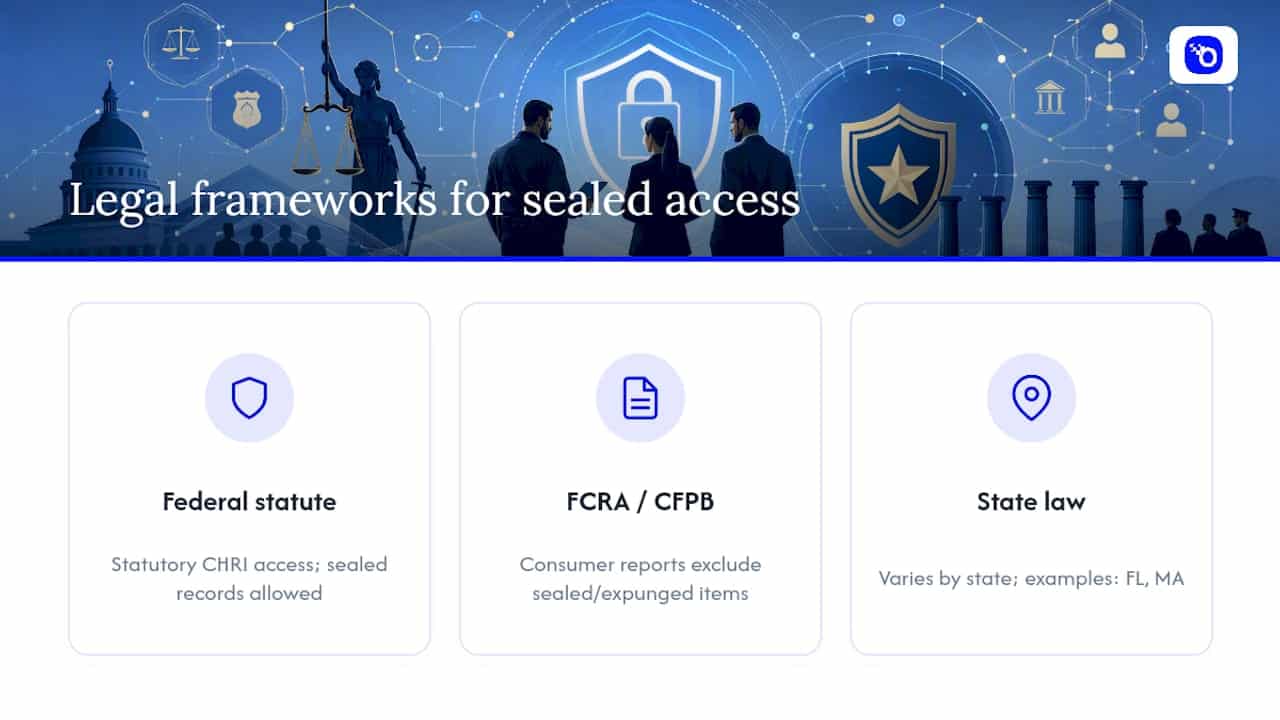
5 U.S.C. § 9101 gives criminal justice agencies, and employers conducting background checks for criminal-justice or public-safety purposes, statutory access to CHRI that includes sealed state records. The exception exists specifically because Congress recognized that sealing a record from the general public is not the same as sealing it from the agencies responsible for vetting people who carry a badge, drive an ambulance, or supervise vulnerable populations.
FCRA and the CFPB’s advisory pull the opposite way for commercial reports. CRAs are required to build “reasonable procedures” that keep sealed and expunged items out of consumer reports altogether. That’s why the background check your recruiting vendor pulls through a standard CRA product will often look cleaner than what a fingerprint-based state or FBI check returns for the same candidate.
State law adds a third layer, and it varies widely. Florida’s FDLE, for example, publishes a specific list of entities entitled to access sealed and expunged records, covering law enforcement agencies, childcare licensing bodies, and eldercare employers among others. Massachusetts runs a comparable CORI framework. If your agency operates across state lines, your legal access to sealed records in one jurisdiction may not transfer to another.
The practical implication for HR: don’t assume uniform access. Confirm your agency’s specific statutory standing state by state, and lean on background check laws for agencies to map where you have authorized access versus where you’d need a certified record request instead.
Which Screening Channels Actually Show a Sealed Record
Not every background check method reaches the same information, and confusing them is where agencies get into trouble.
- Fingerprint-based FBI/NGI and state repository checks. These channels tap directly into law-enforcement databases and often show sealed records when your agency’s statutory access qualifies. Treat results here as authoritative for any high-sensitivity role, and use fingerprint checks in public safety hiring as your baseline for sworn officers, armed security, and custody-adjacent positions.
- Commercial CRAs and open-source internet searches. These are constrained by FCRA and CFPB rules, and they will frequently omit sealed or expunged items by design. They can also surface duplicate, stale, or mismatched entries that lack final disposition. Never treat a clean CRA report as the final word for a public safety hire.
- County-level criminal history searches. Useful as a supplement for lower-sensitivity civilian or administrative roles, but they carry the same disposition gaps as CRA data and shouldn’t substitute for fingerprint checks where the law allows deeper access.
Role sensitivity should dictate which channel you require, not budget or turnaround time alone. A dispatcher with system access to CJIS data warrants the same fingerprint-level scrutiny as a patrol candidate. A volunteer fire department administrative role might reasonably rely on a county check plus a driving record. Our complete guide to criminal record check types breaks down which channel fits which role class in more detail.
Pro Tip: Before you deny a candidate based on an old sealed record that surfaced through a fingerprint channel, confirm the sealing order was actually transmitted to the state repository and the FBI. Sealing orders don’t always propagate automatically, and a candidate may be entitled to request a certified disposition that clarifies exactly what’s on file.
Building a Defensible Adjudication Workflow
Access to a sealed record is only half the equation. What you do with it determines your legal exposure under Title VII, and the EEOC’s Green factors give you the structure to get it right.
- Run a targeted screen. Define, in writing, which offense categories are disqualifying for which specific job duties, tied to actual risk (armed authority, financial access, contact with minors). Avoid blanket exclusions that sweep in every prior record regardless of relevance.
- Trigger an individualized assessment when a targeted screen flags a hit. Notify the candidate, give them a real opportunity to respond, and weigh the Green factors: nature and gravity of the offense, time elapsed, and the specific duties of the job.
- Follow FCRA’s adverse action sequence when a consumer report is involved. That means a pre-adverse action notice with a copy of the report, a real waiting period, then an adverse action notice with a Summary of Rights if you proceed. The EEOC’s own background check guidance walks through these obligations in plain terms.
- Document every step: notice sent, candidate response received, mitigating evidence considered, reviewer name and date.
- Retain records securely and dispose of them on a defined schedule, not indefinitely.
Pro Tip: Build a standing individualized-assessment form rather than improvising language each time. A consistent template is what actually protects you in a disparate-impact claim, because it proves the same factors got applied to every candidate, not just the ones HR remembered to slow down for.
Policy, Vendor Controls, and Recordkeeping That Hold Up to Scrutiny
A screening program that works once but can’t be replicated consistently is a liability waiting to surface in litigation. Four policy elements close that gap: a documented role-based screening matrix, a standing individualized-assessment template, an FCRA procedure map for every step from disclosure to disposal, and a written non-discrimination statement tying your criminal history policy to job relevance.
Vendor contracts deserve the same scrutiny as internal policy. Require your screening vendor to disclose its source lists, confirm sealed and expunged suppression procedures for any consumer-report product, commit to an accuracy service level, and support rechecks with notification if new disposition data appears. The CFPB’s guidance places responsibility for accuracy squarely on the CRA, but agencies still carry the burden of verifying results through government channels whenever a sealed record could be material to the decision.
| Policy Element | What It Should Cover |
|---|---|
| Role-based screening matrix | Which channel (fingerprint, state, county, CRA) applies to which job class. |
| Individualized assessment template | Green-factor analysis, candidate response, reviewer name, and final rationale. |
| Vendor accuracy requirements | Source list disclosure, sealed-record suppression procedures, and recheck triggers. |
| Recordkeeping and disposal | Defined retention period, secure storage, and documented destruction schedule. |
The Real Risk Isn’t Visibility. It’s Inconsistency.
Most of the advice floating around treats sealed records like a mystery HR teams need special access to unlock. That’s backwards. Public safety agencies frequently already have lawful access to sealed criminal history through fingerprint and state repository channels. The actual risk sits downstream of access, in what happens the moment a sealed record shows up on a report.

Agencies that auto-disqualify without running a targeted screen or an individualized assessment are the ones that end up defending Title VII claims, not the ones that saw a sealed record in the first place; consulting California Employment Law Attorneys | Cases We Handle can provide tailored counsel to manage legal risks effectively. The EEOC’s Green factors exist precisely because visibility without process is where disparate-impact exposure lives.
If there’s one thing worth prioritizing above everything else in this article, it’s building the documentation habit before you need it. A screening program that can produce a clean audit trail for every adjudication decision, six months or six years later, is the difference between a defensible hiring process and a costly one. Everything else, channel selection, vendor terms, policy language, exists to support that single outcome.
— Matt
How OMNI Intel Supports Compliant Sealed Records Screening
Running fingerprint-channel checks, CRA reports, individualized assessments, and audit-ready documentation through separate systems is how agencies lose track of exactly what a candidate’s file actually contains. OMNIScreen™ was built for public safety agencies specifically, integrating fingerprint-based repository access with tailored screening packages by role sensitivity, so your law enforcement, fire and EMS, dispatch, and security hiring all runs through one compliant workflow instead of three disconnected vendors.

The platform maps directly to the workflow this article just walked through: role-based screening matrices, individualized-assessment documentation that satisfies the Green factors, and FCRA-aligned adverse action steps built into the process rather than bolted on afterward. Continuous post-hire monitoring extends that same documentation discipline beyond the point of hire, so your agency isn’t starting from zero if a new disposition surfaces later. That combination cuts legal exposure and shortens the time between application and a defensible hiring decision. If your agency needs a screening partner that treats sealed records as a compliance workflow rather than a gray area, start with OMNI Intel’s pre-employment screening services and request a walkthrough of how it fits your current hiring pipeline.
Sources
- 5 U.S.C. § 9101 (definition of criminal history record information)
- CFPB: Fair credit reporting; background screening (2024)
- EEOC Enforcement Guidance on consideration of arrest and conviction records in employment decisions
FAQ
Can Employers See Sealed Records During a Background Check?
Public safety and criminal justice agencies often can, through fingerprint-based FBI and state repository channels authorized under 5 U.S.C. § 9101, but standard commercial CRA reports typically exclude sealed items.
What’s the Difference Between Sealed and Expunged Records for Hiring Purposes?
Sealed records are hidden from public view but can remain accessible to authorized criminal justice agencies, while expunged records are generally destroyed or treated as if they never existed, with fewer legal-access exceptions.
Do Sealed Records Show Up on a Standard Background Check?
Usually not on a commercial CRA-based report, since the CFPB’s 2024 guidance requires CRAs to prevent sealed and expunged records from appearing in consumer reports.
How Should HR Respond If an Applicant Discloses a Sealed Record?
Document the disclosure, run a targeted screen tied to job duties, and if the offense is potentially disqualifying, move to an individualized assessment before making any decision.
Which Public Safety Roles Require Fingerprint-Based Screening Over CRA Checks?
Sworn officers, armed security personnel, dispatch staff with CJIS access, and any role involving custody of vulnerable populations should default to fingerprint-based checks rather than relying on a CRA report alone.
Can OMNI Intel Help Agencies Screen for Sealed Records Compliantly?
Yes. OMNIScreen™ integrates fingerprint-channel access with role-based screening packages and adjudication documentation built for public safety hiring requirements.