

Background Check Turnaround: What HR Should Expect and When to Escalate
Most pre-employment background checks return within 1 to 5 business days. Database and identity searches often finish in minutes to a few hours. Criminal record checks typically take 1 to 3 business days with electronic court access, stretching to 5 to 10 business days or longer when a courthouse requires manual retrieval. Employment and education verification runs 2 to 7 days depending on how responsive the former employer or registrar is. Motor vehicle records generally clear in 1 to 3 days, while drug test turnaround depends on the lab and test type.
If your candidate’s package is running past those windows, do not wait passively. Ask your screening provider for component-level ETAs and whether partial results can be released as each piece clears, rather than holding the entire report until the slowest search finishes.
- Database/identity checks: minutes to a few hours
- Criminal records: 1 to 3 days (electronic) or 5 to 10+ days (manual courthouse)
- Employment/education verification: 2 to 7 days, longer for unresponsive third parties
- MVR: 1 to 3 days
- Drug testing: varies by lab and panel type
Immediate action: request a written breakdown of expected turnaround by component before the check starts, not after it stalls.
Key Takeaways
Background check turnaround depends primarily on court access and third-party responsiveness, but candidate data quality and provider automation are the two levers HR fully controls.
| Point | Details |
|---|---|
| Standard turnaround window | Most complete background checks return in 1 to 5 business days, with database checks finishing in minutes to hours. |
| Court access drives criminal delays | Electronic court access returns results in 1 to 3 days; manual courthouse retrieval can take 5 to 10+ days. |
| Verifications are the slowest component | Employment and education verification take 2 to 7 days, longer for closed employers or international institutions. |
| Escalate at five days of silence | No status update after 5 business days on a routine domestic check is a red flag, not normal timing. |
| OMNI Intel targets public safety turnaround | OMNI Intel’s ATS integration, candidate portals, and real-time status reporting reduce rework specifically for public safety hiring. |
Table of Contents
- Typical Background Check Turnaround Time by Component
- What Actually Drives Turnaround Variation
- Verification Steps That Take Longer, and How to Work Around Them
- Normal Delay Versus a Red Flag Worth Escalating
- How to Shorten Turnaround and Cut Rework
- What the Data Actually Tells Us
- Get Background Checks Built for Public Safety Hiring
- Sources
- FAQ
Typical Background Check Turnaround Time by Component
A background check is not one search. It’s a bundle of separate searches, each with its own turnaround profile, and the slowest one sets the pace for the whole package. Understanding which component you’re waiting on tells you whether a delay is normal or worth a phone call.
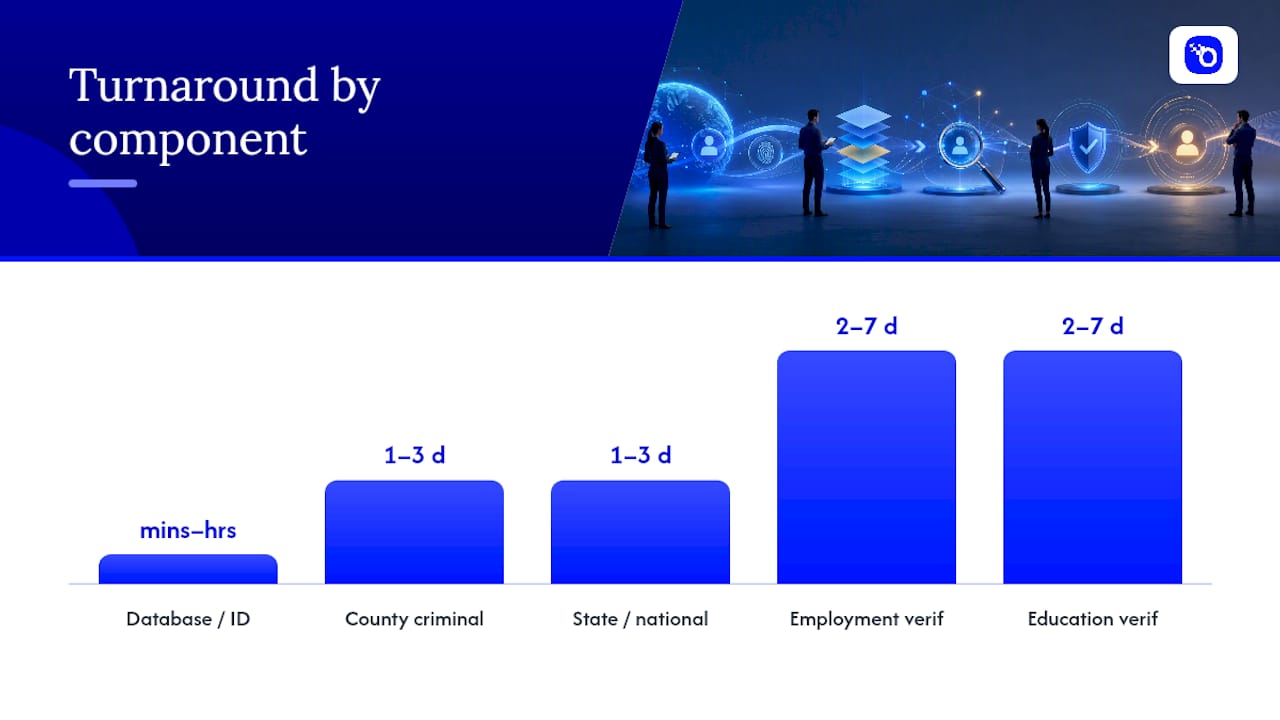
Database searches, including the identity trace and national criminal database sweep, are the fastest piece because they query pre-aggregated records with no human involvement. County criminal searches are the wildcard. Courts with electronic case access return results in 1 to 3 business days, but courts that still require a runner to pull physical files can take 5 to 10 business days or more, especially in rural counties or during court holidays. State repository checks and federal database searches usually land in the 1 to 3 day range regardless of county-level backlogs.
Employment and education verification is where automation makes the biggest visible difference. When a former employer uses an automated verification service, confirmation can return the same day. When HR has to track down a manager by phone or a registrar’s office has to pull paper files, that same check stretches to a week or more. Closed businesses, defunct schools, and international institutions are the slowest cases across the board.
| Component | Typical turnaround | What extends it |
|---|---|---|
| Database/identity trace | Minutes to hours | Rarely delayed |
| County criminal search | 1 to 3 days | Manual court access, rural courts |
| State/national database | 1 to 3 days | Rarely delayed |
| Employment verification | 2 to 7 days | Unresponsive HR contacts, closed employers |
| Education verification | 2 to 7 days | Registrar backlogs, international schools |
| MVR | 1 to 3 days | State DMV processing volume |
| Drug test | Varies by lab | Panel type, retest requirements |
- MVR and drug screening rarely bottleneck a package on their own, but ordering them for roles that don’t require them adds unnecessary scope.
- The types of criminal record checks you order directly determine which court systems get queried and how long the search runs.
What Actually Drives Turnaround Variation
Jurisdiction access is the single biggest lever. A search against a court with a modern electronic case management system behaves nothing like a search against a court that still files paper folders in a basement. That gap explains more turnaround variation than any other factor, and it’s largely outside your control once the candidate’s residence history is set.

Scope compounds the problem. The more counties, states, and verification types a package touches, the higher the odds that at least one of them hits a slow jurisdiction or an unresponsive contact. A candidate with five years at one address in one county is a fast check. A candidate who’s lived in four states and worked for six employers is a slower one, structurally, regardless of provider.
Third-party responsiveness matters just as much. Former HR departments that take a week to respond to a verification request, licensing boards with a backlog, and registrars who only process requests on certain days all extend timing in ways your screening partner can’t force past.
- Court access type (electronic vs. manual) is the largest single variable in turnaround.
- Package scope (counties, states, verification types) multiplies exposure to slow components.
- Third-party response speed from employers, schools, and licensing boards adds unpredictable delay.
- Data quality at intake determines whether a search runs once or has to restart.
- Provider automation (real-time court networks, candidate portals, ATS integration) compresses everything that’s controllable.
Candidate data errors deserve their own callout. A misspelled name, an outdated address, or a missing former alias can force a screening company to re-run a search from scratch, adding days that had nothing to do with courts or third parties.
Pro Tip: Have candidates review their submitted name, aliases, and seven-year address history before you hit submit. A five-minute review at intake avoids the multi-day restart that comes from a mismatched SSN trace.
Verification Steps That Take Longer, and How to Work Around Them
Employment, education, and licensing verifications share a common bottleneck: they depend on someone outside your control picking up the phone or checking an email. Automated verification networks speed this up dramatically for large employers who participate in them, but small businesses, defunct companies, and overseas institutions still rely on manual outreach.
- Employment verification typically confirms dates and title within 2 to 7 days; add time when the former employer only verifies through a specific HR portal or third-party payroll service.
- Education verification follows a similar window but slows further with international institutions, which may require translated transcripts or added privacy documentation.
- License and certification verification depends on the issuing board’s own database speed. Some state boards post real-time license status online; others require a mailed request.
- International checks carry the longest tail. Document authentication, translation requirements, and country-specific privacy law (including consent standards stricter than U.S. norms) can push these searches past two weeks.
Where compliant and appropriate, accepting official transcripts, notarized documents, or candidate-supplied contact confirmations can shorten these steps, since it removes the wait for an institution to respond to a cold outreach request.
- Ask candidates to request their own transcripts in advance when a program allows self-service ordering.
- For international roles, confirm document and consent requirements before the offer stage, not after.
Normal Delay Versus a Red Flag Worth Escalating
A delay tied to a manual courthouse, a holiday week, or an international verification is expected and usually resolves within the outer end of its typical window. What’s not normal is silence.
Treat these as red-flag thresholds:
- No meaningful status update after 5 business days on a routine, domestic-only criminal and database search.
- Repeated slow returns on counties that are known to have electronic access, suggesting a provider-side processing issue rather than a court backlog.
- Vague responses like “still processing” with no estimated completion date or explanation of which component is outstanding.
When you hit one of these, escalate with specific questions: which component is outstanding, is there evidence of a court queue or backlog, can partial results be released now, and what is the realistic completion date. A provider with real visibility into its own pipeline should answer all four without hesitation.
On a routine domestic check, five business days with zero status update is the point to call your provider, not wait another week.

How to Shorten Turnaround and Cut Rework
Most avoidable delay traces back to intake, not courts. Fixing intake fixes more of your timeline than anything else on this list.
- Collect complete candidate data upfront: full legal name, all known aliases, Social Security number, and a complete seven-year address history, with signed authorization secured before the search starts.
- Order role-matched packages only: adding MVR or federal searches to roles that don’t require them expands jurisdictional scope without adding hiring-relevant information.
- Use ATS integration and candidate self-service portals so candidates enter their own information once instead of HR retyping it into a separate system.
- Use live-scan/fingerprint options where your state and role require them, and request partial results as each component clears rather than waiting for the full package.
- Set expectations with hiring managers early: communicate the realistic window for a conditional offer up front so a normal 5 to 10 day court delay doesn’t trigger unnecessary internal pressure.
Pro Tip: Build your conditional offer letter timeline around the slowest component you expect, not the fastest. If a candidate’s address history touches a manual-access county, plan for the 5 to 10 day window from day one instead of being surprised by it later.
Author Credentials and Platform Proof Points
OMNI Intel builds background screening specifically for public safety agencies, law enforcement, fire and EMS, dispatch centers, government entities, non-profits, and private security firms, where turnaround delays carry higher stakes than in general hiring. Its background investigation services combine investigator-driven checks with AI-assisted candidate recruiting tools, built around FCRA compliance and evidence-based hiring decisions.
- ATS integration removes duplicate data entry that causes restarts.
- Candidate portals let applicants supply and correct information directly.
- Real-time status reporting shows exactly which component is outstanding.
Agencies vetting personnel responsible for public safety can’t afford a screening process built on guesswork. Real-time visibility into which component is pending, and why, is what separates a routine delay from an unmanaged one.
What the Data Actually Tells Us
The conventional advice on background check turnaround treats every delay as equally mysterious, as if courts, employers, and providers are all interchangeable black boxes. They aren’t. Court access and third-party responsiveness are structural. They will not improve because you called twice. Candidate data quality and provider automation are the opposite: fully within your control, and the two variables that account for most of the “why is this taking so long” complaints HR actually files.
That distinction should change how you triage a slow check. If the delay is a rural county with paper files, budget for it and move on. If the delay is your own provider giving vague updates on an electronically accessible county, that’s not bad luck, that’s a process problem worth switching over. Most HR teams spend their frustration on the wrong half of that equation, chasing courts they can’t influence while ignoring intake errors and provider reporting gaps they could fix this week. Prioritize the controllable half first. It’s where nearly all of your realistic time savings live.
— Matt
Get Background Checks Built for Public Safety Hiring
General screening vendors treat law enforcement, fire, EMS, and dispatch hiring the same way they treat retail or warehouse hiring: generic packages, generic timelines, no context for the stakes involved. OMNI Intel is built specifically for public safety agencies, with investigator-driven checks that apply law enforcement investigation principles to every applicant, volunteer, and employee.

If your agency needs faster visibility into where a check stands, not just a final PDF weeks later, OMNI Intel’s pre-employment screening services combine ATS integration, candidate portals, and live-scan options to cut the rework that stalls typical packages. The platform also supports continuous post-hire monitoring, so the vetting doesn’t stop at the hire date. If you’re evaluating your current turnaround against what’s realistic for your agency’s role types, start by requesting a walkthrough of OMNI Intel’s background check services and compare it against your last three hiring cycles.
Sources
FAQ
How long does it usually take to hear back from a background check?
Most checks return within 1 to 5 business days, with database searches completing in minutes to hours and manual court or verification components adding several more days.
How can I tell if I passed my background check?
Neither employers nor candidates receive a simple “pass or fail” label; HR reviews the completed report against the role’s specific criteria, so a returned report doesn’t automatically mean disqualification.
Why is my background check taking longer than expected?
The most common causes are manual courthouse access in the candidate’s home county, an unresponsive former employer or school, or a candidate data error that forced the search to restart.
How do I know if I failed a background check?
There’s no universal fail signal; if an employer intends to take adverse action based on report findings, FCRA rules require they notify the candidate and provide an opportunity to dispute inaccurate information before finalizing that decision.