

Risk Mitigation Strategies Every Public Safety Agency Needs
The most effective personnel risk mitigation for public safety agencies rests on ten pillars: structured pre-employment background investigations, credential and reference verification, conditional-offer policies, continuous post-hire monitoring with rescreening and alerts, early warning systems, duty-to-intervene and mandatory-reporting policies, supervisor-led corrective interventions, targeted training and wellness programs, access-control and audit controls for insider threats, and vendor or contingent workforce screening.
Agencies that treat these as a connected system, not a checklist to file away after hiring, cut incidents before they become headlines. The Department of Justice’s COPS office frames recruiting, model policies, enhanced training, supervision, and early warning systems as the core levers for reducing officer and public risk, and that framing holds whether you run a police department, a fire and EMS service, a dispatch center, or a private security firm. The EEOC’s individualized assessment guidance sits alongside those levers as a legal backstop, keeping screening decisions defensible rather than reflexive. OMNI Intel builds its screening and monitoring workflows around exactly this integrated model.
Here is the working list to bring into your next policy review:
- Structured pre-employment background investigations covering criminal history, employment, and credentials
- Credential, license, and reference verification with documented follow-up
- Conditional-offer policies that allow individualized assessment before final hire
- Continuous post-hire monitoring: rescreening cadences plus near-real-time alerts
- Early warning systems tracking complaints, use-of-force, and driving incidents
- Duty-to-intervene and mandatory-arrest-reporting policies with clear escalation
- Supervisor-led, non-punitive corrective interventions before discipline
- Targeted training and wellness programs (EAP, mentorship, retraining)
- Access-control and audit trails to catch insider threats early
- Vendor and contingent workforce screening tied to the same standards as employees.
Key Takeaways
Personnel risk mitigation works best when structured pre-employment screening, continuous monitoring, and supervisor-led early warning response operate as one connected system rather than three separate initiatives.
| Point | Details |
|---|---|
| Sequence, don’t sprawl | Lock down policy and hiring safeguards first, then add continuous monitoring, then scale training and wellness programs. |
| Screen by role sensitivity | Match screening depth and rescreening frequency to job privilege, not department default. |
| Alerts need human review | Route every EWS threshold alert through documented supervisor assessment before any adverse action. |
| Document individualized assessment | Every disqualification and monitoring decision needs a written rationale to satisfy EEOC guidance. |
| Pilot before scaling | OMNI Intel’s screening and continuous monitoring tools let agencies pilot on a high-privilege cohort before committing to agency-wide rollout. |
This article is general information, not a substitute for advice from a qualified lawyer. Consult a qualified legal professional about your own circumstances before acting on anything here.
Table of Contents
- How Do You Prioritize Risk Mitigation Strategies?
- What Should Pre-Employment Background Screening Include?
- How Often Should You Rescreen Employees After Hire?
- What Metrics Belong in an Early Warning System?
- Which Policies Prevent Misconduct Before It Happens?
- Which Training and Wellness Investments Actually Reduce Risk?
- What Is the Implementation Sequence for a Mitigation Program?
- Copyable Templates for Hiring and Monitoring Policies
- A Screening Provider’s View on What Actually Moves the Needle
- How OMNI Intel Supports These Strategies in Practice
- Sources
- FAQ
How Do You Prioritize Risk Mitigation Strategies?
Not every mitigation tactic deserves budget on day one. The agencies that get this right rank risks by impact and likelihood, then sequence their response instead of trying to fix everything simultaneously.
Start by mapping your common personnel risks against consequence. Misconduct and use-of-force incidents carry high impact and, for most agencies, moderate likelihood. Driving safety violations are high likelihood and moderate to high impact depending on the vehicle and cargo. Insider theft or data misuse is lower likelihood but severe impact when it happens, especially for dispatch centers holding sensitive records. Social media reputational risk is high likelihood, lower direct impact, but compounds quickly once a post goes public.
- High impact, high likelihood: patrol misconduct, driving incidents, use-of-force complaints
- High impact, lower likelihood: insider data theft, decertification-level misconduct
- Lower impact, high likelihood: social media policy violations, minor procedural lapses
- Lower impact, lower likelihood: vendor screening gaps, one-off credential lapses
Pro Tip: Prioritize the highest-privilege and highest-exposure roles first, not just your open vacancies. A dispatcher with access to CAD records or a supervisor with hiring authority carries more downside risk than an unfilled entry-level post, even if the entry-level requisition feels more urgent.
A practical sequence:
- Immediate (0 to 30 days): Lock down policy language for duty to intervene, mandatory arrest reporting, and conditional-offer screening.
- Near-term (30 to 90 days): Stand up continuous monitoring and an early warning system pilot on high-privilege roles.
- Programmatic (90 to 180 days): Roll out supervisor training, wellness programs, and vendor screening standards agency-wide.
This 0-90-180 rhythm gives you a pilot phase to prove the model before asking leadership for scale-up funding, which matters more than most compliance officers admit when budget season arrives.
What Should Pre-Employment Background Screening Include?
A defensible pre-employment screening program covers nine components: identity verification, criminal history checks across every jurisdiction a candidate has lived or worked, multi-jurisdictional employment verification, motor vehicle records, financial checks where the role justifies them, social media review within written policy limits, education and credential verification, psychological screening with scenario-based assessments, and fingerprint or state clearance checks where mandated.
The POST Background Investigation Manual requires verification of good moral character, employment history checks spanning at least ten years, and narrative reports tied to specific behavioral screening dimensions. That documentation standard matters as much as the checks themselves. An investigator who calls a former supervisor directly, rather than relying only on an HR database entry, often surfaces integrity signals that never make it into a formal personnel file. Consistent sequencing of those interview steps also protects the agency against disparate-impact claims down the line.
| Job Sensitivity | Recommended Screening Depth | Rescreening Frequency |
|---|---|---|
| Low (administrative, non-sworn support) | Identity, criminal history, employment verification | Every 2 to 3 years |
| Medium (fire, EMS, dispatch) | Full criminal search, MVR, credential verification, reference calls | Annual |
| High (patrol, supervisors, armed security) | Multi-jurisdiction criminal search, a comprehensive employment history, psychological testing, continuous monitoring | Continuous plus annual review |
Sample disqualifiers should be specific enough to defend in an audit: a felony conviction for a violent offense, a sustained internal-affairs finding of dishonesty at a prior agency, or decertification by another state’s licensing board. The APTA recommended practice for transit security screening recommends anchoring disqualifiers to an approved list of offenses and maintaining a redress process, a model that translates cleanly to law enforcement and private security hiring.
- Felony conviction for violent crime or crimes involving moral turpitude
- Sustained finding of dishonesty, excessive force, or evidence tampering at a prior employer
- Decertification from a peace officer standards board in any state
- Falsification of application materials or credentials
Every conditional offer should include a short compliance note: “This offer is conditional on completion of background investigation, including individualized assessment of any disqualifying history consistent with EEOC guidance.” That single sentence, filed with the candidate record, does more to protect an agency in a later audit than pages of boilerplate.
How Often Should You Rescreen Employees After Hire?
Post-hire risk mitigation combines two distinct practices: periodic rescreening, which rechecks records on a set schedule, and continuous monitoring, which delivers near-real-time alerts when something changes. The National Insider Threat SIG’s continuous screening guide recommends running both together rather than choosing one.
Monitor these data streams:
- Arrest bookings and court filings, including out-of-jurisdiction cases
- Motor vehicle record changes for driving-eligible roles
- Certification and license expirations
- Public social media activity, reviewed under written policy boundaries
- Internal performance metrics logged by supervisors
- Credential status changes reported by licensing boards
Recommended cadences vary by role. Driving positions warrant an MVR pull every six months. High-privilege roles, including patrol officers and dispatch supervisors, benefit from continuous monitoring paired with an annual psychological check-in. Every staff member, regardless of role, should have credential status verified at least annually.
- Set the monitoring cadence by role sensitivity, not by department default.
- Route every alert through a documented supervisor review before any adverse action.
- Retain records of each review to demonstrate individualized assessment.
Pro Tip: Write your mandatory-reporting policy so officers and staff must disclose any arrest within 24 to 48 hours, off-duty or on. Pair that clause with a stated review process so the policy reads as accountability, not as a trigger for automatic termination.
Continuous monitoring technology now allows agencies to catch life-event changes that increase risk well before they escalate into incidents. That speed only holds value if paired with EEOC-aligned individualized review, so an alert never substitutes for a documented human judgment call.

What Metrics Belong in an Early Warning System?
Early warning systems work best as what researchers call a “check engine light” for personnel, flagging patterns early enough for supportive, non-punitive intervention before formal discipline enters the picture. The metrics that predict risk most reliably include use-of-force incidents, citizen complaints, pursuit events, vehicle collisions, sick-leave spikes, training failures, and supervisor-logged near-misses.
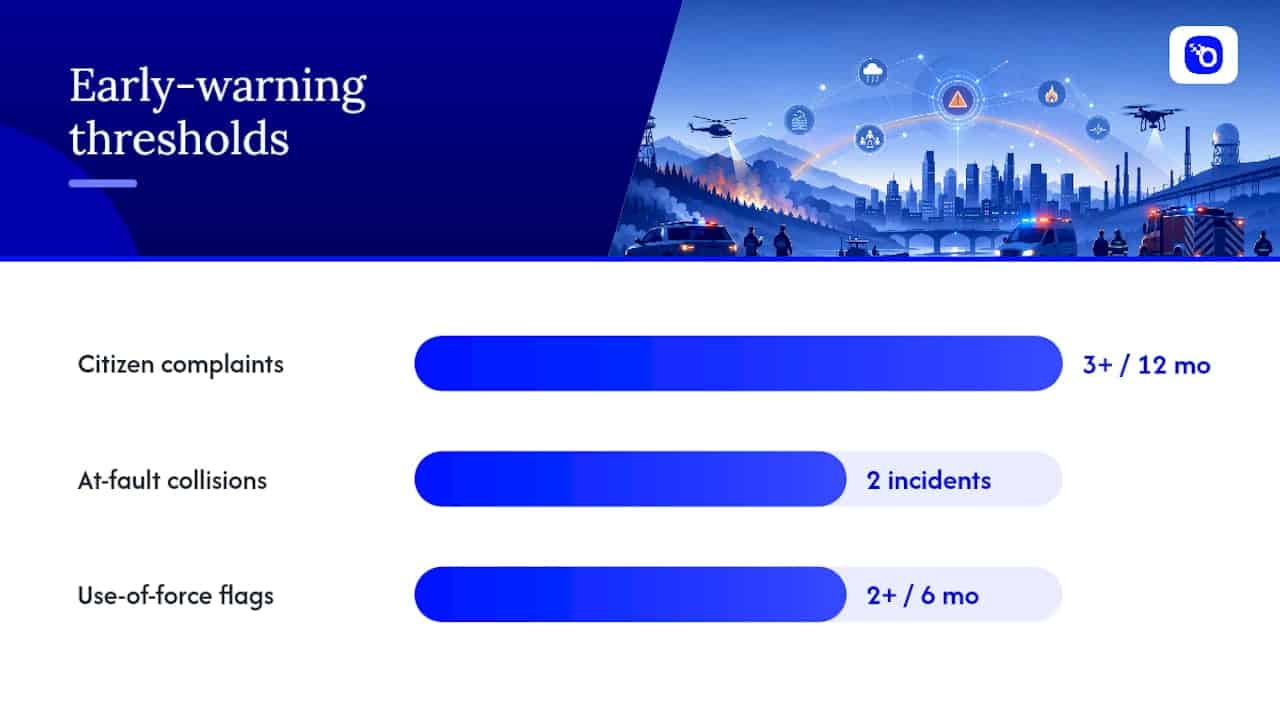
| Metric | Illustrative Threshold | Suggested Follow-Up |
|---|---|---|
| Citizen complaints | 3 or more in a 12-month window | Supervisor review and coaching conversation |
| Vehicle collisions (at-fault) | 2 incidents in a recent period | Defensive driving retraining, MVR reverification |
| Sick-leave spikes | 20% increase over rolling 90-day average | Wellness check-in, EAP referral offer |
| Use-of-force incidents | 2 or more flagged for review in 6 months | Case review board, scenario retraining |
These thresholds are illustrative starting points, not fixed rules. Every agency should calibrate them against its own baseline before treating a number as an automatic trigger. The DOJ COPS guidance also recommends tracking officer injuries, sick leave, retention, and EAP usage as operational indicators of accumulating stress or risk.
- Alert fires when a threshold is crossed
- Supervisor conducts a documented assessment within a set window
- Supportive intervention follows: mentorship, retraining, or an EAP referral
- Escalation to administrative review only if no improvement follows
Picture a mid-career patrol officer who logs two at-fault collisions and a rise in citizen complaints inside the same quarter. The workflow starts with a supervisor conversation, not a disciplinary file. If defensive driving retraining and a coaching session resolve the pattern, the case closes there. If the pattern persists past a second review cycle, it escalates to a formal fitness-for-duty conversation. That sequencing protects morale while still building a documented record.
Which Policies Prevent Misconduct Before It Happens?
Policy language does the heavy lifting between screening and monitoring. Five elements belong in every personnel risk policy: duty to intervene, duty to report, mandatory disclosure of arrests with a fair-review process, defined social media boundaries, and a clear escalation path for allegations.
Sample clause for duty to intervene: “Any employee who observes a colleague engaging in conduct that violates agency policy or endangers public safety shall intervene when safe to do so and report the incident to a supervisor within the same shift.”
Sample clause for contingent workforce: “Vendor personnel with access to facility, data, or personnel systems shall undergo screening equivalent to agency employees and remain subject to ongoing monitoring for the duration of the contract.”
- Least-privilege access: employees see only what their role requires
- Role-based access reviewed at least annually
- Audit logs tied to supervisory sign-off, not just IT record-keeping
- Periodic privilege reviews timed to promotions, transfers, and role changes
The SEI/CMU insider threat guidance is clear that programs only work when policy and enforcement move together. Proactive policy without consistent enforcement is paperwork; enforcement without clear policy is arbitrary. Investigations tied to policy violations need a stated timeline, typically 30 to 60 days for a standard case, with records preserved for the full retention period your state mandates for personnel files.
- Document the alleged violation and the policy section it implicates
- Assign an investigator independent of the employee’s direct chain when possible
- Set an investigation deadline and communicate it to all parties
- Preserve records per your state’s retention schedule for compliance audits
Agencies building or refreshing these clauses can start from public safety policy examples already adapted for law enforcement, fire and EMS, and private security contexts.
Which Training and Wellness Investments Actually Reduce Risk?
Training dollars go furthest when aimed at five interventions: scenario-based de-escalation training, supervisor risk-identification training, mental-health check-ins, EAP access, and structured peer mentoring. Reality-based scenario training in particular gives officers and security personnel muscle memory for situations that classroom instruction alone rarely reaches, a point reality-based training programs emphasize for bylaw and enforcement personnel facing unpredictable field conditions.
- De-escalation scenario training: quarterly, all sworn and field staff
- Supervisor risk-identification training: twice yearly, all supervisory ranks
- Mental-health check-ins: annual minimum, more frequent for high-exposure roles
- EAP access: available continuously, promoted actively rather than buried in a handbook
- Peer mentoring: paired within the first year of hire and after any EWS intervention
- Define target audience and frequency for each program
- Track pass rates and completion, not just attendance
- Report incident reduction, time-to-intervention, and EAP referral rates to leadership quarterly
Coaching, retraining, and fitness-for-duty assessments function as mitigation steps inside the early warning workflow, not as punishment. An agency that treats retraining as the default first response, reserving discipline for repeat or severe cases, tends to see better morale and lower attrition over time.
What Is the Implementation Sequence for a Mitigation Program?
Rolling out personnel risk mitigation follows five gates: assessment, policy, tools, training, and review. Skipping a gate to move faster almost always costs more time later, when a policy gap surfaces mid-audit.
- Assessment: HR and internal affairs jointly map current screening depth, monitoring gaps, and policy language against the framework above.
- Policy: Legal counsel and compliance finalize duty-to-intervene, mandatory-reporting, and access-control language.
- Tools: Operations selects screening and monitoring platforms, prioritizing integration with existing HR systems.
- Training: Supervisors complete EWS response training before the pilot goes live.
- Review: Leadership evaluates pilot metrics at day 90 to decide on scale-up.
| Timeline | Activity | Owner |
|---|---|---|
| Day 0 to 30 | Gap assessment, policy drafting | HR, internal affairs, legal |
| Day 30 to 90 | Tool selection, supervisor training, pilot launch | Operations, HR |
| Day 90 to 180 | Metric review, scale decision, budget request | Leadership, compliance |
Minimum evidence to justify scale-up: measurable reduction in high-risk incidents, faster time-to-detect on flagged patterns, documented supervisor compliance with review timelines, and staff feedback on whether interventions felt supportive rather than punitive. A strategic hiring risk mitigation guide walks through this same gate structure in more detail for agencies building their first pilot proposal.
Copyable Templates for Hiring and Monitoring Policies
A few short, ready-to-adapt clauses save weeks of drafting time.
- Conditional offer: “This offer of employment is conditioned upon successful completion of a background investigation, including verification of criminal history, employment, and credentials, consistent with applicable individualized assessment requirements.”
- Mandatory arrest disclosure: “Employees must report any arrest, citation, or criminal charge to their supervisor within 48 hours, regardless of employment status at the time.”
- EWS response step: “Upon threshold alert, the assigned supervisor will complete a documented review within five business days and recommend a supportive intervention prior to any consideration of formal discipline.”
- Vendor screening clause: “Contracted personnel with facility or data access shall complete equivalent background screening and remain subject to the agency’s continuous monitoring program for the contract term.”
Background files should retain the application, screening results, narrative investigator notes, conditional-offer documentation, and any EWS review records, held for the period your state’s public records and personnel retention rules require. Screening decision language should always reference individualized assessment: “This disqualification reflects a review of the nature of the offense, time elapsed, and relevance to the duties of the position,” rather than a blanket exclusion rule.
A Screening Provider’s View on What Actually Moves the Needle
Working across public safety hiring pipelines, a few patterns repeat often enough to call out directly.
- Agencies overinvest in the initial background check and underinvest in what happens in year two and three, when most preventable incidents actually occur.
- The metrics that predict risk best are rarely dramatic: sick-leave patterns and minor complaint frequency tend to surface problems before a major incident does.
- The most common EEOC misstep isn’t ignoring individualized assessment, it’s documenting it inconsistently, so a defensible decision looks arbitrary on paper.
Pro Tip: Pair every early warning alert with a supervisor conversation before any system-generated flag reaches a personnel file. That single step cuts false positives and keeps staff trust in the system intact, since employees start seeing alerts as support rather than surveillance.
The agencies that get the best return treat screening and monitoring as one continuous system rather than a pre-hire event followed by silence. That shift in mindset matters more than any single tool.
How OMNI Intel Supports These Strategies in Practice
Every strategy above depends on execution, and execution is where most agencies lose momentum between the policy draft and the pilot launch. OMNI Intel builds pre-employment investigations, OMNIScreen background packages, and continuous post-hire monitoring specifically for public safety hiring, so the screening depth in the table above and the monitoring cadence in the post-hire section become configurable settings rather than manual spreadsheets.

The platform’s applicant screening integration connects directly to existing HR and applicant tracking workflows, so a policy-based rescreening trigger, say, an annual credential check or a six-month MVR pull, runs automatically instead of depending on someone remembering to schedule it. Agencies piloting continuous monitoring on a high-privilege cohort, patrol supervisors or dispatch staff with system access, typically report faster incident detection and less manual chasing of court and license records compared to a manual quarterly review process.
If your agency is ready to move from policy draft to working pilot, start with OMNI Intel’s pre-employment screening services built specifically for law enforcement, fire and EMS, dispatch, and private security hiring.
Sources
- Risk Management in Law Enforcement: Discussions on Identifying and Mitigating Risk for Officers, Departments, and the Public (DOJ COPS)
- A Guide For Employers To Implement Continuous Screening Program (National Insider Threat SIG)
- Background Investigation Manual (POST)
- Early Intervention Systems (EIS) research and guidance
- 5 best practices to prevent insider threat (SEI/CMU blog)
FAQ
What Are the Most Effective Personnel Risk Mitigation Strategies?
Structured pre-employment screening, continuous post-hire monitoring, and early warning systems paired with supervisor-led intervention consistently show the strongest results for public safety agencies.
How Is Rescreening Different From Continuous Monitoring?
Rescreening is a periodic recheck on a fixed schedule, while continuous monitoring delivers near-real-time alerts when a data source, like an arrest record or license status, changes.
How Often Should High-Privilege Roles Be Rescreened?
High-privilege roles, including patrol officers and supervisors, benefit from continuous monitoring paired with at least an annual psychological check-in, while driving-eligible roles warrant an MVR pull every six months.
Does OMNI Intel Handle Both Pre-Hire Screening and Post-Hire Monitoring?
Yes. OMNI Intel provides pre-employment background investigations and continuous post-hire monitoring built specifically for law enforcement, fire and EMS, dispatch, and private security agencies.
What Should an Early Warning System Track?
Reliable early warning metrics include citizen complaints, use-of-force incidents, at-fault vehicle collisions, sick-leave spikes, and supervisor-logged near-misses, each tied to a documented supervisor review step.