
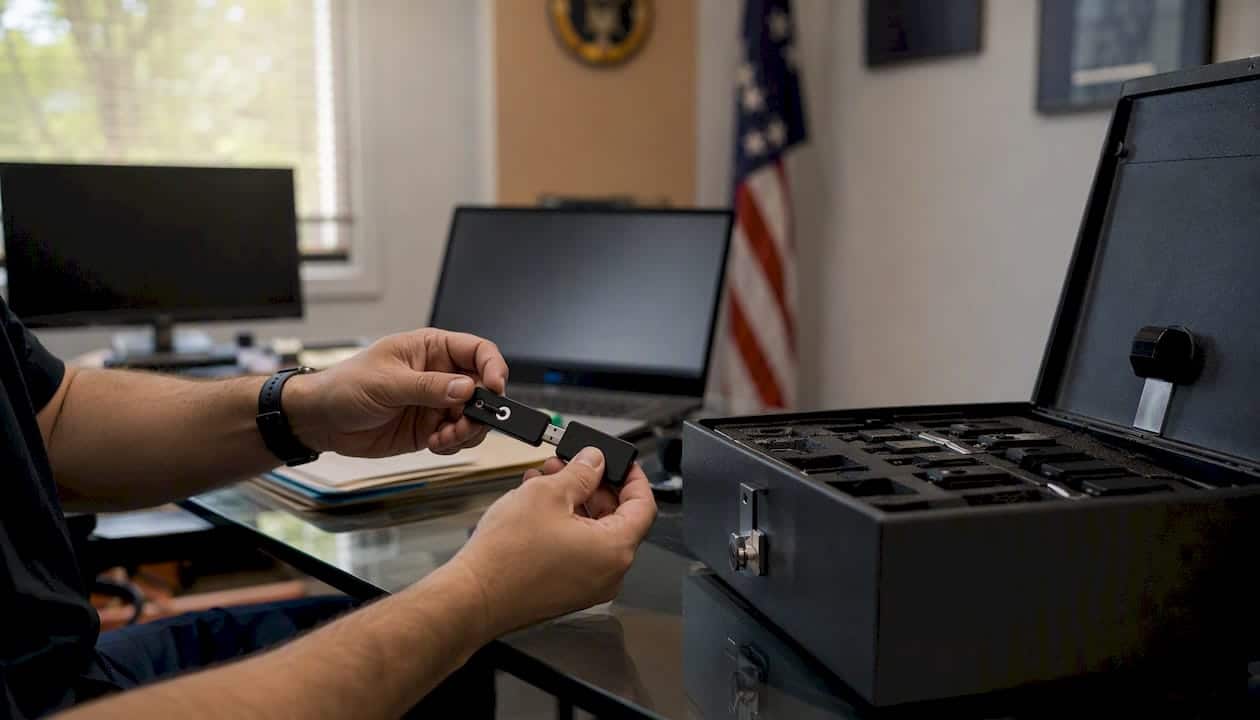
Employee Monitoring Benefits for Public Safety Agencies
Continuous post-hire monitoring and pre-employment screening together deliver the most defensible personnel risk program available to public safety agencies. For law enforcement, fire and EMS, dispatch centers, municipalities, non-profits, and private security firms, the core benefits are:
- Reduced insider risk and community harm — behavioral and status changes are detected before they escalate to misconduct or liability events.
- Higher hiring quality — FCRA-compliant, investigator-driven background checks surface disqualifying history that automated database pulls miss.
- Faster investigations — a documented evidence trail cuts time-to-action for internal affairs and POST board notifications.
- Liability reduction — documented monitoring records demonstrate due diligence in civil litigation and agency audits.
- Integrity preservation — continuous screening catches post-hire license revocations, criminal charges, and social media conduct that pre-hire checks cannot predict.
- Compliance confidence — programs built around FCRA obligations and state POST requirements, such as those outlined in the Minnesota POST hiring checklist, withstand regulatory scrutiny.
OMNI Intel’s public-safety-specific platform is designed to deliver all six outcomes through integrated pre-hire and post-hire workflows.
Key Takeaways
Continuous post-hire monitoring combined with FCRA-compliant pre-employment screening is the most defensible personnel risk strategy available to public safety agencies today.
| Point | Details |
|---|---|
| Monitor continuously, not just at hire | Post-hire status changes, criminal charges, and conduct issues require ongoing detection, not a one-time check. |
| Build on a legal foundation | Written policy, consent documentation, purpose limitation, and FCRA adverse-action procedures are non-negotiable before launch. |
| Use the 7-step checklist | Sequential implementation with defined owners and a pilot cohort reduces rollout risk and accelerates time to value. |
| Track credible alert rate | A credible alert rate above 30% signals well-calibrated detection rules; below 10% indicates threshold problems. |
| OMNI Intel as your platform | OMNI Intel provides integrated pre-hire and post-hire monitoring, FCRA-compliant workflows, and a public-safety-specific implementation playbook. |
Table of Contents
- Benefits of Employee Monitoring in Public Safety: What Each One Looks Like in Practice
- How Monitoring Works in Public Safety: Signals, Tools, and Workflows
- Legal, Privacy, and Ethical Guardrails Agencies Must Observe
- A 7-Step Implementation Checklist for Public Safety Agencies
- Metrics That Prove the Program Is Working
- Operational Risks and How to Mitigate Them
- How to Evaluate Monitoring Vendors and Why OMNI Intel Fits
- What Experienced Public Safety Screening Specialists Recommend
- OMNI Intel: Built for Public Safety Monitoring from Day One
- Sources
- FAQ
Benefits of Employee Monitoring in Public Safety: What Each One Looks Like in Practice
Each benefit above maps to a concrete operational outcome. Understanding that mapping is what separates a defensible program from a compliance checkbox.
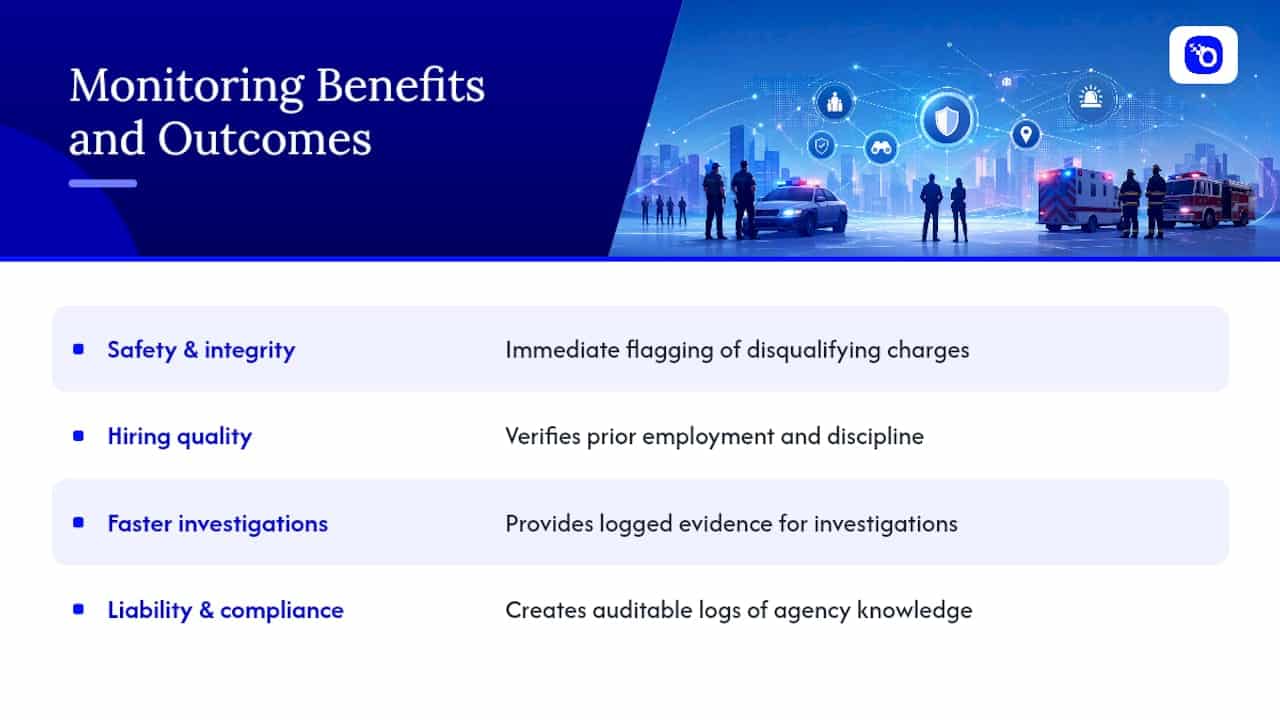
Safety and integrity. A patrol officer who acquires a disqualifying criminal charge six months after hire represents an insider risk that a one-time background check will never catch. Continuous monitoring flags that charge the moment it appears in court records, giving command the evidence needed to act before the officer responds to a call. For dispatch centers, the same logic applies to personnel with access to sensitive location data.
Hiring quality. Investigator-driven checks go beyond database queries. They verify employment history through direct contact, review personnel files from prior agencies, and surface patterns of discipline that a name-and-SSN search cannot find. Pairing pre-employment screening with post-hire monitoring closes the gap between what a candidate discloses and what the record actually shows.
Faster investigations. When an internal affairs inquiry opens, a monitoring program that has been logging access anomalies, overtime irregularities, and complaint trends gives investigators a ready evidence package rather than a blank file. That compression of time-to-evidence is operationally significant: it shortens the administrative leave period, reduces legal exposure, and accelerates POST board notification where required.
Liability reduction and compliance confidence. Civil plaintiffs in negligent-retention cases ask one question: what did the agency know, and when? A documented monitoring record answers that question. Agencies that follow background check best practices and maintain auditable logs are in a materially stronger position than those relying on annual performance reviews alone.
How Monitoring Works in Public Safety: Signals, Tools, and Workflows
Understanding the mechanism helps decision makers set realistic expectations and design detection rules that actually surface risk.
Detection-to-action workflow
The OMNI Intel process guide maps this flow in detail, but the core sequence is:
- Data collection — automated pulls from court records, licensing databases, and integrated HR/ATS systems.
- Automated detection — rule-based alerts trigger when a signal crosses a defined threshold.
- Human triage — a trained reviewer assesses context, eliminates false positives, and classifies alert severity.
- Investigatory evidence package — confirmed alerts are compiled into a documented file ready for internal affairs, command, or POST notification.
Integration points include applicant tracking systems, HRIS platforms, and evidence management systems. OMNI Intel’s monitoring workflow playbook covers the specific API and data-feed connections agencies commonly need.
Pro Tip: Configure detection rules by role, not by department. An evidence technician’s access-log thresholds should differ from a patrol officer’s. Role-based rules reduce false positives and make human triage faster.
Legal, Privacy, and Ethical Guardrails Agencies Must Observe
A monitoring program that lacks a defensible legal foundation creates the very liability it is meant to prevent. The following checklist covers the non-negotiable policy elements.
- Written policy and notice — employees must receive written notice of what is monitored, why, and how findings are used. Many state POST boards require this documentation.
- Consent for specific checks — social media review and certain third-party data pulls require explicit written consent under state law and FCRA guidelines. The Minnesota POST hiring checklist includes a consent section that serves as a model for other jurisdictions.
- Purpose limitation — monitoring data collected for integrity purposes must not be repurposed for performance management without a separate policy basis.
- Role-based access — only personnel with a documented need (internal affairs, HR, command) should access monitoring data. Broad access erodes trust and creates chain-of-custody problems.
- Data retention and disposal — define retention periods aligned with your state’s POST requirements and litigation hold obligations. Dispose of data on schedule and document the disposal.
- FCRA obligations — when monitoring data is used in an adverse employment action, FCRA’s pre-adverse and adverse action notice requirements apply. This is frequently overlooked in post-hire contexts.
- POST board notification — when disqualifying conduct is discovered, most state POST boards require prompt notification. Document the date and method of notification in the personnel file.
Pro Tip: Pair your monitoring policy with a confidential reporting path. Employees who can report concerns without fear of retaliation surface problems faster than automated systems alone, and CISA guidance on insider threat programs explicitly recommends this combination of monitoring with awareness and education.
A 7-Step Implementation Checklist for Public Safety Agencies
OMNI Intel’s 7-step monitoring checklist provides a ready template. The sequence below maps each step to an owner and a realistic time-to-value estimate.
-
Get leadership buy-in and adopt a written policy (Owner: Chief/Director + Legal; Timeline: Weeks 1–3) — without command-level endorsement, monitoring programs stall at the first union or civil liberties challenge. Document the policy rationale and tie it to the agency’s existing code of conduct.
-
Map data sources and system access (Owner: IT + HR; Timeline: Weeks 2–4) — inventory every data source the program will draw from: court records feeds, HRIS, CAD, evidence management, and licensing databases.
-
Define detection rules and thresholds (Owner: Internal Affairs + HR; Timeline: Weeks 3–5) — set role-specific alert thresholds. Avoid one-size-fits-all rules that generate noise and erode reviewer confidence.
-
Integrate with HR, ATS, and evidence systems (Owner: IT + Vendor; Timeline: Weeks 4–8) — connect monitoring feeds to existing platforms. OMNI Intel’s monitoring process guide details standard integration patterns for public safety environments.
-
Set human review and escalation workflows (Owner: Internal Affairs + Command; Timeline: Weeks 5–7) — define who reviews alerts at each severity level, what documentation is required, and when POST notification is triggered.
-
Pilot with a small cohort (Owner: HR + Internal Affairs; Timeline: Weeks 6–10) — run the program on a defined group (a single unit or shift) before agency-wide rollout. Measure false-positive rate and time-to-triage.
-
Scale and measure (Owner: HR + Command; Timeline: Month 3 onward) — expand to the full agency, track KPIs (see Section 6), and review detection rules quarterly.
Pro Tip: Document every POST board notification made during the pilot. That paper trail demonstrates program maturity to auditors and strengthens your position if a personnel action is later challenged.
Metrics That Prove the Program Is Working
Operational Risks and How to Mitigate Them
| Risk | Impact | Mitigation |
|---|---|---|
| False positives | Morale damage, wrongful discipline claims | Role-specific thresholds; mandatory human triage before any action |
| Trust and morale erosion | Reduced retention, union grievances | Transparent written policy; employee education at rollout |
| Mission creep | Legal exposure, policy violations | Purpose-limitation clause in policy; quarterly access audits |
| Evidence handling failures | Inadmissible findings, litigation risk | Chain-of-custody documentation; role-based data access |
| Data security vulnerabilities | Breach of sensitive personnel data | Encryption at rest and in transit; vendor SOC 2 certification |
The non-obvious pitfall: agencies that rely only on annual audits leave months-long windows of undetected risk. A confidential, fast-track reporting mechanism for staff concerns is a high-leverage addition that formal programs frequently omit. Algorithms can surface behavioral patterns invisible to human reviewers, but without clear use policies and transparency, even accurate findings can damage organizational trust.
For a structured approach to managing personnel risk, OMNI Intel’s risk management guide covers these mitigations in depth.
How to Evaluate Monitoring Vendors and Why OMNI Intel Fits
Use these criteria when issuing an RFP or evaluating a shortlist.
- Primary benefit delivered — does the vendor address integrity and insider risk, or primarily productivity and time-tracking? Public safety agencies need the former.
- Who benefits — confirm the platform serves HR, command, and internal affairs, not just IT or a single department.
- Implementation effort and time to value — ask for a documented pilot timeline and references from agencies of comparable size and type.
- Compliance and privacy posture — request evidence of FCRA compliance procedures, data retention controls, and role-based access architecture.
- Total cost of ownership — include integration costs, training, and ongoing support in the comparison, not just the subscription fee.
RFP questions to include: How does the platform handle POST board notification requirements? What is the documented false-positive rate across public safety clients? What SLAs govern data breach notification? Can the platform integrate with our existing ATS and evidence management system?
OMNI Intel maps directly to these criteria. Its public safety background investigations platform combines pre-employment screening with continuous post-hire monitoring, integrates with recruiting and HR workflows, and is built around FCRA compliance and investigator-driven evidence standards. The monitoring best practices guide and implementation playbook give procurement teams documented proof of process maturity.
Pro Tip: Request a sample evidence package from any vendor you are evaluating. A vendor that cannot show you what an escalated alert looks like in practice has not built the workflow public safety internal affairs actually needs.
What Experienced Public Safety Screening Specialists Recommend
The conventional wisdom in public safety HR is that a thorough pre-employment background check is the primary risk control. That framing is incomplete, and agencies that rely on it exclusively are accepting a risk they may not have quantified.
Personnel change after hire. Financial stress, relationship breakdowns, and ideological shifts do not appear in a background file dated three years ago. The agencies that have the strongest integrity records are not necessarily the ones with the most rigorous pre-hire processes. They are the ones that treat screening as a continuous function, not a one-time gate.
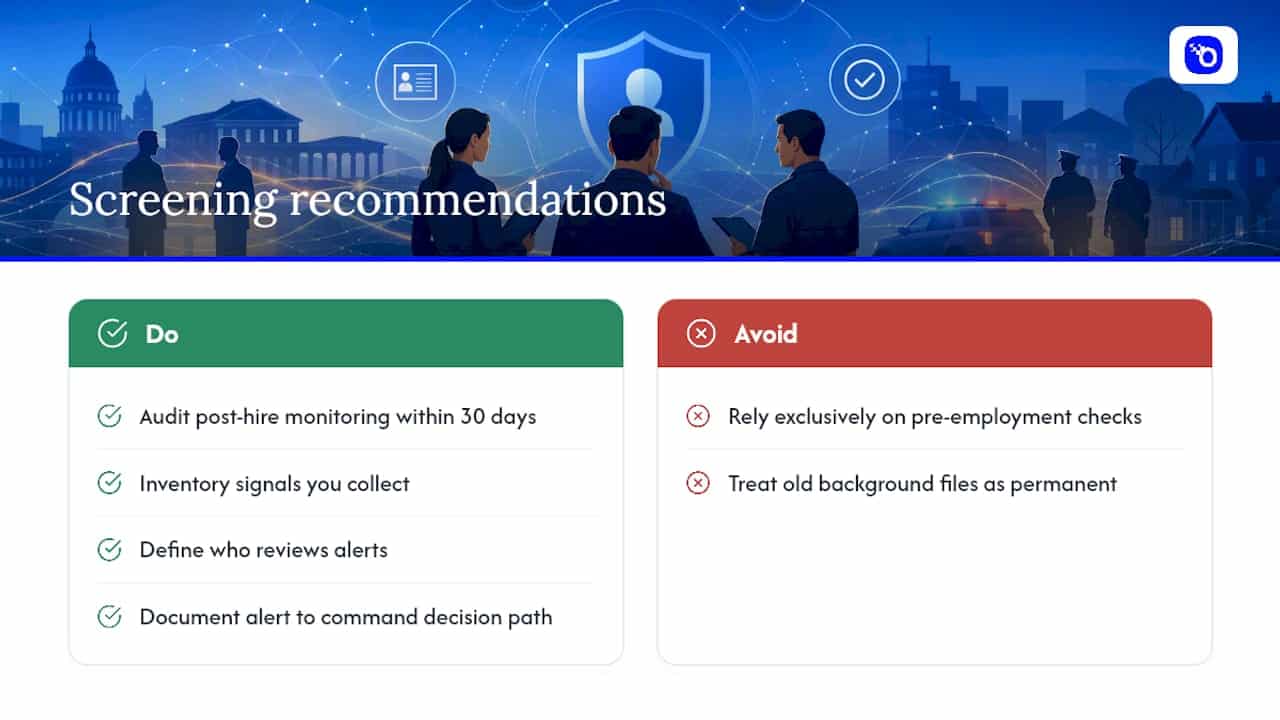
The single most useful action you can take in the next 30 days is to audit your current post-hire monitoring posture: what signals are you actually collecting, who reviews them, and what is the documented path from alert to command decision? Most agencies discover they have no formal answer to the third question. Fixing that gap, before a misconduct event forces the question, is where the real risk reduction lives.
OMNI Intel: Built for Public Safety Monitoring from Day One
Public safety agencies need more than a generic HR monitoring tool. OMNI Intel delivers integrated pre-employment screening and continuous post-hire monitoring purpose-built for law enforcement, fire and EMS, dispatch centers, municipalities, non-profits, and private security firms.

The platform maps directly to the 7-step checklist above: from policy design and data-source integration through automated detection, human triage, and POST-ready evidence packaging. Every workflow is built around FCRA compliance, role-based access, and the investigator-driven standards public safety procurement teams require.
Ready to see how it fits your agency? Request a pilot and get a copy of OMNI Intel’s 7-step monitoring checklist tailored to your agency type.
Sources
- Background Investigation and Hiring Checklist (Minnesota POST) Rev 10-2025
FAQ
What are the main benefits of employee monitoring for public safety agencies?
Continuous monitoring reduces insider risk, accelerates internal investigations, improves hiring quality, and creates auditable evidence trails that support POST board notifications and civil litigation defense.
Is post-hire employee monitoring legal for law enforcement agencies?
Yes, when implemented with a written policy, appropriate consent, purpose limitation, and FCRA-compliant adverse-action procedures. State POST requirements, such as those in the Minnesota POST hiring checklist, provide additional jurisdiction-specific guidance.
How long does it take to implement a monitoring program?
A structured pilot using a 7-step checklist typically reaches initial operation within 8–10 weeks, with full agency-wide deployment by month three, depending on integration complexity.
What signals should a public safety monitoring program track?
Core signals include POST certification status, new criminal charges, access-log anomalies, complaint and discipline trends, attendance pattern changes, and social media conduct where state law and agency policy permit.
How does OMNI Intel support continuous post-hire monitoring?
OMNI Intel combines pre-employment screening with continuous post-hire monitoring, integrates with existing HR and ATS platforms, and provides FCRA-compliant workflows, role-based access controls, and POST-ready evidence packaging for public safety agencies.