

Trustonics.com Alternatives for Public Safety Hiring
For U.S. public safety agencies evaluating trustonics.com alternatives, the right answer is a vendor that combines defensible, documentation-heavy pre-employment investigations with continuous post-hire monitoring and CJIS-compatible data handling. OMNI Intel is built specifically for that requirement.
Your 72-hour action plan:
- Require now: Defensible case files with narrative reports, standardized evaluation dimensions (integrity, impulse control, decision-making), and continuous criminal and MVR monitoring with documented alert workflows.
- Immediate next step: Send finalists a vendor checklist and request sample SLAs plus a redacted investigation file within 48 hours.
- Selection criterion: Any vendor that cannot produce a redacted case file, a monitoring alert log, and a written CJIS or FCRA process statement during the demo should be removed from consideration.
Table of Contents
- What do U.S. public safety agencies need from screening and monitoring?
- What features should you require when comparing screening vendors?
- How does OMNI Intel satisfy the vendor checklist?
- How do you implement a new screening and monitoring vendor?
- What legal and compliance requirements apply to public safety screening?
- What drives cost and how should you structure procurement?
- Key Takeaways
- Why public safety hiring demands a different standard
- OMNI Intel: built for the standard public safety agencies must meet
- Useful sources for procurement and compliance teams
- FAQ
What do U.S. public safety agencies need from screening and monitoring?
Public safety agencies carry a legal and ethical obligation that most private employers do not: every hiring decision is subject to POST compliance inspections, civil litigation, and public scrutiny. The core outcomes hiring leaders must insist on are defensible documentation for audits, consistent suitability evaluations across candidates, and ongoing visibility into post-hire risk.
POST guidance frames background investigations as investigative work, not checkbox exercises. Narrative reports and original supporting documents materially strengthen audit defensibility in ways that automated database pulls alone cannot replicate.
The mandatory investigation elements agencies commonly require include:
- Education and employment verification with direct source contact
- Social media and open-source review
- Disciplinary records and prior complaint outcomes from previous law enforcement or corrections employers, as required under WAC 139-07-020
- Reference interviews with structured, documented responses
- Firearm eligibility checks where the role requires it
- Criminal history at county, state, and federal levels
Pro Tip: When drafting your RFP, include this language: “Vendor must provide one redacted sample investigation file and a written data retention policy specifying retention periods for unsuccessful candidates.” Minnesota POST requires retaining background documentation for six years for candidates not hired. Your RFP should confirm the vendor can meet or exceed that standard.
What features should you require when comparing screening vendors?
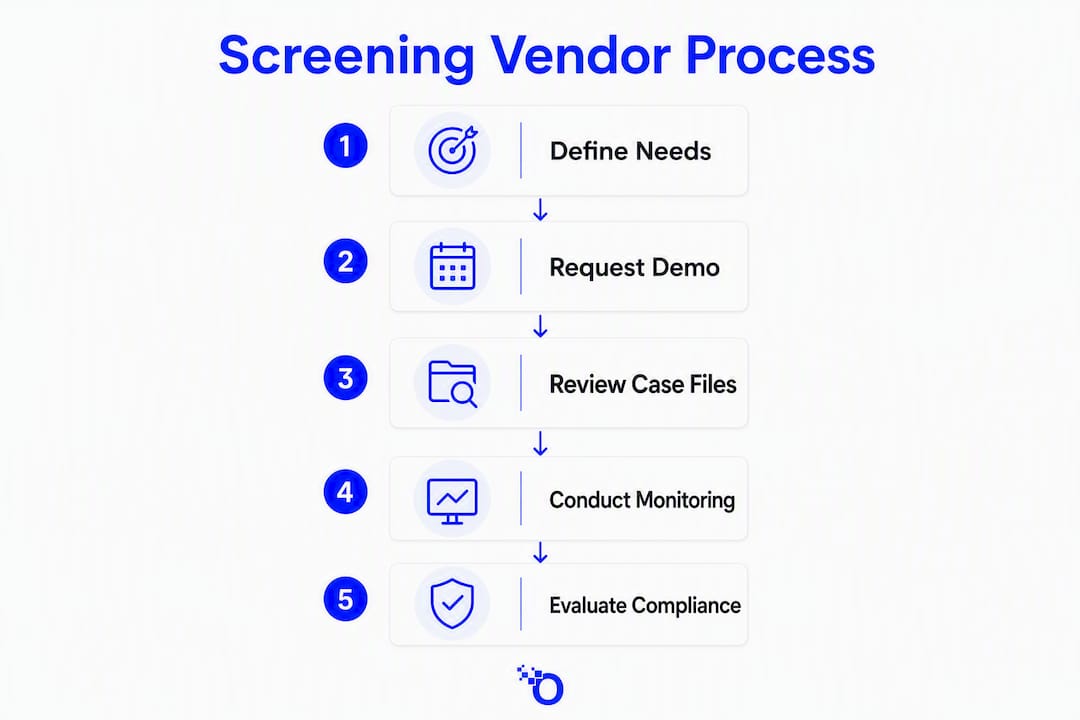
Use this prioritized checklist to score any vendor evaluating trustonics.com substitutes. Weight “Must Have” items at double the value of “Highly Desirable” items in your scoring matrix.
Must Have
- Investigator-driven background checks with narrative reports, not database-only pulls. California regulation mandates narrative reports available for POST compliance inspections.
- Continuous criminal and MVR monitoring with near-real-time alerts and documented follow-up workflows
- FCRA-compliant adverse action process with candidate consent tracking
- Audit-ready case notes and document retention that meets state POST schedules
- CJIS compatibility statement or documented data-handling process for law enforcement clients
Highly Desirable
- Configurable evaluation dimensions aligned with POST standardized assessment criteria to reduce adjudication bias
- Integration with your ATS or HRIS for evidence capture and workflow continuity
- Identity verification and prior-employer inquiry with documented response timelines
- Role-based monitoring scope and consent workflow documentation
Nice to Have
- Mobile access and configurable dashboards for field supervisors
- Multi-location scalability with centralized reporting
Pro Tip: During the demo, ask the vendor to run a live monitoring alert drill. A vendor that cannot demonstrate the alert-to-resolution workflow in real time is telling you something important about their operational maturity.
How does OMNI Intel satisfy the vendor checklist?
OMNI Intel’s OMNIScreen™ platform maps directly to the Must Have items above. Investigations follow law enforcement investigation principles, producing narrative case files with supporting documentation rather than automated report summaries. Continuous monitoring covers criminal records and MVR changes with documented alert workflows and FCRA-aligned response steps.
“Vendor evidence that is hard to fake includes redacted sample investigation files, monitoring alert logs, and documented CJIS or FCRA process statements. Requiring these artifacts during evaluation separates vendors with real operational depth from those with polished sales decks.” — OMNI Intel Pre-Employment Investigations Guidance
The table below maps checklist items to OMNI Intel capabilities and the evidence to request during your evaluation.
| Checklist Item | OMNI Intel Capability | Evidence to Request |
|---|---|---|
| Narrative investigation reports | Investigator-driven case files with supporting documents | Redacted sample investigation file |
| Continuous monitoring | Criminal and MVR monitoring with alert workflows | Live alert drill or sample alert log |
| FCRA compliance | Adverse action process with consent tracking | FCRA process description and consent template |
| Audit-ready documentation | Structured case notes and retention policies | Retention policy document |
| ATS/HRIS integration | OMNIHire™ applicant screening integration | Integration spec sheet or sandbox demo |
| CJIS-aware data handling | Documented data-handling process | CJIS compatibility statement |

Agencies evaluating law enforcement background investigations should request a customer reference from a comparable agency type during the evaluation phase.
How do you implement a new screening and monitoring vendor?
Move through these phases in order. Skipping the data security review before CJIS approval is the most common governance gap agencies create during rushed procurements.
- Define requirements (Week 1): Document investigation scope, monitoring triggers, retention schedules, and integration requirements. Involve legal, IT, and HR leadership.
- Issue RFP and evaluate responses (Weeks 2 to 4): Score vendors against the prioritized checklist. Request redacted sample files and SLA documentation with every response.
- Data security review (Weeks 3 to 5): IT reviews vendor data flow diagrams, encryption standards, and access controls. For law enforcement agencies, confirm CJIS compatibility before proceeding.
- Agency approvals and contract negotiation (Weeks 4 to 6): Legal reviews contract clauses covering SLA turnaround times, audit access, data retention, and liability caps.
- Candidate consent templates and training (Week 6): Finalize consent language with legal. Train hiring managers and background investigators on the platform workflow.
- Pilot enrollment (Weeks 7 to 9): Run 10 to 20 candidates through the full workflow. Validate documentation quality, alert latency, and integration data capture.
- Full rollout (Week 10+): Activate continuous monitoring for all covered employees. Establish a quarterly audit review cadence.
| Phase | Typical Duration | Key Dependency |
|---|---|---|
| Requirements definition | 1 week | Legal and IT availability |
| RFP and vendor evaluation | 2 to 3 weeks | Sample file receipt from vendors |
| Data security and CJIS review | 2 weeks | Vendor data flow documentation |
| Contract negotiation | 1 to 2 weeks | Legal review capacity |
| Consent and training | 1 week | Finalized consent templates |
| Pilot | 2 to 3 weeks | Candidate volume and IT integration |
| Full rollout | Ongoing | Pilot sign-off |
What legal and compliance requirements apply to public safety screening?
Four compliance domains govern every vendor selection decision for U.S. public safety agencies.
- FCRA: Any consumer report used in a hiring decision requires a permissible purpose, pre-adverse and adverse action notices, and documented candidate consent. Confirm the vendor’s process in writing.
- CJIS: Law enforcement agencies accessing criminal justice information must confirm that vendor data handling aligns with FBI CJIS Security Policy requirements. Request a written CJIS compatibility statement or documented equivalent process.
- EEOC guidance: Blanket criminal history exclusions can violate Title VII. Vendors must support individualized assessment workflows with configurable evaluation criteria. Review compliance steps for public safety hiring before finalizing adjudication policies.
- State POST rules and retention: Oregon OAR 259-008-0015 and similar state rules specify mandatory investigation elements. Retention schedules vary by state; Minnesota POST requires six years for unsuccessful candidates.
Minimum documentation to request from any vendor: data flow diagrams, FCRA process description, candidate consent templates, retention policy, and a CJIS compatibility statement.
This article provides general information, not legal advice. Consult your agency’s legal counsel before finalizing vendor contracts or screening policies.
What drives cost and how should you structure procurement?
Investigation depth is the primary cost driver. County-level manual record pulls cost more than national database searches because they require investigative labor. Field interviews, reference checks, and prior-employer disciplinary inquiries add further cost but are often the difference between a defensible file and a thin one.
Key cost drivers to understand before negotiating:
- Search scope: county vs. state vs. national vs. manual records retrieval
- Investigative labor: field interviews, reference checks, prior-employer inquiries
- Continuous monitoring scope: number of employees covered and alert frequency
- CJIS onboarding and compliance documentation costs
- ATS/HRIS integration and customization fees
- Volume discounts for agencies with high annual investigation counts
Contract clauses worth negotiating: SLA turnaround times with financial remedies for breach, audit access rights, data retention and deletion timelines, liability caps, and defined onboarding milestones with payment tied to delivery.
Pro Tip: Request pilot pricing for the first 30 to 60 days. Structure payment milestones around evidence-of-work deliverables: first payment on signed contract, second on successful pilot completion, third on full rollout. This protects the agency if the vendor’s operational quality does not match the sales presentation.
Key Takeaways
For U.S. public safety agencies, the defensible choice among trustonics.com alternatives is a vendor that delivers investigator-driven case files, continuous monitoring with documented alert workflows, and FCRA and CJIS-compatible data handling.
| Point | Details |
|---|---|
| Require narrative case files | Database-only reports do not satisfy POST audit standards; insist on investigator-driven files with supporting documents. |
| Prioritize continuous monitoring | Post-hire criminal and MVR monitoring with near-real-time alerts is a compliance baseline for safety-sensitive roles. |
| Validate with hard evidence | Request a redacted investigation file, a live alert drill, and a written CJIS or FCRA process statement from every finalist. |
| Plan retention from day one | State POST rules commonly require six years of retention for unsuccessful candidates; confirm vendor retention policies before signing. |
| OMNI Intel covers the checklist | OMNI Intel’s OMNIScreen™ platform delivers investigator-driven investigations, continuous monitoring, and ATS integration built for public safety agencies. |
Why public safety hiring demands a different standard
Most background screening vendors were built for commercial hiring. The documentation standards, investigation depth, and post-hire monitoring requirements that public safety agencies face are categorically different from what a retail or logistics employer needs.
The agencies that get into trouble at POST compliance inspections are rarely the ones that skipped a criminal check. They are the ones whose files lack narrative reports, whose prior-employer disciplinary inquiries were never documented, or whose monitoring program produced alerts that no one followed up on in writing. A vendor that cannot show you a complete, redacted sample file during the sales process almost certainly cannot produce one during an audit.
The checklist in this article is not a wish list. It is the minimum standard that defensible public safety hiring requires. Any vendor you evaluate, including OMNI Intel, should be able to satisfy every Must Have item with documented evidence before you sign a contract.
OMNI Intel: built for the standard public safety agencies must meet
Public safety agencies need more than a background check vendor. They need a partner that understands POST compliance, FCRA adverse action workflows, CJIS data handling, and the operational reality of running continuous monitoring across a sworn workforce.

OMNI Intel’s pre-employment screening services deliver investigator-driven case files, continuous criminal and MVR monitoring with documented alert workflows, and ATS integration through OMNIHire™. Every investigation follows law enforcement investigation principles, producing the narrative reports and supporting documentation that POST compliance inspections require.
When you request a demo, ask for: a redacted sample investigation file, a live monitoring alert drill, a written CJIS compatibility statement, and sample SLA contract language. Those four artifacts tell you more about a vendor’s operational depth than any sales presentation.
Request a demo and bring your agency’s specific investigation scope, monitoring requirements, and retention obligations to the conversation.
Useful sources for procurement and compliance teams
- POST Background Investigation Manual (California): Foundational guidance on narrative reporting, documentation standards, and audit-ready case file requirements.
- POST Regulation Notice 2021-38 TPRA (California): Standardized assessment dimensions for candidate suitability evaluations.
- Background Investigation and Hiring Checklist (Minnesota POST): State-level checklist with six-year retention requirement for unsuccessful candidates.
- WAC 139-07-020 (Washington): Requires disciplinary records and prior-employer investigation outcomes in background checks.
- Oregon OAR 259-008-0015: Mandatory background investigation elements for public safety officer hiring.
- California Commission Regulation: Peace Officer Background Investigation: Narrative report and documentation requirements for POST compliance inspections.
- Legislative Affairs Audit Readiness (OneGov): Framework for assessing how vendor processes hold up to external legislative and compliance audits.
- FCRA (15 U.S.C. § 1681 et seq.): Governs consumer report use in employment decisions, including adverse action requirements.
- FBI CJIS Security Policy: Governs data handling for agencies accessing criminal justice information systems.
- EEOC Enforcement Guidance on Criminal History (April 2012): Governs individualized assessment requirements to avoid discriminatory screening outcomes.
FAQ
What must a public safety background investigation file include?
A defensible file includes a narrative report, original supporting documents, education and employment verifications, prior-employer disciplinary records, reference interview notes, and criminal history at county, state, and federal levels. POST guidance and state rules such as Oregon OAR 259-008-0015 specify mandatory elements.
How long must agencies retain background investigation records?
Retention requirements vary by state. Minnesota POST requires six years of retention for candidates not hired. Agencies should confirm their state POST board’s schedule and ensure their vendor’s retention policy meets or exceeds it.
What is continuous post-hire monitoring and why does it matter?
Continuous monitoring tracks criminal record changes and MVR events after hire, generating near-real-time alerts with documented follow-up workflows. A one-time background check becomes outdated immediately after hire; ongoing monitoring closes that visibility gap for safety-sensitive roles.
How does OMNI Intel handle CJIS and FCRA compliance?
OMNI Intel provides a documented data-handling process for CJIS-sensitive environments and an FCRA-compliant adverse action workflow with candidate consent tracking. Agencies should request the written CJIS compatibility statement and FCRA process description during the demo.
What contract clauses should agencies negotiate with any screening vendor?
Require SLA turnaround times with financial remedies for breach, audit access rights, data retention and deletion timelines, liability caps, and payment milestones tied to evidence-of-work deliverables such as successful pilot completion.