

Municipal Employee Background Checks: What Hiring Managers Need to Know
A municipal employee background check is a job-related, legally compliant investigation into an applicant’s criminal, employment, educational, and personal history, governed by FCRA disclosure requirements, CJIS access restrictions, and POST or state-specific mandates, to determine suitability for a public safety position.
Three things every hiring manager should act on before the next candidate advances:
- Obtain signed, FCRA-compliant written consent before initiating any records pull or third-party inquiry.
- Confirm which state POST or civil service rules apply to the specific role, since law enforcement, fire, and EMS positions often carry distinct statutory requirements.
- Treat the investigation as an evaluative process, not a database query. Records inform the decision; the investigator’s narrative judgment makes it defensible.
Pro Tip: Build your screening scope around the position’s access level. A dispatcher with CJIS access requires the same depth of criminal history review as a sworn officer, even though the role is civilian.
The sections below map each component to its compliance obligation, document the required process steps, and close with a ready-to-use checklist.
Table of Contents
- What Does a Municipal Background Check Actually Include?
- How Does a Criminal History Check Differ from a Full Investigation?
- What Legal and Regulatory Requirements Must Agencies Follow?
- What Does the Municipal Screening Process Look Like Step by Step?
- How Should Agencies Approach Psychological and Behavioral Screening?
- How Do You Standardize Documentation and Build an Audit Trail?
- What Post-Hire Monitoring and Recheck Obligations Apply?
- A Ready-to-Use Municipal Background Check Checklist
- How OMNI Intel Supports Municipal Public Safety Investigations
- Key Takeaways
- Why Evidence-Based Hiring Protects Agencies and Communities
- Authoritative Sources for Municipal Background Check Compliance
- FAQ
What Does a Municipal Background Check Actually Include?
For public safety roles, background investigations cover a broader scope than most private-sector employers ever require. Minnesota’s employment background check guidance confirms that job-related checks commonly include document analysis, reference interviews, employment and education verification, and criminal history, but public safety agencies routinely go further.
Core components for law enforcement, fire, and EMS positions:
- Fingerprint-based criminal history: Local, state, and FBI checks through the CJIS network; California POST Commission Regulation 1953(e)(3) requires four separate clearance documents: DOJ official clearance, DOJ firearms clearance, FBI official clearance, and a POST profile report for candidates with prior peace officer experience.
- Employment history: Contacts with all past employers covering a multi-year period for peace officer candidates, per California POST; Indiana’s policy requires verification for an extended but unspecified period for general state positions.
- Education and licensing verification: Confirms degrees, certifications, and any professional licenses the position requires.
- Reference checks: Structured interviews with supervisors, peers, and personal references to surface behavioral patterns not visible in records.
- Driving record: Motor vehicle history is standard for any role involving emergency vehicle operation.
- Credit history: Required for positions with financial authority or access to sensitive data; Indiana’s policy specifically recommends credit checks for roles with disbursement authority.
- Drug testing: Pre-employment and, in many agencies, random post-hire testing.
- Social media and OSINT review: Permitted where documented legal basis exists; the MN POST hiring checklist includes social media as a required investigative element.
- Psychological and behavioral assessment: Validated instruments administered by a licensed evaluator, discussed in detail in Section 6.
Pro Tip: Run criminal history and driving record checks at the prescreen stage to filter disqualifying factors early. Reserve reference interviews, psychological assessments, and social media reviews for finalists to protect candidate privacy and conserve investigator time.

How Does a Criminal History Check Differ from a Full Investigation?
The distinction matters operationally. A criminal history check is a data retrieval activity: it returns arrest and conviction records from a database. A full background investigation is an evaluative process that synthesizes those records with employment history, reference interviews, and behavioral assessments to judge an applicant’s reliability for a position of trust. The U.S. Office of Personnel Management draws this line explicitly, noting that background evaluations collect employment, criminal, and personal history and may include third-party interviews and verification.
| Dimension | Criminal History Check | Full Background Investigation |
|---|---|---|
| Output | Database records | Narrative investigative report |
| Sources | State and FBI repositories | Records, interviews, references, psych assessment |
| Evaluative judgment | None | Investigator and appointing authority |
| Typical use | Initial prescreen | Final selection for sensitive roles |
| Defensibility | Limited | High, when documented |
A candidate with no criminal record can still present serious suitability concerns: a pattern of terminations for insubordination, financial instability in a role with cash access, or social media content reflecting bias. None of those appear in a records pull. Full investigations are required by POST rules and CJIS policy for sworn officers, dispatchers with CJIS access, and any role designated as safety-sensitive by state statute.
What Legal and Regulatory Requirements Must Agencies Follow?
Compliance in municipal public safety hiring rests on four overlapping frameworks.
FCRA and written consent. Before initiating any consumer-report style check, agencies must provide a clear, standalone FCRA disclosure and obtain written applicant consent. This applies to third-party background screening vendors and, in many interpretations, to reference checks conducted through consumer reporting agencies.
CJIS access restrictions. Fingerprint-based criminal history checks through the FBI’s CJIS network are restricted to authorized agencies. Results are governed by CJIS Security Policy and cannot be shared outside the authorized use case.
POST and state mandates. Florida Rule 11B-27.0022 requires agencies to conduct a thorough background investigation and retain a signed investigative summary on file. Florida statute also authorizes municipalities to require fingerprinting and state and FBI checks for safety-sensitive positions. California POST Commission Regulation 1953 specifies required file tabs, narrative report contents, and retention standards. Your state’s POST equivalent carries similar authority.
Compliance file checklist:
- Signed FCRA disclosure and authorization form
- Conditional offer letter (checks occur post-offer for most consumer reports)
- Fingerprint submission records and official clearance responses
- Employment and education verification logs with source and date
- Reference check notes with interviewer name and date
- Drug test chain-of-custody documentation
- Psychological assessment report from a licensed evaluator
- Investigator’s signed narrative summary and recommendation
| Requirement | Governing Authority | Applies To |
|---|---|---|
| Written consent / FCRA disclosure | Fair Credit Reporting Act | All consumer-report checks |
| Fingerprint-based criminal history | CJIS Security Policy / state statute | Sworn officers, CJIS-access roles |
| Investigative summary on file | POST / state rule (e.g., FL 11B-27.0022) | Peace officers and equivalents |
| Credit check | State policy / agency discretion | Financial and executive roles |
| Periodic recheck | IRS Pub. 1075 / state rule | FTI-access roles (every 10 years) |
What Does the Municipal Screening Process Look Like Step by Step?
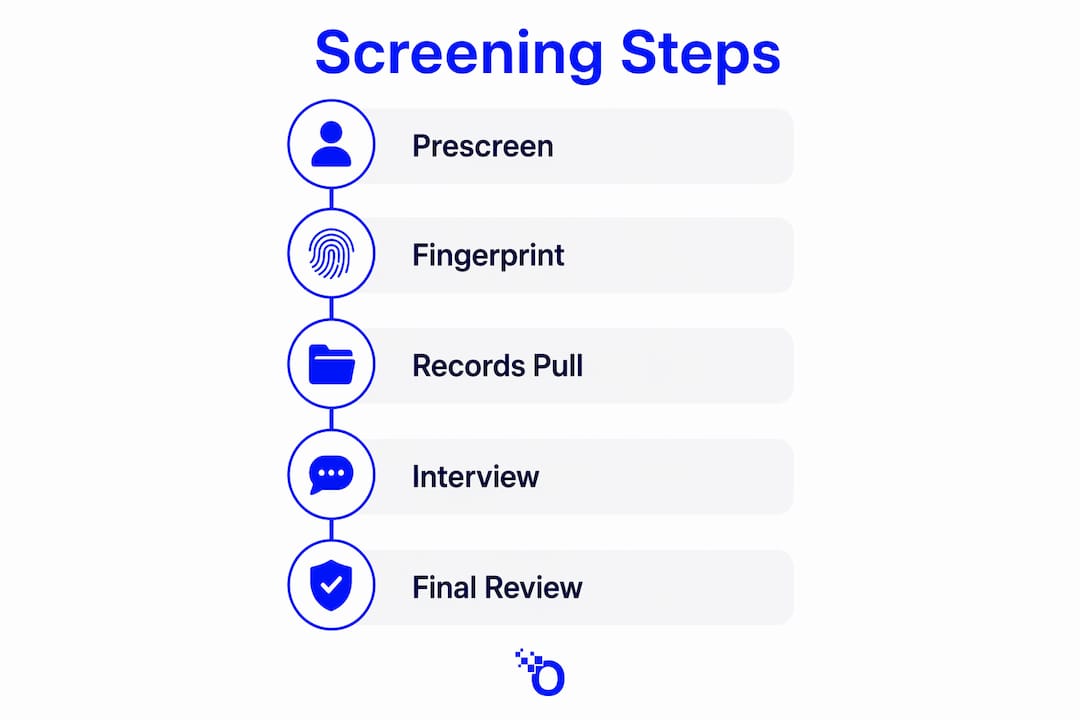
A defensible investigation follows a documented sequence. Standardizing investigative procedures reduces hiring inconsistency and legal exposure during audits.
- Prescreen (Days 1–3): HR reviews application, confirms minimum qualifications, and runs a preliminary criminal and driving record check.
- Conditional offer (Day 4–5): Agency extends a conditional offer. FCRA-compliant disclosure and authorization forms are signed at this stage.
- Fingerprinting (Days 5–7): Applicant is fingerprinted; submissions go to state repository and FBI via CJIS.
- Records pulls (Days 5–14): Employment, education, licensing, credit (where applicable), and sex offender registry checks run concurrently.
- Reference interviews (Days 10–20): Investigator contacts supervisors and personal references; structured interview guides are used and notes are retained.
- Applicant interview (Days 15–20): Investigator conducts a personal history interview to clarify gaps, discrepancies, and behavioral history.
- Psychological and medical evaluation (Days 18–25): Licensed psychologist administers validated instruments; physician completes medical exam where required.
- Investigator narrative and file review (Days 25–30): Investigator compiles all findings into a signed narrative report and submits to the appointing authority.
- Final decision (Days 30–35): Chief or appointing authority reviews the file, documents the rationale, and makes the hiring decision.
| Step | Primary Responsible Party | Estimated Duration |
|---|---|---|
| Prescreen and records pull | HR / screening vendor | Days 1–14 |
| Reference interviews | Background investigator | Days 10–20 |
| Fingerprint clearance | CJIS / state repository | Days 5–14 |
| Psych and medical evaluation | Licensed evaluator / physician | Days 18–25 |
| Narrative report and decision | Investigator / appointing authority | Days 25–35 |
Run fingerprinting, records pulls, and the applicant interview in parallel to compress the timeline without skipping steps.
How Should Agencies Approach Psychological and Behavioral Screening?
Psychological assessment is not a checkbox. POST and IACP guidance promote evidence-based investigations that combine record checks with validated psychological instruments administered by qualified professionals. The California POST Background Investigation Manual directs investigators to assess dimensions including integrity, impulse control, stress tolerance, and decision-making, and to present findings as a narrative rather than a pass/fail score.
Recommended practices for defensible behavioral screening:
- Use only validated instruments with documented reliability and validity for public safety populations.
- Retain a licensed psychologist or licensed clinical social worker to administer and interpret assessments. Unqualified staff administering personality quizzes creates both legal exposure and unreliable data.
- Integrate the psychologist’s narrative into the investigator’s overall report rather than treating it as a standalone attachment.
- Document the specific behavioral dimensions assessed and how each finding relates to the job’s requirements.
Pro Tip: When documenting behavioral findings, tie each observation to a specific job task or performance standard. “Candidate demonstrated low stress tolerance” is not defensible. “Candidate’s responses to scenario-based questions indicated difficulty maintaining composure under time pressure, a core requirement for emergency dispatch” is.
How Do You Standardize Documentation and Build an Audit Trail?
Failing to standardize investigative procedures increases both hiring inconsistency and legal risk. Every file must contain enough documentation for an auditor or court to reconstruct exactly what was reviewed, who reviewed it, and why the decision was made.
Required file contents:
- Signed FCRA disclosure and written authorization
- Conditional offer letter with contingency language
- Fingerprint submission confirmation and official clearance responses
- Employment verification log (source, date, information provided, and any discrepancies noted)
- Education and licensing verification records
- Reference check notes (interviewer, date, questions asked, responses summarized)
- Drug test documentation with chain-of-custody form
- Psychological assessment report signed by the licensed evaluator
- Investigator’s signed narrative summary with recommendation and rationale
- Appointing authority’s signed decision memo
For documentation standards and sample field templates, OMNI Intel’s background check documentation list provides a ready-to-use reference for public safety HR teams.
Pro Tip: Assign each investigation file a version number and log every update with the editor’s name and date. When a FOIA request arrives, redact psychological report narratives and third-party reference content consistent with your state’s privacy statutes before release. Retain the unredacted file separately per your POST or state retention schedule.
What Post-Hire Monitoring and Recheck Obligations Apply?
Hiring is not the end of the risk management cycle. Mature agencies require employees to self-report new arrests and maintain interval rechecks to detect post-hire behavioral changes. San Antonio’s Administrative Directive AD4-55 is a documented example of a municipal self-reporting and monitoring policy in operation.
Post-hire obligations and monitoring options:
- Self-reporting policy: Require employees to report new arrests, indictments, or license suspensions within 48–72 hours. Document the policy in writing and have employees sign an acknowledgment at hire.
- Interval rechecks: Indiana’s policy requires expanded criminal history checks every five years for school employees in covered positions; IRS Publication 1075 requires rechecks every ten years for roles with Federal Tax Information access. Apply similar logic to CJIS-access roles.
- Periodic fingerprint resubmission: Some state repositories support periodic resubmission to flag new criminal activity automatically.
- Targeted OSINT review: Conduct periodic social media and open-source reviews for roles with elevated public trust or CJIS access, documenting the legal basis and methods used.
- Incident-driven investigations: Any sustained complaint, use-of-force incident, or arrest triggers an immediate investigative review of the employee’s file and current conduct.
A Ready-to-Use Municipal Background Check Checklist
Add your agency’s letterhead, adjust the responsible-party column to reflect your org chart, and attach this checklist to every investigation file as a cover sheet.
Small departments may consolidate the investigator and HR roles; large agencies should assign them separately to preserve objectivity.
- Confirm position classification and required check level (HR Director) — Attach position description and sensitivity designation.
- Issue FCRA disclosure and obtain signed authorization (HR) — File original signed form.
- Extend conditional offer (HR / Chief) — File offer letter with contingency language.
- Schedule and complete fingerprinting (HR / Applicant) — Log submission date and tracking number; see our detailed guide on obtaining a police clearance affidavit in Ontario for cross-jurisdictional cases.
- Initiate concurrent records pulls (Investigator / Vendor) — Criminal, driving, credit, sex offender registry, employment, education, licensing.
- Conduct reference interviews (Investigator) — File structured notes for each contact.
- Complete applicant personal history interview (Investigator) — File signed interview summary.
- Schedule psychological and medical evaluation (HR) — File evaluator’s signed report.
- Compile investigator narrative report (Investigator) — Sign and date; attach all supporting documents under labeled tabs.
- Appointing authority review and decision (Chief / Administrator) — File signed decision memo with rationale.
- Notify applicant of decision (HR) — If adverse action, follow FCRA adverse action notice requirements.
- File and retain complete investigation package (HR) — Per POST or state retention schedule.
Pro Tip: Small departments with limited investigator capacity should consider a phased approach: run Steps 1–5 in-house and contract Steps 6–9 to a qualified third-party investigator. This preserves thoroughness without overwhelming a one- or two-person HR team.
How OMNI Intel Supports Municipal Public Safety Investigations

Public safety agencies need more than a database subscription. OMNI Intel’s pre-employment screening platform is built specifically for law enforcement, fire and EMS, dispatch centers, and municipal agencies, with investigation workflows that reflect POST, CJIS, and FCRA requirements rather than generic HR software defaults.
Key capabilities tied directly to the checklist above:
- Structured investigation workflows with built-in audit trails for every file action
- Integration with hiring platforms to eliminate manual data re-entry between recruiting and screening
- Validated psychological assessment workflows coordinated with licensed evaluators
- Post-hire employee monitoring and self-reporting policy support to maintain CJIS and FTI eligibility
- Custom screening packages calibrated to role sensitivity, from entry-level civilian positions to sworn officer appointments
Agencies that want to reduce time-to-hire without cutting investigative depth can review OMNI Intel’s background investigation services or request a demo to see how the platform maps to their current workflow.
Key Takeaways
A municipal employee background check for public safety roles is a multi-source, evaluative investigation governed by FCRA, CJIS, and POST requirements, and it must be documented well enough to survive an audit.
| Point | Details |
|---|---|
| Full investigation vs. records pull | A criminal history check retrieves data; a full investigation synthesizes records, interviews, and behavioral assessments into a defensible narrative. |
| Written consent is non-negotiable | FCRA-compliant disclosure and signed authorization must precede any consumer-report style check, including third-party vendor pulls. |
| POST and state rules govern scope | Florida Rule 11B-27.0022 and California POST Regulation 1953 are examples of state mandates that specify required file contents and retention periods. |
| Documentation determines defensibility | Every file must include signed consent, clearance responses, verification logs, reference notes, psych reports, and a signed investigator narrative. |
| OMNI Intel | OMNI Intel’s platform provides structured investigation workflows, audit trails, and post-hire monitoring designed for public safety agencies. |
Why Evidence-Based Hiring Protects Agencies and Communities
The conventional view in public safety hiring is that a thorough background check is primarily about screening people out. That framing misses the more consequential purpose: building a documented, auditable record that demonstrates the agency made a reasonable, job-related decision based on verified evidence. When a hiring decision is later challenged, the investigation file is the agency’s defense. A narrative report that synthesizes records, reference interviews, and behavioral assessment findings, signed by a qualified investigator and reviewed by the appointing authority, is far more defensible than a database printout with a checkmark.
POST and IACP guidance consistently emphasizes this point. The investigation is not complete when the records come back clean. It is complete when the investigator has synthesized all available information into a written judgment that a reasonable reviewer can follow and evaluate. Agencies that treat the process as a compliance formality rather than a genuine risk assessment are the ones that end up explaining a bad hire to a city council or a federal court. The checklist and documentation standards in this guide exist precisely to close that gap.
Authoritative Sources for Municipal Background Check Compliance
| Source | Type | What It Covers |
|---|---|---|
| MN POST Background Investigation and Hiring Checklist | State POST checklist | Required investigative elements for peace officer hiring |
| California POST Background Investigation Manual | State POST manual | Narrative report standards, behavioral dimensions, file tabs |
| OPM Background Evaluation/Investigation | Federal guidance | Scope and purpose of background evaluations vs. competency checks |
| Florida Rule 11B-27.0022 | State administrative rule | Required investigation and signed summary retention for officers |
| Florida statute | State statute | Municipal authority to require fingerprinting and FBI checks |
| San Antonio AD4-55 | Municipal policy | Employee self-reporting and post-hire monitoring example |
Additional resources worth reviewing:
- Minnesota Management and Budget Volume 1: A Guide for Employment Background Checks: covers job-relatedness requirements, scope of checks, and documentation standards applicable to state and municipal agencies.
- California POST Peace Officer Background Tabs: the definitive file-organization reference for agencies seeking a model for their own documentation structure.
- For agencies navigating background check regulations across multiple jurisdictions, OMNI Intel’s compliance guidance maps federal and state requirements to specific role types.
FAQ
What is a municipal employee background check?
A municipal employee background check is a job-related investigation into an applicant’s criminal, employment, educational, and personal history, conducted to assess suitability for a public safety position and governed by FCRA, CJIS, and applicable POST or state rules.
Which positions require a full background investigation rather than a basic records check?
Any role with CJIS access, sworn peace officer status, or a state-designated safety-sensitive classification requires a full investigation; a basic criminal history check alone does not satisfy POST or CJIS requirements for those positions.
How long does a municipal background investigation typically take?
A complete investigation for a public safety role generally takes 30–35 days when fingerprint clearance, records pulls, reference interviews, and psychological evaluation run on a coordinated schedule.
What must be in the investigation file to be defensible?
At minimum: signed FCRA authorization, fingerprint clearance responses, employment and education verification logs, reference interview notes, a psychological assessment report, and the investigator’s signed narrative summary with the appointing authority’s decision memo.
How does OMNI Intel support the municipal screening process?
OMNI Intel provides structured pre-employment investigation workflows, integrated audit trails, and post-hire monitoring tools built specifically for law enforcement, fire and EMS, and municipal agencies, with screening packages calibrated to role sensitivity and POST/CJIS requirements.