

Recruiting Police Forces: A Complete U.S. Hiring Guide
Which U.S. police forces are actively recruiting right now?
The short answer: most of them. Law enforcement agencies across the United States maintain near-continuous recruiting activity, driven by steady attrition through retirements, resignations, and department expansion. Whether you are a prospective applicant or a recruitment professional, the demand for qualified officers is consistent and geographically widespread.
The current recruiting landscape looks like this:
- Federal agencies such as the United States Capitol Police and the FBI post vacancies on a rolling basis, with structured application windows.
- Large municipal departments in cities like Austin, Los Angeles, and Washington, D.C. recruit year-round through dedicated recruiting units.
- Mid-size and small agencies often recruit seasonally or when staffing drops below threshold levels, posting vacancies on platforms like USAJobs, Indeed, and their own department websites.
- State police and highway patrol agencies typically run academy cohorts on a fixed annual or semi-annual schedule.
- A 2024 survey found that 70% of agencies reported greater difficulty hiring compared to five years prior, confirming that open positions far outnumber qualified applicants in most markets.
Candidates can locate recruiting forces through agency websites, state police association job boards, and the Department of Justice’s Office of Community Oriented Policing Services (COPS Office) funding announcements.
How does the standard police recruitment process work in the U.S.?
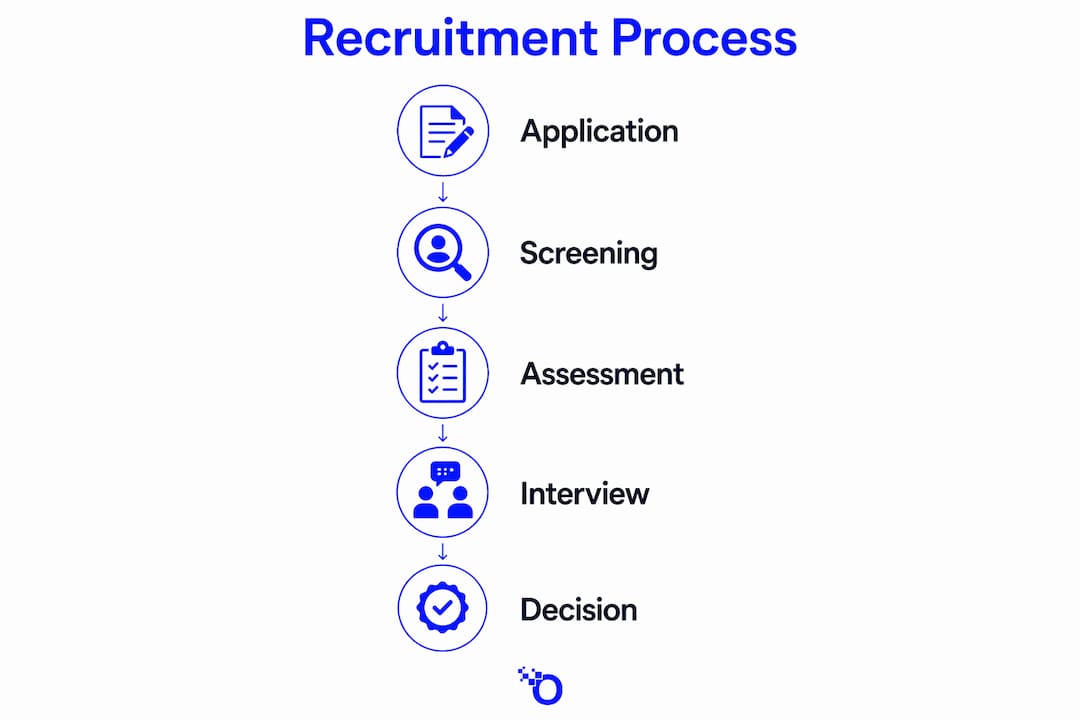
Most agencies follow a multi-phase process that moves candidates from initial application through academy enrollment. The pace varies, but the structure is consistent across federal, state, and local departments.
- Online application submission. Candidates complete a digital application and an initial prescreening questionnaire to confirm basic eligibility.
- Intake review. Recruiters screen applications for disqualifying factors before advancing candidates to testing.
- Written examination. A standardized test covering reading comprehension, basic math, and grammar. The National Police Officer Selection Test (POST) is widely used at the local level.
- Physical fitness assessment. Candidates complete a physical readiness test; some agencies, such as Montgomery County (MD) Police Department, have replaced this with a medical examination to broaden the candidate pool.
- Background history statement. Applicants submit a detailed personal history document. The Austin Police Department reduced its version from a 31-page form to nine pages to reduce candidate drop-off.
- Background investigation. A background investigator reviews criminal history, employment records, references, and financial history.
- Psychological evaluation. A department psychologist conducts a structured interview and reviews standardized assessments such as the MMPI.
- Polygraph examination. Required by most agencies, typically a two-hour process.
- Medical examination and drug screening. A physician evaluates physical fitness for duty; drug testing is standard.
- Oral board interview. A panel of officers assesses communication skills, judgment, and situational awareness.
- Conditional offer of employment. Candidates who clear all prior stages receive an offer, contingent on final command approval.
- Academy enrollment. Recruits begin formal training, averaging approximately 833 hours of instruction across roughly 21 weeks.
Candidate responsiveness at each stage directly affects timeline. The United States Capitol Police explicitly notes that the pace of the process is primarily determined by the applicant’s prompt replies to recruiter correspondence.
What are the eligibility requirements and age limits for police applicants?

The core eligibility standards are consistent across most U.S. agencies, though specific thresholds vary by department and state.
Standard requirements include:
- U.S. citizenship
- Minimum age of 21 at the time of appointment
- High school diploma or GED
- Valid U.S. driver’s license with at least one year of responsible driving history
- No felony convictions
- Selective Service registration (for male applicants)
Age criteria deserve particular attention. Most U.S. police agencies set the minimum at 21 and cap eligibility between 35 and 39. The United States Capitol Police, for example, requires applicants to be at least 21 and no older than 39 at the time of appointment. The upper limit exists because training requires a substantial time investment, and agencies need officers to complete a full career before mandatory retirement age.
Age 27 is well within the eligible window for the vast majority of U.S. departments. Applicants in their late 20s and early 30s are often considered strong candidates because they bring life experience and maturity alongside physical readiness.
Some agencies are also revisiting prior substance use policies, particularly regarding marijuana, given shifting state laws. Physical fitness standards are evolving too, with several departments replacing traditional fitness tests with medical evaluations to attract a broader, more diverse applicant pool.
Modern strategies, challenges, and best practices for law enforcement hiring

Recruiting police forces has shifted from a reactive, vacancy-driven activity to a continuous, system-level function. Agencies that treat recruiting as a program, with dedicated budget, leadership backing, and measurable metrics, consistently outperform those relying on isolated tactics.
The staffing pressure is real. A 2023 national survey found that 65% of agencies reported a rise in retirements, 66% reported more resignations, and 69% reported a drop in applications, with overall staffing falling by an average of 5%. Traditional hiring timelines compound the problem. Processes lasting eight months or more drive candidate attrition before an offer is ever made.
Key modern strategies agencies are deploying:
- Continuous recruitment pipelines maintained through partnerships with colleges, HBCUs, and Hispanic-Serving Institutions, rather than waiting for vacancies to open.
- Applicant tracking systems that keep candidates moving through stages rather than stalling in manual queues. The Metropolitan Police Department in Washington, D.C. cut its hiring timeline from 18 months to under four months by combining medical and background reviews.
- Social media outreach on Instagram, TikTok, and Facebook to reach younger, more diverse candidate pools.
- Employee referral programs with incentives such as cash bonuses or time off. Referral-sourced candidates are more likely to be hired and stay longer than those found through traditional job boards.
- Recruitment incentives including tuition reimbursement, take-home vehicles, childcare support, and housing subsidies. The Los Angeles Police Department launched a program offering recruits $1,000 per month toward rent for up to two years.
- Diversity-focused outreach targeting women’s colleges and minority-serving institutions. Prince William County (VA) Police Department raised female academy representation from 16% to 24% and underrepresented group representation from 40% to 70% after overhauling its approach.
- Metrics-driven management tracking cost-per-hire, first-year attrition, and quality of hire to redirect resources toward what actually works.
Pro Tip: Recruiter communication skills often matter more than salary or benefits in winning candidates. Switching to instant text-based contact between recruiters and applicants helped one agency grow applications from 9 to over 95 within 90 days. Train your recruiters as you would train new officers.
A continuous pipeline model that maintains relationships with educational institutions and uses automated communication consistently outperforms episodic hiring pushes. Agencies that track quality-of-hire and first-year retention rigorously are the ones reallocating resources away from low-yield tactics before those tactics drain the budget.
How OMNI Intel strengthens background screening in police recruitment
Background screening is where law enforcement hiring either holds or breaks down. A thorough pre-employment investigation protects the agency, the community, and the integrity of the force itself. Cutting corners here creates liability that no amount of recruiting success can offset.
OMNI Intel provides a background screening platform built specifically for public safety agencies, integrating investigator-driven checks with AI-assisted tools to reduce hiring time without sacrificing depth. The platform supports FCRA-compliant pre-employment investigations covering criminal history, psychological evaluation records, employment verification, and financial background. Post-hire, continuous monitoring flags new activity that could affect an officer’s fitness for duty, protecting the agency’s reputation long after the academy class graduates.
Core benefits of structured background screening in police recruitment:
- Reduces the risk of negligent hiring by surfacing disqualifying history before appointment.
- Supports compliance with federal and state regulatory requirements throughout the hiring process.
- Enables transparent, evidence-based hiring decisions backed by documented investigative findings.
- Shortens overall hiring timelines through integrated digital workflows and automated candidate tracking.
- Provides post-hire monitoring to identify emerging risks before they become incidents.
| OMNI Intel Feature | Impact on Recruitment |
|---|---|
| AI-driven applicant screening | Accelerates candidate review and reduces manual processing time |
| Investigator-led background checks | Delivers depth and accuracy beyond automated database queries |
| FCRA-compliant workflows | Keeps agencies protected from legal exposure during hiring |
| Post-hire employee monitoring | Identifies conduct risks after an officer joins the force |
| Integration with hiring platforms | Keeps candidates moving through the pipeline without manual handoffs |
Agencies using a platform like OMNI Intel gain a measurable advantage in both speed and defensibility. The cost of a bad hire in law enforcement, factoring in training, liability, and reputational damage, far exceeds the investment in thorough pre-employment vetting.

Whether you are building a recruiting program from the ground up or modernizing an existing one, OMNI Intel’s public safety screening services give your agency the investigative infrastructure to hire with confidence and monitor with precision.
Key Takeaways
Recruiting police forces effectively requires a continuous, metrics-driven program supported by leadership, thorough screening, and candidate-centered communication at every stage.
| Point | Details |
|---|---|
| Active recruiting is widespread | Most U.S. agencies recruit continuously, with 70% reporting greater hiring difficulty than five years ago. |
| Process follows a defined sequence | Candidates move through application, testing, background investigation, psychological review, and academy enrollment. |
| Age 21–39 covers most agencies | The minimum is typically 21; upper limits range between 35 and 39 depending on the department. |
| Speed and communication win candidates | Switching to instant recruiter contact helped one agency grow applications from 9 to over 95 in 90 days. |
| Screening protects the agency | OMNI Intel’s investigator-driven platform reduces hiring risk and supports post-hire monitoring for ongoing compliance. |
FAQ
Is it hard to recruit police officers right now?
Yes. A 2023 national survey found that 69% of agencies reported a drop in applications, and staffing fell by an average of 5% across departments. Agencies that build continuous recruiting programs with dedicated budgets and trained recruiters are closing that gap faster than those relying on traditional tactics.
Is 27 too late to become a police officer?
No. Age 27 falls well within the eligible range for the vast majority of U.S. departments, which typically accept applicants between 21 and 39 years old.
How long does the police hiring process take?
Traditional processes can take eight months or more, though agencies that consolidate testing phases and use digital workflows have cut timelines to under four months. Candidate responsiveness at each stage is the single biggest variable within an applicant’s control.
What disqualifies someone from becoming a police officer?
Felony convictions are an automatic disqualifier at virtually every agency. Other common disqualifiers include a dishonest discharge from military service, failure to pass psychological evaluation, and confirmed drug use within agency-specified timeframes, though marijuana policies are evolving across states.